Indonesia Photo Market: Import Trend Analysis
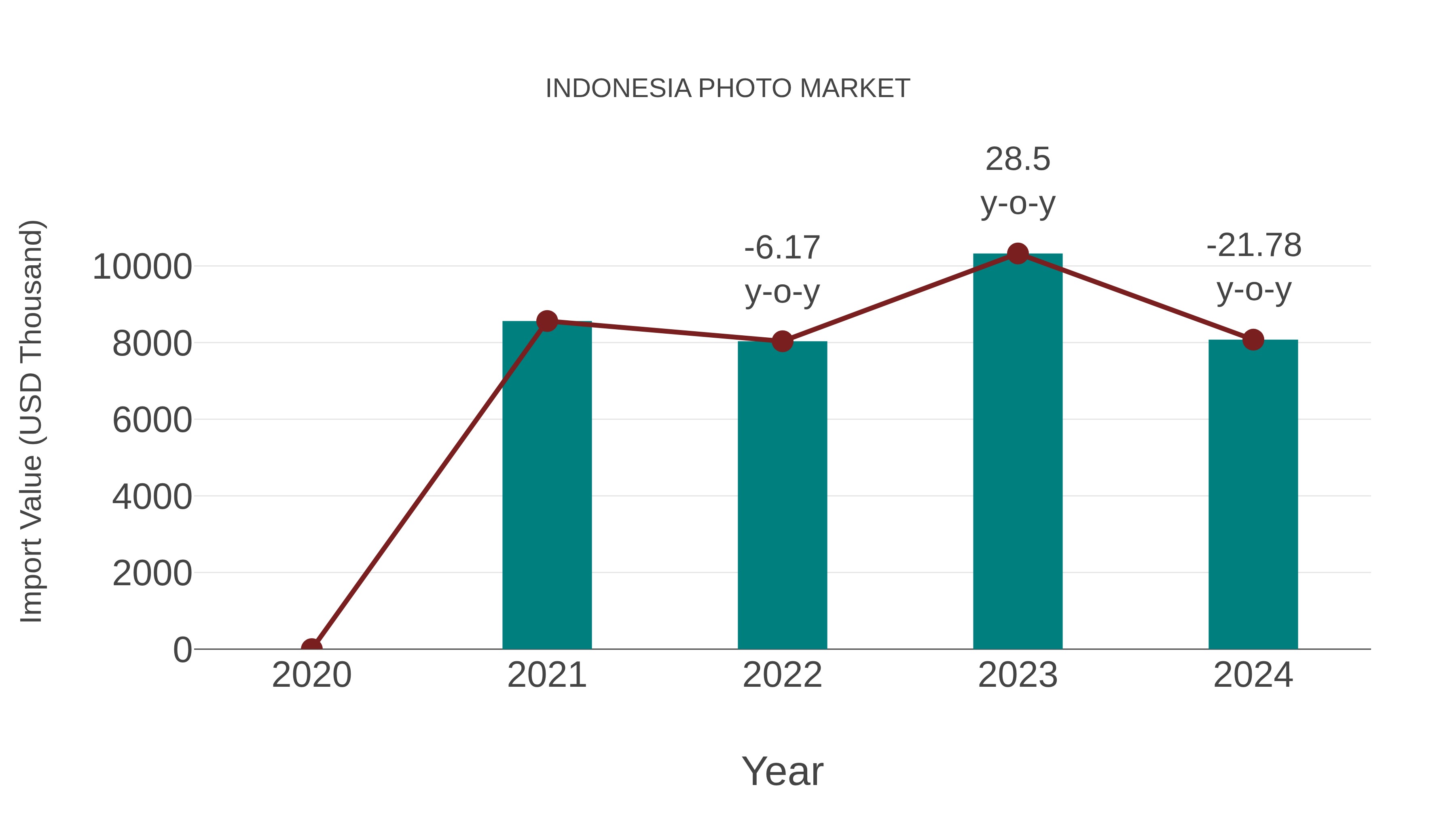
Indonesia`s import trend for the photo market experienced a decline from 2023 to 2024, with a growth rate of -21.78%. The compound annual growth rate (CAGR) for 2020-2024 stood at -1.93%. This negative momentum could be attributed to shifting consumer preferences, changes in trade policies, or market saturation impacting demand.
Indonesia Photo Market Overview
The Indonesia photo market is a dynamic and growing industry driven by the increasing demand for visual content across various sectors such as advertising, media, and e-commerce. With the rising popularity of social media platforms and the proliferation of smartphones with advanced camera capabilities, there is a high demand for high-quality images for personal and professional use. Professional photographers, as well as amateur enthusiasts, contribute to the market by offering a wide range of services including portrait photography, event coverage, and product photography. The market is also influenced by the emergence of online platforms where photographers can showcase and sell their work, providing them with new avenues for exposure and revenue generation. Overall, the Indonesia photo market presents opportunities for growth and innovation as technology continues to shape the way visual content is created and consumed.
Indonesia Photo Market Trends
The photo market in Indonesia is currently experiencing a shift towards digital photography, with a growing demand for high-quality cameras and photography equipment. Mobile photography is also on the rise, with smartphone cameras becoming increasingly advanced and popular among consumers. Social media platforms are influencing photography trends, with a focus on visually appealing images for sharing online. Additionally, there is an increasing interest in drone photography for capturing unique aerial perspectives. Photography workshops and courses are becoming more popular as people seek to improve their skills and knowledge in the field. Overall, the Indonesia photo market is dynamic and evolving, with a mix of traditional and modern trends shaping consumer preferences and industry developments.
Indonesia Photo Market Challenges
In the Indonesia photo market, one of the main challenges faced is the presence of a large number of unlicensed and unregulated photographers, leading to cut-throat competition and pricing wars. This makes it difficult for professional photographers and photography studios to maintain sustainable pricing and quality standards. Additionally, the rise of digital photography and smartphone cameras has made it easier for individuals to take their own photos, reducing the demand for professional photography services. Moreover, copyright infringement is a common issue, with many individuals using images without proper permissions or compensation. Lastly, the lack of standardized regulations and enforcement in the industry further complicates the landscape, making it challenging for legitimate businesses to thrive and for consumers to differentiate between quality service providers and amateurs.
Indonesia Photo Market Investment Opportunities
The Indonesia photo market presents promising investment opportunities in various segments such as professional photography services, stock photography platforms, equipment sales, and photo printing services. With the growing demand for high-quality visual content driven by social media, e-commerce, and digital marketing, there is a need for skilled photographers, advanced equipment, and convenient printing solutions. Investing in photography studios, online platforms for photographers to showcase and sell their work, retail stores offering a wide range of camera gear, and photo printing shops could be lucrative ventures in the Indonesia photo market. Additionally, catering to the increasing interest in drone photography and videography could also be a viable investment opportunity in this dynamic market.
Indonesia Photo Market Government Policy
Government policies in Indonesia related to the photo market include regulations on intellectual property rights, licensing requirements for photographers and studios, and restrictions on certain types of photography deemed culturally sensitive or inappropriate. The government also provides support for the development of the creative industry, including photography, through programs and initiatives aimed at fostering innovation, skills development, and access to resources. Additionally, there are tax incentives and grants available for photography businesses and professionals. However, there are also challenges such as piracy and lack of enforcement of copyright laws that impact the photo market in Indonesia. Overall, the government plays a significant role in shaping the regulatory environment and providing support for the growth of the photography industry in the country.
Indonesia Photo Market Future Outlook
The future outlook for the Indonesia photo market appears promising, driven by the increasing popularity of photography as a hobby and the growing demand for professional photography services. With the rise of social media platforms and the importance of visual content in digital marketing, there is a continuous need for high-quality images. Additionally, advancements in smartphone camera technology have made photography more accessible to a wider audience, leading to a higher volume of photo sharing and printing. As disposable incomes increase and the middle class expands in Indonesia, consumers are likely to invest more in photography equipment and services. Overall, the Indonesia photo market is expected to experience steady growth in the coming years, presenting opportunities for photographers, camera manufacturers, and related businesses to thrive in this dynamic industry.
Key Highlights of the Report:
- Indonesia Photo Market Outlook
- Market Size of Indonesia Photo Market,2025
- Forecast of Indonesia Photo Market, 2032
- Historical Data and Forecast of Indonesia Photo Revenues & Volume for the Period 2022-2032F
- Indonesia Photo Market Trend Evolution
- Indonesia Photo Market Drivers and Challenges
- Indonesia Photo Price Trends
- Indonesia Photo Porter's Five Forces
- Indonesia Photo Industry Life Cycle
- Historical Data and Forecast of Indonesia Photo Market Revenues & Volume By Type for the Period 2022-2032F
- Historical Data and Forecast of Indonesia Photo Market Revenues & Volume By Digital for the Period 2022-2032F
- Historical Data and Forecast of Indonesia Photo Market Revenues & Volume By Print for the Period 2022-2032F
- Historical Data and Forecast of Indonesia Photo Market Revenues & Volume By Stock Photos for the Period 2022-2032F
- Historical Data and Forecast of Indonesia Photo Market Revenues & Volume By Commercial for the Period 2022-2032F
- Historical Data and Forecast of Indonesia Photo Market Revenues & Volume By Others for the Period 2022-2032F
- Historical Data and Forecast of Indonesia Photo Market Revenues & Volume By Format for the Period 2022-2032F
- Historical Data and Forecast of Indonesia Photo Market Revenues & Volume By JPEG, RAW for the Period 2022-2032F
- Historical Data and Forecast of Indonesia Photo Market Revenues & Volume By Glossy, Matte for the Period 2022-2032F
- Historical Data and Forecast of Indonesia Photo Market Revenues & Volume By Licensed Images for the Period 2022-2032F
- Historical Data and Forecast of Indonesia Photo Market Revenues & Volume By High-Resolution for the Period 2022-2032F
- Historical Data and Forecast of Indonesia Photo Market Revenues & Volume By Others for the Period 2022-2032F
- Historical Data and Forecast of Indonesia Photo Market Revenues & Volume By End User for the Period 2022-2032F
- Historical Data and Forecast of Indonesia Photo Market Revenues & Volume By Individual Consumers for the Period 2022-2032F
- Historical Data and Forecast of Indonesia Photo Market Revenues & Volume By Advertising Agencies for the Period 2022-2032F
- Historical Data and Forecast of Indonesia Photo Market Revenues & Volume By Media Companies for the Period 2022-2032F
- Historical Data and Forecast of Indonesia Photo Market Revenues & Volume By Businesses for the Period 2022-2032F
- Historical Data and Forecast of Indonesia Photo Market Revenues & Volume By Professional Photographers for the Period 2022-2032F
- Historical Data and Forecast of Indonesia Photo Market Revenues & Volume By Application for the Period 2022-2032F
- Historical Data and Forecast of Indonesia Photo Market Revenues & Volume By Personal Photography for the Period 2022-2032F
- Historical Data and Forecast of Indonesia Photo Market Revenues & Volume By Marketing Campaigns for the Period 2022-2032F
- Historical Data and Forecast of Indonesia Photo Market Revenues & Volume By Content Creation for the Period 2022-2032F
- Historical Data and Forecast of Indonesia Photo Market Revenues & Volume By Brand Promotion for the Period 2022-2032F
- Historical Data and Forecast of Indonesia Photo Market Revenues & Volume By Artistic Expression for the Period 2022-2032F
- Indonesia Photo Import Export Trade Statistics
- Market Opportunity Assessment By Type
- Market Opportunity Assessment By Format
- Market Opportunity Assessment By End User
- Market Opportunity Assessment By Application
- Indonesia Photo Top Companies Market Share
- Indonesia Photo Competitive Benchmarking By Technical and Operational Parameters
- Indonesia Photo Company Profiles
- Indonesia Photo Key Strategic Recommendations






































