Indonesia Ploughing and Cultivating Machinery Market Size, Share & Growth Rate
The Indonesia Ploughing and Cultivating Machinery Market was estimated at USD 372 Million in 2025 and is projected to reach USD 494 Million by 2032, growing at a CAGR of 4.1% from 2026 to 2032. This growth trajectory is primarily driven by an increase in agricultural activities, supported by government initiatives that encourage mechanization through subsidies. Moreover, as farmers focus on enhancing crop yields, there is a growing tendency to adopt modern plowing technologies, further propelling demand in this market.
Indonesia Ploughing and Cultivating Machinery Market Year-wise Growth Rate and Key Drivers
This graph highlights how the Indonesia Ploughing and Cultivating Machinery Market has steadily grown over the years, supported by major growth factors.
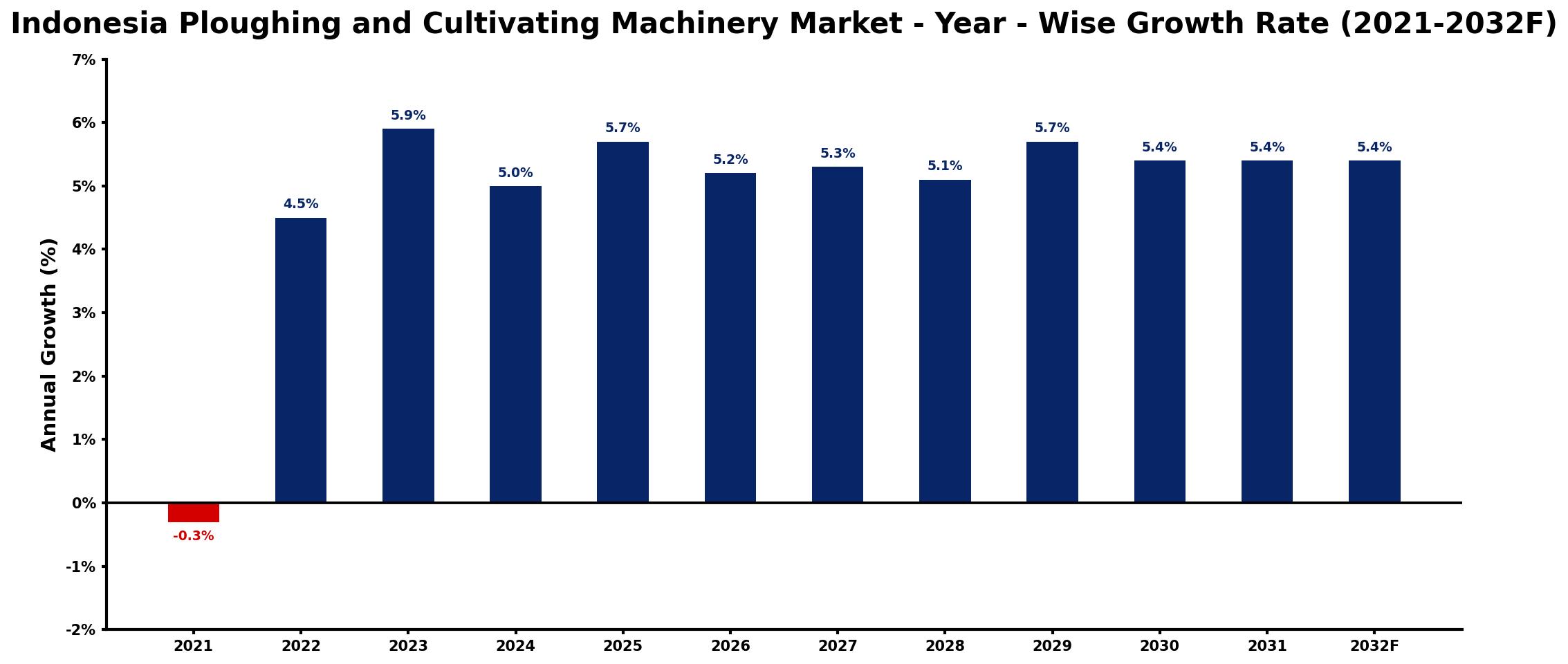
The table below presents the year‑wise growth rates along with the key drivers influencing the market
| Year | Growth Rate | Major Drivers |
| 2021 | -0.3% | decreased agricultural investment levels |
| 2022 | 4.5% | rising demand for efficiency enhancements |
| 2023 | 5.9% | growing adoption of technology integration |
| 2024 | 5.0% | increased focus on sustainable practices |
| 2025 | 5.7% | expansion of export markets opportunities |
| 2026 | 5.2% | surge in government funding initiatives |
| 2027 | 5.3% | increased interest in precision agriculture |
| 2028 | 5.1% | growth in rural infrastructure development |
| 2029 | 5.7% | rising export shipment volumes |
| 2030 | 5.4% | enhanced access to financing options |
| 2031 | 5.4% | growing partnerships with research institutions |
| 2032 | 5.4% | increased awareness of climate resilience |
Note: Market size estimations and growth projections presented in this report are based on 6Wresearch's proprietary forecasting methodology, utilizing the latest available industry data, government publications, and primary research inputs.
Indonesia Ploughing and Cultivating Machinery Market Synopsis
In Indonesia, the ploughing and cultivating machinery market is experiencing a notable transition as modernization in agriculture gains momentum. Farmers are increasingly recognizing the significance of adopting advanced machinery to improve productivity and address labor shortages that have become a pressing issue in the sector.
The Indonesian government has been a proactive supporter of agricultural mechanization, implementing policies and providing financial assistance to facilitate farmers' access to modern equipment. This environment is conducive to the expansion of the ploughing and cultivating machinery market, fostering a robust ecosystem for growth.
Indonesia Ploughing and Cultivating Machinery Market Key Takeaways
- The market is poised for steady growth driven by government support and increasing mechanization.
- Farmers are investing in technologies aimed at boosting crop yields and operational efficiency.
- Challenges such as high upfront costs and maintenance issues need to be addressed for wider adoption.
- Advanced solutions like zero tillage systems are becoming more popular among progressive farmers.
- Understanding regional agricultural diversity is crucial for tailoring machinery solutions effectively.
Evaluation of Restraints in Indonesia Ploughing and Cultivating Machinery Market
Despite the promising outlook, several constraints hold back the markets full potential. One major limitation is the high initial investment associated with purchasing modern ploughing and cultivating machinery. This financial hurdle can discourage smaller-scale farmers who may lack sufficient capital. Additionally, the availability of qualified technicians for maintenance remains a concern; improper upkeep can lead to reduced efficiency and increased operational costs. Lastly, Indonesia's diverse geography and variable soil conditions necessitate customized solutions, posing additional challenges for manufacturers.
Indonesia Ploughing and Cultivating Machinery Market Trends
Several trends are shaping the landscape of the Indonesia ploughing and cultivating machinery market. A significant shift towards sustainable farming practices is emerging, with farmers increasingly opting for eco-friendly technologies like zero tillage. Moreover, advancements in automation and smart agriculture are driving innovations in machinery, enhancing precision and efficiency. The integration of digital technologies for monitoring and managing farm operations is also gaining traction, reflecting a broader trend towards digitization in agriculture.
Indonesia Ploughing and Cultivating Machinery Market Opportunities
The future of the Indonesia ploughing and cultivating machinery market holds substantial opportunities for growth. As awareness of sustainable farming practices grows, there is potential for investment in eco-friendly machinery solutions that offer long-term benefits. Additionally, expanding financial programs and subsidies aimed at smallholders can unlock new avenues for market penetration. Partnerships between local manufacturers and technology providers can also catalyze innovation, creating tailored solutions that cater to the unique needs of Indonesia's diverse agricultural landscape.
Government Initiatives in the Indonesia Ploughing and Cultivating Machinery Market
The Indonesian government has taken a proactive stance in promoting mechanized agriculture, recognizing its critical role in enhancing productivity and food security. Initiatives include various subsidies for purchasing agricultural equipment, alongside training programs aimed at upskilling farmers in using modern machinery. Furthermore, policies designed to facilitate access to financing for smallholder farmers are being implemented, supporting the overall growth of the ploughing and cultivating machinery sector.
Future Insights of the Indonesia Ploughing and Cultivating Machinery Market
Looking ahead, the Indonesia ploughing and cultivating machinery market is set for a transformative period from 2026 to 2032. As agricultural practices become increasingly mechanized, the demand for advanced machinery will likely surge. Enhanced government support, coupled with a growing focus on sustainability, will further shape the trajectory of this market. By embracing innovative technologies and addressing existing challenges, stakeholders can capitalize on the opportunities presented, leading to a more efficient and productive agricultural sector.
Indonesia Ploughing and Cultivating Machinery Market Latest Developments (2025 - 2026)
Recent developments in the Indonesia ploughing and cultivating machinery market suggest a heightened focus on innovation and sustainability. There has been a notable increase in collaborative efforts between government entities and private sectors aimed at enhancing agricultural mechanization. The introduction of new financing schemes and technology transfer programs is encouraging farmers to adopt modern practices. Additionally, advancements in machinery design are becoming more aligned with the need for environmentally sustainable solutions, reflecting a shift towards responsible farming.
Indonesia Ploughing and Cultivating Machinery Market - Key Attractiveness of the Report
- 10 Years of Market Numbers
- Historical Data Starting from 2022 to 2025
- Base Year: 2025
- Forecast Data until 2032
- Key Performance Indicators Impacting the Market
- Major Upcoming Developments and Projects
Key Highlights of the Report:
- Indonesia Ploughing and Cultivating Machinery Market Outlook
- Market Size of Indonesia Ploughing and Cultivating Machinery Market, 2025
- Forecast of Indonesia Ploughing and Cultivating Machinery Market, 2032
- Historical Data and Forecast of Indonesia Ploughing and Cultivating Machinery Revenues & Volume for the Period 2022-2032F
- Indonesia Ploughing and Cultivating Machinery Market Trend Evolution
- Indonesia Ploughing and Cultivating Machinery Market Drivers and Challenges
- Indonesia Ploughing and Cultivating Machinery Price Trends
- Indonesia Ploughing and Cultivating Machinery Porter's Five Forces
- Indonesia Ploughing and Cultivating Machinery Industry Life Cycle
- Historical Data and Forecast of Indonesia Ploughing and Cultivating Machinery Market Revenues & Volume By Type for the Period 2022-2032F
- Historical Data and Forecast of Indonesia Ploughing and Cultivating Machinery Market Revenues & Volume By Ploughs for the Period 2022-2032F
- Historical Data and Forecast of Indonesia Ploughing and Cultivating Machinery Market Revenues & Volume By Harrows for the Period 2022-2032F
- Historical Data and Forecast of Indonesia Ploughing and Cultivating Machinery Market Revenues & Volume By Others for the Period 2022-2032F
- Historical Data and Forecast of Indonesia Ploughing and Cultivating Machinery Market Revenues & Volume By Application for the Period 2022-2032F
- Historical Data and Forecast of Indonesia Ploughing and Cultivating Machinery Market Revenues & Volume By Soil Loosening for the Period 2022-2032F
- Historical Data and Forecast of Indonesia Ploughing and Cultivating Machinery Market Revenues & Volume By Clod Size Reduction for the Period 2022-2032F
- Historical Data and Forecast of Indonesia Ploughing and Cultivating Machinery Market Revenues & Volume By Clod Sorting for the Period 2022-2032F
- Historical Data and Forecast of Indonesia Ploughing and Cultivating Machinery Market Revenues & Volume By Others for the Period 2022-2032F
- Indonesia Ploughing and Cultivating Machinery Import Export Trade Statistics
- Market Opportunity Assessment By Type
- Market Opportunity Assessment By Application
- Indonesia Ploughing and Cultivating Machinery Top Companies Market Share
- Indonesia Ploughing and Cultivating Machinery Competitive Benchmarking By Technical and Operational Parameters
- Indonesia Ploughing and Cultivating Machinery Company Profiles
- Indonesia Ploughing and Cultivating Machinery Key Strategic Recommendations






































