Indonesia Postcard Market: Import Trend Analysis
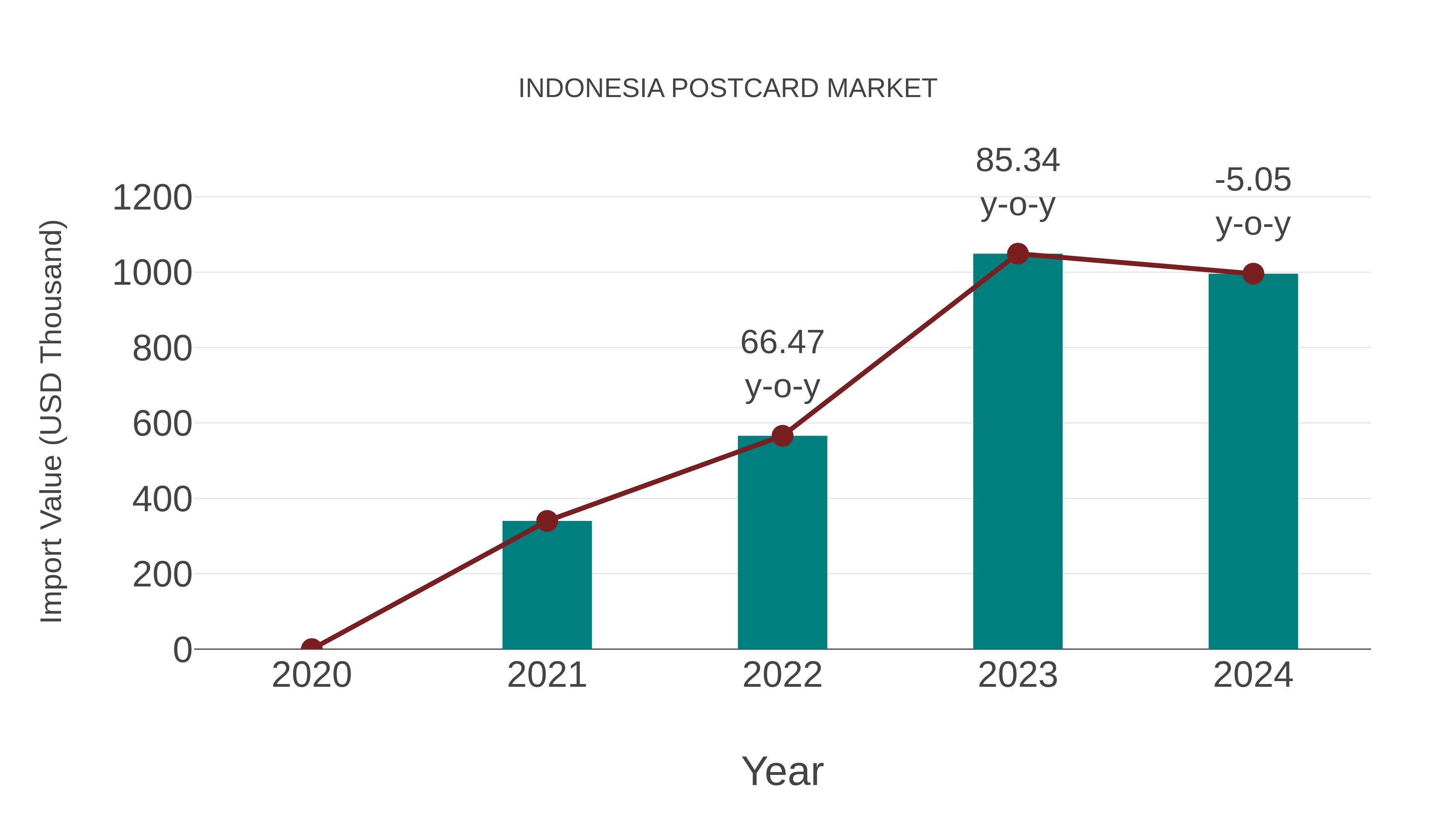
In the Indonesia postcard market, the import trend experienced a decrease from 2023 to 2024, with a growth rate of -5.05%. However, the compound annual growth rate (CAGR) for the period of 2020-2024 stood at a notable 43.08%. This decline in import momentum could be attributed to shifts in consumer preferences or changes in trade policies affecting the market`s stability.
Indonesia Postcard Market Highlights
| Report Name | Indonesia Postcard Market |
| Forecast period | 2025-2031 |
| CAGR | 6.4% |
| Growing Sector | Tourism Sector |
Topics Covered in the Indonesia Postcard Market
Indonesia Postcard Market report thoroughly covers the market by type, Usage and End -User. The market outlook report provides an unbiased and detailed analysis of the ongoing market trends, opportunities/high growth areas, and market drivers which would help the stakeholders to devise and align their market strategies according to the current and future market dynamics.
Indonesia Postcard Market Synopsis
Indonesia Postcard Market is expected to grow in the forecast period as Sending a postcard is one of the oldest and most traditional ways of keeping in touch with our loved ones who are far away. It is not only a way of communicating but also of sharing memories. Indonesia has a rich culture and is a popular tourist destination, making it a perfect market for postcard enthusiasts. The postcard market in Indonesia has seen significant growth in recent years. The key players in this market are local producers who offer a range of postcards capturing the essence of Indonesian culture. The government has also taken initiatives to support the growth of the market. In the future, the postcard industry is expected to become more diverse, innovative, and personalized, leveraging emerging technologies like augmented reality and virtual reality.
According to 6Wresearch, the Indonesia Postcard Market size is projected to grow at the CAGR of 6.4% during the forecast period of 2025-2031. The key drivers of the Indonesia postcard market are the increasing tourist inflow, growing interest in collecting postcards as a hobby, rising demand for thematic and personalized postcards, and the expansion of e-commerce platforms. Collecting postcards is also becoming a popular hobby among the younger generation, who prefer tangible and aesthetic souvenirs over digital ones. To cater to this segment, postcard vendors are offering customized and branded postcards with catchy designs and quotes. Moreover, e-commerce platforms like Lazada and Shopee are enabling easy and convenient online purchase of postcards, making them accessible to a wider audience. Despite the promising growth prospects, the Indonesia postcard Industry also faces some challenges. One of the major challenges is the proliferation of counterfeit postcards that dilute the authenticity and value of genuine ones. Another challenge is the lack of standardized quality control mechanisms, which leads to variations in paper quality, printing methods, and packaging. Moreover, the postcard market is highly fragmented, with a large number of small-scale and unorganized vendors competing for the same pool of customers. This results in price wars, low-profit margins, and limited scope for innovation and product differentiation. To overcome these challenges, the government and industry associations can collaborate to set up a certification system for authentic postcards, provide training and support for vendors to improve their production quality and marketing skills, and foster a culture of appreciation and preservation of postcard heritage.
Government policies and schemes introduced in the Indonesia Postcard Market
The government has initiated several programs to support Indonesia Postcard Market Growth and promote cultural tourism. For instance, the Ministry of Tourism has launched a Visit Wonderful Indonesia (ViWI) campaign, which includes a postcard competition to showcase the unique aspects of Indonesian culture and nature. The government has also established the Indonesian Creative Economy Agency (BEKRAF) to provide funding and resources for creative industries, including the postcard market. In addition, the government has designated 10 tourist destinations as priority destinations, which are expected to receive special attention and development plans to enhance their infrastructure, facilities, and branding.
Leading players in the Indonesia Postcard Market
The Postcard Market in Indonesia comprises various players, ranging from local souvenir shops and street vendors to international chains and online sellers. Some of the key players in the market are Museum Bank Indonesia, Toko Jadoel, Gramedia, Paperina, and Galeri Keris. These players offer a diverse range of postcards, including vintage, contemporary, hand-painted, 3D, and pop-up designs. They also cater to different target segments, such as tourists, collectors, art enthusiasts, and corporate clients. To stay competitive, these players are adopting various strategies, such as expanding their product portfolio, leveraging social media and influencer marketing, collaborating with artists and designers, and offering discounts and loyalty programs.
Future Insight of the Indonesia Postcard Market
The Indonesia postcard market is anticipated to witness significant growth in the coming years, driven by the government's push towards financial inclusion and digital transactions. While this market has been dominated by cash transactions, the pandemic has accelerated digital payment adoption, offering opportunities for market growth. As the country moves towards a more digitized and cashless economy, the postcard market is expected to expand significantly, catering to consumer needs for secure, convenient, and reliable financial transactions.
Market analysis by Type
The postcard market in Indonesia can be divided into two types: general purpose and private label. A general-purpose card is accepted at multiple merchants, while a private label card is only accepted at specific stores. The general-purpose card segment is expected to grow at a higher rate than the private label segment due to the convenience factor. With a general-purpose card, consumers can make purchases at a variety of merchants and locations, which is a huge advantage.
Market analysis By Usage
According to Shivankar, Research Manager, 6Wresearch, the postcard market usage is segmented into general purpose reloadable cards, government benefit/disbursement card, payroll card, and other cards. The government benefit/disbursement card segment is expected to grow the fastest in the coming years, with the government increasingly digitizing government payments and subsidies. These postcards offer an efficient and secure method to distribute social benefits; thus, driving their adoption in the country.
Market analysis By End -User
The end-user population in the postcard market includes retail establishments, corporate institutions, government bodies, and financial institutions. Retail establishments are likely to emerge as the largest segment in the near future, with the increasing adoption of e-commerce and brick-and-mortar retailing
Key attractiveness of the report
- 10 Years of Market Numbers.
- Historical Data Starting from 2021 to 2024.
- Base Year: 2024
- Forecast Data until 2031.
- Key Performance Indicators Impacting the Market.
- Major Upcoming Developments and project
Key Highlights of the Report:
- Indonesia Postcard Market Outlook
- Market Size of Indonesia Postcard Market, 2025
- Forecast of Indonesia Postcard Market, 2032
- Historical Data and Forecast of Indonesia Postcard Revenues & Volume for the Period 2022 - 2032F
- Indonesia Postcard Market Trend Evolution
- Indonesia Postcard Market Drivers and Challenges
- Indonesia Postcard Price Trends
- Indonesia Postcard Porter's Five Forces
- Indonesia Postcard Industry Life Cycle
- Historical Data and Forecast of Indonesia Postcard Market Revenues & Volume By Type for the Period 2022 - 2032F
- Historical Data and Forecast of Indonesia Postcard Market Revenues & Volume By General Purpose for the Period 2022 - 2032F
- Historical Data and Forecast of Indonesia Postcard Market Revenues & Volume By Private Label for the Period 2022 - 2032F
- Historical Data and Forecast of Indonesia Postcard Market Revenues & Volume By Usage for the Period 2022 - 2032F
- Historical Data and Forecast of Indonesia Postcard Market Revenues & Volume By General Purpose Re-Loadable Card for the Period 2022 - 2032F
- Historical Data and Forecast of Indonesia Postcard Market Revenues & Volume By Government Benefit/Disbursement Card for the Period 2022 - 2032F
- Historical Data and Forecast of Indonesia Postcard Market Revenues & Volume By Payroll Card for the Period 2022 - 2032F
- Historical Data and Forecast of Indonesia Postcard Market Revenues & Volume By Others for the Period 2022 - 2032F
- Historical Data and Forecast of Indonesia Postcard Market Revenues & Volume By End-User for the Period 2022 - 2032F
- Historical Data and Forecast of Indonesia Postcard Market Revenues & Volume By Retail Establishments for the Period 2022 - 2032F
- Historical Data and Forecast of Indonesia Postcard Market Revenues & Volume By Corporate Institutions for the Period 2022 - 2032F
- Historical Data and Forecast of Indonesia Postcard Market Revenues & Volume By Government for the Period 2022 - 2032F
- Historical Data and Forecast of Indonesia Postcard Market Revenues & Volume By Financial Institutions for the Period 2022 - 2032F
- Indonesia Postcard Import Export Trade Statistics
- Market Opportunity Assessment By Type
- Market Opportunity Assessment By Usage
- Market Opportunity Assessment By End-User
- Indonesia Postcard Top Companies Market Share
- Indonesia Postcard Competitive Benchmarking By Technical and Operational Parameters
- Indonesia Postcard Company Profiles
- Indonesia Postcard Key Strategic Recommendations
Market Covered
The report offers a comprehensive study of the subsequent market segments:
By Type
- General Purpose
- Private Label
By Usage
- General Purpose Re-Loadable Card
- Government Benefit/Disbursement Card
- Payroll Card
- Others
By End-User
- Retail Establishments
- Corporate Institutions
- Government
- Financial Institutions






































