Indonesia Radar Systems Market Size, Share & Growth Rate
The Indonesia Radar Systems Market was estimated at USD 317 Million in 2025 and is projected to reach USD 419 Million by 2032, growing at a CAGR of 4.1% from 2026 to 2032. This steady growth trajectory is largely attributed to the escalating defense and security needs of the nation, driven by its unique geographical challenges. As Indonesia continues to modernize its military capabilities and enhance its coastal surveillance, the demand for sophisticated radar systems will remain on the rise, particularly in aviation, maritime, and disaster management sectors.
Indonesia Radar Systems Market Year-wise Growth Rate and Key Drivers
This graph highlights how the Indonesia Radar Systems Market has steadily grown over the years, supported by major growth factors.
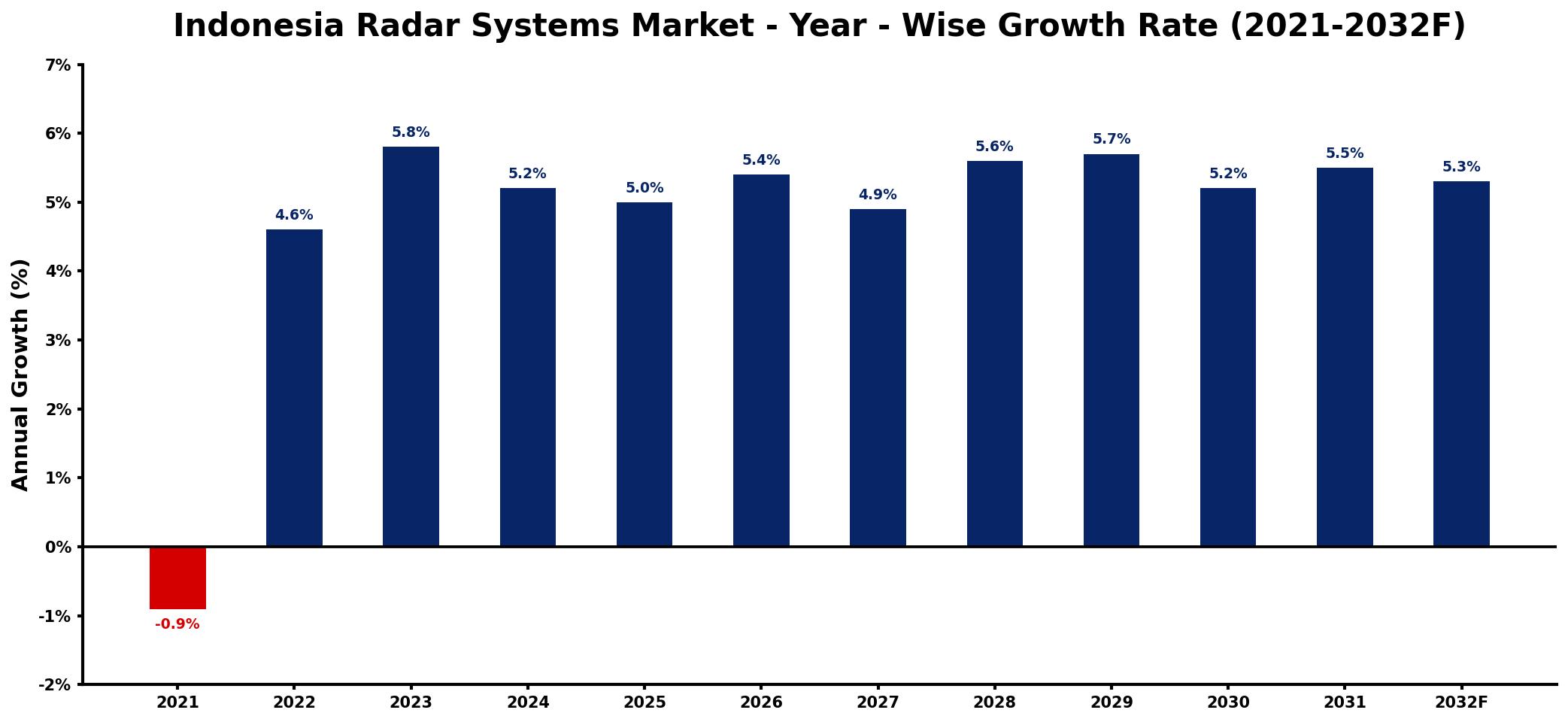
The table below presents the year‑wise growth rates along with the key drivers influencing the market
| Year | Growth Rate | Major Drivers |
| 2021 | -0.9% | decreased defense spending on technology |
| 2022 | 4.6% | expanding healthcare application demand |
| 2023 | 5.8% | growing demand for surveillance technologies |
| 2024 | 5.2% | expansion of maritime security initiatives |
| 2025 | 5.0% | rising investments in aerospace sector |
| 2026 | 5.4% | enhanced focus on border security |
| 2027 | 4.9% | development of smart city projects |
| 2028 | 5.6% | growing interest in automation solutions |
| 2029 | 5.7% | increased partnerships with private sector |
| 2030 | 5.2% | emphasis on environmental monitoring applications |
| 2031 | 5.5% | higher demand for military upgrades |
| 2032 | 5.3% | growing automotive sector requirements |
Note: Market size estimations and growth projections presented in this report are based on 6Wresearch's proprietary forecasting methodology, utilizing the latest available industry data, government publications, and primary research inputs.
Indonesia Radar Systems Market Synopsis
The radar systems market in Indonesia has seen significant momentum in recent years, propelled by heightened national security concerns and strategic investments in defense infrastructure. As the landscape evolves, the market is poised for continued expansion, particularly as technology integration progresses and applications diversify.
Moreover, the increasing recognition of radar systems critical roles in surveillance, navigation, and environmental monitoring is shaping future growth. By aligning with broader government initiatives aimed at enhancing disaster preparedness and maritime security, the radar systems market stands to benefit from both investment and innovation.
Indonesia Radar Systems Market Key Takeaways
- Significant growth is driven by national security requirements and technological advancements.
- The market will benefit from increased integration of radar with emerging sensor technologies.
- Geographical complexities present both challenges and opportunities for radar deployment.
- Government initiatives will play a vital role in shaping the future of radar systems in Indonesia.
- Post-pandemic recovery is expected to accelerate market growth, particularly in defense and aviation sectors.
Evaluation of Restraints in Indonesia Radar Systems Market
Despite the promising outlook, the Indonesia Radar Systems market grapples with significant infrastructural challenges. The nation's diverse geography, encompassing numerous islands and mountainous terrains, complicates the establishment and maintenance of radar installations. Moreover, the susceptibility of these systems to natural disasters, such as earthquakes and storms, raises concerns regarding their operational integrity. Furthermore, the shortage of skilled technicians required for the upkeep of complex radar systems also serves as a constraint to market growth.
Indonesia Radar Systems Market Trends
A notable trend in the Indonesia Radar Systems market is the growing integration of radar with other advanced sensor technologies, improving system capabilities and operational efficiency. The rise of phased array radar systems, which offer superior resolution and faster response times, is particularly noteworthy. Additionally, there is an increasing focus on leveraging radar systems for disaster management, reinforcing their utility beyond traditional defense applications. The continuous push towards smart transportation and enhanced maritime security further drives innovation and investment in this sector.
Indonesia Radar Systems Market Opportunities
The radar systems market in Indonesia presents genuine opportunities for growth, especially in military and civil applications. As the government prioritizes defense enhancements and disaster resilience, stakeholders can explore partnerships to develop integrated solutions that meet evolving needs. Expanding the use of radar in traffic management and environmental monitoring also opens doors for investment, particularly in urban development initiatives. Additionally, as global players look to enter the Southeast Asian market, local partnerships may foster technology transfer and capacity building.
Government Initiatives in the Indonesia Radar Systems Market
The Indonesian government has committed to modernizing its defense and security capabilities through various policies aimed at bolstering infrastructure and technology. Public spending on military upgrades, including advanced radar systems, highlights a proactive approach to national security. Moreover, initiatives focused on improving disaster preparedness and response capabilities underline the importance of radar technologies in safeguarding citizens and infrastructure. Collaborative efforts between public and private sectors are encouraged to facilitate advancements in radar technologies that align with national interests.
Future Insights of the Indonesia Radar Systems Market
Looking ahead to 2026-2032, the Indonesia Radar Systems market is expected to continue its upward trajectory, driven by a combination of increased defense spending, technological advancements, and diversified applications. The integration of artificial intelligence and machine learning into radar systems will likely enhance operational efficiency and decision-making processes. Furthermore, as Indonesia enhances its strategic partnerships with international defense entities, opportunities for knowledge transfer and technological innovation are expected to flourish, reinforcing the countrys position in the regional radar market.
Indonesia Radar Systems Market Latest Developments (2025 - 2026)
In recent months, the Indonesia Radar Systems market has witnessed a shift towards advanced radar technologies, with ongoing investments aimed at enhancing national defense capabilities. Government-led initiatives are accelerating the deployment of sophisticated radar systems for surveillance and coastal security. Additionally, collaborative projects between local firms and international technology providers are emerging, focusing on developing next-generation radar solutions tailored to Indonesias unique geographical challenges. The emphasis on improving operational readiness and disaster response capabilities remains a priority, shaping the direction of the industry.
Indonesia Radar Systems Market - Key Attractiveness of the Report
- 10 Years of Market Numbers
- Historical Data Starting from 2022 to 2025
- Base Year: 2025
- Forecast Data until 2032
- Key Performance Indicators Impacting the Market
- Major Upcoming Developments and Projects
Key Highlights of the Report:
- Indonesia Radar Systems Market Outlook
- Market Size of Indonesia Radar Systems Market, 2025
- Forecast of Indonesia Radar Systems Market, 2032
- Historical Data and Forecast of Indonesia Radar Systems Revenues & Volume for the Period 2022-2032F
- Indonesia Radar Systems Market Trend Evolution
- Indonesia Radar Systems Market Drivers and Challenges
- Indonesia Radar Systems Price Trends
- Indonesia Radar Systems Porter's Five Forces
- Indonesia Radar Systems Industry Life Cycle
- Historical Data and Forecast of Indonesia Radar Systems Market Revenues & Volume By Type for the Period 2022-2032F
- Historical Data and Forecast of Indonesia Radar Systems Market Revenues & Volume By Continuous Wave RADAR Systems for the Period 2022-2032F
- Historical Data and Forecast of Indonesia Radar Systems Market Revenues & Volume By Pulsated Wave RADAR Systems for the Period 2022-2032F
- Historical Data and Forecast of Indonesia Radar Systems Market Revenues & Volume By Application for the Period 2022-2032F
- Historical Data and Forecast of Indonesia Radar Systems Market Revenues & Volume By Airborne for the Period 2022-2032F
- Historical Data and Forecast of Indonesia Radar Systems Market Revenues & Volume By Land-based for the Period 2022-2032F
- Historical Data and Forecast of Indonesia Radar Systems Market Revenues & Volume By Naval for the Period 2022-2032F
- Historical Data and Forecast of Indonesia Radar Systems Market Revenues & Volume By End-user Industry for the Period 2022-2032F
- Historical Data and Forecast of Indonesia Radar Systems Market Revenues & Volume By Aviation for the Period 2022-2032F
- Historical Data and Forecast of Indonesia Radar Systems Market Revenues & Volume By Maritime Applications for the Period 2022-2032F
- Historical Data and Forecast of Indonesia Radar Systems Market Revenues & Volume By Automotive for the Period 2022-2032F
- Historical Data and Forecast of Indonesia Radar Systems Market Revenues & Volume By Military & Defense for the Period 2022-2032F
- Indonesia Radar Systems Import Export Trade Statistics
- Market Opportunity Assessment By Type
- Market Opportunity Assessment By Application
- Market Opportunity Assessment By End-user Industry
- Indonesia Radar Systems Top Companies Market Share
- Indonesia Radar Systems Competitive Benchmarking By Technical and Operational Parameters
- Indonesia Radar Systems Company Profiles
- Indonesia Radar Systems Key Strategic Recommendations






































