Indonesia Railway Maintenance Machinery Market Size, Share & Growth Rate
The Indonesia Railway Maintenance Machinery Market was estimated at USD 472 Million in 2025 and is projected to reach USD 729 Million by 2032, growing at a CAGR of 6.4% from 2026 to 2032. This robust growth can be attributed to escalating investments in the country's transportation infrastructure, as well as an increasing demand for efficient public transport systems. The government's proactive initiatives to encourage private sector participation in railway maintenance further amplify market potential.
Indonesia Railway Maintenance Machinery Market Year-wise Growth Rate and Key Drivers
This graph highlights how the Indonesia Railway Maintenance Machinery Market has steadily grown over the years, supported by major growth factors.
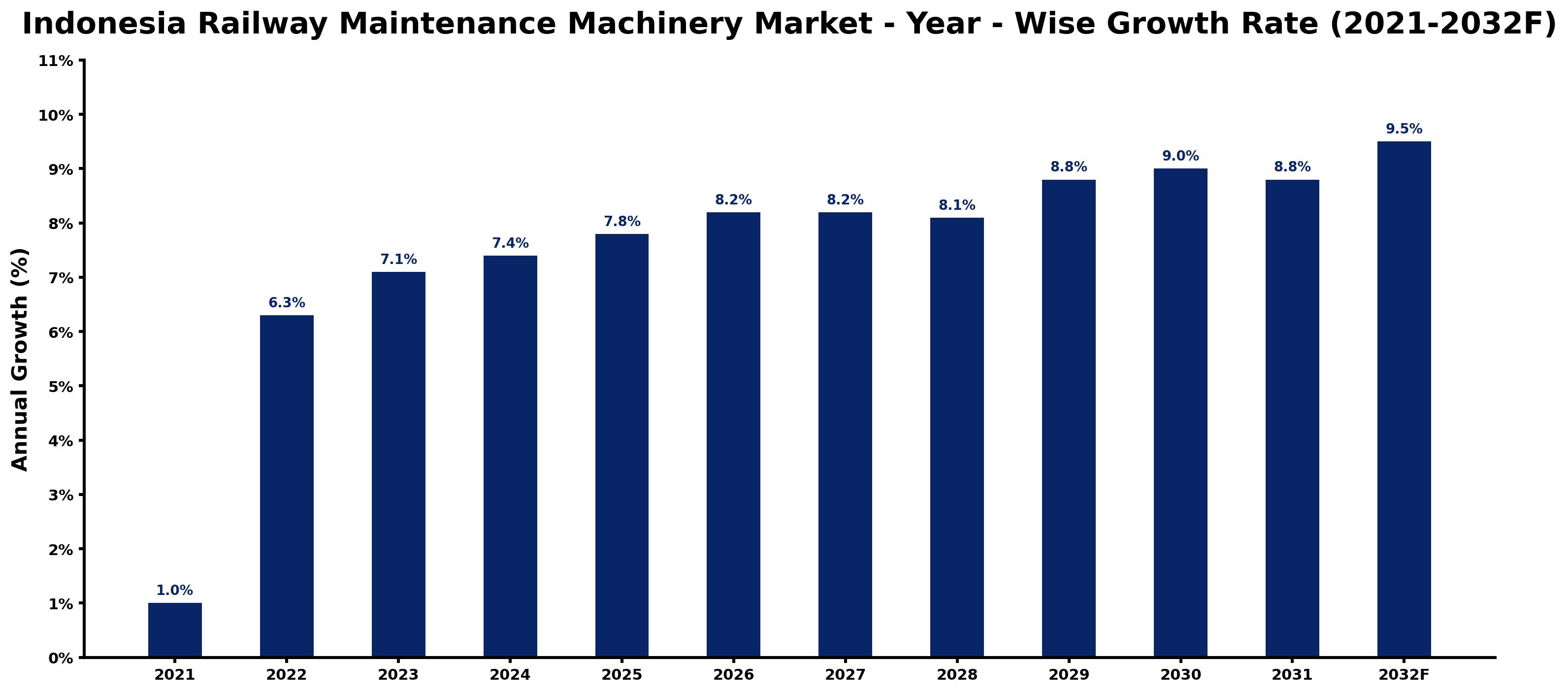
The table below presents the year‑wise growth rates along with the key drivers influencing the market
| Year | Growth Rate | Major Drivers |
| 2021 | 1.0% | Rising electricity demand across industries |
| 2022 | 6.3% | Increasing adoption of advanced technologies |
| 2023 | 7.1% | Rapid growth in telecom and data center sectors |
| 2024 | 7.4% | Expansion of transportation and logistics networks |
| 2025 | 7.8% | Increasing adoption of advanced technologies |
| 2026 | 8.2% | Expansion of commercial construction activities |
| 2027 | 8.2% | Increasing adoption of advanced technologies |
| 2028 | 8.1% | Increasing smart city development projects |
| 2029 | 8.8% | Increasing smart city development projects |
| 2030 | 9.0% | Increasing industrial automation investments |
| 2031 | 8.8% | Increasing industrial automation investments |
| 2032 | 9.5% | Increasing industrial automation investments |
Note - Market size estimations and growth projections presented in this report are based on 6Wresearch's advanced forecasting approach, validated with industry datasets as of June 2026.
Indonesia Railway Maintenance Machinery Market Synopsis
In Indonesia, the railway sector is undergoing a significant transformation, with a distinct emphasis on enhancing the maintenance infrastructure. The surge in population and urbanization has created an urgent need for effective public transport solutions, which in turn drives regular maintenance and upgrades to existing rail systems.
The Indonesian government is increasingly supporting investments in railway maintenance machinery through various incentives. These policies aim to boost operational efficiency and reduce the dependence on traditional public sector entities, thereby paving the way for private players to actively engage in the market.
Indonesia Railway Maintenance Machinery Market Key Takeaways
- The market is poised for substantial growth driven by increased government spending on rail infrastructure.
- Urbanization and rising population densities are intensifying the demand for reliable public transport solutions.
- Private sector investments are being encouraged, supported by government incentives and tax benefits.
- There are challenges related to standardization and compatibility that impact machinery procurement.
- Supply chain complexities, including import duties and spare parts availability, hinder local adoption rates.
Evaluation of Restraints in Indonesia Railway Maintenance Machinery Market
Despite the promising growth outlook, several constraints impede the Indonesia railway maintenance machinery market. The lack of standardization across the railway networks presents significant compatibility challenges when acquiring new machinery. Additionally, regional variations in pricing and the complexities introduced by domestic import duties complicate procurement processes, making local machinery less competitive compared to international options. Furthermore, inadequate availability of spare parts in certain areas can disrupt maintenance activities, deterring potential buyers from committing to new machinery investments.
Indonesia Railway Maintenance Machinery Market Trends
There are several notable trends shaping the Indonesia Railway Maintenance Machinery Market. One significant trend is the increasing adoption of advanced technologies such as automation and IoT in maintenance processes, aiming to enhance efficiency and reduce manual labor. Moreover, the demand for environmentally friendly machinery is rising, as stakeholders focus on sustainable practices in railway maintenance. Additionally, the collaboration between public and private sectors is becoming more pronounced, facilitating innovation and modern solutions in maintenance activities.
Indonesia Railway Maintenance Machinery Market Opportunities
Significant growth opportunities exist within the Indonesia Railway Maintenance Machinery Market, particularly in expanding urban areas. The government's focus on regional connectivity projects is likely to spur demand for advanced maintenance machinery. Companies can also capitalize on the ongoing modernization of railway networks by developing and offering specialized machinery that meets contemporary operational requirements. With the trend toward increased investment in rail infrastructure, there is a ripe opportunity for machinery manufacturers to introduce cutting-edge solutions tailored to the unique challenges faced by the Indonesian market.
Government Initiatives in the Indonesia Railway Maintenance Machinery Market
The Indonesian government has been actively formulating policies to bolster the railway sector, which includes promoting investments in maintenance machinery. Various initiatives are designed to attract private investment, reduce the fiscal burden on public enterprises, and enhance overall infrastructure efficiency. By offering tax incentives and subsidies, the government aims to create a conducive environment for private players to participate in railway maintenance, thus enhancing the overall capability of the sector.
Future Insights of the Indonesia Railway Maintenance Machinery Market
Looking ahead to the period between 2026 and 2032, the Indonesia Railway Maintenance Machinery Market is expected to witness considerable transformations. The ongoing urbanization, coupled with robust government investment, is likely to sustain a high growth trajectory. Furthermore, as new railway projects are initiated and existing systems are upgraded, the demand for specialized maintenance machinery will become increasingly prominent. The integration of smart technologies into maintenance practices will also shape the future landscape, leading to enhanced operational efficiencies and reduced downtime.
Indonesia Railway Maintenance Machinery Market Latest Developments (May 2025 - June 2026)
Recent developments in the Indonesia Railway Maintenance Machinery Market have illustrated a clear pivot towards modernization and efficiency. Industry stakeholders are focusing on integrating advanced technologies into maintenance equipment, fostering collaborations that aim to enhance overall service delivery. Additionally, government policies have been actively adapting to encourage more private sector participation, facilitating a more vibrant market landscape. These dynamics are indicative of a market poised for transformation as it responds to both infrastructural needs and technological advancements.
Indonesia Railway Maintenance Machinery Market - Key Attractiveness of the Report
- 10 Years of Market Numbers
- Historical Data Starting from 2022 to 2025
- Base Year: 2025
- Forecast Data until 2032
- Key Performance Indicators Impacting the Market
- Major Upcoming Developments and Projects
Key Highlights of the Report:
- Indonesia Railway Maintenance Machinery Market Outlook
- Market Size of Indonesia Railway Maintenance Machinery Market, 2025
- Forecast of Indonesia Railway Maintenance Machinery Market, 2032F
- Historical Data and Forecast of Indonesia Railway Maintenance Machinery Revenues & Volume for the Period 2022-2032F
- Indonesia Railway Maintenance Machinery Market Trend Evolution
- Indonesia Railway Maintenance Machinery Market Drivers and Challenges
- Indonesia Railway Maintenance Machinery Price Trends
- Indonesia Railway Maintenance Machinery Porter's Five Forces
- Indonesia Railway Maintenance Machinery Industry Life Cycle
- Historical Data and Forecast of Indonesia Railway Maintenance Machinery Market Revenues & Volume By Type for the Period 2022-2032F
- Historical Data and Forecast of Indonesia Railway Maintenance Machinery Market Revenues & Volume By Tamping Machine for the Period 2022-2032F
- Historical Data and Forecast of Indonesia Railway Maintenance Machinery Market Revenues & Volume By Stabilizing Machinery for the Period 2022-2032F
- Historical Data and Forecast of Indonesia Railway Maintenance Machinery Market Revenues & Volume By Rail Handling Machinery for the Period 2022-2032F
- Historical Data and Forecast of Indonesia Railway Maintenance Machinery Market Revenues & Volume By Ballast Cleaning Machine for the Period 2022-2032F
- Historical Data and Forecast of Indonesia Railway Maintenance Machinery Market Revenues & Volume By Other for the Period 2022-2032F
- Historical Data and Forecast of Indonesia Railway Maintenance Machinery Market Revenues & Volume By Applications for the Period 2022-2032F
- Historical Data and Forecast of Indonesia Railway Maintenance Machinery Market Revenues & Volume By Ballast Track for the Period 2022-2032F
- Historical Data and Forecast of Indonesia Railway Maintenance Machinery Market Revenues & Volume By Ballastless Track for the Period 2022-2032F
- Indonesia Railway Maintenance Machinery Import Export Trade Statistics
- Market Opportunity Assessment By Type
- Market Opportunity Assessment By Applications
- Indonesia Railway Maintenance Machinery Top Companies Market Share
- Indonesia Railway Maintenance Machinery Competitive Benchmarking By Technical and Operational Parameters
- Indonesia Railway Maintenance Machinery Company Profiles
- Indonesia Railway Maintenance Machinery Key Strategic Recommendations






































