Indonesia Real Estate Market Size, Share & Growth Rate
The Indonesia Real Estate Market was estimated at USD 357 Million in 2025 and is projected to reach USD 470 Million by 2032, growing at a CAGR of 4.0% from 2026 to 2032. This growth is primarily driven by the rapid urbanization, increasing middle-class population, and a surge in foreign investments aimed at seizing the opportunities presented in urban properties. Additionally, positive government policies that promote home ownership are further invigorating the market dynamics.
Indonesia Real Estate Market Year-wise Growth Rate and Key Drivers
This graph highlights how the Indonesia Real Estate Market has steadily grown over the years, supported by major growth factors.
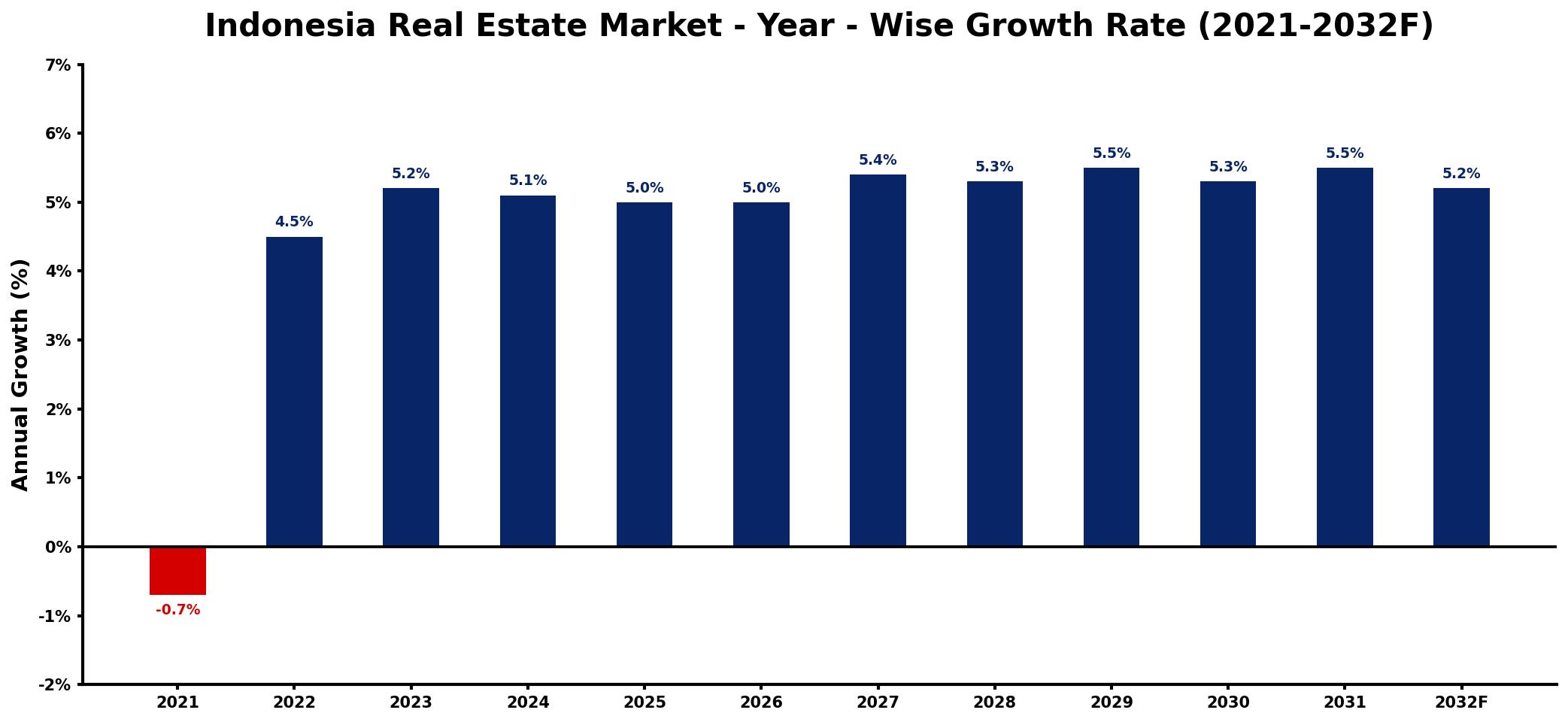
The table below presents the year‑wise growth rates along with the key drivers influencing the market
| Year | Growth Rate | Major Drivers |
| 2021 | -0.7% | decreased consumer spending on housing |
| 2022 | 4.5% | increased foreign investment interest |
| 2023 | 5.2% | rising urban population demand |
| 2024 | 5.1% | expansion of infrastructure projects |
| 2025 | 5.0% | growing middle class purchasing power |
| 2026 | 5.0% | enhanced digital marketing strategies |
| 2027 | 5.4% | increased demand for sustainable living |
| 2028 | 5.3% | growing regional consumption patterns |
| 2029 | 5.5% | growing interest in smart homes |
| 2030 | 5.3% | rising demand for rental properties |
| 2031 | 5.5% | increased focus on urban renewal |
| 2032 | 5.2% | stronger distribution network expansion |
Note: Market size estimations and growth projections presented in this report are based on 6Wresearch's proprietary forecasting methodology, utilizing the latest available industry data, government publications, and primary research inputs.
Indonesia Real Estate Market Synopsis
The real estate landscape in Indonesia is undergoing a notable transformation, spurred by escalating urban development and rising incomes among its populace. A substantial portion of the residential real estate transactions, valued at approximately USD 29 billion in 2017, illustrates the sector's robust activity, reflecting a growing appetite for property acquisition.
As the nation advances, several factors including a booming urban population, major infrastructure projects, and an expanding middle class are shaping market trends. However, challenges such as regulatory hurdles and fluctuating property prices necessitate strategic considerations for stakeholders looking to navigate this vibrant but complex environment.
Indonesia Real Estate Market Key Takeaways
- The Indonesia Real Estate Market is on a steady growth path, influenced by a combination of urbanization and foreign investment.
- Government initiatives supporting affordable housing are crucial for sustaining demand in residential properties.
- Infrastructure development continues to play a pivotal role in enhancing market accessibility and attractiveness.
- The market demonstrates resilience, gradually recovering from the disruptions caused by the COVID-19 pandemic.
- Strategic investments in urban areas are likely to yield high returns as demand escalates.
Evaluation of Restraints in Indonesia Real Estate Market
While the potential of the Indonesia real estate market is substantial, several challenges persist that could impact its growth trajectory. Property price fluctuations can deter potential buyers, while limited affordable housing options remain a pressing issue for the emerging middle class. Complicated land acquisition processes and regulatory hurdles also pose significant obstacles, often leading to project delays. Furthermore, the demand for sustainable urban development is intensifying, necessitating a shift in strategy among real estate developers to align with evolving consumer preferences.
Indonesia Real Estate Market Trends
The Indonesia real estate market is witnessing several transformative trends that shape demand and technology integration. The rise of smart city initiatives is pushing developers to incorporate technology into urban planning, focusing on sustainability and efficiency. Furthermore, an increasing preference for mixed-use developments indicates a shift towards lifestyle-oriented spaces that cater to the needs of modern urban dwellers. Also, the growing trend of remote working is prompting a re-evaluation of residential property designs and locations, further influencing the demand landscape.
Indonesia Real Estate Market Opportunities
Investment opportunities abound in Indonesia's real estate sector, particularly in urban centers where demand for residential and commercial spaces is surging. The push for affordable housing presents a significant chance for developers to meet unmet needs, while infrastructure projects continue to unlock new areas for real estate investment. Additionally, as the market gradually recovers from the pandemic, there is a compelling opportunity to invest in tourism-related real estate as travel restrictions ease.
Government Initiatives in the Indonesia Real Estate Market
The Indonesian government has implemented various policies aimed at stimulating the real estate sector, particularly focusing on affordable housing initiatives. These include subsidies and incentives designed to make home ownership more accessible to the average citizen. Public spending on infrastructure projects is also critical, as it improves connectivity and enhances property values. As the government emphasizes urban development, ongoing initiatives signal a commitment to fostering a favorable environment for both local and foreign investors.
Future Insights of the Indonesia Real Estate Market
Looking ahead to 2026-2032, the Indonesia real estate market is poised for continued growth driven by a convergence of urbanization and economic development. As the urban population expands and disposable incomes rise, demand for both residential and commercial spaces will likely increase. The governments support in facilitating property transactions and addressing housing shortages will enhance market stability. Furthermore, as the impacts of the pandemic continue to wane, there is potential for a revitalized interest in real estate investments, particularly within emerging urban areas.
Indonesia Real Estate Market Latest Developments (2025 - 2026)
In recent months, the Indonesia real estate market has seen a resurgence in construction activity, reflecting a broader recovery from pandemic-related setbacks. There has been increased focus on sustainable building practices, aligning with global trends and local demands for environmentally friendly developments. Additionally, emerging technology in real estate management and sales is becoming more prevalent, reshaping the way transactions are conducted and properties are marketed. Investors are particularly keen on urban regeneration projects as these initiatives attract both local and international interest.
Indonesia Real Estate Market - Key Attractiveness of the Report
- 10 Years of Market Numbers
- Historical Data Starting from 2022 to 2025
- Base Year: 2025
- Forecast Data until 2032
- Key Performance Indicators Impacting the Market
- Major Upcoming Developments and Projects
Key Highlights of the Report:
- Indonesia Real Estate Market Outlook
- Market Size of Indonesia Real Estate Market, 2025
- Forecast of Indonesia Real Estate Market, 2032
- Historical Data and Forecast of Indonesia Real Estate Revenues & Volume for the Period 2022-2032F
- Indonesia Real Estate Market Trend Evolution
- Indonesia Real Estate Market Drivers and Challenges
- Indonesia Real Estate Price Trends
- Indonesia Real Estate Porter's Five Forces
- Indonesia Real Estate Industry Life Cycle
- Historical Data and Forecast of Indonesia Real Estate Market Revenues & Volume By Property for the Period 2022-2032F
- Historical Data and Forecast of Indonesia Real Estate Market Revenues & Volume By Residential for the Period 2022-2032F
- Historical Data and Forecast of Indonesia Real Estate Market Revenues & Volume By Commercial for the Period 2022-2032F
- Historical Data and Forecast of Indonesia Real Estate Market Revenues & Volume By Industrial for the Period 2022-2032F
- Historical Data and Forecast of Indonesia Real Estate Market Revenues & Volume By Land for the Period 2022-2032F
- Historical Data and Forecast of Indonesia Real Estate Market Revenues & Volume By Others for the Period 2022-2032F
- Historical Data and Forecast of Indonesia Real Estate Market Revenues & Volume By Type for the Period 2022-2032F
- Historical Data and Forecast of Indonesia Real Estate Market Revenues & Volume By Sales for the Period 2022-2032F
- Historical Data and Forecast of Indonesia Real Estate Market Revenues & Volume By Rental for the Period 2022-2032F
- Historical Data and Forecast of Indonesia Real Estate Market Revenues & Volume By Lease for the Period 2022-2032F
- Indonesia Real Estate Import Export Trade Statistics
- Market Opportunity Assessment By Property
- Market Opportunity Assessment By Type
- Indonesia Real Estate Top Companies Market Share
- Indonesia Real Estate Competitive Benchmarking By Technical and Operational Parameters
- Indonesia Real Estate Company Profiles
- Indonesia Real Estate Key Strategic Recommendations






































