Indonesia Renewable Chemicals Market Size, Share & Growth Rate
The Indonesia Renewable Chemicals Market was estimated at USD 289 Million in 2025 and is projected to reach USD 380 Million by 2032, growing at a CAGR of 4.0% from 2026 to 2032. This growth trajectory reflects a notable shift towards sustainable chemical alternatives driven by Indonesia's rich agricultural resources, which offer abundant feedstocks for renewable chemical production. Additionally, the rising consumer demand for eco-friendly products and stringent government regulations supporting sustainability initiatives are further propelling market expansion.
Indonesia Renewable Chemicals Market Year-wise Growth Rate and Key Drivers
This graph highlights how the Indonesia Renewable Chemicals Market has steadily grown over the years, supported by major growth factors.
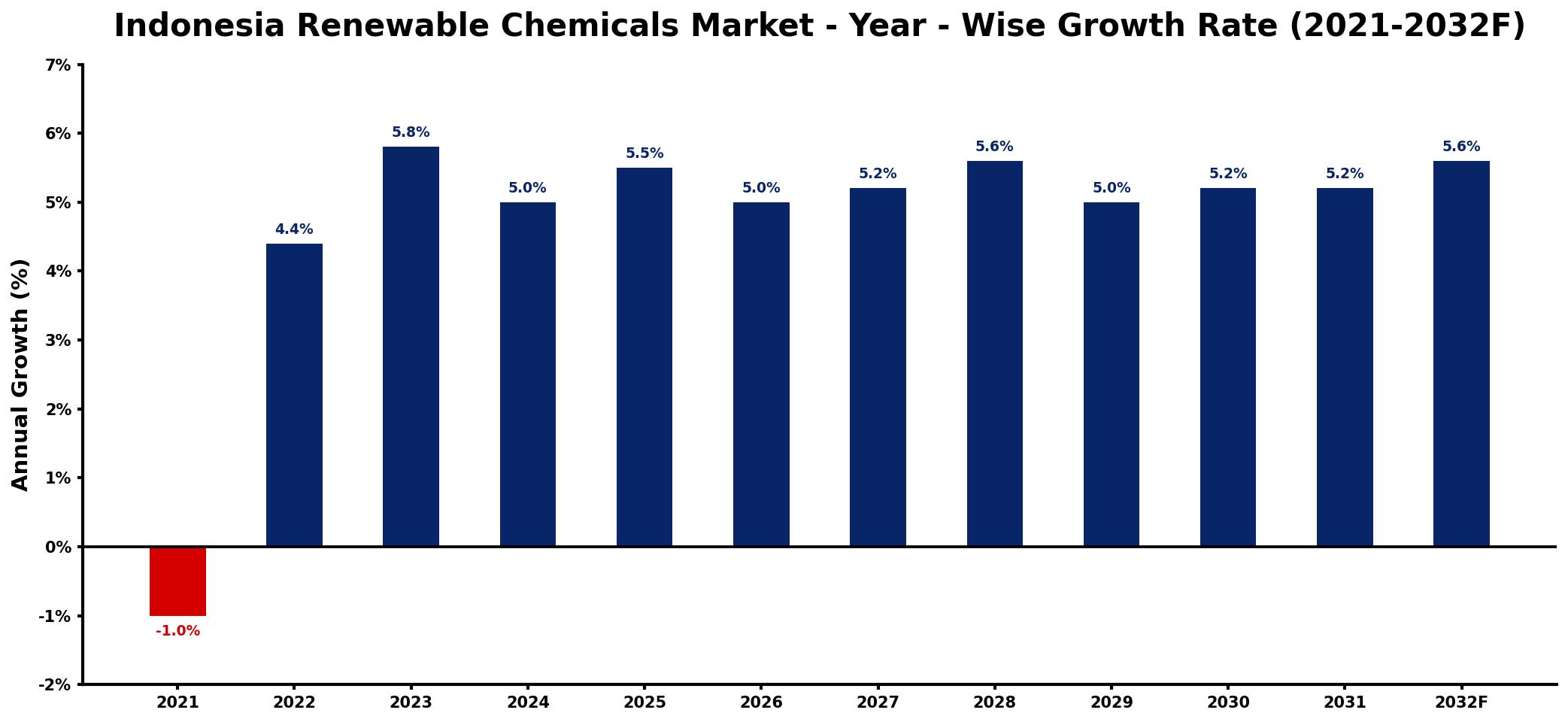
The table below presents the year‑wise growth rates along with the key drivers influencing the market
| Year | Growth Rate | Major Drivers |
| 2021 | -1.0% | weak end-use demand conditions |
| 2022 | 4.4% | increased investment in sustainable technologies |
| 2023 | 5.8% | growing demand for eco-friendly solutions |
| 2024 | 5.0% | expansion of green manufacturing facilities |
| 2025 | 5.5% | rising interest in circular economy |
| 2026 | 5.0% | enhanced regulatory support for sustainability |
| 2027 | 5.2% | increased collaborations among industries |
| 2028 | 5.6% | growing awareness of environmental impact |
| 2029 | 5.0% | advancements in sustainable production methods |
| 2030 | 5.2% | wider acceptance of green innovations |
| 2031 | 5.2% | strengthened supply chain sustainability efforts |
| 2032 | 5.6% | expanding healthcare application demand |
Note: Market size estimations and growth projections presented in this report are based on 6Wresearch's proprietary forecasting methodology, utilizing the latest available industry data, government publications, and primary research inputs.
Indonesia Renewable Chemicals Market Synopsis
As a leading producer of palm oil and other agricultural commodities, Indonesia has the potential to become a significant player in the renewable chemicals market. The availability of bio-based feedstocks, such as palm oil and other biomass, is driving innovations in biofuels, bioplastics, and green solvents tailored for local and global markets.
Moreover, the increasing awareness of environmental issues and the impact of traditional chemicals have sparked a shift in industry preferences. This has led to heightened investment in research and development of renewable alternatives that not only reduce carbon footprints but also meet the demands of environmentally conscious consumers.
Indonesia Renewable Chemicals Market Key Takeaways
- The market is projected to grow significantly, reflecting strong local demand for sustainable chemical solutions.
- Indonesia's agricultural sector provides a solid foundation for renewable feedstock production.
- Government incentives and environmental regulations are key drivers supporting market growth.
- Consumer preferences are increasingly leaning towards eco-friendly and sustainable products.
- Innovations in production technologies are essential for overcoming cost and quality challenges.
Evaluation of Restraints in Indonesia Renewable Chemicals Market
Despite the promising outlook, the Indonesia Renewable Chemicals Market faces several restraints. One major challenge is the need for cost-competitive production methods, as renewable chemicals often require higher initial investments compared to conventional counterparts. Additionally, ensuring consistent quality of renewable products poses a hurdle for market players. Companies must also navigate complex regulatory frameworks while balancing sustainability expectations with the economic viability of their offerings.
Indonesia Renewable Chemicals Market Trends
Current trends indicate a marked rise in collaborations between public and private sectors aimed at developing innovative renewable chemical technologies. Furthermore, the integration of advanced analytics and biotechnology is transforming traditional production methods, enhancing efficiency and sustainability. There is also an increasing focus on circular economy principles, encouraging the recycling and reusing of materials within the renewable chemicals sector.
Indonesia Renewable Chemicals Market Opportunities
Opportunities for growth in the Indonesia Renewable Chemicals Market are abundant. The push for bio-based alternatives to petrochemicals is gaining traction, opening avenues for investments in bioplastics and biofuels. Additionally, the development of green solvents for various industrial applications presents a lucrative opportunity for players willing to innovate. The expansion of global markets for renewable chemicals can also provide Indonesian manufacturers with access to new revenue streams.
Government Initiatives in the Indonesia Renewable Chemicals Market
The Indonesian government is actively supporting the renewable chemicals sector through various initiatives aimed at promoting sustainability. Incentives such as tax breaks, subsidies for green technology, and investment in research and development are designed to encourage local production of renewable chemicals. Furthermore, public spending on environmental programs and compliance with international sustainability standards are pivotal in shaping the future of this market.
Future Insights of the Indonesia Renewable Chemicals Market
Looking ahead to the period between 2026 and 2032, the Indonesia Renewable Chemicals Market is expected to gain significant momentum, driven by both domestic and international demand for sustainable products. The emphasis on reducing greenhouse gas emissions will likely bolster investments in renewable chemical technologies. With a growing consumer base prioritizing sustainability, market players who embrace innovation and adapt to evolving market dynamics will likely thrive in this burgeoning sector.
Indonesia Renewable Chemicals Market Latest Developments (2025 - 2026)
In the latest developments within the Indonesia Renewable Chemicals Market, industry stakeholders are increasingly focusing on partnerships aimed at technological advancements. Collaborative efforts between academia and the private sector are fostering innovation in bio-based chemical production. Additionally, there have been announcements regarding new projects aimed at enhancing production capacities for bioplastics and biofuels, reflecting an optimistic outlook for sustainable chemical solutions.
Indonesia Renewable Chemicals Market - Key Attractiveness of the Report
- 10 Years of Market Numbers
- Historical Data Starting from 2022 to 2025
- Base Year: 2025
- Forecast Data until 2032
- Key Performance Indicators Impacting the Market
- Major Upcoming Developments and Projects
Key Highlights of the Report:
- Indonesia Renewable Chemicals Market Outlook
- Market Size of Indonesia Renewable Chemicals Market, 2025
- Forecast of Indonesia Renewable Chemicals Market, 2032
- Historical Data and Forecast of Indonesia Renewable Chemicals Revenues & Volume for the Period 2022-2032F
- Indonesia Renewable Chemicals Market Trend Evolution
- Indonesia Renewable Chemicals Market Drivers and Challenges
- Indonesia Renewable Chemicals Price Trends
- Indonesia Renewable Chemicals Porter's Five Forces
- Indonesia Renewable Chemicals Industry Life Cycle
- Historical Data and Forecast of Indonesia Renewable Chemicals Market Revenues & Volume By Product Type for the Period 2022-2032F
- Historical Data and Forecast of Indonesia Renewable Chemicals Market Revenues & Volume By Alcohols for the Period 2022-2032F
- Historical Data and Forecast of Indonesia Renewable Chemicals Market Revenues & Volume By Organic Acids for the Period 2022-2032F
- Historical Data and Forecast of Indonesia Renewable Chemicals Market Revenues & Volume By Ketones for the Period 2022-2032F
- Historical Data and Forecast of Indonesia Renewable Chemicals Market Revenues & Volume By Platform Chemicals for the Period 2022-2032F
- Historical Data and Forecast of Indonesia Renewable Chemicals Market Revenues & Volume By Biopolymers for the Period 2022-2032F
- Historical Data and Forecast of Indonesia Renewable Chemicals Market Revenues & Volume By Others for the Period 2022-2032F
- Historical Data and Forecast of Indonesia Renewable Chemicals Market Revenues & Volume By Applications for the Period 2022-2032F
- Historical Data and Forecast of Indonesia Renewable Chemicals Market Revenues & Volume By Transportation for the Period 2022-2032F
- Historical Data and Forecast of Indonesia Renewable Chemicals Market Revenues & Volume By Textiles for the Period 2022-2032F
- Historical Data and Forecast of Indonesia Renewable Chemicals Market Revenues & Volume By Food safety for the Period 2022-2032F
- Historical Data and Forecast of Indonesia Renewable Chemicals Market Revenues & Volume By Environment for the Period 2022-2032F
- Historical Data and Forecast of Indonesia Renewable Chemicals Market Revenues & Volume By Communication for the Period 2022-2032F
- Historical Data and Forecast of Indonesia Renewable Chemicals Market Revenues & Volume By Housing for the Period 2022-2032F
- Historical Data and Forecast of Indonesia Renewable Chemicals Market Revenues & Volume By Recreation for the Period 2022-2032F
- Historical Data and Forecast of Indonesia Renewable Chemicals Market Revenues & Volume By Other Applications for the Period 2022-2032F
- Indonesia Renewable Chemicals Import Export Trade Statistics
- Market Opportunity Assessment By Product Type
- Market Opportunity Assessment By Applications
- Indonesia Renewable Chemicals Top Companies Market Share
- Indonesia Renewable Chemicals Competitive Benchmarking By Technical and Operational Parameters
- Indonesia Renewable Chemicals Company Profiles
- Indonesia Renewable Chemicals Key Strategic Recommendations






































