Indonesia Residential Boiler Market: Import Trend Analysis
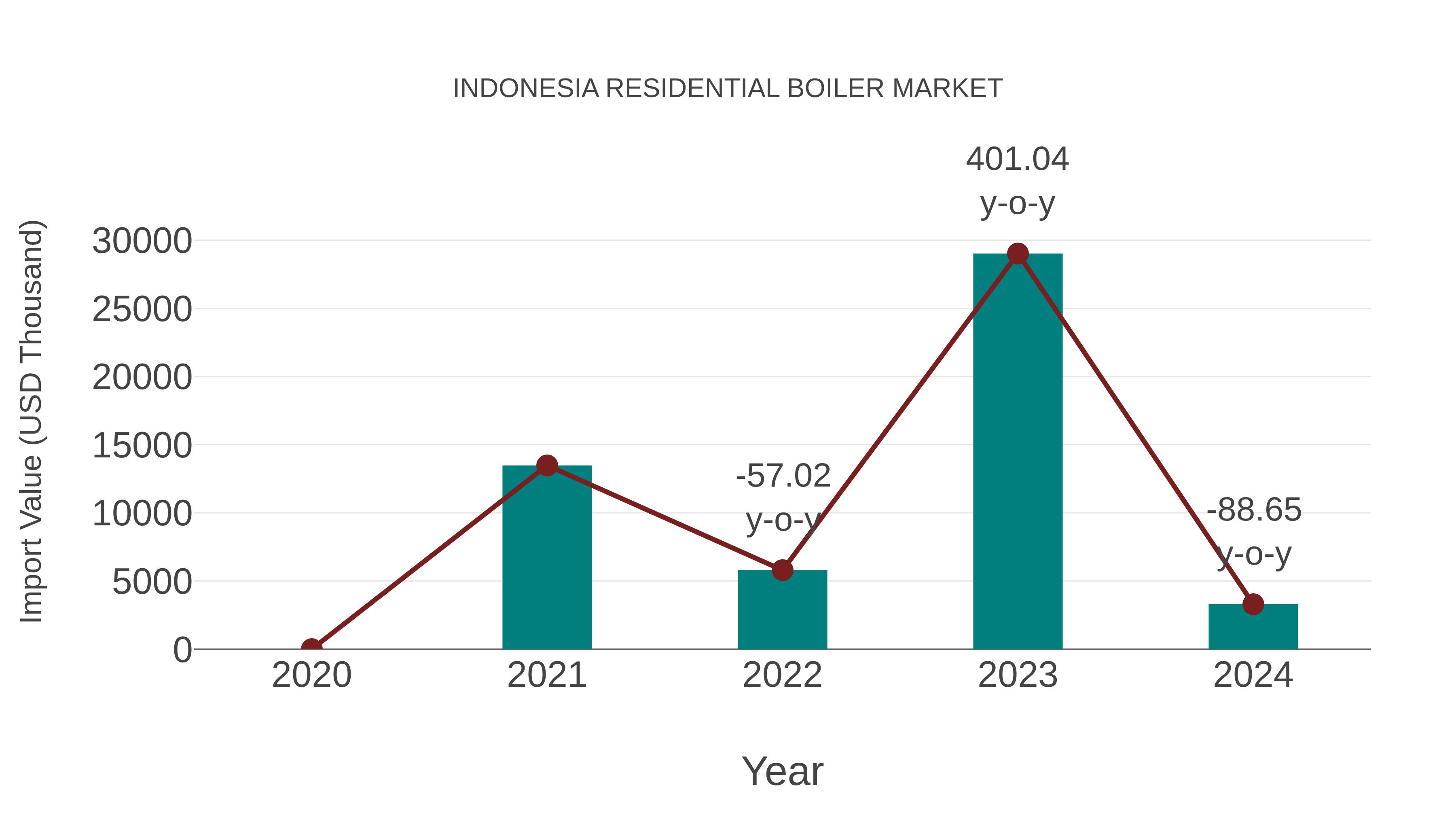
Indonesia`s import trend for residential boilers in 2024 experienced a significant decline, with a growth rate of -88.65% compared to the previous year. The compound annual growth rate (CAGR) for the period 2020-2024 stood at -37.48%. This steep negative trend could be attributed to a combination of reduced demand and potential shifts in trade policies impacting the market stability.
Indonesia Residential Boiler Market Synopsis
Residential boilers are essential for providing heating and hot water in households. In Indonesia, the residential boiler market is influenced by factors such as climate conditions and urbanization. As urban areas expand, the demand for residential heating systems, including boilers, is expected to grow. Market players need to focus on energy-efficient and environmentally friendly solutions to align with global sustainability goals. Additionally, government policies and incentives related to energy conservation can impact the market`s outlook.
Drivers of the Market
The Indonesia residential boiler market is on the rise due to several factors. Urbanization and population growth are driving the construction of residential complexes and housing, creating a demand for heating solutions, including boilers. Moreover, as Indonesia experiences changing weather patterns, the need for efficient heating systems in residential buildings has increased. Environmental concerns are also contributing to the adoption of modern, energy-efficient boilers. Government incentives and regulations promoting energy-efficient home heating systems further bolster the market.
Challenges of the Market
The residential boiler market in Indonesia faces challenges related to energy efficiency and environmental concerns. As homeowners increasingly seek eco-friendly heating solutions, manufacturers need to develop boilers that are energy-efficient and emit fewer emissions. Additionally, affordability is a key concern for the residential market, making it challenging for manufacturers to balance cost-effective production with high-quality components. Market fluctuations and economic conditions can also impact consumer spending on residential heating systems.
COVID-19 Impact on the Market
The residential boiler market faced challenges as construction projects slowed down during the pandemic. Reduced economic activity and cautious consumer spending also affected demand. However, as the housing market and construction sector regain momentum, the demand for residential boilers is expected to increase, driven by the need for efficient heating solutions in new residential developments.
Key Players in the Market
The residential boiler market in Indonesia is driven by the increasing demand for hot water and heating solutions. Key players in this market are PT. Euroasiatic Jaya, PT. Grand Kartech Tbk, and PT. Atmindo Tbk.
Key Highlights of the Report:
- Indonesia Residential Boiler Market Outlook
- Market Size of Indonesia Residential Boiler Market, 2025
- Forecast of Indonesia Residential Boiler Market, 2032
- Historical Data and Forecast of Indonesia Residential Boiler Revenues & Volume for the Period 2022-2032F
- Indonesia Residential Boiler Market Trend Evolution
- Indonesia Residential Boiler Market Drivers and Challenges
- Indonesia Residential Boiler Price Trends
- Indonesia Residential Boiler Porter's Five Forces
- Indonesia Residential Boiler Industry Life Cycle
- Historical Data and Forecast of Indonesia Residential Boiler Market Revenues & Volume By Type for the Period 2022-2032F
- Historical Data and Forecast of Indonesia Residential Boiler Market Revenues & Volume By Water Tube Boiler for the Period 2022-2032F
- Historical Data and Forecast of Indonesia Residential Boiler Market Revenues & Volume By Fire Tube Boiler for the Period 2022-2032F
- Historical Data and Forecast of Indonesia Residential Boiler Market Revenues & Volume By Electric Boiler for the Period 2022-2032F
- Historical Data and Forecast of Indonesia Residential Boiler Market Revenues & Volume By Fuel Type for the Period 2022-2032F
- Historical Data and Forecast of Indonesia Residential Boiler Market Revenues & Volume By Coal Fired for the Period 2022-2032F
- Historical Data and Forecast of Indonesia Residential Boiler Market Revenues & Volume By Oil Fired for the Period 2022-2032F
- Historical Data and Forecast of Indonesia Residential Boiler Market Revenues & Volume By Gas Fired for the Period 2022-2032F
- Historical Data and Forecast of Indonesia Residential Boiler Market Revenues & Volume By Others for the Period 2022-2032F
- Historical Data and Forecast of Indonesia Residential Boiler Market Revenues & Volume By Technology for the Period 2022-2032F
- Historical Data and Forecast of Indonesia Residential Boiler Market Revenues & Volume By Condensing for the Period 2022-2032F
- Historical Data and Forecast of Indonesia Residential Boiler Market Revenues & Volume By Non-condensing for the Period 2022-2032F
- Indonesia Residential Boiler Import Export Trade Statistics
- Market Opportunity Assessment By Type
- Market Opportunity Assessment By Fuel Type
- Market Opportunity Assessment By Technology
- Indonesia Residential Boiler Top Companies Market Share
- Indonesia Residential Boiler Competitive Benchmarking By Technical and Operational Parameters
- Indonesia Residential Boiler Company Profiles
- Indonesia Residential Boiler Key Strategic Recommendations






































