Indonesia Semiconductor Foundry Market Size, Share & Growth Rate
The Indonesia Semiconductor Foundry Market was estimated at USD 228 Million in 2025 and is projected to reach USD 303 Million by 2032, growing at a CAGR of 4.1% from 2026 to 2032. This growth trajectory is propelled by a combination of governmental support and increasing demand for electronics across various sectors. Additionally, the country's strategic initiatives to establish itself as a regional manufacturing hub are enhancing the appeal of semiconductor foundries, fostering a more robust domestic supply chain.
Indonesia Semiconductor Foundry Market Year-wise Growth Rate and Key Drivers
This graph highlights how the Indonesia Semiconductor Foundry Market has steadily grown over the years, supported by major growth factors.
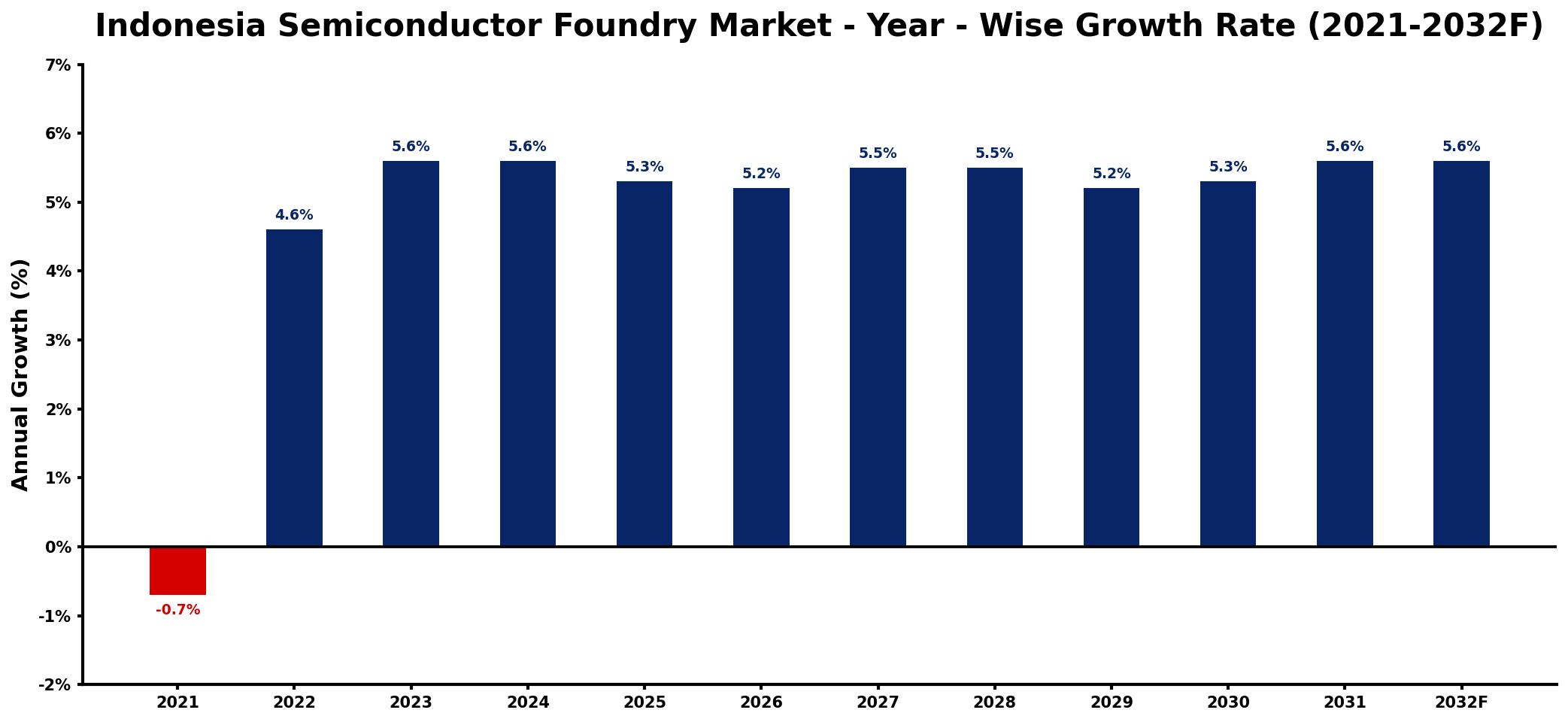
The table below presents the year‑wise growth rates along with the key drivers influencing the market
| Year | Growth Rate | Major Drivers |
| 2021 | -0.7% | Global supply chain disruptions impact |
| 2022 | 4.6% | Increased demand for electronic devices |
| 2023 | 5.6% | Expansion of 5G infrastructure projects |
| 2024 | 5.6% | Rising adoption of AI technologies |
| 2025 | 5.3% | Growth in automotive electronics sector |
| 2026 | 5.2% | Surge in renewable energy applications |
| 2027 | 5.5% | Investment in smart manufacturing solutions |
| 2028 | 5.5% | Emergence of IoT connected devices |
| 2029 | 5.2% | Development of advanced packaging techniques |
| 2030 | 5.3% | Growing demand for consumer electronics |
| 2031 | 5.6% | growing regional consumption patterns |
| 2032 | 5.6% | Increase in mobile device production |
Note: Market size estimations and growth projections presented in this report are based on 6Wresearch's proprietary forecasting methodology, utilizing the latest available industry data, government publications, and primary research inputs.
Indonesia Semiconductor Foundry Market Synopsis
Recent momentum in the Indonesia Semiconductor Foundry Market signals a notable shift towards increased local production capacity. As manufacturers set up shop to cater to the rising demand for electronics, the sector is poised for substantial growth and innovation. This development reflects Indonesia's broader ambitions to fortify its semiconductor landscape while simultaneously reducing its reliance on international imports.
As the market matures, the push for advanced technology and skilled labor will shape the competitive landscape. The growing need for semiconductors in industries such as automotive and industrial automation underscores the market's potential to thrive. These dynamics present a unique opportunity for both domestic and foreign investors to capitalize on Indonesia's strategic position in the global semiconductor ecosystem.
Indonesia Semiconductor Foundry Market Key Takeaways
- The market is experiencing a steady increase in demand for semiconductors driven by various sectors, including automotive and consumer electronics.
- Government initiatives are crucial in enhancing investment opportunities and establishing favorable policies for foundry development.
- The growing emphasis on reducing import dependency is reshaping the semiconductor manufacturing landscape in Indonesia.
- Technology advancements and a skilled workforce are essential components for sustaining growth in this competitive market.
- Global economic conditions and supply chain stability will continue to influence market performance significantly.
Evaluation of Restraints in Indonesia Semiconductor Foundry Market
While the Indonesia Semiconductor Foundry Market shows promise, it faces a unique set of constraints that could hinder its growth trajectory. A significant reliance on evolving technology means that manufacturers must continually adapt to maintain competitiveness. Additionally, the challenge of cultivating a skilled workforce is pressing, as the current pool may not meet the industry's rapid advancements. Furthermore, securing a reliable supply of raw materials is critical, especially considering global fluctuations and geopolitical factors that could disrupt supply chains. These issues underscore the necessity for strategic planning and investment to ensure long-term sustainability in the market.
Indonesia Semiconductor Foundry Market Trends
Several trends are currently shaping the Indonesia Semiconductor Foundry Market. Notably, the push for automation and the Internet of Things (IoT) is driving demand for more sophisticated semiconductor solutions. Additionally, the trend towards sustainability is influencing manufacturing practices, prompting foundries to adopt greener technologies. There's also an increasing collaboration between industry stakeholders to foster innovation, including joint ventures and partnerships focused on research and development. These trends collectively enhance the growth potential of the market, laying the groundwork for a more resilient future.
Indonesia Semiconductor Foundry Market Opportunities
Opportunities within the Indonesia Semiconductor Foundry Market are ripe for exploration. The governments focus on enhancing infrastructure and attracting foreign investments creates a conducive environment for new entrants and existing players. Moreover, sectors such as automotive, consumer electronics, and industrial automation are projected to drive significant growth in semiconductor demand. Investing in advanced manufacturing technologies and fostering local talent will be essential for companies looking to capitalize on this burgeoning market. With the right approach, there is potential for substantial returns as the landscape continues to evolve.
Government Initiatives in the Indonesia Semiconductor Foundry Market
The Indonesian government has actively pursued policies aimed at bolstering the semiconductor industry. Initiatives include tax incentives, infrastructure investments, and support for research and development in semiconductor technology. These measures are designed to create a robust ecosystem for semiconductor manufacturing, fostering partnerships between the government and private sectors. By promoting investment in the semiconductor space, Indonesia aims to position itself as a key player in the regional and global electronics manufacturing landscape.
Future Insights of the Indonesia Semiconductor Foundry Market
Looking ahead to the period from 2026 to 2032, the Indonesia Semiconductor Foundry Market is expected to continue its upward momentum. Factors such as increasing local demand for high-tech electronics and supportive government policies are likely to drive further investments in foundries. The market's growth will also be influenced by the pace of technological innovation, as companies strive to remain competitive in an increasingly globalized environment. By addressing existing challenges and leveraging opportunities for growth, Indonesia's semiconductor sector could emerge as a formidable player on the international stage.
Indonesia Semiconductor Foundry Market Latest Developments (2025 - 2026)
In recent months, the Indonesia Semiconductor Foundry Market has seen a surge in activity as various industry stakeholders explore opportunities for growth and collaboration. New partnerships are being formed to enhance research and development capabilities, while existing foundries are investing in advanced manufacturing technologies to improve efficiency and output. As companies focus on scaling operations, the landscape is poised for significant changes that will shape the future of semiconductor manufacturing in the country.
Indonesia Semiconductor Foundry Market - Key Attractiveness of the Report
- 10 Years of Market Numbers
- Historical Data Starting from 2022 to 2025
- Base Year: 2025
- Forecast Data until 2032
- Key Performance Indicators Impacting the Market
- Major Upcoming Developments and Projects
Key Highlights of the Report:
- Indonesia Semiconductor Foundry Market Outlook
- Market Size of Indonesia Semiconductor Foundry Market, 2025
- Forecast of Indonesia Semiconductor Foundry Market, 2032
- Historical Data and Forecast of Indonesia Semiconductor Foundry Revenues & Volume for the Period 2022-2032F
- Indonesia Semiconductor Foundry Market Trend Evolution
- Indonesia Semiconductor Foundry Market Drivers and Challenges
- Indonesia Semiconductor Foundry Price Trends
- Indonesia Semiconductor Foundry Porter's Five Forces
- Indonesia Semiconductor Foundry Industry Life Cycle
- Historical Data and Forecast of Indonesia Semiconductor Foundry Market Revenues & Volume By Technology Node for the Period 2022-2032F
- Historical Data and Forecast of Indonesia Semiconductor Foundry Market Revenues & Volume By 10/7/5 nm for the Period 2022-2032F
- Historical Data and Forecast of Indonesia Semiconductor Foundry Market Revenues & Volume By 16/14 nm for the Period 2022-2032F
- Historical Data and Forecast of Indonesia Semiconductor Foundry Market Revenues & Volume By 20 nm for the Period 2022-2032F
- Historical Data and Forecast of Indonesia Semiconductor Foundry Market Revenues & Volume By 28 nm for the Period 2022-2032F
- Historical Data and Forecast of Indonesia Semiconductor Foundry Market Revenues & Volume By 45/40 nm for the Period 2022-2032F
- Historical Data and Forecast of Indonesia Semiconductor Foundry Market Revenues & Volume By 65 nm for the Period 2022-2032F
- Historical Data and Forecast of Indonesia Semiconductor Foundry Market Revenues & Volume By Other for the Period 2022-2032F
- Historical Data and Forecast of Indonesia Semiconductor Foundry Market Revenues & Volume By Application for the Period 2022-2032F
- Historical Data and Forecast of Indonesia Semiconductor Foundry Market Revenues & Volume By Consumer Electronics and Communication for the Period 2022-2032F
- Historical Data and Forecast of Indonesia Semiconductor Foundry Market Revenues & Volume By Automotive for the Period 2022-2032F
- Historical Data and Forecast of Indonesia Semiconductor Foundry Market Revenues & Volume By Industrial for the Period 2022-2032F
- Historical Data and Forecast of Indonesia Semiconductor Foundry Market Revenues & Volume By HPC for the Period 2022-2032F
- Historical Data and Forecast of Indonesia Semiconductor Foundry Market Revenues & Volume By Other Applications for the Period 2022-2032F
- Indonesia Semiconductor Foundry Import Export Trade Statistics
- Market Opportunity Assessment By Technology Node
- Market Opportunity Assessment By Application
- Indonesia Semiconductor Foundry Top Companies Market Share
- Indonesia Semiconductor Foundry Competitive Benchmarking By Technical and Operational Parameters
- Indonesia Semiconductor Foundry Company Profiles
- Indonesia Semiconductor Foundry Key Strategic Recommendations






































