Indonesia Stainless Steel Market: Import Trend Analysis
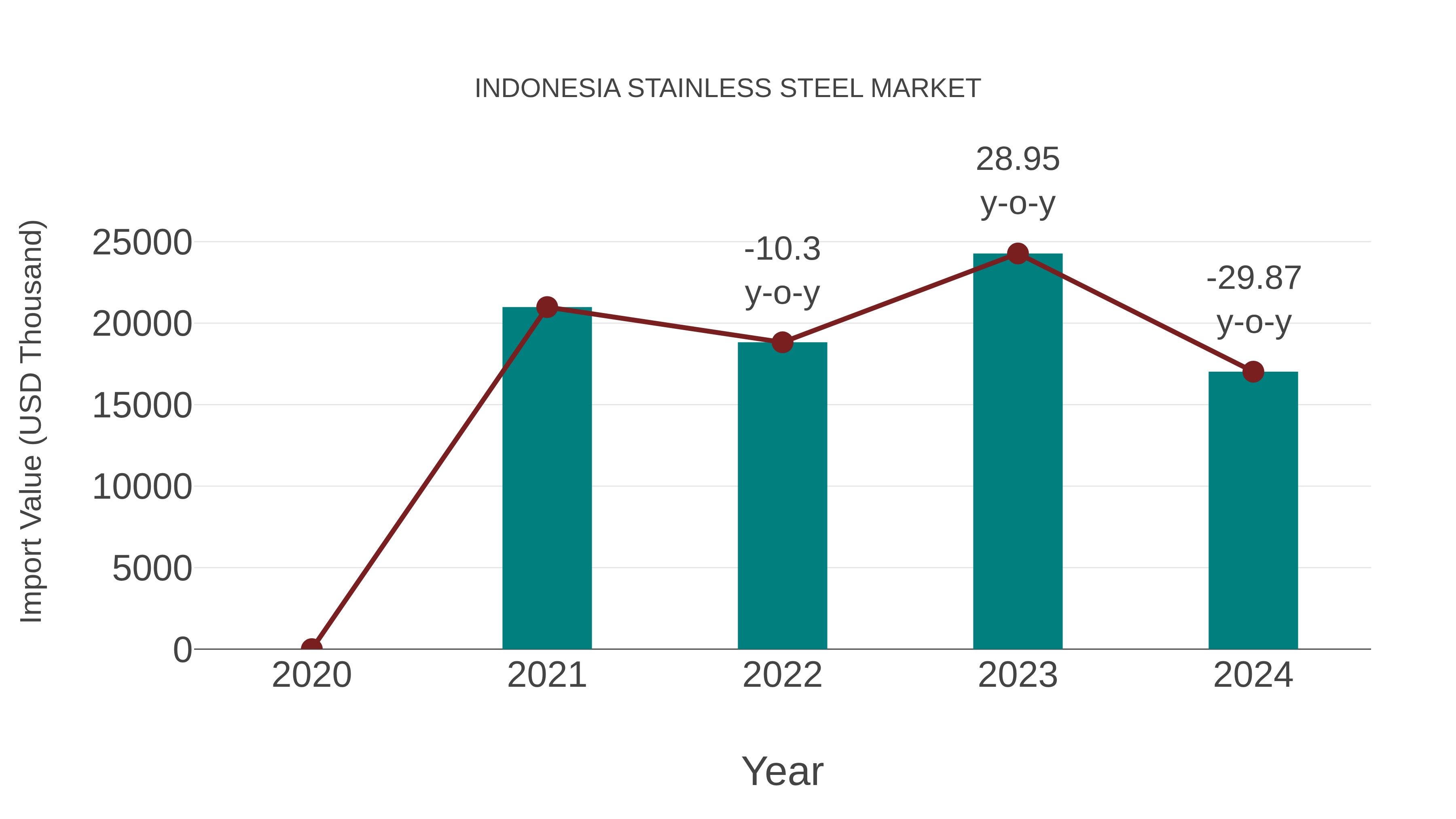
Indonesia`s stainless steel market witnessed a notable decline in import momentum from 2023 to 2024, with a growth rate of -29.87%. The compound annual growth rate (CAGR) for the period 2020-2024 stood at -6.74%. This downward trend could be attributed to shifting demand dynamics, possibly influenced by changing trade policies or market conditions.
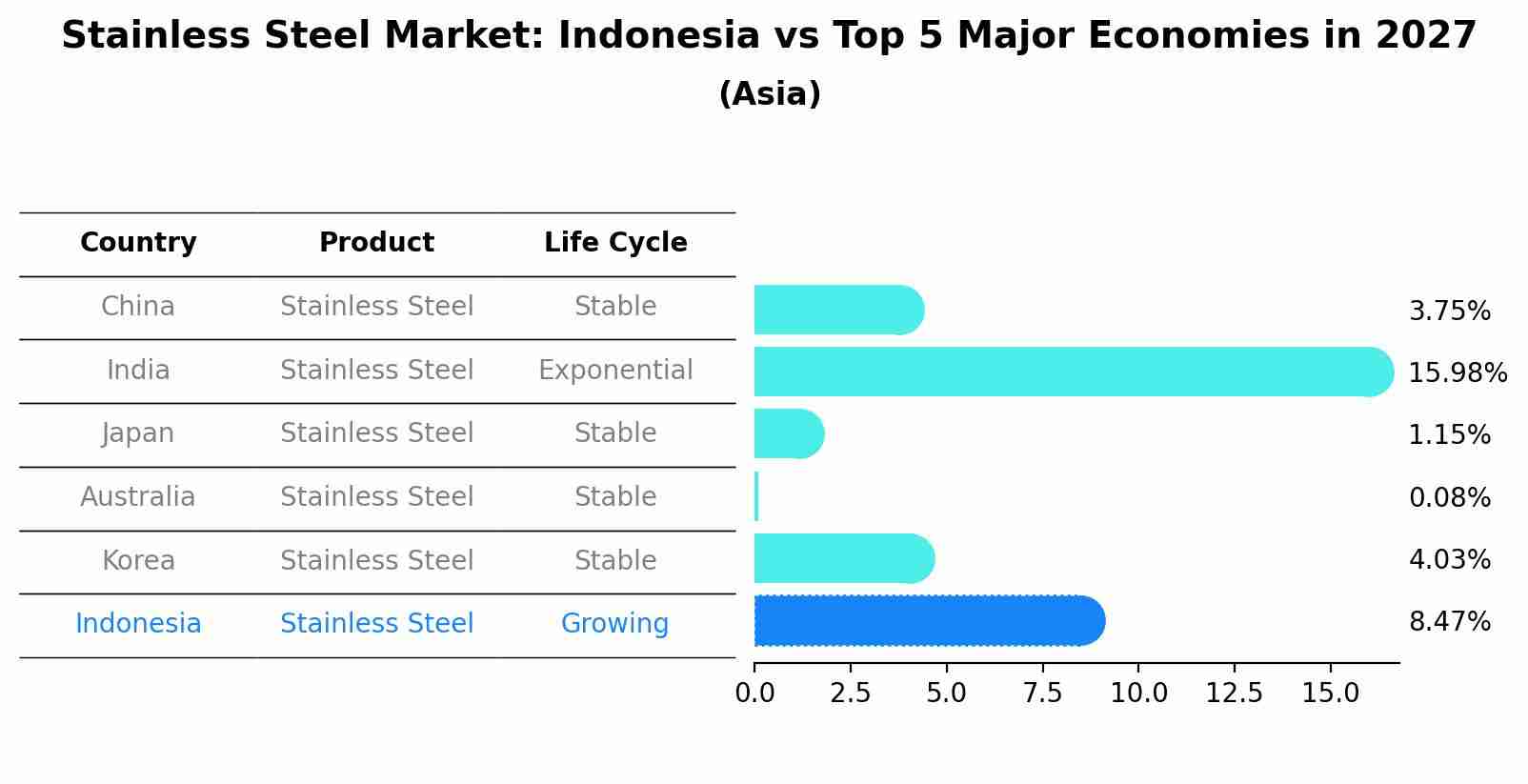
Stainless Steel Market: Indonesia vs Top 5 Major Economies in 2027 (Asia)
In the Asia region, the Stainless Steel market in Indonesia is projected to expand at a growing growth rate of 8.47% by 2027. The largest economy is China, followed by India, Japan, Australia and South Korea.
Indonesia Stainless Steel Market Growth Rate
According to 6Wresearch internal database and industry insights, the Indonesia Stainless Steel Market is projected to grow at a compound annual growth rate (CAGR) of 7.2% during the forecast period from 2026 to 2032.
Topics Covered in the Indonesia Stainless Steel Market Report
The Indonesia Stainless Steel Market report thoroughly covers the market by product, application, and end user. It provides an unbiased and detailed analysis of ongoing market trends, opportunities, challenges, and market drivers, helping stakeholders align their strategies with current and future market dynamics.
Indonesia Stainless Steel Market Highlights
| Report Name | Indonesia Stainless Steel Market |
| Forecast Period | 2026–2032 |
| CAGR | 7.2% |
| Growing Sector | Metals and Mining |
Indonesia Stainless Steel Market Synopsis
Indonesia Stainless Steel Market is expected to witness massive growth as it is driven by the country status as the world largest nickel producer and the government aggressive "downstreaming" policy, which mandates domestic processing of raw ores. The market is also fuelled by rapid urbanization, the construction of the new national capital (IKN), and a burgeoning automotive sector. With growing demand for durable, corrosion-resistant materials in the oil and gas and food processing sectors, the market is expected to have a steady expansion.
Evaluation of Growth Drivers in Indonesia Stainless Steel Market
Below mentioned are some prominent drivers and their impact on Indonesia Stainless Steel Market dynamics:
| Drivers | Primary Segment Affected | Why It Matters (Evidence) |
| Mineral Downstreaming Policy | All Segments | Mandating domestic processing of nickel ore has turned Indonesia into a global hub for low-cost, high-quality stainless steel production. |
| Infrastructure Modernization | Flat, Long Products | Large-scale projects like the North-South Railway and new bridges increase the consumption of structural stainless steel. |
| Automotive Industry Expansion | Exhaust Systems | Indonesia desire to become a regional automotive hub drives up the demand for stainless steel in exhaust and engine components. |
| Urbanization and Lifestyle | Consumer Goods | The growing urban population is opting for modern kitchenware and appliances, which predominantly use stainless steel for longevity. |
| Energy Sector Diversification | Oil & Gas | The expansion of a refinery and petrochemical production facility will require the use of high-performance alloys to withstand harsh chemical environments. |
Indonesia Stainless Steel Market is projected to grow at a CAGR of 7.2% from 2026 to 2032. The stainless steel market in Indonesia stands on fast industrialization in capital segments like automotive, oil & gas, and consumer goods. Food and beverage production is the biggest growth driver for stainless steel with the industry's concern that stainless steel is non-reactive. Infrastructure expansion projects further increase demand for stainless steel components that can withstand the durability of modern structural buildings. Also, technological advancements need to focus on increasing stainless steel manufacturing efficiency and cost reduction. The rise of export opportunities also contributes to the overall Indonesia Stainless Steel Market Growth.
Evaluation of Restraints in Indonesia Stainless Steel Market
Below mentioned are some major restraints and their influence on Indonesia Stainless Steel Market dynamics:
| Restraints | Primary Segment Affected | What This Means (Evidence) |
| Volatile Raw Material Prices | All Segments | Fluctuations in the global prices of chromium and nickel can impact the production costs and final pricing of stainless steel. |
| Environmental Regulations | Production/Smelting | Strict carbon emission standards for heavy industries may increase operational costs for traditional smelting plants. |
| High Energy Dependency | All Segments | The energy-intensive nature of stainless steel manufacturing makes the industry vulnerable to changes in electricity and fuel prices. |
| Global Trade Barriers | Export Market | Anti-dumping duties imposed by certain western nations on Indonesian steel can limit the growth of the export-oriented segment. |
Indonesia Stainless Steel Market Challenges
The Indonesia stainless steel market is hindered in such a way that the raw material prices vary, especially when it comes to nickel procurement major input in the stainless steel production process. These price fluctuations directly affect the profit margins of manufacturers. On the other hand, there is an increasing challenge to import steel products against domestic players. Another barrier would be adhering to strict environmental regulations concerning stainless steel production, which requires heavy investments in green production systems. If the consumers are unaware of the cost-effectiveness and sustainability of stainless steel in the long run, then they may consider rejection in the cost-sensitive industry.
Emerging Trends in the Indonesia Stainless Steel Market
An unprecedented shift in trends in the Indonesia stainless steel market is occurring with a distinct burgeoning demand for specialty products such as high-quality polished finishes for luxurious applications or surgical instruments for the healthcare sector. Industries now increasingly hold custom solutions in higher regard, which has consequently propelled the demand for stainless steel products tailored to the needs of end-users. Advanced grades of stainless steel are now being used in the automotive sector for designs that are light in weight and, thus, gait toward fuel efficiency. Besides, in recent times, the emergence of renewable energy projects has placed much importance on stainless steel and stainless steel infrastructure, such as that for solar panels and wind turbines.
Investment Opportunities in the Indonesia Stainless Steel Market
Indonesia Stainless Steel Industry investment opportunities span widely, like implementing automation and advanced manufacturing techniques for productivity and quality improvement. Opportunities for strategic investment exist in stainless steel applications for use in various industries, including renewable energy, health, and infrastructure. The development of a green facility could offer mutually beneficial applications for the long-term concerning the demand for sustainable materials. Furthermore, export-marketing investment, particularly targeting the neighboring region of ASEAN, can utilize free trade agreements in conjunction with Indonesia's cost-competitive production base.
Top 5 Leading Players in the Indonesia Stainless Steel Market
Below is a list of prominent companies leading in the Indonesia Stainless Steel Market:
1. Sutindo Raya Mulia
| Company Name | Sutindo Raya Mulia |
|---|---|
| Established Year | 1997 |
| Headquarters | Surabaya, East Java, Indonesia |
| Official Website | Click Here |
A major Indonesian stainless steel supplier and distributor with a nationwide network, offering stainless steel bars, plates, sheets, coils, and fittings for industrial sectors such as oil & gas, petrochemical, and commercial applications.
2. PT Gunung Raja Paksi Tbk
| Company Name | PT Gunung Raja Paksi Tbk |
|---|---|
| Established Year | 1970 |
| Headquarters | Bekasi, West Java |
| Official Website | Click Here |
One of the largest private steel companies in Indonesia, they provide a wide range of steel products and are increasingly focusing on high-quality stainless steel for infrastructure.
3. PT Krakatau Steel Tbk
| Company Name | PT Krakatau Steel Tbk |
|---|---|
| Established Year | 1970 |
| Headquarters | Cilegon, Banten |
| Official Website | Click Here |
As a state-owned enterprise, they are a cornerstone of the Indonesian steel industry, focusing on diverse steel products including specialty alloys for industrial use.
4. PT Global Inti Steel
| Company Name | PT Global Inti Steel |
|---|---|
| Established Year | 2006 |
| Headquarters | Jakarta, Indonesia |
| Official Website | Click Here |
A leading distributor, supplier, and stockist of stainless steel materials serving manufacturers, contractors, and workshops across Indonesia with a broad inventory of stainless steel products.
5. PT Jindal Stainless
| Company Name | PT Jindal Stainless |
|---|---|
| Established Year | 2004 |
| Headquarters | Gresik, East Java |
| Official Website | Click Here |
A subsidiary of the global Jindal Stainless group, they specialize in cold-rolled stainless steel products, catering to the automotive and consumer goods sectors in Indonesia.
Government Regulations Introduced in the Indonesia Stainless Steel Market
The Indonesian administration has come up with several policies to be adopted for fostering the stainless steel industry. One of them is the Ministry of Industry "Making Indonesia 4.0" initiative, which, besides enabling the use of the most modern technologies in the production sector through the technology called “smart factory”, also allows the implementation of automation to increase efficiency. Subsidies for manufacturing are also available through the Investment Coordinating Board (BKPM). Moreover, the restrictions imposed on the import of low-quality steel are used as a tool to create a space for local players to get a market share.
Future Insights of the Indonesia Stainless Steel Market
Indonesia Stainless Steel Market Share is expected to experience a strong growth in the upcoming years with the help of the completed transition of the new capital city and the maturity of the domestic EV ecosystem. Moreover, Indonesia is also expected to become a leading manufacturer of finished products made from stainless steel rather than simply manufacturing intermediate products. Green and recyclable materials are becoming increasingly popular in an ecologically conscious market, ensuring demand. Newer industrial technology, such as AI-powered quality control and precise cutting, will boost output and stimulate domestic manufacturing. The growth in exports within ASEAN and beyond will promote Indonesia as the global stainless steel production hub.
Market Segmentation Analysis
The report offers a comprehensive study of the following market segments and their leading categories:
By Product - Flat Products to dominate the market
According to Ekta Gupta, Senior Research Analyst, 6Wresearch, Flat products (sheets, coils, and plates) are expected to dominate the market share. This is attributed to their extensive use in the manufacturing of household appliances, storage tanks for the food and chemical industries, and decorative panels in the construction sector.
By Application - Exhaust Systems to dominate the market
Exhaust systems represent a dominant application segment due to the massive volume of automotive production in Indonesia. Stainless steel’s ability to withstand high temperatures and prevent oxidation makes it the standard material for both two-wheeler and four-wheeler exhaust assemblies, a sector that is seeing consistent year-on-year growth.
By End User - Consumer Goods to dominate the market
Consumer goods lead the end-user segment. As household income levels rise in the Philippines and Indonesia, there is a marked increase in the purchase of stainless steel kitchenware, sinks, and white goods.
Key Attractiveness of the Report
- 10 Years of Market Numbers
- Historical Data Starting from 2022 to 2025
- Base Year: 2025
- Forecast Data until 2032
- Key Performance Indicators Impacting the Market
- Major Upcoming Developments and Projects
Key Highlights of the Report:
- Indonesia Stainless Steel Market Outlook
- Market Size of Indonesia Stainless Steel Market, 2025
- Forecast of Indonesia Stainless Steel Market, 2032
- Historical Data and Forecast of Indonesia Stainless Steel Revenues & Volume for the Period 2022-2032F
- Indonesia Stainless Steel Market Trend Evolution
- Indonesia Stainless Steel Market Drivers and Challenges
- Indonesia Stainless Steel Price Trends
- Indonesia Stainless Steel Porter's Five Forces
- Indonesia Stainless Steel Industry Life Cycle
- Historical Data and Forecast of Indonesia Stainless Steel Market Revenues & Volume By Product for the Period 2022-2032F
- Historical Data and Forecast of Indonesia Stainless Steel Market Revenues & Volume By Long for the Period 2022-2032F
- Historical Data and Forecast of Indonesia Stainless Steel Market Revenues & Volume By Flat for the Period 2022-2032F
- Historical Data and Forecast of Indonesia Stainless Steel Market Revenues & Volume By Application for the Period 2022-2032F
- Historical Data and Forecast of Indonesia Stainless Steel Market Revenues & Volume By Polish finishing for the Period 2022-2032F
- Historical Data and Forecast of Indonesia Stainless Steel Market Revenues & Volume By Exhaust system for the Period 2022-2032F
- Historical Data and Forecast of Indonesia Stainless Steel Market Revenues & Volume By Surgical instrument for the Period 2022-2032F
- Historical Data and Forecast of Indonesia Stainless Steel Market Revenues & Volume By Others for the Period 2022-2032F
- Historical Data and Forecast of Indonesia Stainless Steel Market Revenues & Volume By End User for the Period 2022-2032F
- Historical Data and Forecast of Indonesia Stainless Steel Market Revenues & Volume By Consumer goods for the Period 2022-2032F
- Historical Data and Forecast of Indonesia Stainless Steel Market Revenues & Volume By Automotive for the Period 2022-2032F
- Historical Data and Forecast of Indonesia Stainless Steel Market Revenues & Volume By Food & beverage for the Period 2022-2032F
- Historical Data and Forecast of Indonesia Stainless Steel Market Revenues & Volume By Oil & gas for the Period 2022-2032F
- Historical Data and Forecast of Indonesia Stainless Steel Market Revenues & Volume By Others for the Period 2022-2032F
- Indonesia Stainless Steel Import Export Trade Statistics
- Market Opportunity Assessment By Product
- Market Opportunity Assessment By Application
- Market Opportunity Assessment By End User
- Indonesia Stainless Steel Top Companies Market Share
- Indonesia Stainless Steel Competitive Benchmarking By Technical and Operational Parameters
- Indonesia Stainless Steel Company Profiles
- Indonesia Stainless Steel Key Strategic Recommendations
Markets Covered
The report offers a comprehensive study of the subsequentmarket segments:
By Product:
- Long
- Flat
By Application:
- Polish Finishing
- Exhaust System
- Surgical Instrument
- Others
By End User:
- Consumer Goods
- Automotive
- Food & Beverage
- Oil & Gas
- Others






































