Indonesia Sugar Mill Machinery Market Size, Share & Growth Rate
The Indonesia Sugar Mill Machinery Market was estimated at USD 488 Million in 2025 and is projected to reach USD 644 Million by 2032, growing at a CAGR of 4.0% from 2026 to 2032. This steady trajectory can be attributed to the increasing domestic consumption of sugar as well as favorable export conditions. As Indonesian sugar mills modernize and adapt to technological advancements, the efficiency and output of sugar production are set to improve significantly, fueling further investment in machinery.
Indonesia Sugar Mill Machinery Market Year-wise Growth Rate and Key Drivers
This graph highlights how the Indonesia Sugar Mill Machinery Market has steadily grown over the years, supported by major growth factors.
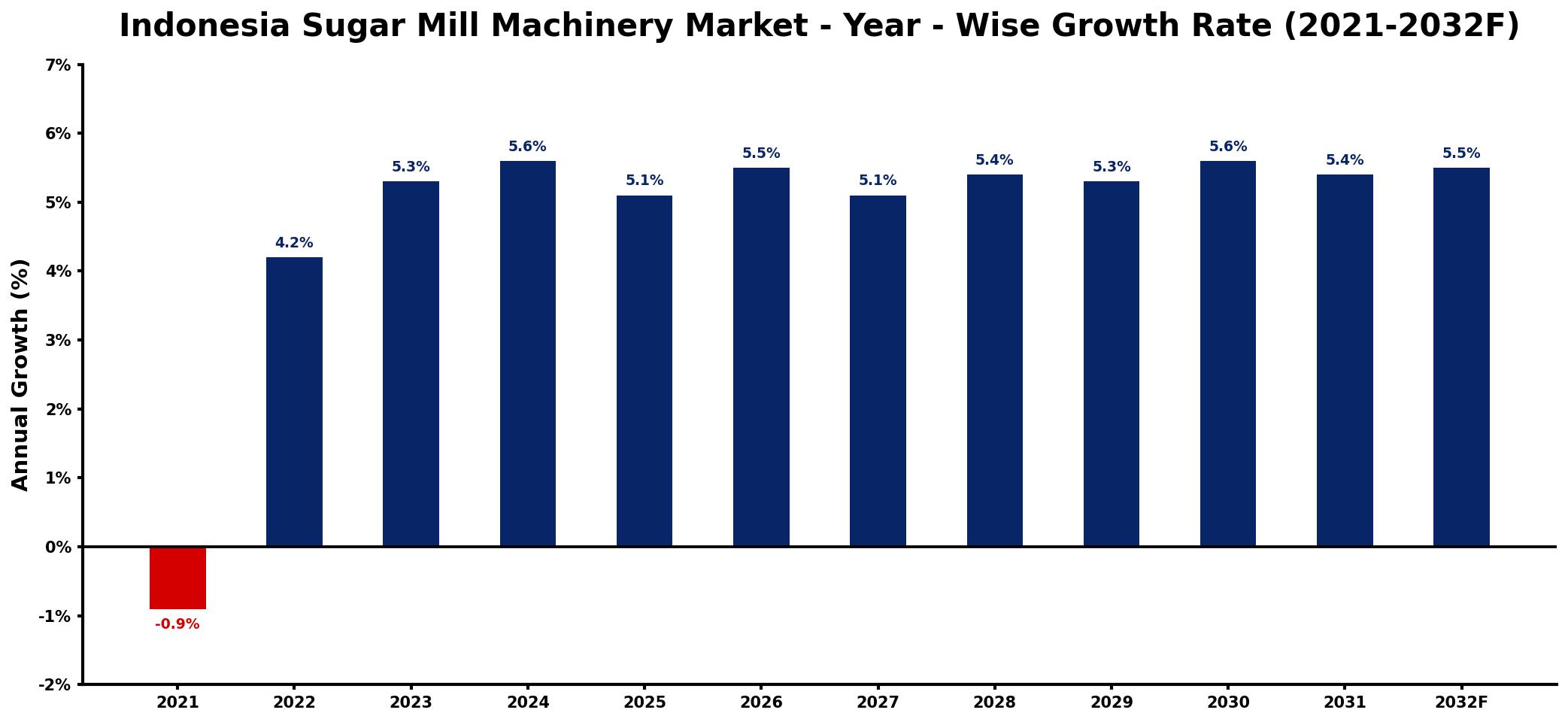
The table below presents the year‑wise growth rates along with the key drivers influencing the market
| Year | Growth Rate | Major Drivers |
| 2021 | -0.9% | decrease in agricultural investments |
| 2022 | 4.2% | rising demand for sustainable practices |
| 2023 | 5.3% | increased government subsidies announced |
| 2024 | 5.6% | expansion of export markets identified |
| 2025 | 5.1% | higher production efficiency initiatives |
| 2026 | 5.5% | growing interest in automation technology |
| 2027 | 5.1% | enhanced focus on renewable resources |
| 2028 | 5.4% | surge in local consumption rates |
| 2029 | 5.3% | improvements in supply chain logistics |
| 2030 | 5.6% | development of innovative processing techniques |
| 2031 | 5.4% | strengthening of industry partnerships formed |
| 2032 | 5.5% | increased foreign direct investments attracted |
Note: Market size estimations and growth projections presented in this report are based on 6Wresearch's proprietary forecasting methodology, utilizing the latest available industry data, government publications, and primary research inputs.
Indonesia Sugar Mill Machinery Market Synopsis
Currently, Indonesia is experiencing a significant upswing in its sugar production capabilities, driven by both domestic and international demand. This surge has led to a corresponding need for advanced sugar mill machinery that can meet the efficiency and capacity requirements of modern production processes.
The sugar mill machinery sector encompasses a wide array of equipment essential for the processing of sugar cane into raw sugar. Recent advancements in technology, particularly automation, are proving crucial in enhancing production efficiency and reducing operational costs, thereby solidifying the market's growth potential.
Indonesia Sugar Mill Machinery Market Key Takeaways
- The market is poised for substantial growth due to rising sugar consumption and modernization efforts in production facilities.
- Technological innovations, particularly automation, are driving efficiency and reducing costs within the sector.
- Investment in R&D is crucial for the continuous upgrade of machinery and adapting to market demands.
- The growing sugar export market is a significant factor influencing machinery demand.
- Environmental considerations and compliance with regulations are becoming increasingly relevant in machinery upgrades.
Evaluation of Restraints in Indonesia Sugar Mill Machinery Market
While the market outlook remains positive, several restraints could hinder growth. The modernization of existing machinery to improve efficiency presents challenges, especially for smaller operators with limited capital. Furthermore, environmental regulations surrounding sugar production are becoming stricter, necessitating investments in sustainable practices and technology. Market fluctuations in sugar prices can also affect investment levels, leading to uncertainty for machinery manufacturers and investors alike.
Indonesia Sugar Mill Machinery Market Trends
The trend towards automation and smart technology in the Indonesia Sugar Mill Machinery Market is notably gaining traction. Equipment that integrates advanced data analytics and monitoring capabilities is becoming increasingly common, helping producers optimize their operations. Additionally, the push for sustainability is driving manufacturers to develop eco-friendly machinery solutions that minimize waste and energy consumption.
Indonesia Sugar Mill Machinery Market Opportunities
There are robust opportunities within the Indonesia Sugar Mill Machinery Market, particularly for companies focusing on innovative and energy-efficient machinery. The governments support for boosting domestic sugar production and the rising trend of export-oriented production provides an avenue for investment and growth. Furthermore, collaborations with research institutions for technology development could enhance product offerings and market competitiveness.
Government Initiatives in the Indonesia Sugar Mill Machinery Market
The Indonesian government is actively promoting initiatives aimed at enhancing the domestic sugar production landscape. Programs designed to improve agricultural practices and encourage mechanization in sugar mills are gaining momentum. In addition, public spending on infrastructure related to sugar production and processing is expected to rise, further supporting the demand for advanced sugar mill machinery.
Future Insights of the Indonesia Sugar Mill Machinery Market
Looking ahead to 2026-2032, the Indonesia Sugar Mill Machinery Market is projected to continue its upward trajectory, driven by increasing investments and advancements in technology. The ongoing modernization of sugar mills will require machinery that not only enhances output but also aligns with sustainability goals. As the market evolves, businesses that can adapt to changing consumer preferences and regulatory landscapes will be best positioned to thrive.
Indonesia Sugar Mill Machinery Market Latest Developments (2025 - 2026)
Recent developments in the Indonesia Sugar Mill Machinery Market indicate a heightened focus on smart technology integration. Manufacturers are increasingly unveiling products that leverage IoT and AI to enhance processing efficiency. Additionally, sustainability initiatives are driving companies to develop machinery that meets environmental standards, thereby responding to regulatory pressures and market demands.
Indonesia Sugar Mill Machinery Market - Key Attractiveness of the Report
- 10 Years of Market Numbers
- Historical Data Starting from 2022 to 2025
- Base Year: 2025
- Forecast Data until 2032
- Key Performance Indicators Impacting the Market
- Major Upcoming Developments and Projects
Key Highlights of the Report:
- Indonesia Sugar Mill Machinery Market Outlook
- Market Size of Indonesia Sugar Mill Machinery Market, 2025
- Forecast of Indonesia Sugar Mill Machinery Market, 2032
- Historical Data and Forecast of Indonesia Sugar Mill Machinery Revenues & Volume for the Period 2022-2032F
- Indonesia Sugar Mill Machinery Market Trend Evolution
- Indonesia Sugar Mill Machinery Market Drivers and Challenges
- Indonesia Sugar Mill Machinery Price Trends
- Indonesia Sugar Mill Machinery Porter's Five Forces
- Indonesia Sugar Mill Machinery Industry Life Cycle
- Historical Data and Forecast of Indonesia Sugar Mill Machinery Market Revenues & Volume By Machinery Type for the Period 2022-2032F
- Historical Data and Forecast of Indonesia Sugar Mill Machinery Market Revenues & Volume By Cane Handling Equipment for the Period 2022-2032F
- Historical Data and Forecast of Indonesia Sugar Mill Machinery Market Revenues & Volume By Cutting & Grinding Equipment for the Period 2022-2032F
- Historical Data and Forecast of Indonesia Sugar Mill Machinery Market Revenues & Volume By Processing Equipment for the Period 2022-2032F
- Historical Data and Forecast of Indonesia Sugar Mill Machinery Market Revenues & Volume By Packaging Equipment for the Period 2022-2032F
- Historical Data and Forecast of Indonesia Sugar Mill Machinery Market Revenues & Volume By Refineries Type for the Period 2022-2032F
- Historical Data and Forecast of Indonesia Sugar Mill Machinery Market Revenues & Volume By Front End Refineries for the Period 2022-2032F
- Historical Data and Forecast of Indonesia Sugar Mill Machinery Market Revenues & Volume By Back End Refineries for the Period 2022-2032F
- Indonesia Sugar Mill Machinery Import Export Trade Statistics
- Market Opportunity Assessment By Machinery Type
- Market Opportunity Assessment By Refineries Type
- Indonesia Sugar Mill Machinery Top Companies Market Share
- Indonesia Sugar Mill Machinery Competitive Benchmarking By Technical and Operational Parameters
- Indonesia Sugar Mill Machinery Company Profiles
- Indonesia Sugar Mill Machinery Key Strategic Recommendations






































