Indonesia Timing Belt Market: Import Trend Analysis
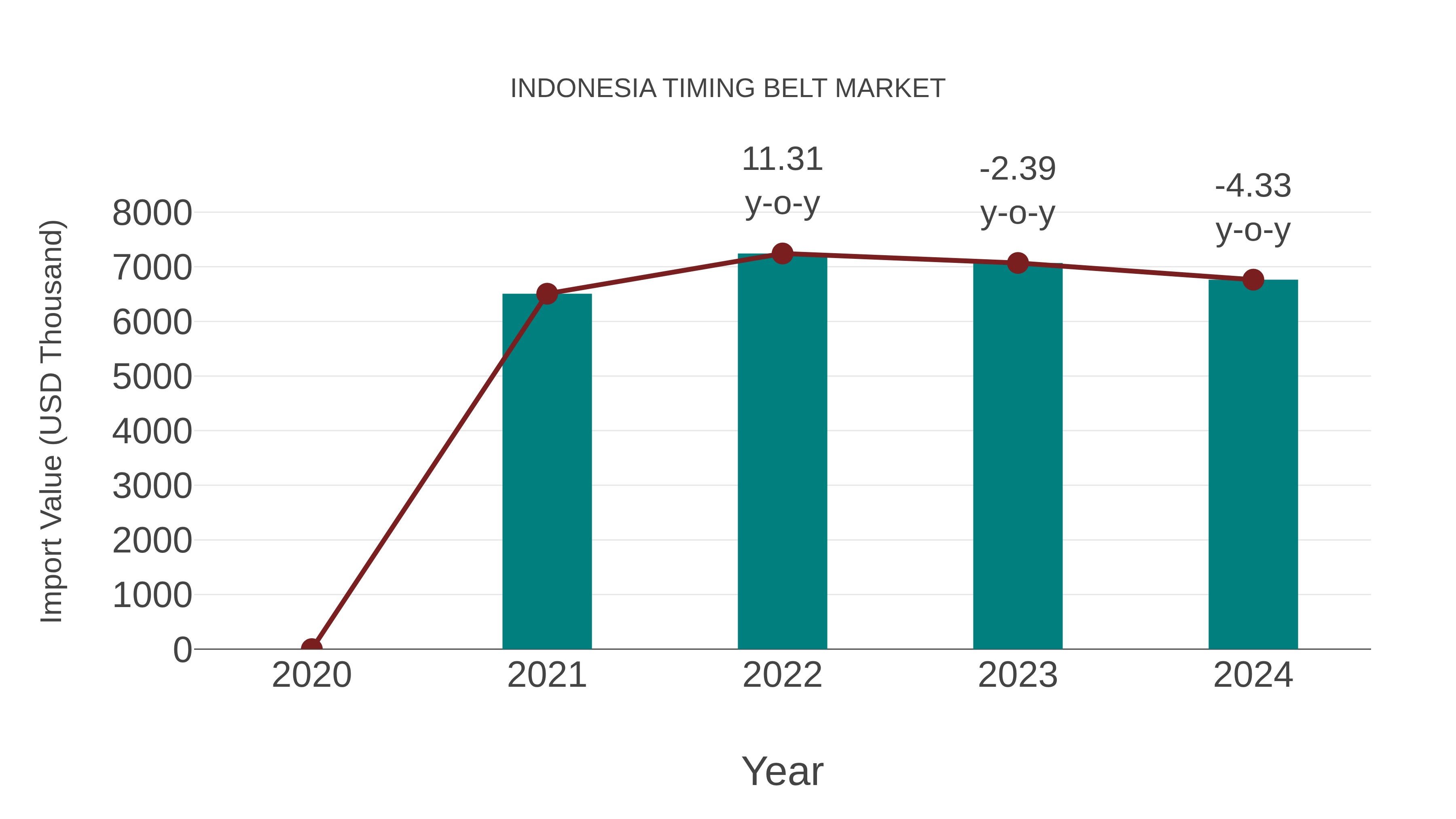
In the Indonesia timing belt market, the import trend showed a decline from 2023 to 2024, with a growth rate of -4.33%. The compound annual growth rate (CAGR) for imports from 2020 to 2024 was 1.3%. This negative momentum in import growth could be attributed to shifts in demand patterns or changes in trade policies impacting market stability.
Indonesia Timing Belt Market Overview
Timing belts are a critical component in the precise synchronization of an engine`s moving parts. In Indonesia, the timing belt market is thriving, given the expanding automotive sector. As the country continues to experience growth in vehicle production and sales, the demand for reliable and high-quality timing belts remains strong.
Drivers of the Market
The Indonesia Timing Belt market is experiencing notable growth due to several key drivers. First and foremost, the robust expansion of the automotive sector in Indonesia is propelling demand for timing belts, as they are critical components of internal combustion engines. As more people in the country embrace car ownership, the timing belt market is poised to expand significantly. Furthermore, the automotive industry`s focus on fuel efficiency and reduced emissions drives the adoption of advanced engine technologies, which, in turn, require high-quality timing belts to ensure precise engine timing. Additionally, the rise of two-wheeler and small engine manufacturing in Indonesia contributes to the growth of the timing belt market, as these vehicles also rely on timing belts for proper engine operation. These factors collectively make timing belts a vital component in the Indonesian automotive industry`s pursuit of technological advancements and cleaner, more efficient vehicles.
Challenges of the Market
The Indonesia Timing Belt market is driven by the growth in the automotive industry and the demand for reliable power transmission solutions. A challenge in this market is the increasing competition from alternative technologies like timing chains. Timing belts require regular replacement, and some consumers may prefer the longevity of timing chains, posing a challenge for manufacturers and suppliers in the timing belt market.
COVID-19 Impacts on the Market
The timing belt market in Indonesia was affected by the pandemic as well. With vehicle sales and manufacturing down, the demand for timing belts decreased. Manufacturers encountered difficulties in sourcing materials and maintaining production levels.
Key Players of the Makret
Timing belt manufacturers, both local and international, play a significant role in Indonesia. Companies like Gates Corporation and Mitsuboshi Belting are known for their high-quality timing belts in the Indonesian market.
Key Highlights of the Report:
- Indonesia Timing Belt Market Outlook
- Market Size of Indonesia Timing Belt Market, 2025
- Forecast of Indonesia Timing Belt Market, 2032
- Historical Data and Forecast of Indonesia Timing Belt Revenues & Volume for the Period 2022-2032F
- Indonesia Timing Belt Market Trend Evolution
- Indonesia Timing Belt Market Drivers and Challenges
- Indonesia Timing Belt Price Trends
- Indonesia Timing Belt Porter's Five Forces
- Indonesia Timing Belt Industry Life Cycle
- Historical Data and Forecast of Indonesia Timing Belt Market Revenues & Volume By Drive Type for the Period 2022-2032F
- Historical Data and Forecast of Indonesia Timing Belt Market Revenues & Volume By Dry Belts for the Period 2022-2032F
- Historical Data and Forecast of Indonesia Timing Belt Market Revenues & Volume By Chain for the Period 2022-2032F
- Historical Data and Forecast of Indonesia Timing Belt Market Revenues & Volume By Belt in Oil for the Period 2022-2032F
- Historical Data and Forecast of Indonesia Timing Belt Market Revenues & Volume By Component for the Period 2022-2032F
- Historical Data and Forecast of Indonesia Timing Belt Market Revenues & Volume By Idler Pulley for the Period 2022-2032F
- Historical Data and Forecast of Indonesia Timing Belt Market Revenues & Volume By Sprocket for the Period 2022-2032F
- Historical Data and Forecast of Indonesia Timing Belt Market Revenues & Volume By Tensioner for the Period 2022-2032F
- Historical Data and Forecast of Indonesia Timing Belt Market Revenues & Volume By Timing Shield/Cover for the Period 2022-2032F
- Historical Data and Forecast of Indonesia Timing Belt Market Revenues & Volume By ICE & Hybrid for the Period 2022-2032F
- Historical Data and Forecast of Indonesia Timing Belt Market Revenues & Volume By Passenger Car for the Period 2022-2032F
- Historical Data and Forecast of Indonesia Timing Belt Market Revenues & Volume By Commercial Vehicle for the Period 2022-2032F
- Historical Data and Forecast of Indonesia Timing Belt Market Revenues & Volume By HEV for the Period 2022-2032F
- Historical Data and Forecast of Indonesia Timing Belt Market Revenues & Volume By PHEV for the Period 2022-2032F
- Indonesia Timing Belt Import Export Trade Statistics
- Market Opportunity Assessment By Drive Type
- Market Opportunity Assessment By Component
- Market Opportunity Assessment By ICE & Hybrid
- Indonesia Timing Belt Top Companies Market Share
- Indonesia Timing Belt Competitive Benchmarking By Technical and Operational Parameters
- Indonesia Timing Belt Company Profiles
- Indonesia Timing Belt Key Strategic Recommendations






































