Indonesia Tobacco Market: Import Trend Analysis
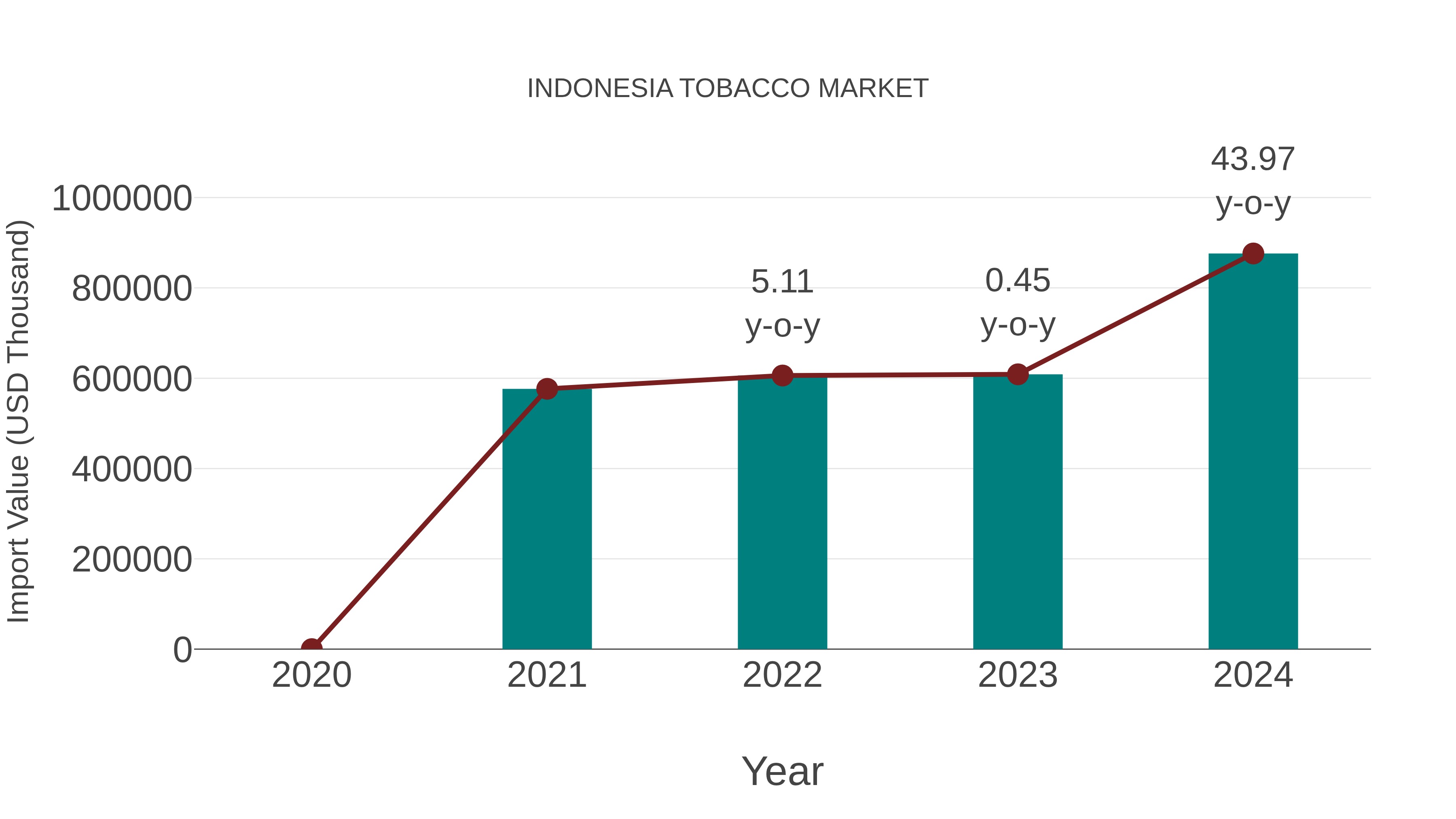
In the Indonesia tobacco market, the import trend experienced significant growth from 2023 to 2024, with a growth rate of 43.97%. The compound annual growth rate (CAGR) for imports between 2020 and 2024 stood at 14.98%. This import momentum can be attributed to shifting consumer preferences towards international tobacco products, indicating a potential increase in market demand or changes in trade policies during this period.
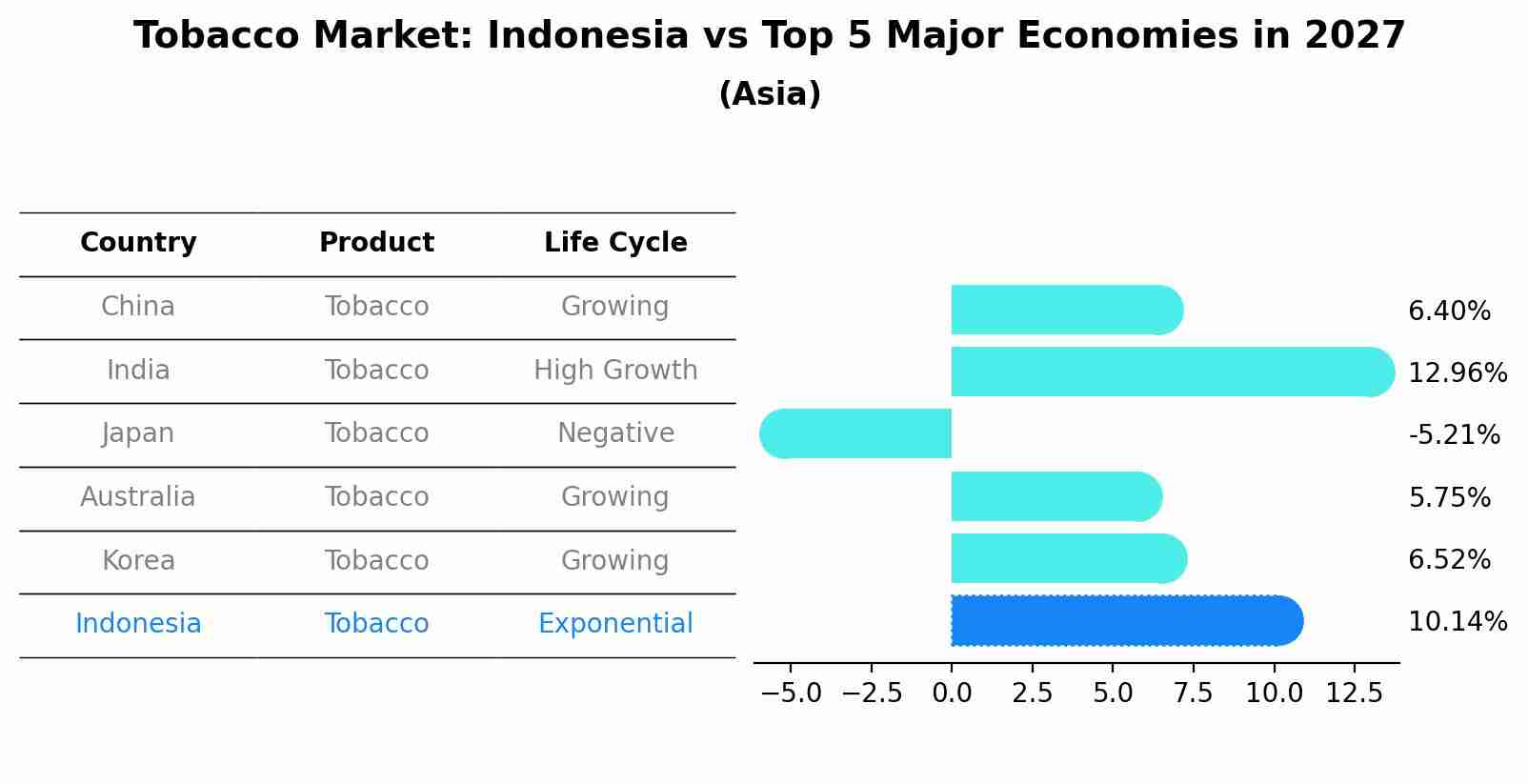
Tobacco Market: Indonesia vs Top 5 Major Economies in 2027 (Asia)
The Tobacco market in Indonesia is projected to grow at a high growth rate of 10.14% by 2027, within the Asia region led by China, along with other countries like India, Japan, Australia and South Korea, collectively shaping a dynamic and evolving market environment driven by innovation and increasing adoption of emerging technologies.
Indonesia Tobacco Market Growth
According to 6Wresearch internal database and industry insights
Topics Covered in the Indonesia Tobacco Market Report
The Indonesia Tobacco Market report thoroughly covers the market by product type and distribution channel. The report provides an unbiased and detailed analysis of ongoing market trends, high-growth areas, and market drivers, helping stakeholders align their strategies with current and future market dynamics.
Indonesia Tobacco Market Highlights
| Report Name | Indonesia Tobacco Market |
| Forecast Period | 2026–2032 |
| CAGR | 5.8% |
| Growing Sector | E-commerce |
Indonesia Tobacco Market Synopsis
The Indonesia Tobacco Market currently undergoes major changes. The market sustained robust demand due to Indonesia’s comparatively high smoking prevalence and the strong cultural integration of tobacco consumption. The market receives additional support from several factors, which are the significant number of adult customers and the extensive distribution of tobacco products throughout both urban and rural regions. The increasing government regulations and the growing public health awareness are expected to boost the expansion of the market.
Evaluation of Growth Drivers in the Indonesia Tobacco Market
Below mentioned are some prominent drivers and their influence on market dynamics:
| Drivers | Primary Segments Affected | Why It Matters (Evidence) |
| Strong Cultural Acceptance | Cigarettes | Indonesia has one of the highest smoking rates globally, maintaining steady demand for cigarettes. |
| Product Innovation | Next Generation Products | Vaping and heated tobacco devices are relatively new on the market and hence extremely attractive to youth. |
| Rising Disposable Income | Cigarettes, Cigar & Cigarillos | Consumers are increasingly shifting toward premium tobacco brands. |
| Retail Expansion | Offline Distribution | Convenience stores and kiosks are increasing the product availability. |
| Digital Commerce Growth | Online Channel | E-commerce platforms facilitate this process. |
The Indonesia Tobacco Market is anticipated to experience significant growth at a CAGR of 5.8% during the forecast period (2026–2032), due to the increasing frequency of smoking and the strong cultural integration of tobacco consumption across the nation. The development of the market is driven in part by a large adult consumer segment and the rising population growth rate. The market expansion will benefit from several factors, which include the widespread availability of tobacco products through retail networks and the rising demand for both traditional and new nicotine products.
Evaluation of Restraints in the Indonesia Tobacco Market
Below mentioned are some major restraints and their influence on market dynamics:
| Restraints | Primary Segments Affected | What This Means (Evidence) |
| Government Tax Increases | Cigarettes | The rise in excise duties translates into higher end consumer prices. |
| Health Awareness Campaigns | All Segments | Increasing awareness could potentially moderate long term consumptions levels. |
| Regulatory Restrictions | Advertising & Distribution | Strict promotional guidelines are slowing the growth of the market. |
| Illicit Trade | Cigarettes | The presence of illicit and non taxed products poses challenges for established players. |
| Growth of Alternative Nicotine Products | Cigarettes | Rising adoption of next generation nicotine products may reduce demand. |
Indonesia Tobacco Market Challenges
At the same time, the Indonesia Tobacco Market revenue can be affected due to major challenges. The government imposes strict regulations that include increased excise taxes and advertising bans, which create major difficulties for manufacturers who face limitations on sales expansion. The public health awareness movement, together with anti-smoking campaigns, will effectively reduce tobacco consumption among younger people. The industry could face growth limitations due to the rising consumer shift toward alternative nicotine solutions.
Indonesia Tobacco Market Trends
The following are major trends transforming the growth of the market:
- Product Premiumization: Growing demand for high-end tobacco brands is influencing the growth of the market.
- Innovation in Next-Generation Products: The expansion of next-generation nicotine products, such as e-cigarettes, is expected to fuel the development of the market.
- Expansion of Organized Retail Networks: The rapid expansion of convenience stores and modern trade outlets has enhanced product visibility and accessibility.
- Digital Engagement and Brand Positioning: Despite restrictions posed, companies are improvising strategic brand positioning and adult engagement initiatives within the legislative circumference.
Investment Opportunities in the Indonesia Tobacco Market
The following are key investment opportunities that are expected to increase the share of the market:
- Product Diversification: Investing in next-generation nicotine products enables companies to address shifting consumer preferences.
- Strengthening Distribution Infrastructure: Increasing distribution networks across multiple regions can increase the accessibility of the product.
- Manufacturing Efficiency and Technology Upgradation: The increasing advancements in production technologies can reduce the operational costs.
- Strategic Pricing and Premium Segments: Investing in premium product segments can increase profit margins and strengthen brand positioning.
Top 5 Leading Players in the Indonesia Tobacco Market
Below is a comprehensive list of leading players operating in the Indonesia Tobacco Market:
1. Gudang Garam
| Company Name | Gudang Garam |
|---|---|
| Established Year | 1958 |
| Headquarters | Indonesia |
| Official Website | Click Here |
Gudang Garam is one of Indonesia’s largest cigarette manufacturers, primarily known for its kretek (clove cigarette) products. The company has a strong domestic presence supported by extensive distribution networks and established brand loyalty among adult consumers.
2. HM Sampoerna
| Company Name | HM Sampoerna |
|---|---|
| Established Year | 1913 |
| Headquarters | Indonesia |
| Official Website | Click Here |
HM Sampoerna, a subsidiary of Philip Morris International, is a key player in the Indonesian tobacco industry. The company offers a broad portfolio of machine-made and hand-rolled kretek cigarettes.
3. Djarum
| Company Name | Djarum |
|---|---|
| Established Year | 1951 |
| Headquarters | Indonesia |
| Official Website | Click Here |
Djarum is a major Indonesian tobacco manufacturer recognized for its premium kretek cigarette brands. The company has a strong domestic footprint.
4. Bentoel Group
| Company Name | Bentoel Group |
|---|---|
| Established Year | 1930 |
| Headquarters | Indonesia |
| Official Website | Click Here |
Bentoel Group, part of British American Tobacco, operates as a significant player in Indonesia’s tobacco sector. The company focuses on product diversification.
5. Wismilak
| Company Name | Wismilak |
|---|---|
| Established Year | 1962 |
| Headquarters | Indonesia |
| Official Website | Click Here |
Wismilak is an established Indonesian tobacco manufacturer known for its machine-made and hand-rolled kretek products. The company emphasizes quality manufacturing.
Government Regulations in the Indonesia Tobacco Market
The Indonesian government has established multiple regulations to control tobacco product manufacturing and distribution and sales activities throughout the country. The authorities have adopted increased tax structures and mandatory labeling regulations to regulate tobacco sales, which are estimated to fuel the growth of the market. The regulatory framework establishes controls for tobacco consumption that protect public health while enforcing industry compliance, which is expected to boost the development of the market.
Future Insights of the Indonesia Tobacco Market
The Indonesia Tobacco Market revenue is anticipated to increase in the coming years. This growth is driven by the increasing adult smoker population and the rising cultural acceptance of tobacco use. The market growth will receive additional support from product innovations that will be developed for traditional and alternative nicotine products. Moreover, the advancements of technology in manufacturing processes are estimated to play an important role in reshaping the market’s expansion.
Market Segmentation Analysis
This report provides an inclusive study of the following market segments and their leading categories:
By Product – Cigarettes to Dominate
According to Sarthi, Senior Research Analyst, 6Wresearch, cigarettes are expected to dominate the Indonesia Tobacco Market due to the increasing frequency of smoking and the strong cultural affinity for conventional smoking products.
By Distribution Channel – Offline to Lead
The offline distribution channel is expected to lead the Indonesia Tobacco Market due to the widespread existence of traditional retail outlets and small kiosks across the country. The physical retail locations provide customers with direct product access while showing products to their full visibility.
Key Attractiveness of the Report
- 10 Years of Market Numbers
- Historical Data Starting from 2022 to 2025
- Base Year: 2025
- Forecast Data until 2032
- Key Performance Indicators Impacting the Market
- Major Upcoming Developments and Projects
Key Highlights of the Report:
- Indonesia Tobacco Market Outlook
- Market Size of Indonesia Tobacco Market, 2025
- Forecast of Indonesia Tobacco Market, 2032
- Historical Data and Forecast of Indonesia Tobacco Revenues & Volume for the Period 2022-2032
- Indonesia Tobacco Market Trend Evolution
- Indonesia Tobacco Market Drivers and Challenges
- Indonesia Tobacco Price Trends
- Indonesia Tobacco Porter's Five Forces
- Indonesia Tobacco Industry Life Cycle
- Historical Data and Forecast of Indonesia Tobacco Market Revenues & Volume By Product for the Period 2022-2032
- Historical Data and Forecast of Indonesia Tobacco Market Revenues & Volume By Smokeless for the Period 2022-2032
- Historical Data and Forecast of Indonesia Tobacco Market Revenues & Volume By Cigarettes for the Period 2022-2032
- Historical Data and Forecast of Indonesia Tobacco Market Revenues & Volume By Cigar & Cigarillos for the Period 2022-2032
- Historical Data and Forecast of Indonesia Tobacco Market Revenues & Volume By Next Generation Products for the Period 2022-2032
- Historical Data and Forecast of Indonesia Tobacco Market Revenues & Volume By Waterpipes for the Period 2022-2032
- Historical Data and Forecast of Indonesia Tobacco Market Revenues & Volume By Distribution Channel for the Period 2022-2032
- Historical Data and Forecast of Indonesia Tobacco Market Revenues & Volume By Offline for the Period 2022-2032
- Historical Data and Forecast of Indonesia Tobacco Market Revenues & Volume By Online for the Period 2022-2032
- Indonesia Tobacco Import Export Trade Statistics
- Market Opportunity Assessment By Product
- Market Opportunity Assessment By Distribution Channel
- Indonesia Tobacco Top Companies Market Share
- Indonesia Tobacco Competitive Benchmarking By Technical and Operational Parameters
- Indonesia Tobacco Company Profiles
- Indonesia Tobacco Key Strategic Recommendations
Markets Covered
The market report for the Indonesia Tobacco Market has been segmented and sub-segmented into the following categories:
By Product
- Smokeless
- Cigarettes
- Cigar & Cigarillos
- Next Generation Products
- Waterpipes
By Distribution Channel
- Offline
- Online






































