Indonesia Toys and Games Market Size, Share & Growth Rate
The Indonesia Toys and Games Market was estimated at USD 446 Million in 2025 and is projected to reach USD 589 Million by 2032, growing at a CAGR of 4.1% from 2026 to 2032. This upward trajectory is underpinned by rising disposable incomes, which empower families to invest more in leisure and educational activities. Additionally, a growing number of working women is contributing to heightened purchasing power, while the expanding e-commerce industry offers unprecedented access to a variety of products, thereby reshaping consumer behavior across the nation.
Indonesia Toys and Games Market Year-wise Growth Rate and Key Drivers
This graph highlights how the Indonesia Toys and Games Market has steadily grown over the years, supported by major growth factors.
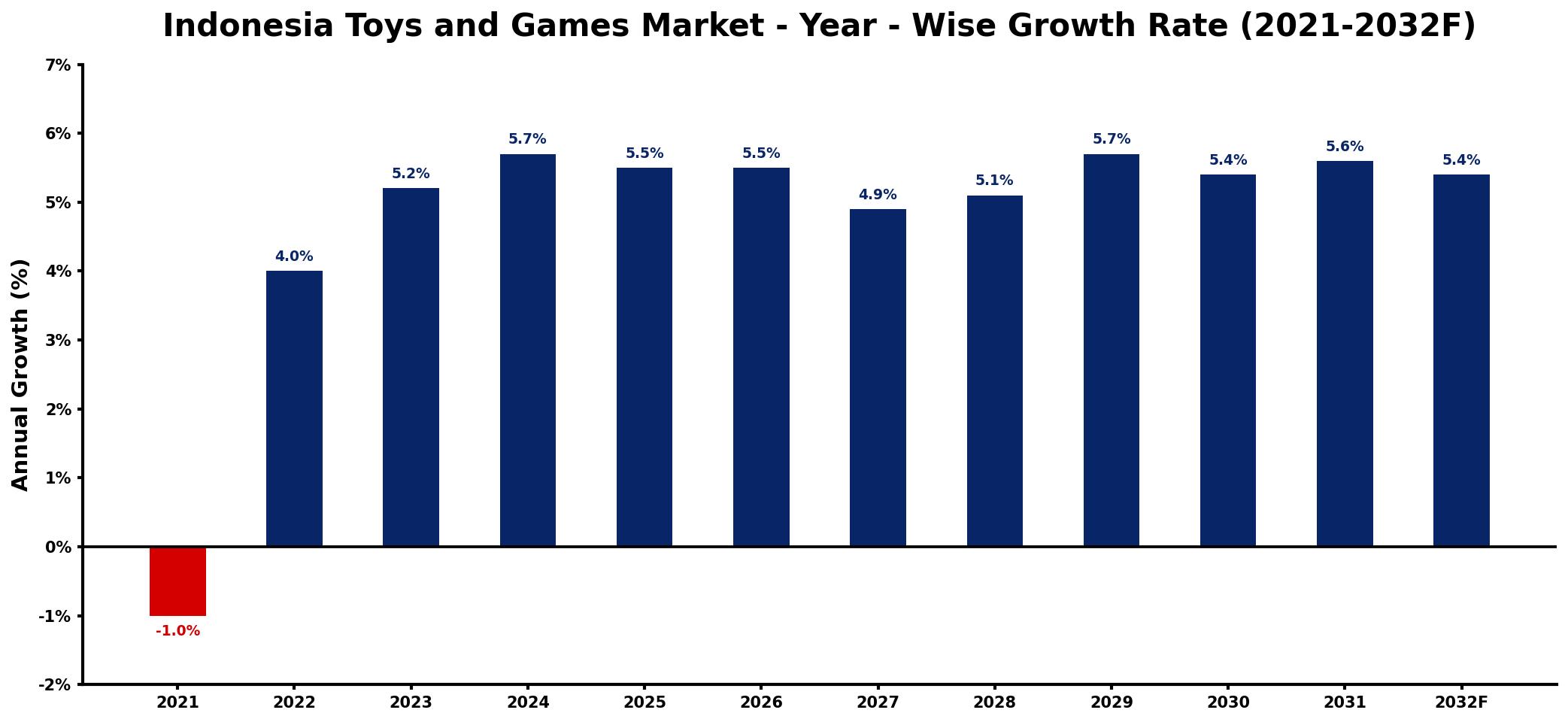
The table below presents the year‑wise growth rates along with the key drivers influencing the market
| Year | Growth Rate | Major Drivers |
| 2021 | -1.0% | decreased consumer spending patterns |
| 2022 | 4.0% | increased disposable income levels |
| 2023 | 5.2% | rising urban population growth |
| 2024 | 5.7% | expansion of online retail channels |
| 2025 | 5.5% | growing interest in educational products |
| 2026 | 5.5% | increased focus on sustainability trends |
| 2027 | 4.9% | enhanced marketing strategies effectiveness |
| 2028 | 5.1% | growing influence of social media |
| 2029 | 5.7% | rising demand from electronics |
| 2030 | 5.4% | growing emerging market penetration |
| 2031 | 5.6% | increased investment in local production |
| 2032 | 5.4% | growing popularity of subscription services |
Note: Market size estimations and growth projections presented in this report are based on 6Wresearch's proprietary forecasting methodology, utilizing the latest available industry data, government publications, and primary research inputs.
Indonesia Toys and Games Market Synopsis
While the past few years witnessed fluctuating demand, primarily due to the COVID-19 pandemic's impacts, the Indonesia toys and games market is set to rebound robustly. As schools reopen and social activities resume, there is a noticeable shift towards educational and interactive toys, reflecting parents increasing focus on childhood development.
The market is transitioning towards digital channels, with online retailers gaining traction in recent years. This shift is supported by a growing base of internet users and improved logistics, allowing for greater convenience and variety in toy selections. The outlook for this market remains positive, indicating a strong recovery and ongoing evolution in consumer preferences.
Indonesia Toys and Games Market Key Takeaways
- Projected growth driven by rising disposable incomes and increased online retail penetration.
- Strong demand for educational and interactive toys aligns with parental priorities.
- Action figures and branded products are gaining popularity among children.
- Government initiatives such as the Toys Donations Program are enhancing market dynamics.
- Continuous adaptation to e-commerce is reshaping buying behaviors and product offerings.
Evaluation of Restraints in Indonesia Toys and Games Market
Despite its promising growth trajectory, the Indonesia toys and games market faces notable restraints. Economic uncertainty resulting from job losses and fluctuating consumer spending poses significant challenges for companies. The shift to online sales has not been uniformly smooth; slow customer adoption of digital platforms continues to hamper growth. Additionally, logistical delays, rising raw material costs, and heightened competition from international brands may further complicate market conditions for local players.
Indonesia Toys and Games Market Trends
Several key trends are shaping the Indonesia toys and games market. There is an increasing demand for educational toys that promote learning through play, as parents prioritize developmental benefits. Furthermore, board games and puzzles have resurged in popularity, offering families interactive experiences. Another significant trend is the rise of action figures tied to popular media franchises, captivating the interests of children aged 5-14. Additionally, the expansion of e-commerce continues to make a profound impact, facilitating easier access to a diverse range of products.
Indonesia Toys and Games Market Opportunities
The Indonesia toys and games market presents numerous avenues for growth and investment. With the ongoing digital transformation, there are significant opportunities for brands to enhance their online presence and leverage data analytics to better understand consumer preferences. Innovations in product development can cater to the rising demand for educational toys. Furthermore, tapping into local production can help reduce reliance on imports while ensuring alignment with local tastes and preferences, opening new channels of growth.
Government Initiatives in the Indonesia Toys and Games Market
The Indonesian government has undertaken several initiatives aimed at stimulating the toys and games market. Programs such as the Toys Donations Program not only encourage charitable contributions but also aim to increase access to toys for underprivileged children, fostering a culture of play and development. Additionally, initiatives to support the e-commerce sector are enhancing logistics infrastructure, making it easier for manufacturers and retailers to reach consumers.
Future Insights of the Indonesia Toys and Games Market
Looking ahead to 2026-2032, the Indonesia toys and games market is poised for robust growth. The ongoing rise in disposable income will likely continue to fuel consumer spending, particularly on educational and interactive toys. The expansion of online retail will further revolutionize shopping habits, with seamless delivery options becoming a key expectation among consumers. As the market evolves, a growing emphasis on sustainability and locally-sourced products could also shape new opportunities and consumer preferences.
Indonesia Toys and Games Market Latest Developments (2025 - 2026)
In the recent months, the Indonesia toys and games market has seen a significant pivot towards e-commerce solutions, with many retailers enhancing their online platforms to meet changing consumer demands. Companies are increasingly investing in technology to improve the user experience, integrating features that allow for more personalized shopping journeys. Moreover, the introduction of new product lines that cater to both entertainment and education reflects a market keen on aligning with parental values.
Indonesia Toys and Games Market - Key Attractiveness of the Report
- 10 Years of Market Numbers
- Historical Data Starting from 2022 to 2025
- Base Year: 2025
- Forecast Data until 2032
- Key Performance Indicators Impacting the Market
- Major Upcoming Developments and Projects
Key Highlights of the Report:
- Indonesia ToysandGames Market Outlook
- Market Size of Indonesia ToysandGames Market, 2025
- Forecast of Indonesia ToysandGames Market, 2032
- Historical Data and Forecast of Indonesia ToysandGames Revenues & Volume for the Period 2022-2032F
- Indonesia ToysandGames Market Trend Evolution
- Indonesia ToysandGames Market Drivers and Challenges
- Indonesia ToysandGames Price Trends
- Indonesia ToysandGames Porter's Five Forces
- Indonesia ToysandGames Industry Life Cycle
- Historical Data and Forecast of Indonesia ToysandGames Market Revenues & Volume By Product Type for the Period 2022-2032F
- Historical Data and Forecast of Indonesia ToysandGames Market Revenues & Volume By Games and Puzzles for the Period 2022-2032F
- Historical Data and Forecast of Indonesia ToysandGames Market Revenues & Volume By Video Games for the Period 2022-2032F
- Historical Data and Forecast of Indonesia ToysandGames Market Revenues & Volume By Construction Toys for the Period 2022-2032F
- Historical Data and Forecast of Indonesia ToysandGames Market Revenues & Volume By Dolls and Accessories for the Period 2022-2032F
- Historical Data and Forecast of Indonesia ToysandGames Market Revenues & Volume By Outdoor and Sports Toys for the Period 2022-2032F
- Historical Data and Forecast of Indonesia ToysandGames Market Revenues & Volume By Other for the Period 2022-2032F
- Historical Data and Forecast of Indonesia ToysandGames Market Revenues & Volume By Distribution Channel for the Period 2022-2032F
- Historical Data and Forecast of Indonesia ToysandGames Market Revenues & Volume By Online Channel for the Period 2022-2032F
- Historical Data and Forecast of Indonesia ToysandGames Market Revenues & Volume By Offline Channel for the Period 2022-2032F
- Indonesia ToysandGames Import Export Trade Statistics
- Market Opportunity Assessment By Product Type
- Market Opportunity Assessment By Distribution Channel
- Indonesia ToysandGames Top Companies Market Share
- Indonesia ToysandGames Competitive Benchmarking By Technical and Operational Parameters
- Indonesia ToysandGames Company Profiles
- Indonesia ToysandGames Key Strategic Recommendations






































