Indonesia Wood Preservatives Market Size, Share & Growth Rate
The Indonesia Wood Preservatives Market was estimated at USD 168 Million in 2025 and is projected to reach USD 223 Million by 2032, growing at a CAGR of 4.1% from 2026 to 2032. This growth trajectory is primarily fueled by an increasing demand for sustainable building materials, bolstered by heightened awareness of environmentally friendly products among consumers. Additionally, government support for green construction practices and a surge in infrastructure development further drive the adoption of wood preservatives across both residential and commercial sectors.
Indonesia Wood Preservatives Market Growth Rate Analysis (2021-2032)
The Indonesia wood preservatives market has experienced a notable turnaround, recovering from a slight decline of 0.7% in 2021 to a robust growth of 4.8% in 2022 and further increasing by 5.5% in 2023. This upward trend is driven by rising consumer demand for sustainable construction practices, coupled with investments in industrial modernization. The government’s initiatives to enhance infrastructure and promote environmentally friendly materials have bolstered market confidence. Forecasts suggest continued growth, with anticipated rates of 5.1% in 2024 and reaching 5.8% by 2032, as digitalization within the sector streamlines production. Such advancements signify a consistent shift toward innovation, addressing both consumer needs and regulatory pressures while reinforcing the overall resilience of this market.
Indonesia Wood Preservatives Market Year-wise Growth Rate and Key Drivers
This graph highlights how the Indonesia Wood Preservatives Market has steadily grown over the past five years, supported by major growth factors.
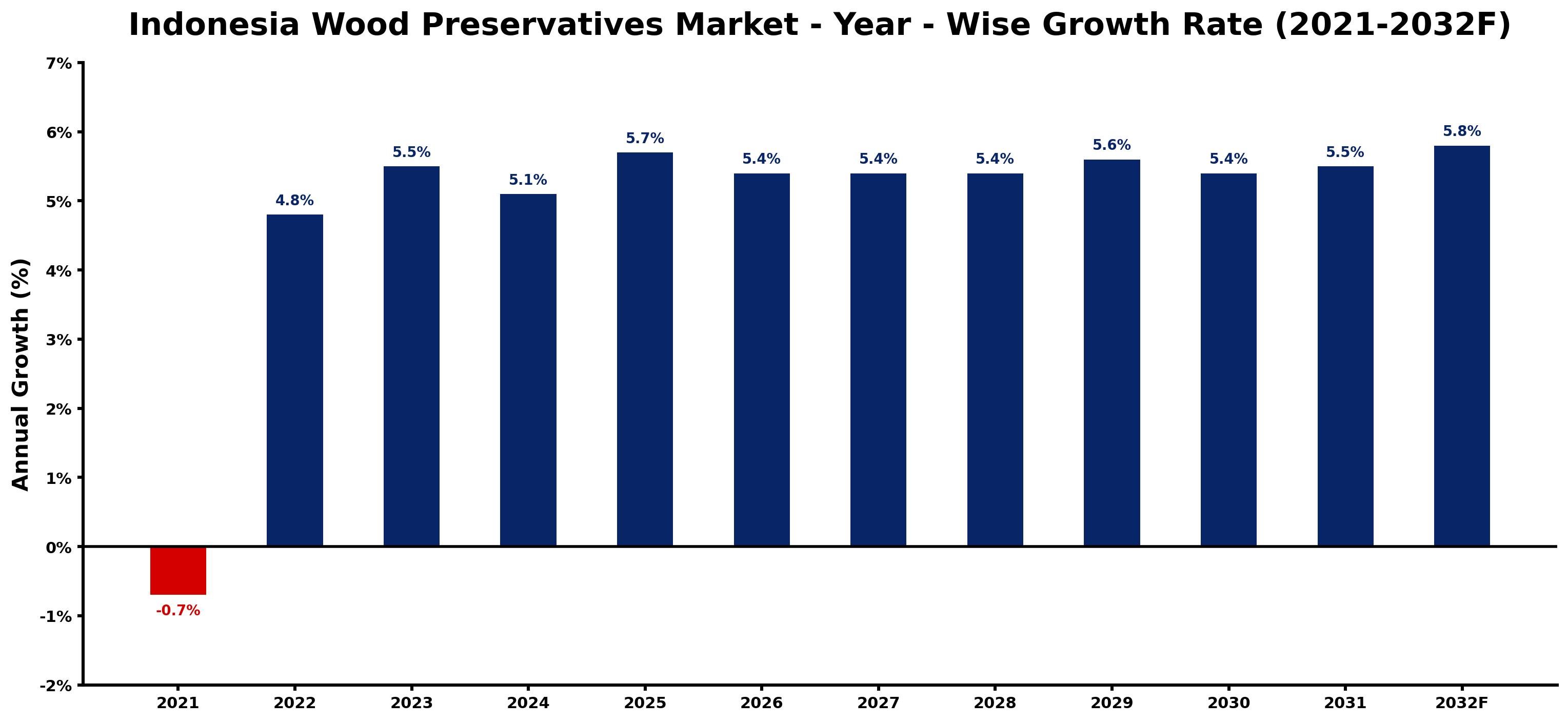
The table below presents the year‑wise growth rates along with the key drivers influencing the market
| Year | Growth Rate | Major Drivers |
| 2021 | -0.7% | Expansion of manufacturing activities |
| 2022 | 4.8% | Expansion of commercial construction activities |
| 2023 | 5.5% | Growing renewable energy integration projects |
| 2024 | 5.1% | Expansion of transportation and logistics networks |
| 2025 | 5.7% | Increasing industrial automation investments |
| 2026 | 5.4% | Expansion of commercial construction activities |
| 2027 | 5.4% | Growing urbanization and commercial development |
| 2028 | 5.4% | Increasing smart city development projects |
| 2029 | 5.6% | Government infrastructure modernization initiatives |
| 2030 | 5.4% | Rapid growth in telecom and data center sectors |
| 2031 | 5.5% | Increasing industrial automation investments |
| 2032 | 5.8% | Increasing industrial automation investments |
Note - Market size estimations and growth projections presented in this report are based on 6Wresearch’s advanced forecasting approach, validated with industry datasets as of June 2026.
Indonesia Wood Preservatives Market Synopsis
The Indonesia wood preservatives market has shown robust growth in recent years, largely due to the surge in construction activities and a shift towards eco-friendly materials. As urbanization continues to advance, the market is increasingly influenced by regulations promoting the use of non-toxic and sustainable alternatives for wood protection.
With a strong inclination towards green building initiatives, stakeholders are finding significant opportunities in the wood preservatives sector. The focus on eliminating hazardous chemicals in favor of environmentally safe options is fostering innovation and expansion among industry players, cementing the role of wood preservatives in the construction landscape.
Indonesia Wood Preservatives Market Key Takeaways
- Growing demand for eco-friendly wood preservatives due to increased consumer awareness.
- Government initiatives promoting sustainable construction practices are accelerating market growth.
- Residential and commercial construction activities are primary drivers of demand.
- Regulations restricting hazardous chemicals are creating opportunities for safer alternatives.
- Continued investment in infrastructure is propelling the wood preservatives sector forward.
Evaluation of Restraints in Indonesia Wood Preservatives Market
Despite the market's promising outlook, several restraints could impede growth. Chief among these are the challenges associated with supply chain disruptions, which can affect the availability of eco-friendly raw materials. Additionally, the cost of transitioning to greener alternatives may deter some manufacturers, particularly smaller enterprises that lack the financial resources to adapt swiftly. Consumer price sensitivity could also limit the potential for widespread adoption of premium wood preservatives, ultimately affecting market dynamics.
Indonesia Wood Preservatives Market Trends
Several key trends are shaping the Indonesia wood preservatives market. The growing popularity of bio-based preservatives, derived from renewable resources, reflects an industry shift towards sustainability. Moreover, advancements in technology are enabling the development of more effective and longer-lasting preservative solutions. As construction practices evolve, the integration of smart building technologies also indicates a future where innovative wood treatments could gain traction. The focus on circular economy principles is further encouraging the use of reclaimed wood, thereby increasing the relevance of effective preservation techniques.
Indonesia Wood Preservatives Market Opportunities
The Indonesian wood preservatives market presents several lucrative opportunities for growth. As the construction sector continues to flourish, there is an increasing demand for high-performance wood preservatives that meet both durability and safety standards. Furthermore, expanding awareness of environmental regulations can prompt construction firms to seek out compliant products, creating a prime opportunity for suppliers of eco-friendly wood preservatives. Investments in R&D to innovate new formulations, as well as collaborations with regulatory bodies, could further enhance market positions.
Government Initiatives in the Indonesia Wood Preservatives Market
The Indonesian government has been proactive in promoting sustainable building practices through various initiatives and regulations. Policies are being implemented to incentivize the use of non-toxic wood treatments, particularly in public construction projects. Such initiatives are aimed at reducing environmental impact and promoting a shift towards green materials, thereby enhancing the market's appeal. Furthermore, the government supports training programs to educate contractors and builders on the importance and benefits of using eco-friendly preservatives.
Future Insights of the Indonesia Wood Preservatives Market
Looking ahead to 2026-2032, the Indonesia wood preservatives market is set to evolve significantly. As sustainability remains a priority, demand for wood preservatives that comply with strict environmental standards will escalate. Manufacturers will likely invest heavily in research to develop innovative solutions that cater to the needs of both commercial and residential sectors. The integration of advanced technologies, such as smart building materials, could also redefine how wood preservation is approached, ensuring that the market remains dynamic and responsive to changing consumer preferences.
Indonesia Wood Preservatives Market Latest Developments (May 2025 - June 2026)
Recent developments in the Indonesia wood preservatives market indicate a shift towards biobased formulations, with several companies announcing breakthroughs in eco-friendly product lines. Collaborations between manufacturers and research institutions are becoming more common, fostering innovation and improving product performance. Additionally, local governments are tightening regulations on the use of hazardous substances, prompting manufacturers to expedite the development of compliant alternatives. The commitment to sustainability is also reflected in corporate social responsibility initiatives among key players, further aligning with market demands.
Indonesia Wood Preservatives Market - Key Attractiveness of the Report
- 10 Years of Market Numbers
- Historical Data Starting from 2022 to 2025
- Base Year: 2025
- Forecast Data until 2032
- Key Performance Indicators Impacting the Market
- Major Upcoming Developments and Projects
Key Highlights of the Report:
- Indonesia Wood Preservatives Market Outlook
- Market Size of Indonesia Wood Preservatives Market, 2025
- Forecast of Indonesia Wood Preservatives Market, 2032F
- Historical Data and Forecast of Indonesia Wood Preservatives Revenues & Volume for the Period 2022-2032F
- Indonesia Wood Preservatives Market Trend Evolution
- Indonesia Wood Preservatives Market Drivers and Challenges
- Indonesia Wood Preservatives Price Trends
- Indonesia Wood Preservatives Porter's Five Forces
- Indonesia Wood Preservatives Industry Life Cycle
- Historical Data and Forecast of Indonesia Wood Preservatives Market Revenues & Volume By Formulation for the Period 2022-2032F
- Historical Data and Forecast of Indonesia Wood Preservatives Market Revenues & Volume By Water-Based Wood Preservatives for the Period 2022-2032F
- Historical Data and Forecast of Indonesia Wood Preservatives Market Revenues & Volume By Solvent-Based Wood Preservatives for the Period 2022-2032F
- Historical Data and Forecast of Indonesia Wood Preservatives Market Revenues & Volume By Oil-Based Wood Preservatives for the Period 2022-2032F
- Historical Data and Forecast of Indonesia Wood Preservatives Market Revenues & Volume By Application for the Period 2022-2032F
- Historical Data and Forecast of Indonesia Wood Preservatives Market Revenues & Volume By Residential for the Period 2022-2032F
- Historical Data and Forecast of Indonesia Wood Preservatives Market Revenues & Volume By Commercial for the Period 2022-2032F
- Historical Data and Forecast of Indonesia Wood Preservatives Market Revenues & Volume By Industrial for the Period 2022-2032F
- Indonesia Wood Preservatives Import Export Trade Statistics
- Market Opportunity Assessment By Formulation
- Market Opportunity Assessment By Application
- Indonesia Wood Preservatives Top Companies Market Share
- Indonesia Wood Preservatives Competitive Benchmarking By Technical and Operational Parameters
- Indonesia Wood Preservatives Company Profiles
- Indonesia Wood Preservatives Key Strategic Recommendations






































