Iran Adhesives Market Growth Rate Analysis (2025 - 2031)
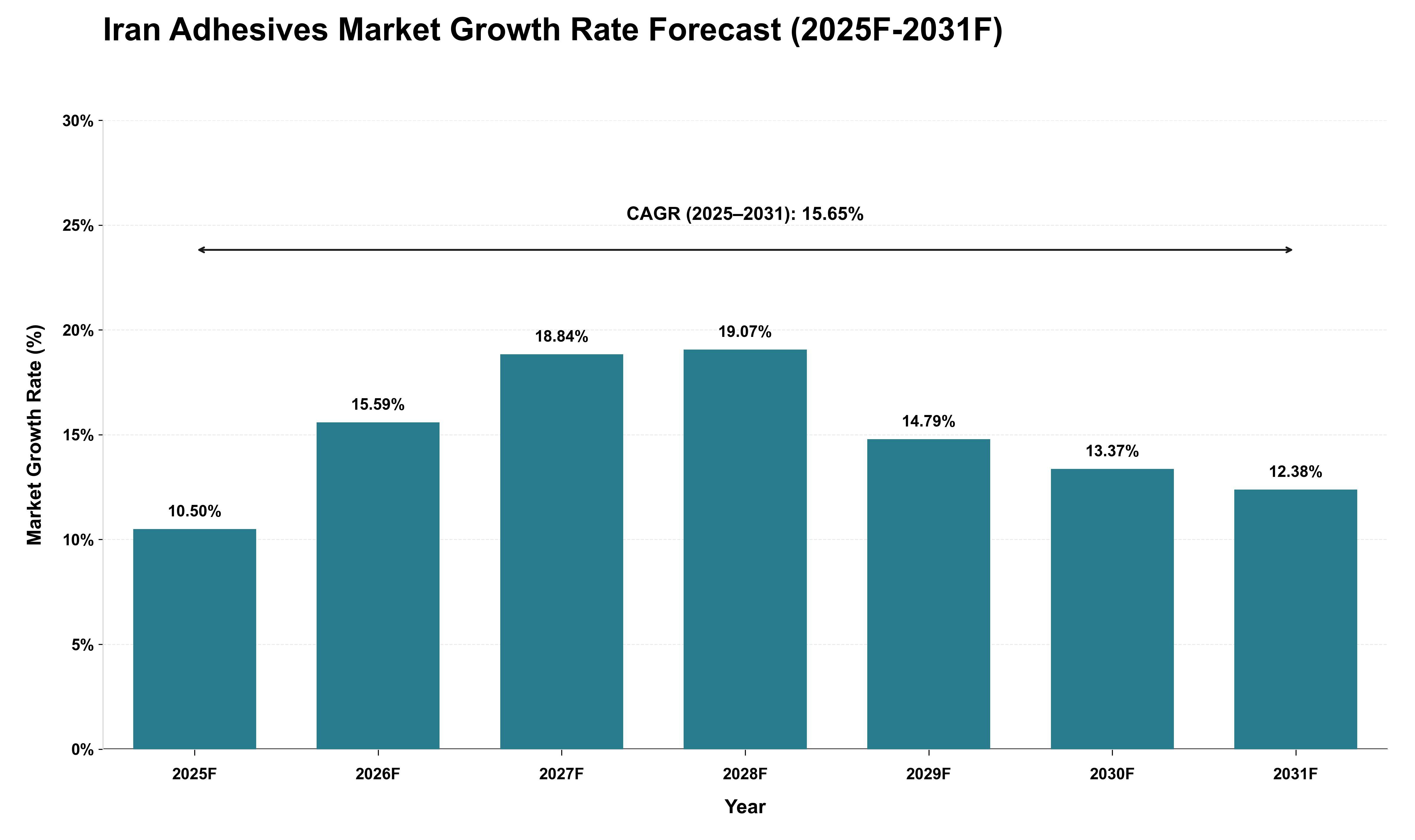
The Iran adhesives market will experience robust growth driven by increasing construction activities and industrial applications, which will significantly influence import and export dynamics. As the forecasted CAGR of 15.65% suggests, the market is poised for substantial expansion, particularly in 2027 and 2028, where growth rates are projected to peak at 18.84% and 19.07%, respectively. This surge can be attributed to heightened demand for adhesives in various sectors, including automotive and packaging, which will necessitate a greater reliance on imported raw materials due to domestic production limitations. Consequently, trade flows will reflect this dependency, with imports likely increasing to meet the rising consumption needs while exports may also rise as local manufacturers enhance their capabilities. By 2031, despite a gradual decline in growth rates to 12.38%, the overall trend indicates a strong upward trajectory in both import volumes and export potential within the adhesives sector.
Key Highlights of the Report:
- Iran Adhesives Market Outlook
- Market Size of Iran Adhesives Market, 2024
- Forecast of Iran Adhesives Market, 2031
- Historical Data and Forecast of Iran Adhesives Revenues & Volume for the Period 2021-2031
- Iran Adhesives Market Trend Evolution
- Iran Adhesives Market Drivers and Challenges
- Iran Adhesives Price Trends
- Iran Adhesives Porter`s Five Forces
- Iran Adhesives Industry Life Cycle
- Historical Data and Forecast of Iran Adhesives Market Revenues & Volume By Types for the Period 2021-2031
- Historical Data and Forecast of Iran Adhesives Market Revenues & Volume By Acrylicfor the Period 2021-2031
- Historical Data and Forecast of Iran Adhesives Market Revenues & Volume By Epoxy for the Period 2021-2031
- Historical Data and Forecast of Iran Adhesives Market Revenues & Volume By Polyvinyl Acetate (PVA) for the Period 2021-2031
- Historical Data and Forecast of Iran Adhesives Market Revenues & Volume By Polyurethane (PU) for the Period 2021-2031
- Historical Data and Forecast of Iran Adhesives Market Revenues & Volume By Styrenic Block for the Period 2021-2031
- Historical Data and Forecast of Iran Adhesives Market Revenues & Volume By Ethyl Vinyl Acetate (EVA) for the Period 2021-2031
- Historical Data and Forecast of Iran Adhesives Market Revenues & Volume By Silicone & Others for the Period 2021-2031
- Historical Data and Forecast of Iran Adhesives Market Revenues & Volume By Technology for the Period 2021-2031
- Historical Data and Forecast of Iran Adhesives Market Revenues & Volume By Water-based for the Period 2021-2031
- Historical Data and Forecast of Iran Adhesives Market Revenues & Volume By Solvent-based for the Period 2021-2031
- Historical Data and Forecast of Iran Adhesives Market Revenues & Volume By Hot Melt for the Period 2021-2031
- Historical Data and Forecast of Iran Adhesives Market Revenues & Volume By Pressure Sensitive for the Period 2021-2031
- Historical Data and Forecast of Iran Adhesives Market Revenues & Volume By Reactive and Others for the Period 2021-2031
- Iran Adhesives Import Export Trade Statistics
- Market Opportunity Assessment By Types
- Market Opportunity Assessment By Technology
- Iran Adhesives Top Companies Market Share
- Iran Adhesives Competitive Benchmarking By Technical and Operational Parameters
- Iran Adhesives Company Profiles
- Iran Adhesives Key Strategic Recommendations






































