Iran Motorcycle Market Growth Rate Analysis (2025 - 2031)
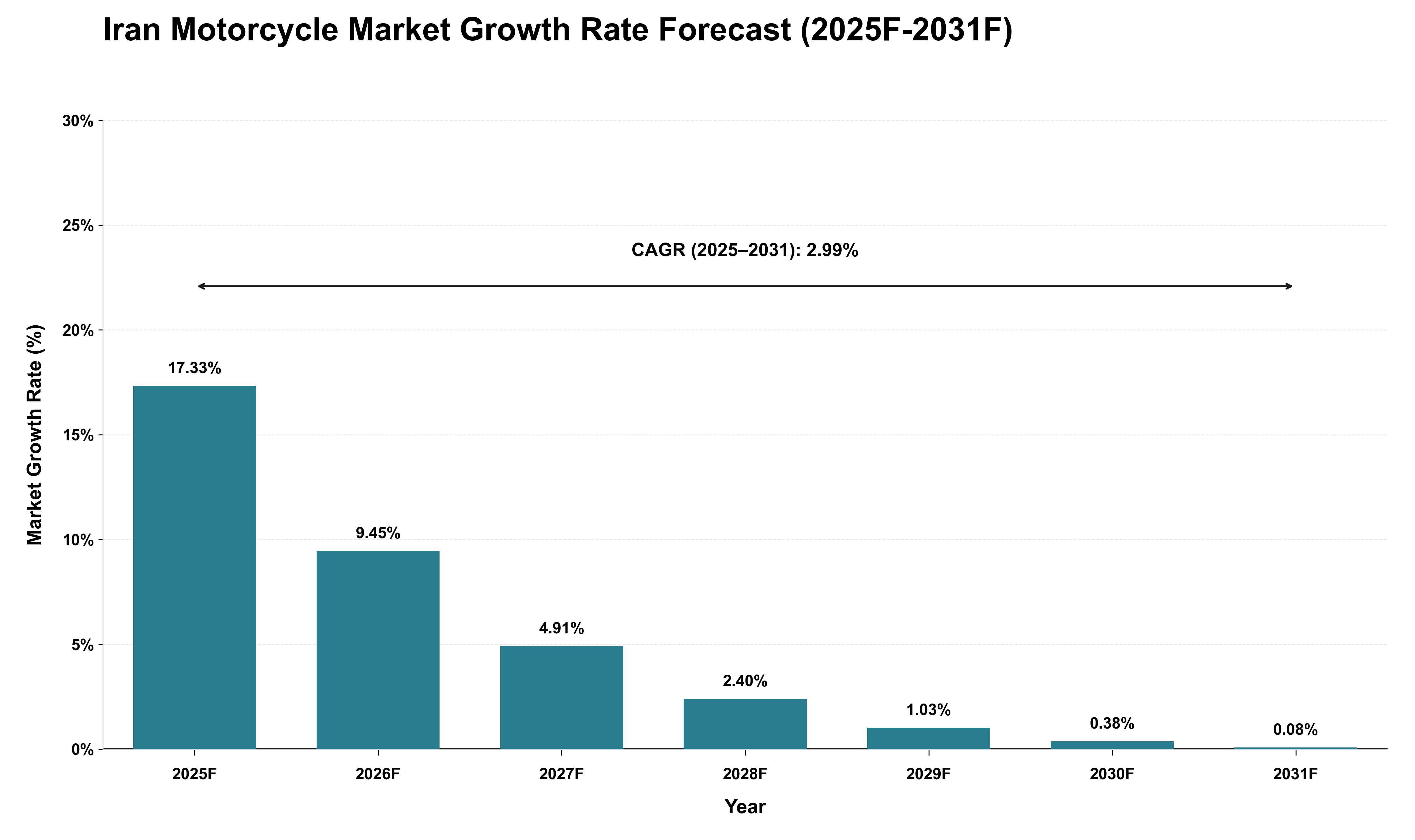
From 2025 onward, the Iranian motorcycle market will experience a notable shift in growth dynamics, driven by evolving import dependencies and cyclical trends typical of the automotive sector. The initial surge of 17.33% in 2025 will likely be fueled by pent-up consumer demand and potential easing of trade restrictions, leading to increased import activity. However, as the forecast progresses, growth rates will decelerate significantly; by 2031, the market is expected to stabilize at a mere 0.08%. This trajectory reflects a transition from robust initial demand to more tempered consumption patterns as economic factors such as inflation and currency fluctuations impact purchasing power. The projected compound annual growth rate (CAGR) of 2.99% underscores this gradual cooling trend while highlighting the importance of external trade flows in shaping market conditions amidst shifting consumer preferences and regulatory environments.
Key Highlights of the Report:
- Iran Motorcycle Market Outlook
- Market Size of Iran Motorcycle Market, 2024
- Forecast of Iran Motorcycle Market, 2031
- Historical Data and Forecast of Iran Motorcycle Revenues & Volume for the Period 2021-2031
- Iran Motorcycle Market Trend Evolution
- Iran Motorcycle Market Drivers and Challenges
- Iran Motorcycle Price Trends
- Iran Motorcycle Porter`s Five Forces
- Iran Motorcycle Industry Life Cycle
- Historical Data and Forecast of Iran Motorcycle Market Revenues & Volume By Type for the Period 2021-2031
- Historical Data and Forecast of Iran Motorcycle Market Revenues & Volume By Adventure for the Period 2021-2031
- Historical Data and Forecast of Iran Motorcycle Market Revenues & Volume By Cruiser for the Period 2021-2031
- Historical Data and Forecast of Iran Motorcycle Market Revenues & Volume By Mopeds for the Period 2021-2031
- Historical Data and Forecast of Iran Motorcycle Market Revenues & Volume By Sports for the Period 2021-2031
- Historical Data and Forecast of Iran Motorcycle Market Revenues & Volume By Standard for the Period 2021-2031
- Historical Data and Forecast of Iran Motorcycle Market Revenues & Volume By Touring for the Period 2021-2031
- Historical Data and Forecast of Iran Motorcycle Market Revenues & Volume By Engine Capacity for the Period 2021-2031
- Historical Data and Forecast of Iran Motorcycle Market Revenues & Volume By 151-300 CC for the Period 2021-2031
- Historical Data and Forecast of Iran Motorcycle Market Revenues & Volume By 301-500 CC for the Period 2021-2031
- Historical Data and Forecast of Iran Motorcycle Market Revenues & Volume By 501-800 CC for the Period 2021-2031
- Historical Data and Forecast of Iran Motorcycle Market Revenues & Volume By 801-1000 CC for the Period 2021-2031
- Historical Data and Forecast of Iran Motorcycle Market Revenues & Volume By 1001-1600 CC for the Period 2021-2031
- Historical Data and Forecast of Iran Motorcycle Market Revenues & Volume By Above 1600 CC for the Period 2021-2031
- Iran Motorcycle Import Export Trade Statistics
- Market Opportunity Assessment By Type
- Market Opportunity Assessment By Engine Capacity
- Iran Motorcycle Top Companies Market Share
- Iran Motorcycle Competitive Benchmarking By Technical and Operational Parameters
- Iran Motorcycle Company Profiles
- Iran Motorcycle Key Strategic Recommendations






































