Iraq Ammonia Market Size, Share & Growth Rate
The Iraq Ammonia Market was estimated at USD 958 Million in 2025 and is projected to reach USD 1364 Million by 2032, growing at a CAGR of 5.2% from 2026 to 2032. This growth is largely propelled by the surging demand for nitrogen-based fertilizers, which are essential in addressing food security amidst a growing population. The shift towards sustainable agricultural practices further enhances the need for ammonia, affirming its pivotal role in Iraq's agricultural ecosystem.
Iraq Ammonia Market Year-wise Growth Rate and Key Drivers
This graph highlights how the Iraq Ammonia Market has steadily grown over the years, supported by major growth factors.
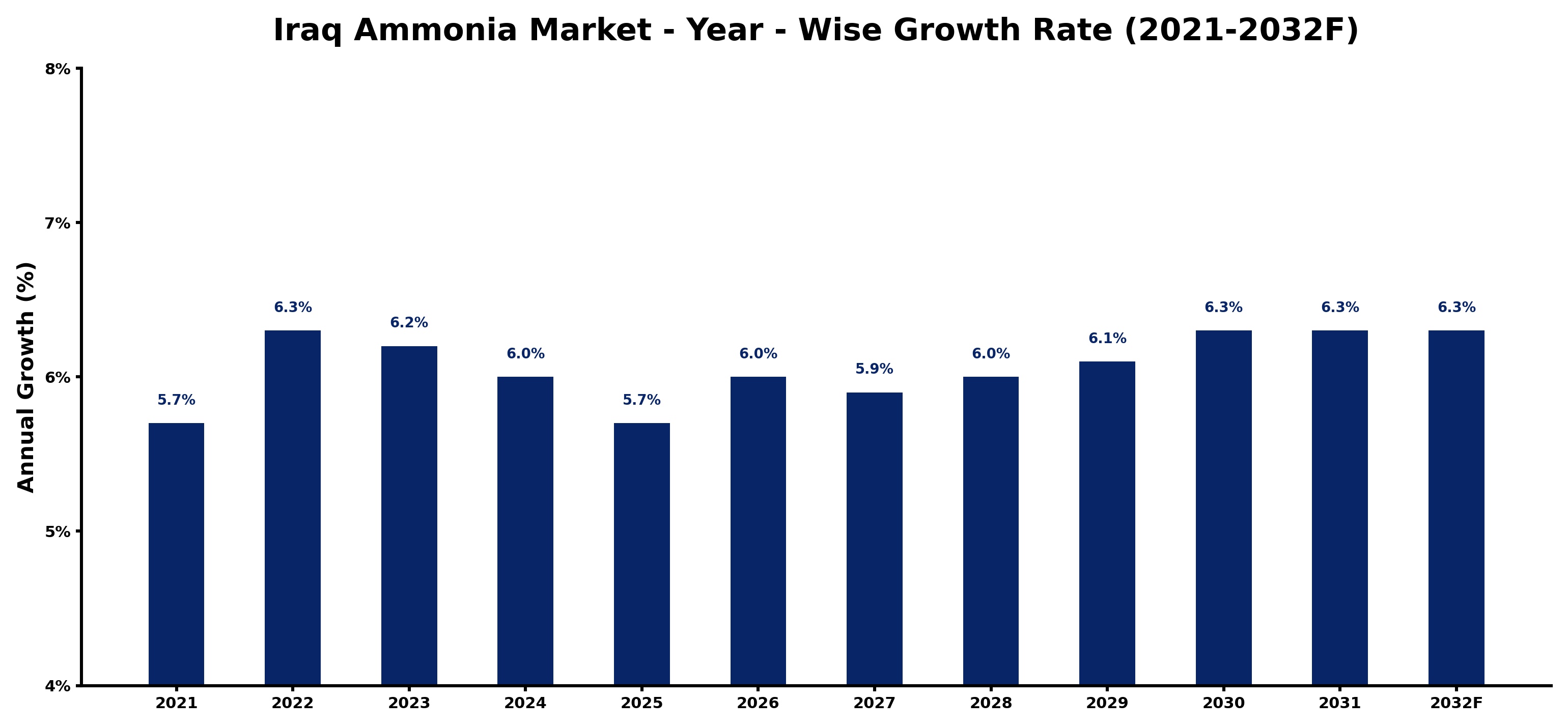
The table below presents the year‑wise growth rates along with the key drivers influencing the market
| Year | Growth Rate | Major Drivers |
| 2021 | 5.7% | Increased agricultural production demand |
| 2022 | 6.3% | Investment in fertilizer manufacturing |
| 2023 | 6.2% | Rising industrial applications usage |
| 2024 | 6.0% | Infrastructure development enhanced logistics |
| 2025 | 5.7% | Growing export opportunities emerged |
| 2026 | 6.0% | Technological advancements improved efficiency |
| 2027 | 5.9% | Sustainability initiatives gained traction |
| 2028 | 6.0% | Regional market integration expanded access |
| 2029 | 6.1% | Government support for agriculture increased |
| 2030 | 6.3% | Rising population drove consumption growth |
| 2031 | 6.3% | Innovative product formulations attracted interest |
| 2032 | 6.3% | Collaborations with international partners strengthened |
Note - Market size estimations and growth projections presented in this report are based on 6Wresearch's advanced forecasting approach, validated with industry datasets as of June 2026.
Iraq Ammonia Market Synopsis
In recent years, Iraq has emerged as a critical player in the ammonia sector, primarily driven by the agricultural industry's insatiable demand for fertilizers. The strategic emphasis on enhancing crop yields has placed ammonia at the forefront of agricultural practices, showcasing its vital contribution to food production.
Moreover, the vast agricultural land and an increasing population present significant opportunities for ammonia consumption in various sectors. Local producers and international entities are actively navigating this expanding market, seeking to leverage the abundant natural gas resources available for ammonia production.
Iraq Ammonia Market Key Takeaways
- The market is set for sustained growth driven by agricultural advancements and fertilizer needs.
- Government initiatives to boost local production are positively influencing market dynamics.
- Technological innovations in ammonia production are enhancing efficiency and sustainability.
- The increasing focus on food security underscores the relevance of ammonia in Iraq's economic landscape.
- Investment opportunities in infrastructure and production facilities are expanding, particularly in light of natural gas availability.
Evaluation of Restraints in Iraq Ammonia Market
Despite its growth potential, the Iraq Ammonia Market grapples with several constraints. Political instability and security issues present significant hurdles that can deter investment and disrupt operations. The ongoing uncertainty in the region affects production schedules and logistics, which in turn hampers the efficient distribution of ammonia. Furthermore, inadequate infrastructure exacerbates these challenges, making it difficult for producers to meet the rising demand efficiently.
Iraq Ammonia Market Trends
The market is witnessing a notable shift toward sustainable practices, as consumers increasingly prefer ammonia-based fertilizers that align with environmental goals. Concurrently, technological advancements are streamlining production processes, reducing operational costs while enhancing output quality. This trend not only aligns with global sustainability initiatives but also positions local producers competitively in the international arena.
Iraq Ammonia Market Opportunities
Investment opportunities in the Iraq Ammonia Market are abundant, especially given the increasing demands from both agricultural and industrial sectors. As the government focuses on agricultural modernization, the need for ammonia as a crucial ingredient in fertilizers will continue to rise. Additionally, expanding applications in industries such as water treatment and refrigeration further open avenues for investors to engage in production and distribution projects.
Government Initiatives in the Iraq Ammonia Market
The Iraqi government is actively promoting policies that favor domestic ammonia production. Initiatives include providing subsidies and tax incentives aimed at local producers, thus supporting the growth of the sector. The government's commitment to enhancing food security and reducing import dependencies aligns with its efforts to encourage self-sufficiency in ammonia production, thereby strengthening the overall economy.
Future Insights of the Iraq Ammonia Market
Looking ahead to the period between 2026 and 2032, the Iraq Ammonia Market is set to experience further expansion, buoyed by heightened agricultural productivity and advancements in sustainable farming. Population growth and the consequent rise in food demand will play a crucial role in sustaining this trajectory. If infrastructure issues can be effectively addressed and political stability is achieved, the market is likely to flourish, with substantial contributions to national economic resilience.
Iraq Ammonia Market Latest Developments (May 2025 - June 2026)
In the past year, the Iraq Ammonia Market has seen significant movement towards sustainability and efficiency. Various stakeholders are increasingly investing in technology upgrades to enhance production capabilities. Additionally, strategic alliances are forming among local entities to optimize distribution networks, ensuring that ammonia products reach the agricultural sectors more effectively.
Iraq Ammonia Market - Key Attractiveness of the Report
- 10 Years of Market Numbers
- Historical Data Starting from 2022 to 2025
- Base Year: 2025
- Forecast Data until 2032
- Key Performance Indicators Impacting the Market
- Major Upcoming Developments and Projects
Key Highlights of the Report:
- Iraq Ammonia Market Outlook
- Market Size of Iraq Ammonia Market, 2025
- Forecast of Iraq Ammonia Market, 2032
- Historical Data and Forecast of Iraq Ammonia Revenues & Volume for the Period 2022-2032F
- Iraq Ammonia Market Trend Evolution
- Iraq Ammonia Market Drivers and Challenges
- Iraq Ammonia Price Trends
- Iraq Ammonia Porter's Five Forces
- Iraq Ammonia Industry Life Cycle
- Historical Data and Forecast of Iraq Ammonia Market Revenues & Volume By Type for the Period 2022-2032F
- Historical Data and Forecast of Iraq Ammonia Market Revenues & Volume By Liquid for the Period 2022-2032F
- Historical Data and Forecast of Iraq Ammonia Market Revenues & Volume By Gas for the Period 2022-2032F
- Historical Data and Forecast of Iraq Ammonia Market Revenues & Volume By End-user Industry for the Period 2022-2032F
- Historical Data and Forecast of Iraq Ammonia Market Revenues & Volume By Agriculture for the Period 2022-2032F
- Historical Data and Forecast of Iraq Ammonia Market Revenues & Volume By Textiles for the Period 2022-2032F
- Historical Data and Forecast of Iraq Ammonia Market Revenues & Volume By Mining for the Period 2022-2032F
- Historical Data and Forecast of Iraq Ammonia Market Revenues & Volume By Pharmaceutical for the Period 2022-2032F
- Historical Data and Forecast of Iraq Ammonia Market Revenues & Volume By Refrigeration for the Period 2022-2032F
- Historical Data and Forecast of Iraq Ammonia Market Revenues & Volume By Others for the Period 2022-2032F
- Iraq Ammonia Import Export Trade Statistics
- Market Opportunity Assessment By Type
- Market Opportunity Assessment By End-user Industry
- Iraq Ammonia Top Companies Market Share
- Iraq Ammonia Competitive Benchmarking By Technical and Operational Parameters
- Iraq Ammonia Company Profiles
- Iraq Ammonia Key Strategic Recommendations






































