Iraq Armored Vehicle Market Size, Share & Growth Rate
The Iraq Armored Vehicle Market was estimated at USD 438 Million in 2025 and is projected to reach USD 617 Million by 2032, growing at a CAGR of 5.0% from 2026 to 2032. This growth trajectory is primarily driven by the urgent need for enhanced security in response to ongoing military operations against insurgent groups and the modernization initiatives undertaken by the Iraqi armed forces. Additionally, the market's evolution is influenced by increasing defense budgets, which emphasize the acquisition of advanced, technologically sophisticated armored vehicles.
Iraq Armored Vehicle Market Year-wise Growth Rate and Key Drivers
This graph highlights how the Iraq Armored Vehicle Market has steadily grown over the years, supported by major growth factors.
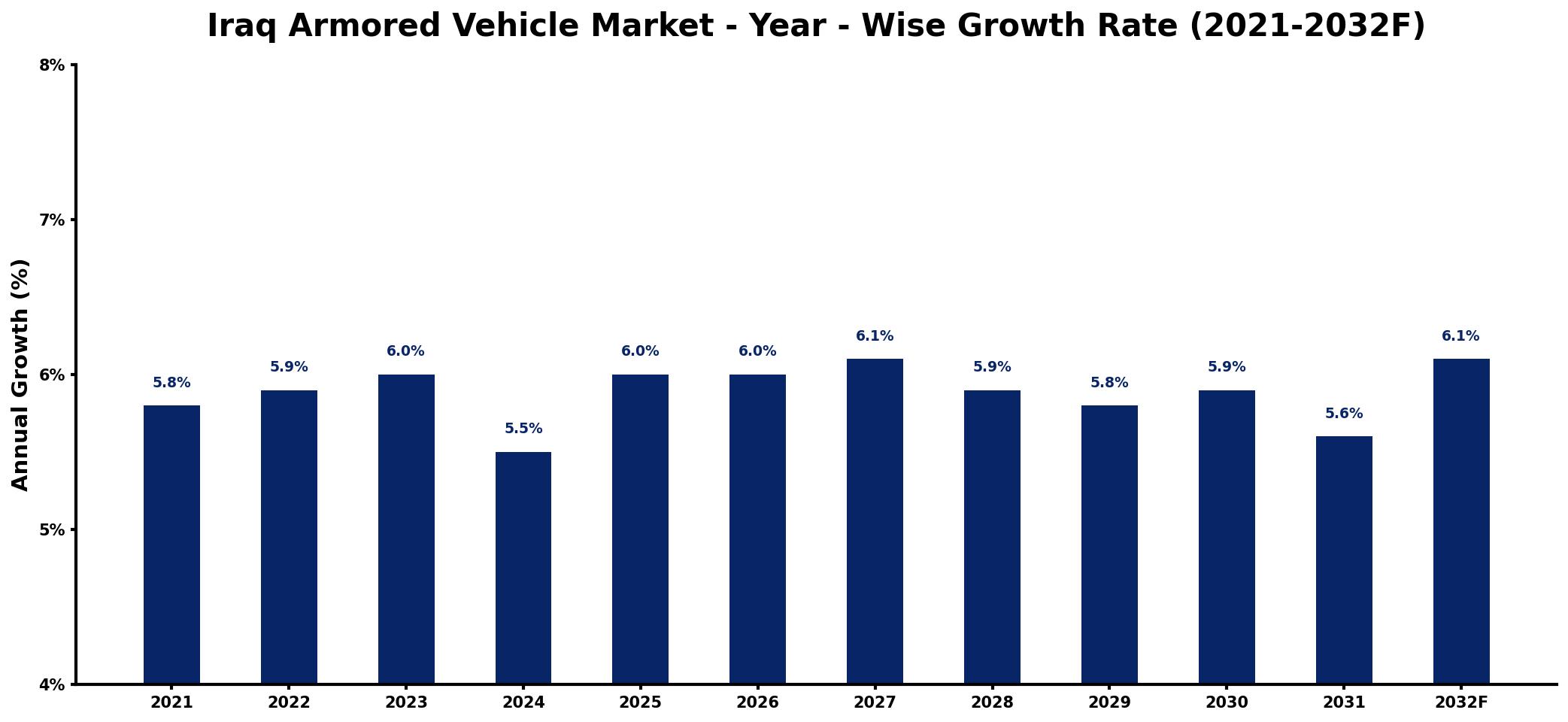
The table below presents the year‑wise growth rates along with the key drivers influencing the market
| Year | Growth Rate | Major Drivers |
| 2021 | 5.8% | growing commercial sector adoption |
| 2022 | 5.9% | Rising geopolitical tensions observed |
| 2023 | 6.0% | Growing private security investments |
| 2024 | 5.5% | Enhanced military modernization programs |
| 2025 | 6.0% | Expanding infrastructure protection initiatives |
| 2026 | 6.0% | Surge in regional stability efforts |
| 2027 | 6.1% | Boost in foreign military partnerships |
| 2028 | 5.9% | Heightened demand for internal security |
| 2029 | 5.8% | improved processing technologies adoption |
| 2030 | 5.9% | Increased arms procurement agreements |
| 2031 | 5.6% | Growing interest in domestic production |
| 2032 | 6.1% | Expansion of multinational defense collaborations |
Note: Market size estimations and growth projections presented in this report are based on 6Wresearch's proprietary forecasting methodology, utilizing the latest available industry data, government publications, and primary research inputs.
Iraq Armored Vehicle Market Synopsis
Amidst the prevailing security challenges, Iraq has shown a growing preference for mine-resistant ambush protected (MRAP) vehicles, crucial for troop protection in asymmetric warfare environments. Furthermore, the emphasis on modernizing military capabilities is leading to a surge in demand for armored personnel carriers (APCs) that can traverse Iraq's complex terrain.
The landscape of the Iraq Armored Vehicle Market is evolving with a focus on integrating cutting-edge technology, such as advanced communication systems and active protection features. This trend is essential for enhancing operational effectiveness, thereby creating a dynamic environment for manufacturers and suppliers aiming to meet the specific needs of Iraqi security forces.
Iraq Armored Vehicle Market Key Takeaways
- The demand for armored vehicles in Iraq is significantly driven by ongoing military operations and heightened security needs.
- Investment in advanced technologies is becoming crucial to meet the modern warfare demands of Iraqi armed forces.
- Political stability and economic conditions will play vital roles in shaping market dynamics moving forward.
- Government policies regarding defense procurement are focused on maintaining quality and security compliance.
- There is an increasing shift towards lighter, more maneuverable armored vehicles suited for urban combat scenarios.
Evaluation of Restraints in Iraq Armored Vehicle Market
The Iraq Armored Vehicle Market faces significant constraints stemming from political instability and the pervasive threat of insurgent violence. This precarious security environment complicates procurement processes, deterring potential investors and suppliers from establishing operations. Moreover, the fluctuating oil prices which the Iraqi economy heavily depends upon can adversely affect defense budgets, introducing an element of unpredictability into long-term planning for military expenditures. Consequently, navigating this complex market requires a nuanced understanding of local dynamics, necessitating strategic partnerships and agile operational approaches.
Iraq Armored Vehicle Market Trends
A notable trend in the Iraq Armored Vehicle Market is the increasing demand for vehicles that provide enhanced mobility and protection. Military operations are evolving, and forces require solutions that can effectively navigate urban environments while ensuring troop safety. Additionally, there is a growing interest in vehicles equipped with modern technologies such as surveillance systems and remote weaponry, which are becoming essential in counter-insurgency operations. This trend not only indicates a shift in operational strategy but also underscores the necessity for manufacturers to innovate continuously to meet the evolving demands of the Iraqi military.
Iraq Armored Vehicle Market Opportunities
The Iraq Armored Vehicle Market offers considerable investment opportunities, particularly as the government commits to enhancing its defense capabilities in light of ongoing security challenges. There is a clear demand for advanced armored vehicles that can provide both protection and operational versatility. Moreover, investment in local production and assembly could prove advantageous, aligning with governmental objectives for self-sufficiency in military capabilities. Understanding the specific operational requirements and preferences of Iraqi security forces will be pivotal in capitalizing on these opportunities.
Government Initiatives in the Iraq Armored Vehicle Market
The Iraqi government has implemented various policies aimed at regulating the import and export of armored vehicles to ensure national security and compliance with international arms control standards. Strict guidelines are enforced to facilitate quality control, while licensure requirements for manufacturers and suppliers are established to uphold market integrity. These initiatives are critical for promoting safety and accountability within the sector, thereby enhancing the operational effectiveness of the military and security forces.
Future Insights of the Iraq Armored Vehicle Market
Looking ahead to 2026-2032, the Iraq Armored Vehicle Market is anticipated to experience sustained growth, bolstered by ongoing security challenges and a determined focus on military modernization. With the expected increase in defense budgets, demand for advanced armored vehicles is set to rise as Iraq invests in enhancing its defense infrastructure. Technological advancements will likely play a crucial role in shaping this market, as manufacturers strive to deliver vehicles that meet contemporary operational requirements while ensuring maximum protection and adaptability to various combat environments.
Iraq Armored Vehicle Market Latest Developments (2025 - 2026)
Recent developments in the Iraq Armored Vehicle Market indicate a growing interest from international defense manufacturers in supplying advanced vehicle solutions tailored for the Iraqi military. There's been a noticeable uptick in collaborations aimed at local assembly and production, which aligns with government priorities for self-reliance. Moreover, discussions surrounding the integration of advanced technologies into existing vehicle platforms have gained momentum, as military leaders seek to enhance operational capabilities amidst evolving threats.
Iraq Armored Vehicle Market - Key Attractiveness of the Report
- 10 Years of Market Numbers
- Historical Data Starting from 2022 to 2025
- Base Year: 2025
- Forecast Data until 2032
- Key Performance Indicators Impacting the Market
- Major Upcoming Developments and Projects
Key Highlights of the Report:
- Iraq Armored Vehicle Market Outlook
- Market Size of Iraq Armored Vehicle Market, 2025
- Forecast of Iraq Armored Vehicle Market, 2032
- Historical Data and Forecast of Iraq Armored Vehicle Revenues & Volume for the Period 2022-2032F
- Iraq Armored Vehicle Market Trend Evolution
- Iraq Armored Vehicle Market Drivers and Challenges
- Iraq Armored Vehicle Price Trends
- Iraq Armored Vehicle Porter's Five Forces
- Iraq Armored Vehicle Industry Life Cycle
- Historical Data and Forecast of Iraq Armored Vehicle Market Revenues & Volume By Platform for the Period 2022-2032F
- Historical Data and Forecast of Iraq Armored Vehicle Market Revenues & Volume By Combat Vehicles for the Period 2022-2032F
- Historical Data and Forecast of Iraq Armored Vehicle Market Revenues & Volume By Combat Support Vehicles for the Period 2022-2032F
- Historical Data and Forecast of Iraq Armored Vehicle Market Revenues & Volume By Unmanned Armored Ground Vehicles for the Period 2022-2032F
- Historical Data and Forecast of Iraq Armored Vehicle Market Revenues & Volume By Mobility for the Period 2022-2032F
- Historical Data and Forecast of Iraq Armored Vehicle Market Revenues & Volume By Wheeled for the Period 2022-2032F
- Historical Data and Forecast of Iraq Armored Vehicle Market Revenues & Volume By Tracked for the Period 2022-2032F
- Historical Data and Forecast of Iraq Armored Vehicle Market Revenues & Volume By System for the Period 2022-2032F
- Historical Data and Forecast of Iraq Armored Vehicle Market Revenues & Volume By Engine for the Period 2022-2032F
- Historical Data and Forecast of Iraq Armored Vehicle Market Revenues & Volume By Drive System for the Period 2022-2032F
- Historical Data and Forecast of Iraq Armored Vehicle Market Revenues & Volume By Ballistic Armor for the Period 2022-2032F
- Historical Data and Forecast of Iraq Armored Vehicle Market Revenues & Volume By Turret Drives for the Period 2022-2032F
- Historical Data and Forecast of Iraq Armored Vehicle Market Revenues & Volume By Ammunition Handling System for the Period 2022-2032F
- Historical Data and Forecast of Iraq Armored Vehicle Market Revenues & Volume By Fire Control Systems (FCS) for the Period 2022-2032F
- Historical Data and Forecast of Iraq Armored Vehicle Market Revenues & Volume By Armaments for the Period 2022-2032F
- Historical Data and Forecast of Iraq Armored Vehicle Market Revenues & Volume By Countermeasure System for the Period 2022-2032F
- Iraq Armored Vehicle Import Export Trade Statistics
- Market Opportunity Assessment By Platform
- Market Opportunity Assessment By Mobility
- Market Opportunity Assessment By System
- Iraq Armored Vehicle Top Companies Market Share
- Iraq Armored Vehicle Competitive Benchmarking By Technical and Operational Parameters
- Iraq Armored Vehicle Company Profiles
- Iraq Armored Vehicle Key Strategic Recommendations






































