Thailand Armored Vehicle Market Size, Share & Growth Rate
The Thailand Armored Vehicle Market was estimated at USD 148 Million in 2025 and is projected to reach USD 170 Million by 2032, growing at a CAGR of 2.0% from 2026 to 2032. This gradual growth trajectory is primarily fueled by increasing national security concerns and the necessity for defense modernization efforts. With a strategic location in Southeast Asia, Thailand's commitment to safeguarding its interests has amplified the demand for armored vehicles across military and law enforcement sectors.
Thailand Armored Vehicle Market Year-wise Growth Rate and Key Drivers
This graph highlights how the Thailand Armored Vehicle Market has steadily grown over the years, supported by major growth factors.
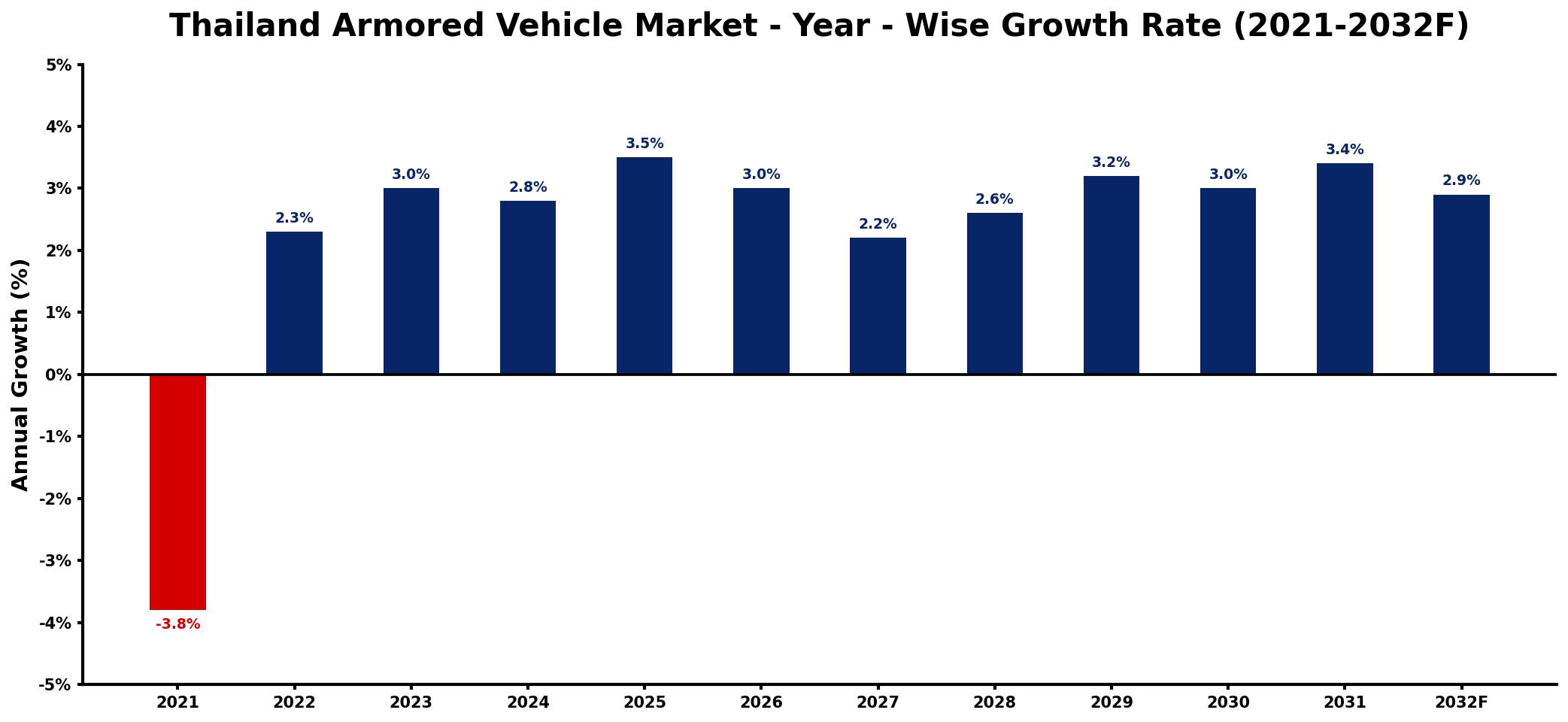
The table below presents the year‑wise growth rates along with the key drivers influencing the market
| Year | Growth Rate | Major Drivers |
| 2021 | -3.8% | decreased military expenditure and investment |
| 2022 | 2.3% | increased defense modernization initiatives |
| 2023 | 3.0% | growing demand for security solutions |
| 2024 | 2.8% | expansion of domestic manufacturing capabilities |
| 2025 | 3.5% | rising geopolitical tensions in region |
| 2026 | 3.0% | enhanced collaboration with international partners |
| 2027 | 2.2% | enhanced product quality standards |
| 2028 | 2.6% | growing interest in technology integration |
| 2029 | 3.2% | rising export shipment volumes |
| 2030 | 3.0% | increased public safety funding allocations |
| 2031 | 3.4% | rising demand for advanced protection |
| 2032 | 2.9% | expanding manufacturing base activity |
Note: Market size estimations and growth projections presented in this report are based on 6Wresearch's proprietary forecasting methodology, utilizing the latest available industry data, government publications, and primary research inputs.
Thailand Armored Vehicle Market Synopsis
The Thailand Armored Vehicle Market is pivotal for the defense and security apparatus of the country, as the need for advanced protection systems intensifies. Local manufacturers are rising to the challenge, producing a diverse array of armored vehicles that meet both military specifications and law enforcement demands.
In addition, the ongoing threats posed by regional instability compel investment in robust armored solutions. As Thailand navigates its unique geopolitical landscape, the emphasis on producing vehicles equipped with advanced technology continues to dominate market strategies.
Thailand Armored Vehicle Market Key Takeaways
- Growing defense budgets and heightened security concerns drive demand for armored vehicles.
- Local manufacturers are progressively enhancing capabilities to meet modern military needs.
- The market shows resilience against economic fluctuations, maintaining stable demand for armored solutions.
- Political dynamics and international competition create an ever-evolving market landscape.
- Investment in technological advancements remains critical for sustaining competitiveness.
Evaluation of Restraints in Thailand Armored Vehicle Market
Despite the upward trends, the Thailand Armored Vehicle Market grapples with significant constraints, notably limited defense budgets. Given the high costs associated with armored vehicles, fiscal restrictions can impede procurement decisions from both military and law enforcement agencies. Additionally, the unpredictable nature of political and security environments may hinder manufacturers' ability to accurately forecast demand, complicating strategic planning efforts. The strong competition from international suppliers further intensifies these challenges, requiring local producers to innovate continually to retain market share.
Thailand Armored Vehicle Market Trends
Emerging trends within the Thailand Armored Vehicle Market indicate a shift towards vehicles integrated with advanced technologies, including improved surveillance, communication systems, and enhanced mobility features. As the global defense landscape evolves, there is a growing emphasis on multifunctional armored vehicles that can operate effectively in diverse environments. Additionally, sustainability practices are becoming more prominent, with manufacturers exploring eco-friendly materials and technologies to reduce the environmental impact of production.
Thailand Armored Vehicle Market Opportunities
The market presents considerable opportunities, particularly in the realm of public-private partnerships aimed at defense modernization. Increased collaboration between government entities and local manufacturers could foster innovation, leading to the development of cutting-edge armored solutions. Furthermore, as Thailand continues to address both internal and external security challenges, there remains significant potential for investment in next-generation armored vehicles tailored for urban conflict scenarios and counter-insurgency operations.
Government Initiatives in the Thailand Armored Vehicle Market
The Thai government has demonstrated a proactive stance in strengthening its defense capabilities through various initiatives aimed at increasing procurement for armored vehicles. Public spending in defense is witnessing a gradual uptrend, particularly focused on modernization programs that include advanced technology integration and local manufacturing. The government is also likely to promote collaborations that enhance domestic production capabilities, thereby fostering a self-sustaining defense industry within the country.
Future Insights of the Thailand Armored Vehicle Market
Looking ahead to 2026-2032, the Thailand Armored Vehicle Market is poised for moderate yet steady growth, driven by ongoing national security imperatives and modernization efforts. As the defense landscape transforms, the emphasis will be on innovation, adaptability, and integrating advanced technologies into armored vehicles. Strategic partnerships and increased local production will likely enhance the overall capabilities of Thailands defense sector, positioning the country to effectively address both current and future security challenges.
Thailand Armored Vehicle Market Latest Developments (2025 - 2026)
Recent developments within the Thailand Armored Vehicle Market reflect a growing commitment to innovation and technological advancement. There has been an increased focus on strengthening supply chains to ensure timely delivery of defense equipment. Additionally, local manufacturers are stepping up efforts to enhance the features and capabilities of armored vehicles, aiming to align with international standards while catering to specific national security needs.
Thailand Armored Vehicle Market - Key Attractiveness of the Report
- 10 Years of Market Numbers
- Historical Data Starting from 2022 to 2025
- Base Year: 2025
- Forecast Data until 2032
- Key Performance Indicators Impacting the Market
- Major Upcoming Developments and Projects
Key Highlights of the Report:
- Thailand Armored Vehicle Market Outlook
- Market Size of Thailand Armored Vehicle Market, 2025
- Forecast of Thailand Armored Vehicle Market, 2032
- Historical Data and Forecast of Thailand Armored Vehicle Revenues & Volume for the Period 2022-2032F
- Thailand Armored Vehicle Market Trend Evolution
- Thailand Armored Vehicle Market Drivers and Challenges
- Thailand Armored Vehicle Price Trends
- Thailand Armored Vehicle Porter's Five Forces
- Thailand Armored Vehicle Industry Life Cycle
- Historical Data and Forecast of Thailand Armored Vehicle Market Revenues & Volume By Platform for the Period 2022-2032F
- Historical Data and Forecast of Thailand Armored Vehicle Market Revenues & Volume By Combat Vehicles for the Period 2022-2032F
- Historical Data and Forecast of Thailand Armored Vehicle Market Revenues & Volume By Combat Support Vehicles for the Period 2022-2032F
- Historical Data and Forecast of Thailand Armored Vehicle Market Revenues & Volume By Unmanned Armored Ground Vehicles for the Period 2022-2032F
- Historical Data and Forecast of Thailand Armored Vehicle Market Revenues & Volume By Mobility for the Period 2022-2032F
- Historical Data and Forecast of Thailand Armored Vehicle Market Revenues & Volume By Wheeled for the Period 2022-2032F
- Historical Data and Forecast of Thailand Armored Vehicle Market Revenues & Volume By Tracked for the Period 2022-2032F
- Historical Data and Forecast of Thailand Armored Vehicle Market Revenues & Volume By System for the Period 2022-2032F
- Historical Data and Forecast of Thailand Armored Vehicle Market Revenues & Volume By Engine for the Period 2022-2032F
- Historical Data and Forecast of Thailand Armored Vehicle Market Revenues & Volume By Drive System for the Period 2022-2032F
- Historical Data and Forecast of Thailand Armored Vehicle Market Revenues & Volume By Ballistic Armor for the Period 2022-2032F
- Historical Data and Forecast of Thailand Armored Vehicle Market Revenues & Volume By Turret Drives for the Period 2022-2032F
- Historical Data and Forecast of Thailand Armored Vehicle Market Revenues & Volume By Ammunition Handling System for the Period 2022-2032F
- Historical Data and Forecast of Thailand Armored Vehicle Market Revenues & Volume By Fire Control Systems (FCS) for the Period 2022-2032F
- Historical Data and Forecast of Thailand Armored Vehicle Market Revenues & Volume By Armaments for the Period 2022-2032F
- Historical Data and Forecast of Thailand Armored Vehicle Market Revenues & Volume By Countermeasure System for the Period 2022-2032F
- Thailand Armored Vehicle Import Export Trade Statistics
- Market Opportunity Assessment By Platform
- Market Opportunity Assessment By Mobility
- Market Opportunity Assessment By System
- Thailand Armored Vehicle Top Companies Market Share
- Thailand Armored Vehicle Competitive Benchmarking By Technical and Operational Parameters
- Thailand Armored Vehicle Company Profiles
- Thailand Armored Vehicle Key Strategic Recommendations






































