Iraq Barley Market Size, Share & Growth Rate
The Iraq Barley Market was estimated at USD 386 Million in 2025 and is projected to reach USD 512 Million by 2032, growing at a CAGR of 4.1% from 2026 to 2032. This growth is predominantly driven by the rising demand for barley from the livestock sector, particularly for animal feed, as Iraq's poultry and cattle industries expand. The growing popularity of barley-based products, coupled with increasing beer consumption among younger demographics, further solidifies the market's positive outlook.
Iraq Barley Market Year-wise Growth Rate and Key Drivers
This graph highlights how the Iraq Barley Market has steadily grown over the years, supported by major growth factors.
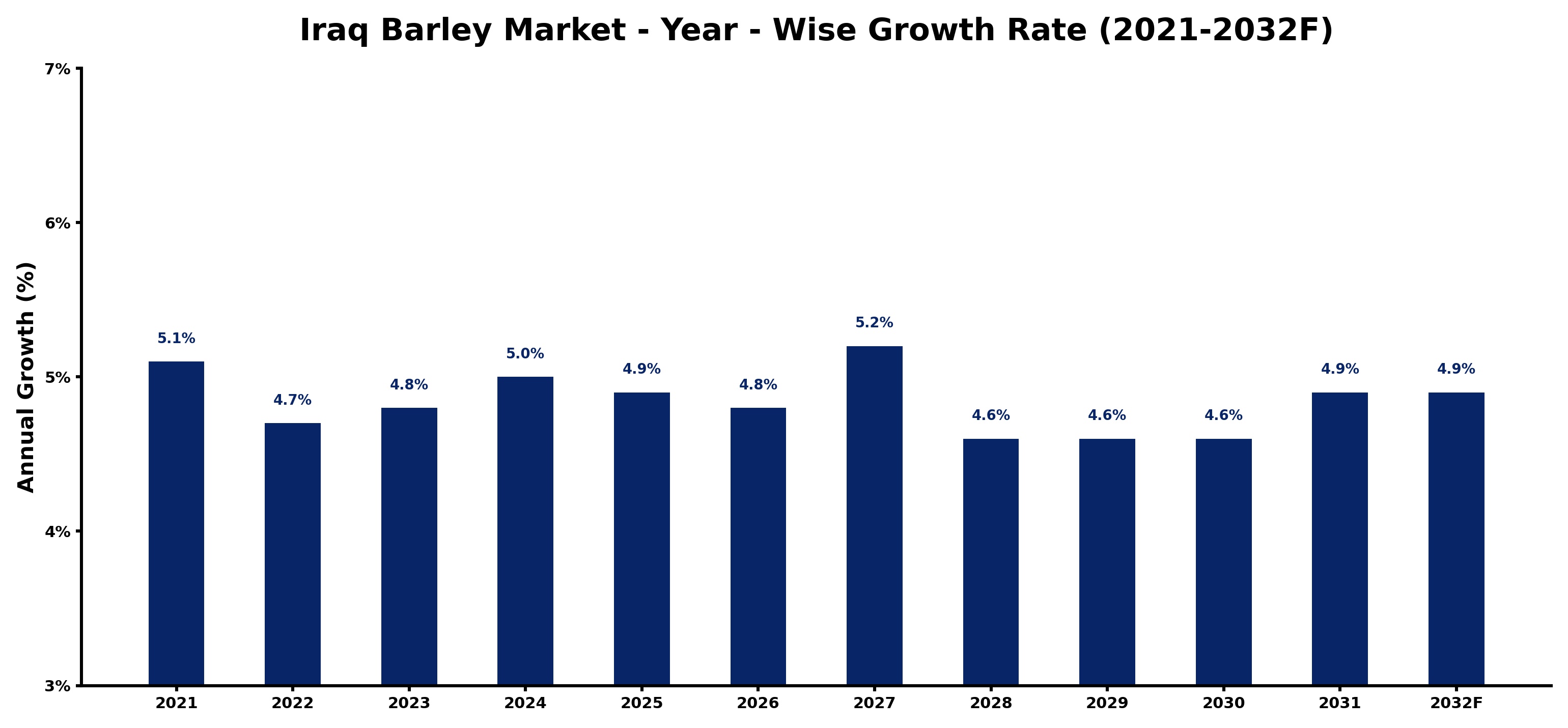
The table below presents the year‑wise growth rates along with the key drivers influencing the market
| Year | Growth Rate | Major Drivers |
| 2021 | 5.1% | New irrigation systems boost barley yields and processing efficiency |
| 2022 | 4.7% | Strengthened grain handling infrastructure improved barley export capacity utilization |
| 2023 | 4.8% | Local mill investments boost barley processing and export capabilities |
| 2024 | 5.0% | Export driven barley quality improvements boost international market competitiveness |
| 2025 | 4.9% | Local malt production facilities attract significant manufacturing investments |
| 2026 | 4.8% | Precision farming technology boosts barley yield and resource efficiency |
| 2027 | 5.2% | Improved irrigation techniques boosted barley yield and market supply |
| 2028 | 4.6% | Domestic grain storage improvements boost barley supply chain efficiency |
| 2029 | 4.6% | New barley processing facilities boost regional grain supply capacity |
| 2030 | 4.6% | Barley processing facility upgrades drive local production capacity expansion |
| 2031 | 4.9% | Barley processing plant upgrades boosted production and export capacity |
| 2032 | 4.9% | Precision farming technology boosts barley yield and export potential |
Note - Market size estimations and growth projections presented in this report are based on 6Wresearch’s advanced forecasting approach, validated with industry datasets as of June 2026.
Iraq Barley Market Synopsis
Currently, the Iraq barley market is witnessing steady consumption levels fueled by the dual demand from the animal feed and brewing industries. As the local livestock sector continues to develop, the reliance on barley for feed formulations has become more pronounced, ensuring its significance in Iraq's agricultural landscape.
Additionally, barley's role in traditional Iraqi cuisine, where it features prominently in soups and stews, enhances its value in the consumer market. However, challenges such as climatic variability and limited arable land due to historical conflicts complicate the production landscape, necessitating strategic interventions.
Iraq Barley Market Key Takeaways
- The market is primarily driven by increasing demand from the animal feed sector.
- Barley consumption is supported by cultural dietary preferences and the popularity of beverages.
- Investment in agricultural infrastructure and sustainable farming methods is essential for growth.
- Challenges from climate and political instability impact local production capabilities.
- Government policies aim to balance import needs with domestic production incentives.
Evaluation of Restraints in Iraq Barley Market
The Iraq barley market faces significant restraints that impede its overall growth trajectory. Limited availability of arable land, primarily due to historical conflicts and ongoing political instability, constrains local production capabilities. Additionally, inconsistent government policies can lead to unpredictability in agricultural output, further complicating the environment for barley cultivation. The lack of modern farming techniques, combined with inadequate access to quality seeds and fertilizers, exacerbates these issues, placing additional pressure on domestic farmers.
Moreover, the market's dependence on imports to meet domestic demand introduces price volatility and potential supply chain disruptions. These factors collectively hinder the competitiveness of the Iraq barley market, creating a complex landscape that requires immediate attention from stakeholders to ensure sustainable growth.
Iraq Barley Market Trends
The Iraq barley market is currently influenced by several key trends that are shaping its demand and technological landscape. A notable trend is the increasing adoption of sustainable farming practices aimed at improving barley yields amidst the challenges posed by water scarcity and inconsistent weather patterns. Furthermore, as consumer preferences shift towards healthier dietary options, the incorporation of barley into various food products is gaining traction.
Simultaneously, the brewing industry in Iraq is expanding, spurred by a younger population that is more inclined to experiment with craft beers and other malt-based beverages. This burgeoning interest in brewing is likely to further elevate barley consumption in the coming years, presenting a dual opportunity for growth within the market.
Iraq Barley Market Opportunities
Investment opportunities in the Iraq barley market are ripe for exploration, particularly in the establishment of barley farming operations. The expansion of the livestock feed industry presents a compelling case for developing local barley production to reduce dependency on imports. Additionally, enhancing storage and distribution infrastructure can effectively cater to the increasing demand for barley and improve supply chain efficiency.
Collaborating with local farmers to implement modern agricultural techniques not only has the potential to increase yield but also to create a more resilient farming community. These investments could significantly bolster the barley sector, ensuring that it meets the growing demand while also contributing to broader economic stability in the region.
Government Initiatives in the Iraq Barley Market
The Iraqi government has implemented a range of policies and initiatives aimed at bolstering the barley market and enhancing food security. Import regulations, including tariffs and quotas, are designed to protect local farmers while promoting domestic production. Furthermore, government subsidies and financial incentives are in place to encourage farmers to increase barley cultivation and improve overall productivity.
Various support programs, including agricultural extension services and research initiatives, are also being introduced to enhance the competitiveness of the barley market. These government efforts reflect a commitment to balancing the needs of domestic farmers with market requirements, thereby ensuring a stable supply of barley for both local consumption and potential export.
Future Insights of the Iraq Barley Market
Looking forward, the Iraq Barley Market is well-positioned for consistent growth between 2026 and 2032. The increasing demand for barley from the livestock sector, coupled with the rising popularity of barley-based food products, signals a robust market trajectory. Favorable climate conditions in certain regions for barley cultivation, alongside government backing for agricultural development, further bolster this optimistic outlook.
However, market stakeholders must remain cognizant of challenges such as water scarcity and the need for technological advancements in farming. By addressing these issues through strategic investments and the promotion of sustainable practices, the Iraq barley market can achieve its full potential in the foreseeable future.
Iraq Barley Market Latest Developments (May 2025 - June 2026)
In recent months, the Iraq barley market has seen a heightened focus on improving agricultural productivity through enhanced farming techniques and irrigation solutions. Stakeholders are increasingly investing in technology-driven approaches to address the challenges posed by climate variability. Additionally, there has been a surge in initiatives aimed at fostering collaboration between local farmers and agricultural experts, ensuring that best practices are disseminated effectively throughout the region.
Moreover, the brewing industry has begun to capitalize on the rising consumer interest in malt beverages, leading to increased barley procurement. This trend indicates a promising direction for the market as the dual demand from both the livestock and brewing sectors continues to grow.
Iraq Barley Market - Key Attractiveness of the Report
- 10 Years of Market Numbers
- Historical Data Starting from 2022 to 2025
- Base Year: 2025
- Forecast Data until 2032
- Key Performance Indicators Impacting the Market
- Major Upcoming Developments and Projects
Key Highlights of the Report:
- Iraq Barley Market Outlook
- Market Size of Iraq Barley Market, 2025
- Forecast of Iraq Barley Market, 2032
- Historical Data and Forecast of Iraq Barley Revenues & Volume for the Period 2022-2032F
- Iraq Barley Market Trend Evolution
- Iraq Barley Market Drivers and Challenges
- Iraq Barley Price Trends
- Iraq Barley Porter's Five Forces
- Iraq Barley Industry Life Cycle
- Historical Data and Forecast of Iraq Barley Market Revenues & Volume By Type for the Period 2022-2032F
- Historical Data and Forecast of Iraq Barley Market Revenues & Volume By Hulless for the Period 2022-2032F
- Historical Data and Forecast of Iraq Barley Market Revenues & Volume By Covered for the Period 2022-2032F
- Historical Data and Forecast of Iraq Barley Market Revenues & Volume By Six-Row Barley for the Period 2022-2032F
- Historical Data and Forecast of Iraq Barley Market Revenues & Volume By Two-Row Barley for the Period 2022-2032F
- Historical Data and Forecast of Iraq Barley Market Revenues & Volume By Grade for the Period 2022-2032F
- Historical Data and Forecast of Iraq Barley Market Revenues & Volume By Food Grade for the Period 2022-2032F
- Historical Data and Forecast of Iraq Barley Market Revenues & Volume By Malt Grade for the Period 2022-2032F
- Historical Data and Forecast of Iraq Barley Market Revenues & Volume By Feed Grade for the Period 2022-2032F
- Historical Data and Forecast of Iraq Barley Market Revenues & Volume By Application for the Period 2022-2032F
- Historical Data and Forecast of Iraq Barley Market Revenues & Volume By Animal Feed for the Period 2022-2032F
- Historical Data and Forecast of Iraq Barley Market Revenues & Volume By Food & Beverages for the Period 2022-2032F
- Historical Data and Forecast of Iraq Barley Market Revenues & Volume By Seed Industry for the Period 2022-2032F
- Historical Data and Forecast of Iraq Barley Market Revenues & Volume By Nutraceuticals for the Period 2022-2032F
- Historical Data and Forecast of Iraq Barley Market Revenues & Volume By Pharmaceuticals for the Period 2022-2032F
- Historical Data and Forecast of Iraq Barley Market Revenues & Volume By Method of Cultivation for the Period 2022-2032F
- Historical Data and Forecast of Iraq Barley Market Revenues & Volume By Organic for the Period 2022-2032F
- Historical Data and Forecast of Iraq Barley Market Revenues & Volume By Inorganic for the Period 2022-2032F
- Iraq Barley Import Export Trade Statistics
- Market Opportunity Assessment By Type
- Market Opportunity Assessment By Grade
- Market Opportunity Assessment By Application
- Market Opportunity Assessment By Method of Cultivation
- Iraq Barley Top Companies Market Share
- Iraq Barley Competitive Benchmarking By Technical and Operational Parameters
- Iraq Barley Company Profiles
- Iraq Barley Key Strategic Recommendations






































