Iraq BBQ Charcoal Market Size, Share & Growth Rate
The Iraq BBQ Charcoal Market was estimated at USD 278 Million in 2025 and is projected to reach USD 360 Million by 2032, growing at a CAGR of 3.8% from 2026 to 2032. This growth trajectory is primarily fueled by the deeply ingrained culinary traditions of outdoor grilling and barbecuing that resonate with the Iraqi lifestyle. As the country embraces leisure-oriented living, the increasing popularity of social gatherings and festive outdoor cooking further solidifies the demand for high-quality BBQ charcoal.
Iraq BBQ Charcoal Market Year-wise Growth Rate and Key Drivers
This graph highlights how the Iraq BBQ Charcoal Market has steadily grown over the years, supported by major growth factors.
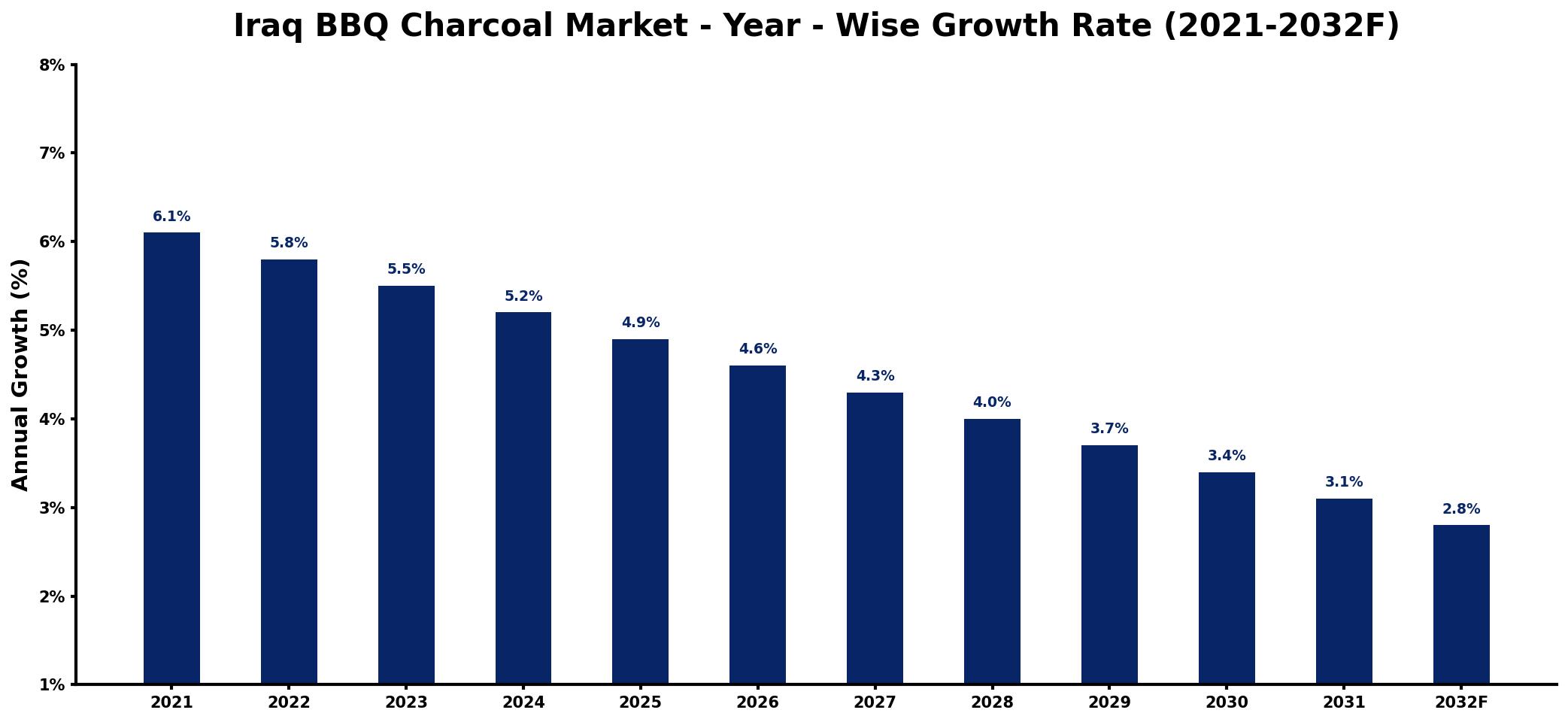
The table below presents the year‑wise growth rates along with the key drivers influencing the market
| Year | Growth Rate | Major Drivers |
| 2021 | 6.1% | Rising outdoor cooking popularity |
| 2022 | 5.8% | Increased consumer disposable income |
| 2023 | 5.5% | Growth in hospitality sector demand |
| 2024 | 5.2% | Expansion of retail distribution channels |
| 2025 | 4.9% | Surge in local production capacity |
| 2026 | 4.6% | Growing trend of outdoor gatherings |
| 2027 | 4.3% | Increased investments in leisure activities |
| 2028 | 4.0% | Higher demand for sustainable options |
| 2029 | 3.7% | Popularity of grilling events rises |
| 2030 | 3.4% | Emergence of new culinary trends |
| 2031 | 3.1% | Boost in tourism and travel |
| 2032 | 2.8% | expanding industrial usage applications |
Note: Market size estimations and growth projections presented in this report are based on 6Wresearch's proprietary forecasting methodology, utilizing the latest available industry data, government publications, and primary research inputs.
Iraq BBQ Charcoal Market Synopsis
In Iraq, BBQ charcoal is not merely a cooking fuel; it embodies cultural significance, especially during celebrations and communal events. The market's dynamics are influenced by the diverse applications of BBQ charcoal, from grilling various meats to preparing seafood and vegetables, catering to a broad consumer base.
The surge in outdoor recreational activities has made BBQ charcoal a staple for many households, particularly during the warmer months. This consistent engagement in outdoor cooking, coupled with a growing interest in quality products, creates a fertile ground for manufacturers to innovate and refine their offerings.
Iraq BBQ Charcoal Market Key Takeaways
- The market is experiencing steady growth driven by cultural and culinary preferences for outdoor cooking.
- High heat output and prolonged burning time of BBQ charcoal are key selling points for consumers.
- Regulatory measures aimed at sustainable production practices are shaping the industry's landscape.
- Competitive pressures from alternative cooking fuels continue to challenge market stability.
- Emerging trends include increased consumer awareness regarding product quality and environmental impacts.
Evaluation of Restraints in Iraq BBQ Charcoal Market
Despite the promising growth outlook, the Iraq BBQ Charcoal Market faces several constraints. Sustainability remains a major concern, as the reliance on traditional charcoal production methods raises issues regarding deforestation and environmental degradation. Fluctuating demand patterns can create instability, particularly with economic uncertainties impacting disposable incomes. Furthermore, the competitive landscape is increasingly influenced by alternative cooking fuels, which often offer convenience and lower costs, adding pressure on traditional charcoal producers.
Iraq BBQ Charcoal Market Trends
Several trends are currently shaping the Iraq BBQ Charcoal Market. A significant trend is the rising consumer awareness regarding the quality and sourcing of charcoal, with more individuals seeking sustainably produced options. Additionally, the integration of innovative technology in charcoal production is enhancing efficiency and product consistency. The market is also witnessing an increase in specialty charcoal products, such as flavored or lump charcoal, which cater to discerning customers looking to elevate their grilling experiences.
Iraq BBQ Charcoal Market Opportunities
The market offers substantial growth and investment opportunities, particularly in the area of sustainable charcoal production. With governmental policies supporting environmental protection and sustainable forestry, businesses that align their operations with these initiatives are likely to benefit from public and private sector support. Moreover, as outdoor dining culture continues to flourish, manufacturers have the chance to innovate and develop niche products to attract a diverse customer base.
Government Initiatives in the Iraq BBQ Charcoal Market
Iraq's government has recognized the importance of the BBQ charcoal market, introducing various initiatives aimed at promoting sustainable practices. Key policies focus on regulating charcoal production to prevent illegal logging and deforestation, coupled with campaigns to raise public awareness about responsible charcoal consumption. These measures not only aim to safeguard the environment but also encourage the development of a more resilient and sustainable charcoal industry.
Future Insights of the Iraq BBQ Charcoal Market
Looking ahead to 2026-2032, the Iraq BBQ Charcoal Market is set to evolve significantly. Consumer preferences will likely continue shifting towards eco-friendly products, prompting manufacturers to adopt greener production methods. Additionally, with increasing urbanization and outdoor lifestyle trends, the demand for BBQ charcoal is expected to rise consistently. Market participants who stay ahead of these trends and invest in product quality and sustainability will be well-positioned to capture growth in this vibrant sector.
Iraq BBQ Charcoal Market Latest Developments (2025 - 2026)
Recent developments in the Iraq BBQ Charcoal Market indicate a growing focus on quality assurance and sustainability among producers. As manufacturers strive to meet new regulatory standards, many are exploring innovative production techniques to enhance product offerings. Furthermore, consumer education campaigns are being launched to raise awareness about the benefits of high-quality, sustainably sourced BBQ charcoal, aligning with global trends towards environmentally responsible consumption.
Iraq BBQ Charcoal Market - Key Attractiveness of the Report
- 10 Years of Market Numbers
- Historical Data Starting from 2022 to 2025
- Base Year: 2025
- Forecast Data until 2032
- Key Performance Indicators Impacting the Market
- Major Upcoming Developments and Projects
Key Highlights of the Report:
- Iraq BBQ Charcoal Market Outlook
- Market Size of Iraq BBQ Charcoal Market, 2025
- Forecast of Iraq BBQ Charcoal Market, 2032
- Historical Data and Forecast of Iraq BBQ Charcoal Revenues & Volume for the Period 2022-2032F
- Iraq BBQ Charcoal Market Trend Evolution
- Iraq BBQ Charcoal Market Drivers and Challenges
- Iraq BBQ Charcoal Price Trends
- Iraq BBQ Charcoal Porter's Five Forces
- Iraq BBQ Charcoal Industry Life Cycle
- Historical Data and Forecast of Iraq BBQ Charcoal Market Revenues & Volume By Form for the Period 2022-2032F
- Historical Data and Forecast of Iraq BBQ Charcoal Market Revenues & Volume By Briquettes BBQ Charcoal for the Period 2022-2032F
- Historical Data and Forecast of Iraq BBQ Charcoal Market Revenues & Volume By Lump Wood BBQ Charcoal for the Period 2022-2032F
- Historical Data and Forecast of Iraq BBQ Charcoal Market Revenues & Volume By Sales Channel for the Period 2022-2032F
- Historical Data and Forecast of Iraq BBQ Charcoal Market Revenues & Volume By Direct BBQ Charcoal Sales for the Period 2022-2032F
- Historical Data and Forecast of Iraq BBQ Charcoal Market Revenues & Volume By Retail BBQ Charcoal Sales for the Period 2022-2032F
- Historical Data and Forecast of Iraq BBQ Charcoal Market Revenues & Volume By End User for the Period 2022-2032F
- Historical Data and Forecast of Iraq BBQ Charcoal Market Revenues & Volume By BBQ Charcoal for Hotels, Restaurants and Catering (HoReCa) for the Period 2022-2032F
- Historical Data and Forecast of Iraq BBQ Charcoal Market Revenues & Volume By BBQ Charcoal for Households for the Period 2022-2032F
- Historical Data and Forecast of Iraq BBQ Charcoal Market Revenues & Volume By Source for the Period 2022-2032F
- Historical Data and Forecast of Iraq BBQ Charcoal Market Revenues & Volume By BBQ Charcoal made from Agricultural Waste for the Period 2022-2032F
- Historical Data and Forecast of Iraq BBQ Charcoal Market Revenues & Volume By BBQ Charcoal made from Coconut Shells for the Period 2022-2032F
- Historical Data and Forecast of Iraq BBQ Charcoal Market Revenues & Volume By BBQ Charcoal made from Nutshells for the Period 2022-2032F
- Historical Data and Forecast of Iraq BBQ Charcoal Market Revenues & Volume By BBQ Charcoal made from Hardwood for the Period 2022-2032F
- Historical Data and Forecast of Iraq BBQ Charcoal Market Revenues & Volume By BBQ Charcoal made from Bamboo for the Period 2022-2032F
- Iraq BBQ Charcoal Import Export Trade Statistics
- Market Opportunity Assessment By Form
- Market Opportunity Assessment By Sales Channel
- Market Opportunity Assessment By End User
- Market Opportunity Assessment By Source
- Iraq BBQ Charcoal Top Companies Market Share
- Iraq BBQ Charcoal Competitive Benchmarking By Technical and Operational Parameters
- Iraq BBQ Charcoal Company Profiles
- Iraq BBQ Charcoal Key Strategic Recommendations






































