South Korea BBQ Charcoal Market Size, Share & Growth Rate
The South Korea BBQ Charcoal Market was estimated at USD 279 Million in 2025 and is projected to reach USD 364 Million by 2032, growing at a CAGR of 3.9% from 2026 to 2032. This growth trajectory is primarily driven by the burgeoning outdoor cooking culture in South Korea, which emphasizes traditional grilling methods. Consumers are increasingly seeking high-quality charcoal products, such as hardwood charcoal and charcoal briquettes, due to their superior heat generation and longer burn times.
South Korea BBQ Charcoal Market Year-wise Growth Rate and Key Drivers
This graph highlights how the South Korea BBQ Charcoal Market has steadily grown over the years, supported by major growth factors.
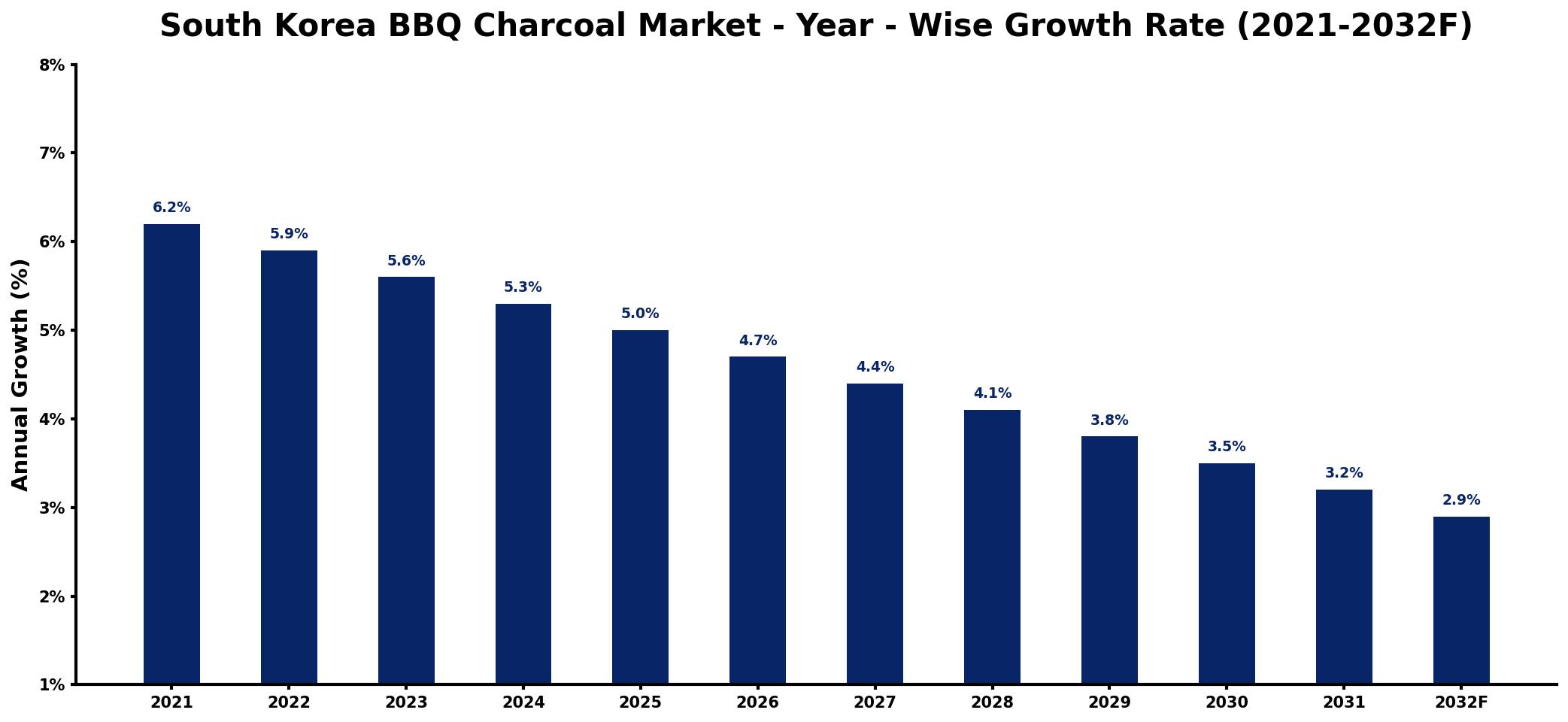
The table below presents the year‑wise growth rates along with the key drivers influencing the market
| Year | Growth Rate | Major Drivers |
| 2021 | 6.2% | Increased outdoor dining popularity |
| 2022 | 5.9% | Growth of grilling lifestyle trends |
| 2023 | 5.6% | Expansion of retail distribution channels |
| 2024 | 5.3% | Rising consumer interest in sustainability |
| 2025 | 5.0% | Increased investment in production facilities |
| 2026 | 4.7% | growing regional consumption patterns |
| 2027 | 4.4% | Emergence of premium product offerings |
| 2028 | 4.1% | Rising demand for outdoor gatherings |
| 2029 | 3.8% | Increased focus on culinary experiences |
| 2030 | 3.5% | Growth in eco-friendly alternatives |
| 2031 | 3.2% | Emerging markets adopting grilling culture |
| 2032 | 2.9% | growing commercial sector adoption |
Note: Market size estimations and growth projections presented in this report are based on 6Wresearch's proprietary forecasting methodology, utilizing the latest available industry data, government publications, and primary research inputs.
South Korea BBQ Charcoal Market Synopsis
The most significant force shaping the South Korea BBQ Charcoal Market is the growing enthusiasm for outdoor grilling, which has permeated social gatherings, family events, and even culinary culture. As urbanization continues, there is a notable shift towards premium and eco-friendly charcoal products that align with consumers increasing awareness of sustainability.
Moreover, the trend towards healthier cooking methods has propelled interest in high-quality charcoal options that offer efficient heat and unique flavor profiles. The increasing popularity of BBQ restaurants and food trucks in urban areas also contributes to the rising demand for premium charcoal products.
South Korea BBQ Charcoal Market Key Takeaways
- Outdoor cooking and BBQ culture are significant growth drivers for the market.
- High-quality charcoal products are in demand, reflecting a shift toward sustainability.
- Government policies are supporting eco-friendly manufacturing practices.
- Raw material price fluctuations pose challenges to consistent market supply.
- Competition from alternative fuels, such as gas and electric, is increasing.
Evaluation of Restraints in South Korea BBQ Charcoal Market
Despite the positive market outlook, the South Korea BBQ Charcoal Market faces several restraints that could limit its growth potential. Notably, fluctuations in the prices of raw materials can lead to unpredictable production costs, affecting overall profitability. Additionally, the increasing competition from alternative grilling fuels, such as gas and electric grills, poses a significant challenge for traditional charcoal producers. Environmental concerns surrounding charcoal production also necessitate adherence to stringent regulations, which may impose additional operational burdens on manufacturers.
South Korea BBQ Charcoal Market Trends
A distinct trend emerging in the South Korea BBQ Charcoal Market is the growing consumer preference for environmentally-friendly products. Innovations in manufacturing processes that utilize sustainable forestry practices are gaining traction, as consumers demand transparency and responsibility from brands. Moreover, an increasing number of artisanal charcoal brands are entering the market, offering unique blends that enhance the grilling experience. The rise of social media influencers promoting outdoor cooking has further fueled consumer interest in premium charcoal products.
South Korea BBQ Charcoal Market Opportunities
Opportunities for growth in the South Korea BBQ Charcoal Market are plentiful. With increasing disposable incomes, consumers are willing to invest in higher-quality grilling products. Furthermore, the expansion of BBQ festivals and food trucks provides new avenues for market penetration. Retailers can leverage online platforms to reach a broader audience, capitalizing on the trend of e-commerce in food and leisure products. There is also a growing demand for charcoal products tailored for specific cooking methods, such as smoking and slow-cooking.
Government Initiatives in the South Korea BBQ Charcoal Market
Government initiatives in South Korea are increasingly focused on promoting sustainable practices within the BBQ charcoal sector. Policies aimed at regulating production and distribution ensure compliance with environmental protection laws and fire safety standards. The government is also investing in public education campaigns to inform consumers about the safe and responsible use of BBQ charcoal. Incentives for businesses adopting eco-friendly manufacturing technologies are expected to foster growth in this market while addressing environmental concerns.
Future Insights of the South Korea BBQ Charcoal Market
Looking ahead to 2026-2032, the South Korea BBQ Charcoal Market is poised for growth, driven by increasing consumer preference for outdoor cooking and grilling experiences. Innovations in product development, particularly in eco-friendly charcoal options, are likely to attract a broader consumer base. As local and international brands adapt to changing consumer demands, market competition will intensify, stimulating further advancements in product quality and sustainability practices. The alignment of consumer trends with government initiatives will also play a crucial role in shaping the future landscape of this market.
South Korea BBQ Charcoal Market Latest Developments (2025 - 2026)
Recent developments in the South Korea BBQ Charcoal Market indicate a significant shift towards environmentally sustainable products. Manufacturers are increasingly investing in eco-friendly production methods and sustainable sourcing of raw materials. Additionally, collaborative initiatives between companies and environmental organizations are emerging, aimed at enhancing industry standards for sustainability. The rise of social media marketing strategies has also been noted, with brands leveraging influencer partnerships to promote their premium charcoal products.
South Korea BBQ Charcoal Market - Key Attractiveness of the Report
- 10 Years of Market Numbers
- Historical Data Starting from 2022 to 2025
- Base Year: 2025
- Forecast Data until 2032
- Key Performance Indicators Impacting the Market
- Major Upcoming Developments and Projects
Key Highlights of the Report:
- South Korea BBQ Charcoal Market Outlook
- Market Size of South Korea BBQ Charcoal Market, 2025
- Forecast of South Korea BBQ Charcoal Market, 2032
- Historical Data and Forecast of South Korea BBQ Charcoal Revenues & Volume for the Period 2022-2032F
- South Korea BBQ Charcoal Market Trend Evolution
- South Korea BBQ Charcoal Market Drivers and Challenges
- South Korea BBQ Charcoal Price Trends
- South Korea BBQ Charcoal Porter's Five Forces
- South Korea BBQ Charcoal Industry Life Cycle
- Historical Data and Forecast of South Korea BBQ Charcoal Market Revenues & Volume By Form for the Period 2022-2032F
- Historical Data and Forecast of South Korea BBQ Charcoal Market Revenues & Volume By Briquettes BBQ Charcoal for the Period 2022-2032F
- Historical Data and Forecast of South Korea BBQ Charcoal Market Revenues & Volume By Lump Wood BBQ Charcoal for the Period 2022-2032F
- Historical Data and Forecast of South Korea BBQ Charcoal Market Revenues & Volume By Sales Channel for the Period 2022-2032F
- Historical Data and Forecast of South Korea BBQ Charcoal Market Revenues & Volume By Direct BBQ Charcoal Sales for the Period 2022-2032F
- Historical Data and Forecast of South Korea BBQ Charcoal Market Revenues & Volume By Retail BBQ Charcoal Sales for the Period 2022-2032F
- Historical Data and Forecast of South Korea BBQ Charcoal Market Revenues & Volume By End User for the Period 2022-2032F
- Historical Data and Forecast of South Korea BBQ Charcoal Market Revenues & Volume By BBQ Charcoal for Hotels, Restaurants and Catering (HoReCa) for the Period 2022-2032F
- Historical Data and Forecast of South Korea BBQ Charcoal Market Revenues & Volume By BBQ Charcoal for Households for the Period 2022-2032F
- Historical Data and Forecast of South Korea BBQ Charcoal Market Revenues & Volume By Source for the Period 2022-2032F
- Historical Data and Forecast of South Korea BBQ Charcoal Market Revenues & Volume By BBQ Charcoal made from Agricultural Waste for the Period 2022-2032F
- Historical Data and Forecast of South Korea BBQ Charcoal Market Revenues & Volume By BBQ Charcoal made from Coconut Shells for the Period 2022-2032F
- Historical Data and Forecast of South Korea BBQ Charcoal Market Revenues & Volume By BBQ Charcoal made from Nutshells for the Period 2022-2032F
- Historical Data and Forecast of South Korea BBQ Charcoal Market Revenues & Volume By BBQ Charcoal made from Hardwood for the Period 2022-2032F
- Historical Data and Forecast of South Korea BBQ Charcoal Market Revenues & Volume By BBQ Charcoal made from Bamboo for the Period 2022-2032F
- South Korea BBQ Charcoal Import Export Trade Statistics
- Market Opportunity Assessment By Form
- Market Opportunity Assessment By Sales Channel
- Market Opportunity Assessment By End User
- Market Opportunity Assessment By Source
- South Korea BBQ Charcoal Top Companies Market Share
- South Korea BBQ Charcoal Competitive Benchmarking By Technical and Operational Parameters
- South Korea BBQ Charcoal Company Profiles
- South Korea BBQ Charcoal Key Strategic Recommendations






































