Iraq Benzoic Acid Market Size, Share & Growth Rate
The Iraq Benzoic Acid Market was estimated at USD 1167 Million in 2025 and is projected to reach USD 1685 Million by 2032, growing at a CAGR of 5.4% from 2026 to 2032. This robust growth is fueled by the increasing applications of benzoic acid across diverse sectors, particularly food and beverage, pharmaceuticals, and personal care products. As consumer preferences shift towards longer shelf life and safer preservation methods, benzoic acid's role as a preservative is increasingly recognized, further driving demand in the region.
Iraq Benzoic Acid Market Year-wise Growth Rate and Key Drivers
This graph highlights how the Iraq Benzoic Acid Market has steadily grown over the years, supported by major growth factors.
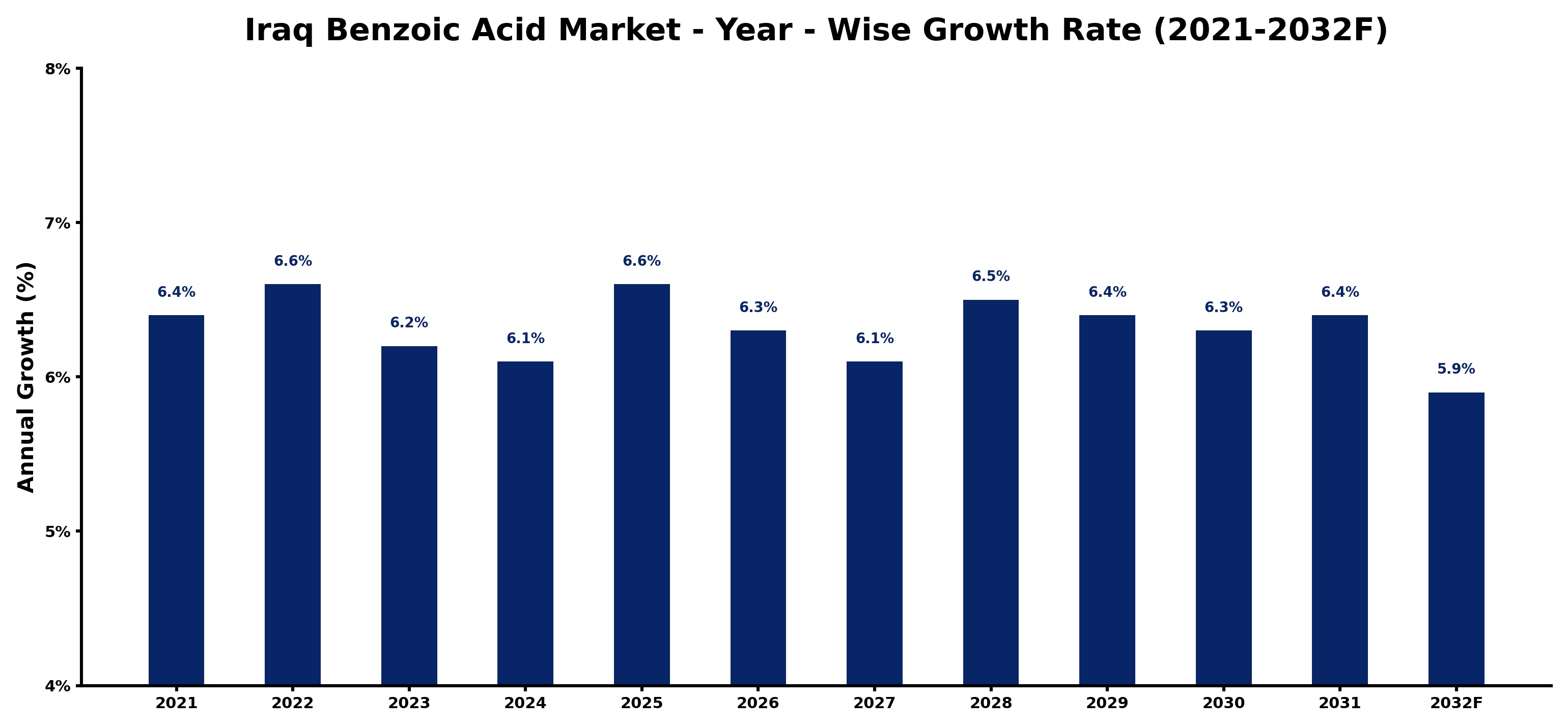
The table below presents the year‑wise growth rates along with the key drivers influencing the market
| Year | Growth Rate | Major Drivers |
| 2021 | 6.4% | Manufacturing investments in chemical plants boosted benzoic acid production capacity |
| 2022 | 6.6% | Higher domestic manufacturing demand boosted benzoic acid production rates |
| 2023 | 6.2% | Investment in chemical processing infrastructure boosts benzoic acid production efficiency |
| 2024 | 6.1% | Increased manufacturing capacity for personal care products drives benzoic acid demand |
| 2025 | 6.6% | Improved production facilities increased benzoic acid manufacturing capacity |
| 2026 | 6.3% | Technology adoption in benzoic acid production enhances efficiency and output |
| 2027 | 6.1% | New chemical production facilities boost benzoic acid manufacturing capacity |
| 2028 | 6.5% | Chemical manufacturers integrate advanced automation to enhance production efficiency |
| 2029 | 6.4% | Local manufacturers invest in advanced processing technologies for benzoic acid |
| 2030 | 6.3% | Improved plant efficiency boosted benzoic acid production capabilities |
| 2031 | 6.4% | Higher local benzoic acid production meets rising domestic chemical demand |
| 2032 | 5.9% | Domestic textile manufacturing boost fuels benzoic acid consumption demand |
Note - Market size estimations and growth projections presented in this report are based on 6Wresearch’s advanced forecasting approach, validated with industry datasets as of June 2026.
Iraq Benzoic Acid Market Synopsis
The strongest force currently shaping the Iraq Benzoic Acid Market is the rising consumer awareness regarding the benefits of preservatives. With an increasing population and improved economic conditions, more consumers are opting for packaged food and beauty products that utilize benzoic acid for preservation. This trend indicates a significant opportunity for growth in the sector.
Moreover, the ongoing shift towards natural and organic ingredients in consumer products is reinforcing the importance of benzoic acid, as it is viewed as a safer alternative compared to synthetic preservatives. This evolution is prompting local manufacturers to innovate and expand their production capacities to cater to an increasingly discerning market.
Iraq Benzoic Acid Market Key Takeaways
- The Iraq Benzoic Acid Market is projected to grow from USD 1167 Million in 2025 to USD 1685 Million by 2032.
- Increasing awareness of benzoic acid's preservative benefits is a key driver of market growth.
- Consumers are gravitating towards products with longer shelf life, boosting demand for benzoic acid.
- Local manufacturers are focusing on product innovation and enhancing distribution networks.
- The trend towards natural and organic preservatives is further elevating benzoic acid's market potential.
Evaluation of Restraints in Iraq Benzoic Acid Market
Despite the positive outlook for the Iraq Benzoic Acid Market, several challenges could hinder its full potential. Limited access to quality raw materials remains a significant issue, with local manufacturers often relying on imports, leading to supply chain vulnerabilities and fluctuating costs. Additionally, competition from alternative preservatives, such as sorbic acid, could pose challenges for market players. Regulatory compliance further complicates operations, as companies must navigate strict quality controls and safety standards set by the government. Maintaining competitiveness while adhering to these demands will be crucial for success in this evolving market.
Iraq Benzoic Acid Market Trends
The Iraq Benzoic Acid Market is seeing several noteworthy trends that shape both demand and technological advancement. One significant trend is the increased emphasis on sustainability, with consumers preferring products that are both effective and environmentally friendly. This shift is prompting manufacturers to invest in more eco-conscious production methods. Additionally, the growing popularity of online retail channels is altering distribution strategies, allowing for wider access to benzoic acid-containing products. As businesses pivot to meet these consumer demands, innovations in formulations are also anticipated, enhancing the efficacy and safety profiles of products.
Iraq Benzoic Acid Market Opportunities
The potential for investment in the Iraq Benzoic Acid Market is promising, particularly due to the escalating demand across various sectors. Opportunities abound in establishing production facilities that capitalize on local resources, reducing dependency on imports. Furthermore, enhancing distribution networks and forging partnerships with local suppliers can facilitate market penetration. Research and development investments focusing on innovative applications of benzoic acid will also be essential, particularly as consumer preferences continue to shift towards natural and organic products.
Government Initiatives in the Iraq Benzoic Acid Market
The Iraqi government is actively promoting policies aimed at regulating the production and import of benzoic acid to ensure safety and quality. By implementing stringent standards for health and environmental safety, the government aims to protect consumer interests while supporting domestic producers. Additionally, measures to promote sustainable practices within the industry underscore a commitment to environmental stewardship. These initiatives not only help safeguard public health but also foster a competitive landscape conducive to market growth.
Future Insights of the Iraq Benzoic Acid Market
Looking forward to the years 2026-2032, the Iraq Benzoic Acid Market is expected to experience substantial growth, driven by increasing industrial applications. The rising disposable income and evolving consumer preferences towards safe, effective preservation methods will further enhance market dynamics. Additionally, as the local economy strengthens, the demand for packaged goods, pharmaceuticals, and personal care items will provide ample opportunities for benzoic acid. With favorable conditions for growth and an expanding range of applications, the market is well-positioned for continued expansion.
Iraq Benzoic Acid Market Latest Developments (May 2025 - June 2026)
In recent months, the Iraq Benzoic Acid Market has witnessed a wave of activity, with several companies enhancing their production capabilities to meet surging demand. Innovations in benzoic acid formulations have also been reported, reflecting a proactive approach to align with consumer preferences for safer and more effective preservatives. Additionally, improvements in distribution logistics have facilitated broader market access, allowing products to reach a larger audience. These developments signify a dynamic and responsive market environment that is adapting to both challenges and opportunities.
Iraq Benzoic Acid Market - Key Attractiveness of the Report
- 10 Years of Market Numbers
- Historical Data Starting from 2022 to 2025
- Base Year: 2025
- Forecast Data until 2032
- Key Performance Indicators Impacting the Market
- Major Upcoming Developments and Projects
Key Highlights of the Report:
- Iraq Benzoic Acid Market Outlook
- Market Size of Iraq Benzoic Acid Market, 2025
- Forecast of Iraq Benzoic Acid Market, 2032
- Historical Data and Forecast of Iraq Benzoic Acid Revenues & Volume for the Period 2022-2032F
- Iraq Benzoic Acid Market Trend Evolution
- Iraq Benzoic Acid Market Drivers and Challenges
- Iraq Benzoic Acid Price Trends
- Iraq Benzoic Acid Porter's Five Forces
- Iraq Benzoic Acid Industry Life Cycle
- Historical Data and Forecast of Iraq Benzoic Acid Market Revenues & Volume By End-use Industry for the Period 2022-2032F
- Historical Data and Forecast of Iraq Benzoic Acid Market Revenues & Volume By Food & Beverages for the Period 2022-2032F
- Historical Data and Forecast of Iraq Benzoic Acid Market Revenues & Volume By Chemical for the Period 2022-2032F
- Historical Data and Forecast of Iraq Benzoic Acid Market Revenues & Volume By Pharmaceutical for the Period 2022-2032F
- Historical Data and Forecast of Iraq Benzoic Acid Market Revenues & Volume By Application for the Period 2022-2032F
- Historical Data and Forecast of Iraq Benzoic Acid Market Revenues & Volume By Benzoates for the Period 2022-2032F
- Historical Data and Forecast of Iraq Benzoic Acid Market Revenues & Volume By Benzoate plasticizers for the Period 2022-2032F
- Historical Data and Forecast of Iraq Benzoic Acid Market Revenues & Volume By Benzoyl Chloride for the Period 2022-2032F
- Historical Data and Forecast of Iraq Benzoic Acid Market Revenues & Volume By Alkyd Resins for the Period 2022-2032F
- Historical Data and Forecast of Iraq Benzoic Acid Market Revenues & Volume By Animal Feed Additive for the Period 2022-2032F
- Iraq Benzoic Acid Import Export Trade Statistics
- Market Opportunity Assessment By End-use Industry
- Market Opportunity Assessment By Application
- Iraq Benzoic Acid Top Companies Market Share
- Iraq Benzoic Acid Competitive Benchmarking By Technical and Operational Parameters
- Iraq Benzoic Acid Company Profiles
- Iraq Benzoic Acid Key Strategic Recommendations






































