Iraq Calcined Petroleum Coke Market Size, Share & Growth Rate
The Iraq Calcined Petroleum Coke Market was estimated at USD 378 Million in 2025 and is projected to reach USD 509 Million by 2032, growing at a CAGR of 4.3% from 2026 to 2032. This growth is being propelled by a surge in the refining and aluminum sectors, where calcined petroleum coke is increasingly recognized as an essential carbon additive. As the demand for aluminum products escalates, the need for consistent, high-quality carbon materials becomes paramount, creating a substantial opportunity for suppliers within the market.
Iraq Calcined Petroleum Coke Market Year-wise Growth Rate and Key Drivers
This graph highlights how the Iraq Calcined Petroleum Coke Market has steadily grown over the years, supported by major growth factors.
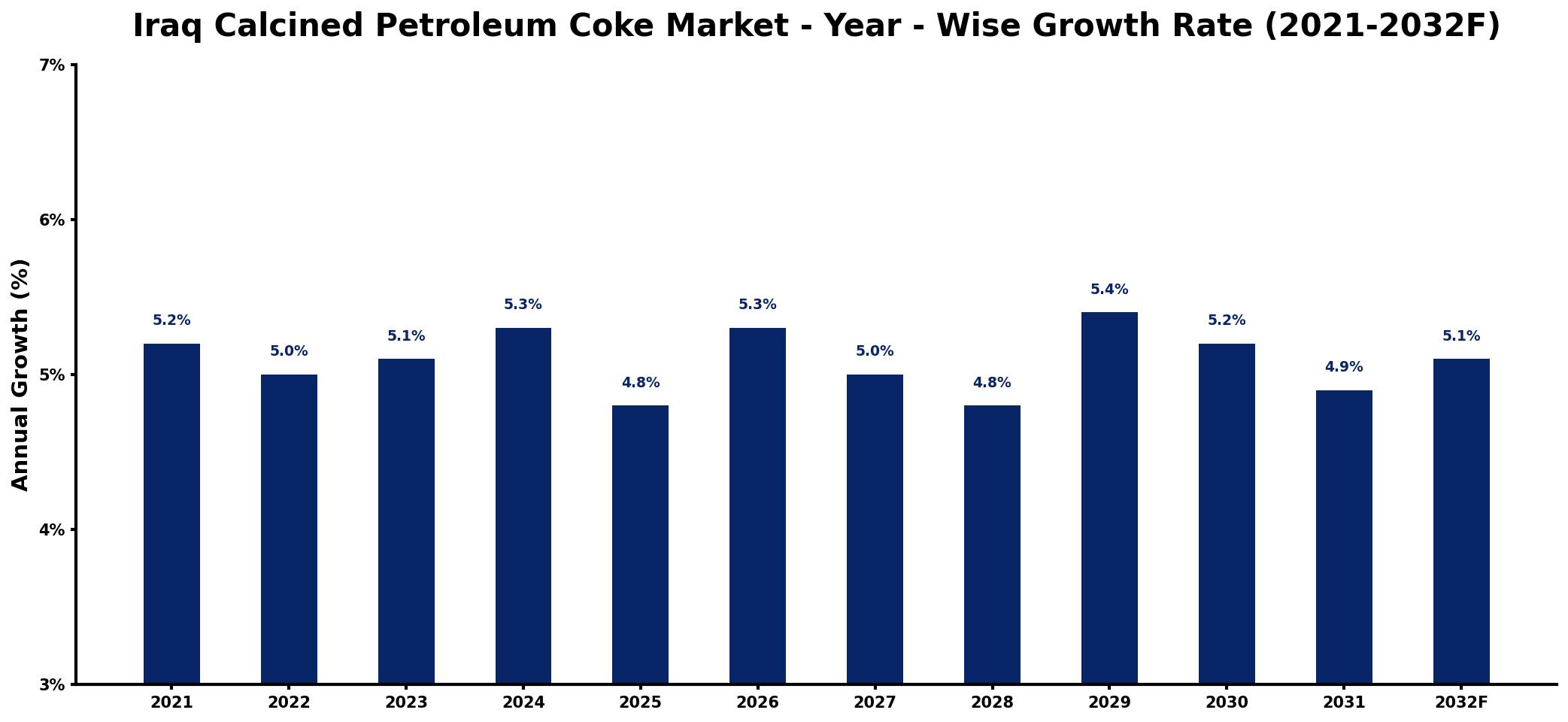
The table below presents the year‑wise growth rates along with the key drivers influencing the market
| Year | Growth Rate | Major Drivers |
| 2021 | 5.2% | Increased industrial energy demand |
| 2022 | 5.0% | Growing aluminum production capacity |
| 2023 | 5.1% | Expansion of manufacturing facilities |
| 2024 | 5.3% | Rising global energy prices |
| 2025 | 4.8% | Shift towards alternative energy sources |
| 2026 | 5.3% | Strengthening export opportunities abroad |
| 2027 | 5.0% | Innovations in production technology |
| 2028 | 4.8% | Enhanced infrastructure development projects |
| 2029 | 5.4% | Growing domestic consumption trends |
| 2030 | 5.2% | Increased foreign direct investments |
| 2031 | 4.9% | Emerging market diversification strategies |
| 2032 | 5.1% | Strengthened regulatory compliance initiatives |
Note: Market size estimations and growth projections presented in this report are based on 6Wresearch's proprietary forecasting methodology, utilizing the latest available industry data, government publications, and primary research inputs.
Iraq Calcined Petroleum Coke Market Synopsis
The most significant force shaping the Iraq Calcined Petroleum Coke Market is the robust demand from the aluminum and metallurgical industries. As Iraqs industrial landscape expands, the requirement for carbon anodes used in aluminum smelting and electrodes for steelmaking is seeing a marked increase, aligning production capabilities with growing market needs.
However, the market is navigating complexities related to environmental regulations and sustainability practices. Balancing the necessity of production with adherence to environmental standards poses challenges that the industry must address to capitalize fully on the available growth opportunities.
Iraq Calcined Petroleum Coke Market Key Takeaways
- The market is experiencing growth primarily due to increased demand from aluminum and steel industries.
- Environmental regulations pose significant challenges that need strategic responses from producers.
- Investment in cleaner technologies is essential for compliance and sustainability.
- Opportunities exist for suppliers focusing on product quality and consistency.
- Government initiatives are shaping the regulatory landscape, influencing market dynamics.
Evaluation of Restraints in Iraq Calcined Petroleum Coke Market
Despite the positive trajectory, the Iraq Calcined Petroleum Coke Market grapples with notable restraints. Key among these are the stringent environmental regulations that aim to curtail the carbon footprint associated with petroleum coke production. Additionally, fluctuations in demand from core industries like aluminum and steel can introduce volatility into the market. The growing competition from alternative carbon materials further complicates the landscape for domestic producers. To maintain competitive advantage, significant investment in quality assurance and diversification strategies will be critical.
Iraq Calcined Petroleum Coke Market Trends
Currently, the market is witnessing a shift towards cleaner production technologies as stakeholders recognize the importance of sustainability. Innovations in calcination processes are enhancing the quality of calcined petroleum coke, meeting stricter industry specifications. Furthermore, the emphasis on recycling and reusing materials is driving trends that favor sustainable practices across the sector, which may reshape the product offerings in the coming years.
Iraq Calcined Petroleum Coke Market Opportunities
The landscape for growth within the Iraq Calcined Petroleum Coke Market is promising. Opportunities abound for suppliers willing to invest in advanced production techniques that enhance product consistency and quality. Theres also a notable potential for research and development into alternative uses of petroleum coke, which can expand its application beyond traditional industries. As the refining capacity in Iraq increases, so too will the availability of raw materials, further fueling market expansion.
Government Initiatives in the Iraq Calcined Petroleum Coke Market
The Iraqi government has implemented a series of initiatives to bolster the calcined petroleum coke market. These measures are geared towards improving product quality and ensuring compliance with environmental standards. The government is also fostering investment in calcination facilities to elevate processing capabilities, in addition to incentivizing research and development efforts aimed at exploring alternative applications for petroleum coke. Such initiatives are expected to create a more robust regulatory environment that promotes sustainable practices.
Future Insights of the Iraq Calcined Petroleum Coke Market
Looking ahead to 2026-2032, the Iraq Calcined Petroleum Coke Market is poised for continued growth, driven by persistent demand from aluminum and steel sectors. Advancements in production technologies and adherence to environmental regulations will shape the competitive landscape. As the focus on sustainability intensifies, the market will likely see innovative approaches to coke production and utilization. Investment in cleaner technologies will not only support regulatory compliance but may also open avenues for new business models, ensuring long-term viability and growth.
Iraq Calcined Petroleum Coke Market Latest Developments (2025 - 2026)
Recent developments in the Iraq Calcined Petroleum Coke Market indicate a heightened focus on technological innovation to meet evolving industry standards. As companies actively seek to improve their environmental footprint, investments are increasingly directed towards cleaner production methods. Additionally, partnerships between industry players are emerging, aimed at enhancing supply chain efficiencies and product quality. These trends highlight the market's adaptive strategies in response to both regulatory pressures and evolving consumer demands.
Iraq Calcined Petroleum Coke Market - Key Attractiveness of the Report
- 10 Years of Market Numbers
- Historical Data Starting from 2022 to 2025
- Base Year: 2025
- Forecast Data until 2032
- Key Performance Indicators Impacting the Market
- Major Upcoming Developments and Projects
Key Highlights of the Report:
- Iraq Calcined Petroleum Coke Market Outlook
- Market Size of Iraq Calcined Petroleum Coke Market, 2025
- Forecast of Iraq Calcined Petroleum Coke Market, 2032
- Historical Data and Forecast of Iraq Calcined Petroleum Coke Revenues & Volume for the Period 2022-2032F
- Iraq Calcined Petroleum Coke Market Trend Evolution
- Iraq Calcined Petroleum Coke Market Drivers and Challenges
- Iraq Calcined Petroleum Coke Price Trends
- Iraq Calcined Petroleum Coke Porter's Five Forces
- Iraq Calcined Petroleum Coke Industry Life Cycle
- Historical Data and Forecast of Iraq Calcined Petroleum Coke Market Revenues & Volume By Type for the Period 2022-2032F
- Historical Data and Forecast of Iraq Calcined Petroleum Coke Market Revenues & Volume By Anode Grade for the Period 2022-2032F
- Historical Data and Forecast of Iraq Calcined Petroleum Coke Market Revenues & Volume By Needle Grade for the Period 2022-2032F
- Historical Data and Forecast of Iraq Calcined Petroleum Coke Market Revenues & Volume By for the Period 2022-2032F
- Historical Data and Forecast of Iraq Calcined Petroleum Coke Market Revenues & Volume By End-user for the Period 2022-2032F
- Historical Data and Forecast of Iraq Calcined Petroleum Coke Market Revenues & Volume By Carburizing & Recarburizing for the Period 2022-2032F
- Historical Data and Forecast of Iraq Calcined Petroleum Coke Market Revenues & Volume By Electric Arc & Induction Furnaces for the Period 2022-2032F
- Historical Data and Forecast of Iraq Calcined Petroleum Coke Market Revenues & Volume By Others for the Period 2022-2032F
- Iraq Calcined Petroleum Coke Import Export Trade Statistics
- Market Opportunity Assessment By Type
- Market Opportunity Assessment By End-user
- Iraq Calcined Petroleum Coke Top Companies Market Share
- Iraq Calcined Petroleum Coke Competitive Benchmarking By Technical and Operational Parameters
- Iraq Calcined Petroleum Coke Company Profiles
- Iraq Calcined Petroleum Coke Key Strategic Recommendations






































