Iraq Carbon Credit Market Size, Share & Growth Rate
The Iraq Carbon Credit Market was estimated at USD 156 Million in 2025 and is projected to reach USD 209 Million by 2032, growing at a CAGR of 4.3% from 2026 to 2032. This growth trajectory is primarily driven by the increased adoption of renewable energy projects and the growing awareness among businesses about carbon credit trading. The Iraqi governments commitment to environmental initiatives also fuels the demand for carbon credits as companies strive to meet international compliance standards.
Iraq Carbon Credit Market Year-wise Growth Rate and Key Drivers
This graph highlights how the Iraq Carbon Credit Market has steadily grown over the years, supported by major growth factors.
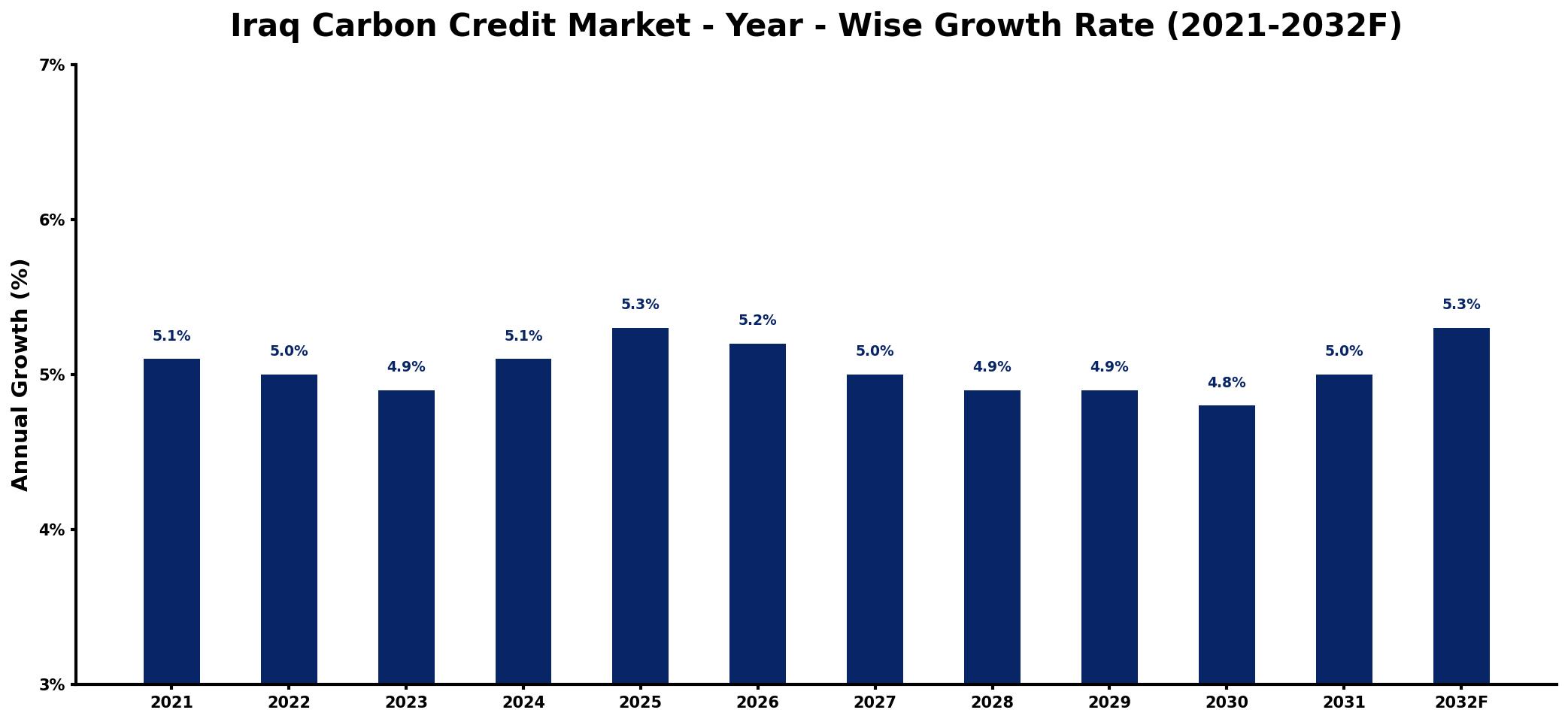
The table below presents the year‑wise growth rates along with the key drivers influencing the market
| Year | Growth Rate | Major Drivers |
| 2021 | 5.1% | increased renewable energy investments |
| 2022 | 5.0% | growing interest in sustainability initiatives |
| 2023 | 4.9% | rising corporate environmental commitments |
| 2024 | 5.1% | expansion of green technology adoption |
| 2025 | 5.3% | enhanced regulatory support frameworks |
| 2026 | 5.2% | strengthened international cooperation efforts |
| 2027 | 5.0% | growing market for sustainable practices |
| 2028 | 4.9% | increased public awareness campaigns |
| 2029 | 4.9% | greater participation from private sector |
| 2030 | 4.8% | emphasis on climate change mitigation |
| 2031 | 5.0% | development of innovative financing models |
| 2032 | 5.3% | broadened scope of environmental policies |
Note: Market size estimations and growth projections presented in this report are based on 6Wresearch's proprietary forecasting methodology, utilizing the latest available industry data, government publications, and primary research inputs.
Iraq Carbon Credit Market Synopsis
Recently, the Iraq Carbon Credit Market has gained traction, reflecting a budding commitment to reduce greenhouse gas emissions and bolster sustainability. Various sectors, particularly energy and waste management, are embracing carbon credit projects, signaling a shift toward an eco-friendly economic model.
Despite its early-stage development, the market is poised for growth as Iraq seeks to diversify its economy and attract foreign investment. However, the journey is not without obstacles, including political instability and an evolving regulatory landscape, which must be navigated to fully realize this potential.
Iraq Carbon Credit Market Key Takeaways
- The market is on an upward trajectory, with significant investment opportunities in renewable energy projects.
- Government support and international collaborations are crucial for market development and overcoming existing challenges.
- Growing awareness among businesses about carbon credits is contributing to increased participation in the market.
- Political stability and regulatory clarity will be essential for sustained growth and investment confidence.
- Market growth aligns with global trends emphasizing sustainability and compliance with environmental regulations.
Evaluation of Restraints in Iraq Carbon Credit Market
The Iraq Carbon Credit Market faces several significant restraints that may impede its development. One of the most pressing issues is the ongoing political instability, which creates uncertainty and deters both domestic and foreign investment. Additionally, the lack of a clear regulatory framework hampers businesses from understanding their roles within carbon credit trading. This uncertainty, compounded by insufficient infrastructure to monitor and report emissions, limits the market's growth potential. Moreover, many stakeholders possess a limited understanding of carbon credit mechanisms, which can stall the implementation of effective emission reduction strategies. Addressing these obstacles through robust governance and clear policies will be crucial to unleashing the markets full potential.
Iraq Carbon Credit Market Trends
Emerging trends in the Iraq Carbon Credit Market include a significant shift toward renewable energy adoption, particularly solar and wind projects. As the world increasingly prioritizes sustainability, Iraqi businesses are aligning their strategies to meet both local and international environmental standards. Additionally, companies are exploring innovative ways to monetize carbon credits, leading to heightened interest and participation in trading. Education and capacity-building initiatives are gaining traction, aimed at improving understanding and expertise in carbon credit mechanisms. This evolving landscape suggests a growing market maturity and readiness for expansion.
Iraq Carbon Credit Market Opportunities
Investment opportunities abound within the Iraq Carbon Credit Market, particularly in renewable energy projects such as solar and wind initiatives. The potential for energy efficiency improvements and reforestation efforts further enhances the appeal of this market for investors. As companies increasingly look to offset their emissions, engaging in carbon credit trading can yield both financial returns and contribute positively to environmental sustainability. The collaborative efforts between government, private sector, and international partners create a fertile ground for long-term investments in sustainable projects.
Government Initiatives in the Iraq Carbon Credit Market
The Iraqi government is actively pursuing policies aimed at fostering a vibrant carbon credit market. By setting ambitious emission reduction targets and implementing regulations to monitor and report emissions, the government is signaling its commitment to a low-carbon economy. Initiatives designed to attract investments in clean energy projects further support this objective. Iraq's participation in international agreements such as the Paris Agreement highlights its dedication to engaging in global climate action and promoting sustainable practices through the carbon credit market.
Future Insights of the Iraq Carbon Credit Market
Looking ahead to 2026-2032, the Iraq Carbon Credit Market is anticipated to expand as the country increasingly recognizes the importance of sustainability. The combination of a growing renewable energy sector and rising global emphasis on environmental responsibility presents substantial opportunities for market growth. However, the trajectory of this growth will be heavily influenced by improvements in political stability and the establishment of a clear regulatory framework. If these factors align, Iraq has the potential to emerge as a key player in the regional carbon credit landscape, attracting investments that drive sustainable development initiatives.
Iraq Carbon Credit Market Latest Developments (2025 - 2026)
Recent developments in the Iraq Carbon Credit Market indicate a growing commitment from both public and private sectors towards sustainable initiatives. Collaborative partnerships are being formed to enhance the capacity for generating and trading carbon credits. Projects focusing on renewable energy sources, particularly in solar and wind, are gaining significant momentum. Additionally, there are discussions around creating a more structured regulatory framework to facilitate the trading of carbon credits, which could bolster investor confidence and streamline market operations.
Iraq Carbon Credit Market - Key Attractiveness of the Report
- 10 Years of Market Numbers
- Historical Data Starting from 2022 to 2025
- Base Year: 2025
- Forecast Data until 2032
- Key Performance Indicators Impacting the Market
- Major Upcoming Developments and Projects
Key Highlights of the Report:
- Iraq Carbon Credit Market Outlook
- Market Size of Iraq Carbon Credit Market, 2025
- Forecast of Iraq Carbon Credit Market, 2032
- Historical Data and Forecast of Iraq Carbon Credit Revenues & Volume for the Period 2022-2032F
- Iraq Carbon Credit Market Trend Evolution
- Iraq Carbon Credit Market Drivers and Challenges
- Iraq Carbon Credit Price Trends
- Iraq Carbon Credit Porter's Five Forces
- Iraq Carbon Credit Industry Life Cycle
- Historical Data and Forecast of Iraq Carbon Credit Market Revenues & Volume By Sector for the Period 2022-2032F
- Historical Data and Forecast of Iraq Carbon Credit Market Revenues & Volume By Energy for the Period 2022-2032F
- Historical Data and Forecast of Iraq Carbon Credit Market Revenues & Volume By Transportation for the Period 2022-2032F
- Historical Data and Forecast of Iraq Carbon Credit Market Revenues & Volume By Residential And Commercial Buildings for the Period 2022-2032F
- Historical Data and Forecast of Iraq Carbon Credit Market Revenues & Volume By Industry for the Period 2022-2032F
- Historical Data and Forecast of Iraq Carbon Credit Market Revenues & Volume By Agriculture for the Period 2022-2032F
- Historical Data and Forecast of Iraq Carbon Credit Market Revenues & Volume By Forestry for the Period 2022-2032F
- Historical Data and Forecast of Iraq Carbon Credit Market Revenues & Volume By Water And Wastewater for the Period 2022-2032F
- Iraq Carbon Credit Import Export Trade Statistics
- Market Opportunity Assessment By Sector
- Iraq Carbon Credit Top Companies Market Share
- Iraq Carbon Credit Competitive Benchmarking By Technical and Operational Parameters
- Iraq Carbon Credit Company Profiles
- Iraq Carbon Credit Key Strategic Recommendations






































