Iraq Castor Oil Market Size, Share & Growth Rate
The Iraq Castor Oil Market was estimated at USD 484 Million in 2025 and is projected to reach USD 635 Million by 2032, growing at a CAGR of 4.0% from 2026 to 2032. This growth is significantly driven by the increasing demand from the pharmaceutical and cosmetic industries, as well as the expanding industrial applications of castor oil. Its unique properties as a natural, renewable resource align perfectly with the current global shift towards sustainable and eco-friendly products, ensuring a steady rise in market consumption.
Iraq Castor Oil Market Year-wise Growth Rate and Key Drivers
This graph highlights how the Iraq Castor Oil Market has steadily grown over the years, supported by major growth factors.
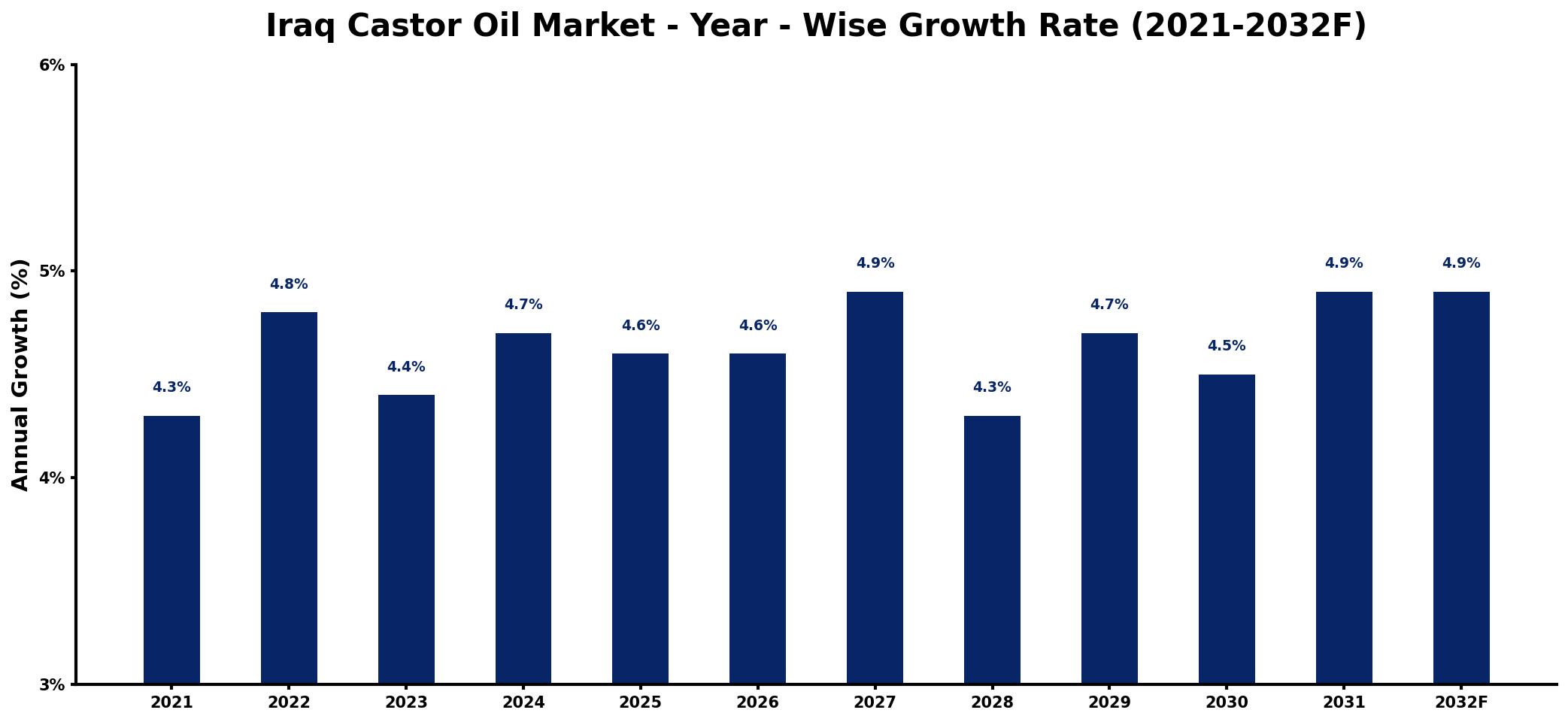
The table below presents the year‑wise growth rates along with the key drivers influencing the market
| Year | Growth Rate | Major Drivers |
| 2021 | 4.3% | Increased demand for natural ingredients |
| 2022 | 4.8% | Expansion of personal care sector |
| 2023 | 4.4% | Growth in biofuel production initiatives |
| 2024 | 4.7% | Rising interest in sustainable products |
| 2025 | 4.6% | Investment in agricultural technologies |
| 2026 | 4.6% | Higher consumption in food industry |
| 2027 | 4.9% | Emergence of new industrial applications |
| 2028 | 4.3% | Increase in export opportunities |
| 2029 | 4.7% | Development of innovative formulations |
| 2030 | 4.5% | Strengthening of regional supply chains |
| 2031 | 4.9% | rising infrastructure development spending |
| 2032 | 4.9% | Growing popularity of eco-friendly alternatives |
Note: Market size estimations and growth projections presented in this report are based on 6Wresearch's proprietary forecasting methodology, utilizing the latest available industry data, government publications, and primary research inputs.
Iraq Castor Oil Market Synopsis
The Iraqi castor oil sector is on an upward trajectory, buoyed by its widespread use in pharmaceuticals, cosmetics, and industrial applications. This versatile oil, derived from castor beans, is gaining popularity due to its effectiveness as a natural moisturizer and lubricant, making it a sought-after ingredient across various sectors.
With the ongoing trend towards sustainable sourcing and natural products, the Iraqi castor oil market is well-positioned for growth. Producers are increasingly focusing on improving extraction methods and supply chain sustainability to meet consumer expectations for quality and environmentally friendly practices.
Iraq Castor Oil Market Key Takeaways
- The market is projected to grow at a CAGR of 4.0% from 2026 to 2032, reaching USD 635 Million by 2032.
- Demand is primarily driven by the pharmaceutical and cosmetic sectors, which value castor oil's moisturizing properties.
- Investment in agricultural practices and processing infrastructure is crucial to enhance production capabilities.
- The market faces competition from imported castor oil and alternative vegetable oils.
- Government initiatives are supporting sustainable practices and improving market access for local producers.
Evaluation of Restraints in Iraq Castor Oil Market
The Iraq Castor Oil Market contends with significant agricultural production constraints. Limited availability of arable land dedicated to castor bean cultivation, coupled with underdeveloped processing infrastructure, hampers growth potential. Fluctuating demand from key sectors, including pharmaceuticals and cosmetics, can create instability, affecting domestic producers. Additionally, intense competition from imported oils and alternative vegetable oils further complicates the landscape, necessitating strategies to enhance local production and maintain market share.
Iraq Castor Oil Market Trends
Current trends indicate a marked shift towards natural and organic ingredients, propelling the demand for castor oil in personal care products. The rise of bio-based chemicals and renewable resources is encouraging manufacturers to incorporate castor oil into their formulations. Furthermore, advancements in extraction technologies are optimizing the efficiency and quality of castor oil, making it more appealing to various industrial applications.
Iraq Castor Oil Market Opportunities
Significant growth opportunities exist for investors in the Iraqi castor oil sector. There is a burgeoning demand for sustainable agricultural practices and value-added processing solutions. Producers who focus on quality enhancement and innovative product development are likely to capture increasing market shares. Additionally, tapping into export markets could offer new revenue streams for domestic manufacturers, particularly as global demand for castor oil continues to rise.
Government Initiatives in the Iraq Castor Oil Market
The Iraqi government recognizes the strategic importance of the castor oil market and has implemented policies aimed at fostering its growth. Initiatives include promoting sustainable cultivation practices, enhancing extraction technologies, and supporting research and innovation in product development. Furthermore, there is an emphasis on improving market access for local producers and encouraging investment in value-added processing to stimulate economic growth within this sector.
Future Insights of the Iraq Castor Oil Market
Looking ahead to 2026-2032, the Iraq Castor Oil Market is poised for robust growth. As the demand for natural and sustainable products continues to gain momentum, local producers are expected to adapt swiftly by improving production processes and diversifying their offerings. Innovations in product applications, particularly in the pharmaceutical and cosmetic industries, will drive increased consumption, thus enhancing market viability.
Iraq Castor Oil Market Latest Developments (2025 - 2026)
Recent developments in the Iraqi castor oil market have focused on strengthening the supply chain and boosting production efficiency. Initiatives aimed at upgrading processing facilities are gaining traction, with stakeholders increasingly prioritizing quality enhancement. There is a notable movement towards collaborations between governmental entities and local producers to promote sustainable practices and expand market reach, reflecting a strong commitment to revitalizing the sector.
Iraq Castor Oil Market - Key Attractiveness of the Report
- 10 Years of Market Numbers
- Historical Data Starting from 2022 to 2025
- Base Year: 2025
- Forecast Data until 2032
- Key Performance Indicators Impacting the Market
- Major Upcoming Developments and Projects
Key Highlights of the Report:
- Iraq Castor Oil Market Outlook
- Market Size of Iraq Castor Oil Market, 2025
- Forecast of Iraq Castor Oil Market, 2032
- Historical Data and Forecast of Iraq Castor Oil Revenues & Volume for the Period 2022-2032F
- Iraq Castor Oil Market Trend Evolution
- Iraq Castor Oil Market Drivers and Challenges
- Iraq Castor Oil Price Trends
- Iraq Castor Oil Porter's Five Forces
- Iraq Castor Oil Industry Life Cycle
- Historical Data and Forecast of Iraq Castor Oil Market Revenues & Volume By End Use for the Period 2022-2032F
- Historical Data and Forecast of Iraq Castor Oil Market Revenues & Volume By Pharmaceuticals for the Period 2022-2032F
- Historical Data and Forecast of Iraq Castor Oil Market Revenues & Volume By Lubricants for the Period 2022-2032F
- Historical Data and Forecast of Iraq Castor Oil Market Revenues & Volume By Paints for the Period 2022-2032F
- Historical Data and Forecast of Iraq Castor Oil Market Revenues & Volume By Soaps for the Period 2022-2032F
- Historical Data and Forecast of Iraq Castor Oil Market Revenues & Volume By Others for the Period 2022-2032F
- Iraq Castor Oil Import Export Trade Statistics
- Market Opportunity Assessment By End Use
- Iraq Castor Oil Top Companies Market Share
- Iraq Castor Oil Competitive Benchmarking By Technical and Operational Parameters
- Iraq Castor Oil Company Profiles
- Iraq Castor Oil Key Strategic Recommendations






































