Iraq Cellular Glass Market Size, Share & Growth Rate
The Iraq Cellular Glass Market was estimated at USD 339 Million in 2025 and is projected to reach USD 459 Million by 2032, growing at a CAGR of 4.4% from 2026 to 2032. This growth trajectory is primarily driven by escalating construction activities across residential, commercial, and industrial sectors, alongside a significant emphasis on energy-efficient building practices. Additionally, the rising awareness regarding the benefits of sustainable building materials is further propelling the demand for cellular glass in Iraq.
Iraq Cellular Glass Market Year-wise Growth Rate and Key Drivers
This graph highlights how the Iraq Cellular Glass Market has steadily grown over the years, supported by major growth factors.
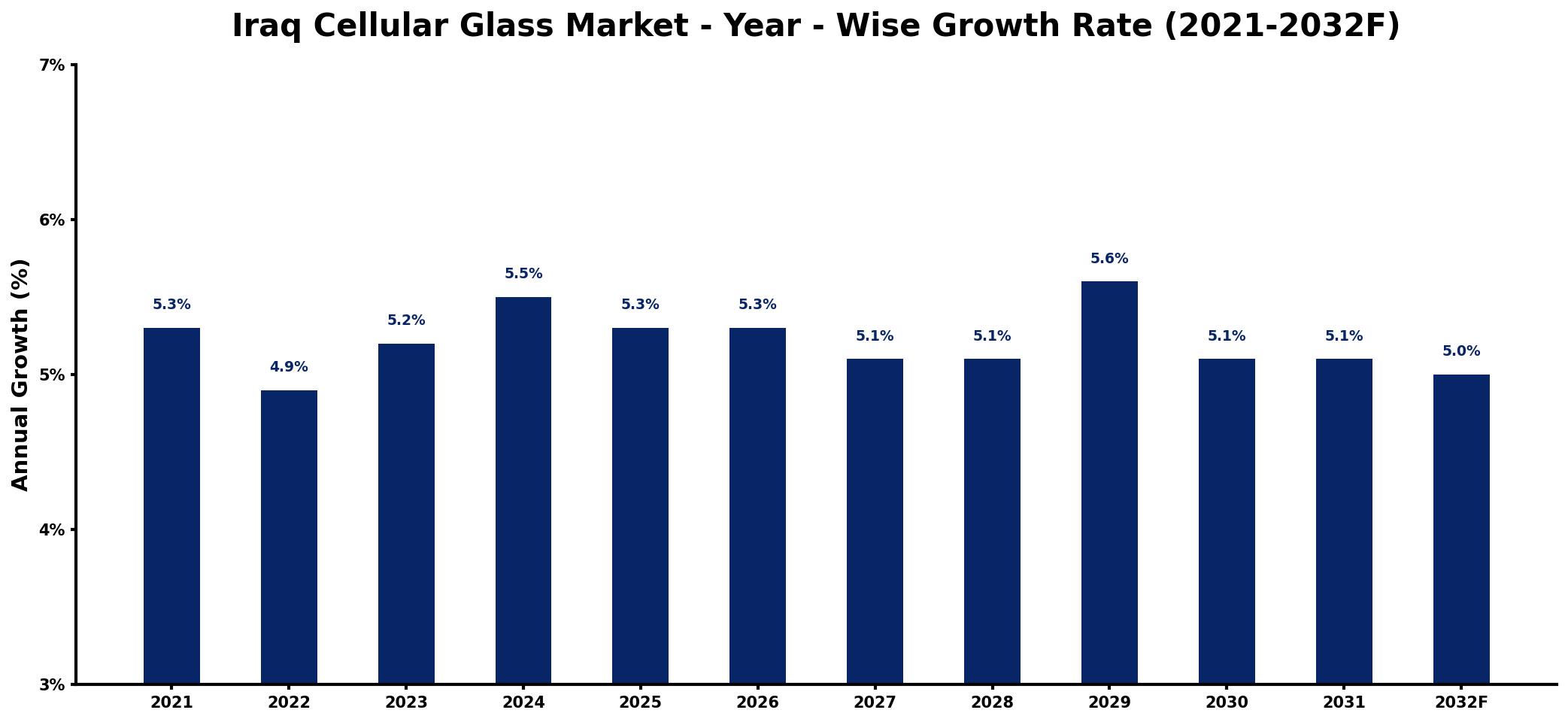
The table below presents the year‑wise growth rates along with the key drivers influencing the market
| Year | Growth Rate | Major Drivers |
| 2021 | 5.3% | Rising construction sector investments |
| 2022 | 4.9% | Increased demand for insulation materials |
| 2023 | 5.2% | Growth in renewable energy projects |
| 2024 | 5.5% | Expansion of manufacturing capabilities |
| 2025 | 5.3% | Surge in urban development initiatives |
| 2026 | 5.3% | Emergence of new construction technologies |
| 2027 | 5.1% | Boost in energy efficiency regulations |
| 2028 | 5.1% | Higher investments in infrastructure projects |
| 2029 | 5.6% | Growing focus on sustainable materials |
| 2030 | 5.1% | Development of innovative building solutions |
| 2031 | 5.1% | Strengthening of regional trade partnerships |
| 2032 | 5.0% | Increased awareness of eco-friendly options |
Note: Market size estimations and growth projections presented in this report are based on 6Wresearch's proprietary forecasting methodology, utilizing the latest available industry data, government publications, and primary research inputs.
Iraq Cellular Glass Market Synopsis
The strongest force shaping the Iraq Cellular Glass Market is the surge in construction activities aimed at infrastructure development and reconstruction efforts. This momentum is not only revitalizing the economy but also creating a pressing need for high-performance insulation solutions that cater to various building requirements.
Cellular glass stands out due to its exceptional thermal insulation properties, fire resistance, and eco-friendliness, making it a favorable choice for architects and builders alike. As more projects adopt sustainable practices, cellular glass is poised to become a cornerstone material in Iraq's evolving construction landscape.
Iraq Cellular Glass Market Key Takeaways
- Steady market growth driven by increasing construction and infrastructure development activities.
- Heightened awareness of energy efficiency and sustainability among builders and consumers.
- Cellular glass emerging as a preferred material for green building initiatives.
- Focus on product innovation to meet the specific needs of the growing construction sector.
- Investment opportunities emerging due to government support for local manufacturing.
Evaluation of Restraints in Iraq Cellular Glass Market
Despite the positive market outlook, several restraints hinder the growth of the Iraq Cellular Glass Market. One notable constraint is the limited availability of skilled labor equipped to install and maintain cellular glass products effectively. Additionally, inconsistencies in quality standards among various suppliers raise concerns about the reliability and performance of the material. Political instability in the region further complicates the business environment, potentially discouraging foreign investment. Moreover, a general lack of awareness among builders and consumers about the advantages of cellular glass continues to impede wider market penetration.
Iraq Cellular Glass Market Trends
The Iraq Cellular Glass Market is currently witnessing an important shift toward sustainable building materials, with cellular glass being at the forefront due to its lightweight, durable, and eco-friendly characteristics. Innovations in manufacturing processes are also emerging, allowing for enhanced product offerings that better meet the evolving needs of the construction sector. Furthermore, a notable trend is the integration of cellular glass in various applications, including insulation for roofs, walls, and floors, aligning with global trends towards energy-efficient building solutions.
Iraq Cellular Glass Market Opportunities
Investment opportunities within the Iraq Cellular Glass Market are robust, especially as the construction sector increasingly seeks energy-efficient materials. Investors have the potential to explore collaborations with local manufacturers or construction firms, particularly those embracing sustainable practices. The market presents a favorable landscape for long-term investments as government initiatives aim to foster local production capabilities and reduce reliance on imports.
Government Initiatives in the Iraq Cellular Glass Market
Government policies in Iraq are primarily geared towards bolstering local production of construction materials, including cellular glass. Initiatives such as import tariffs on competing products, along with subsidies for domestic manufacturers, are designed to nurture and protect the local industry. Furthermore, regulations have been enacted to ensure fair competition and prevent monopolistic practices, while the government also promotes research and development to stimulate innovation and improve product quality in the sector.
Future Insights of the Iraq Cellular Glass Market
Looking ahead to the 2026-2032 period, the Iraq Cellular Glass Market is anticipated to experience sustained growth, fueled by the ongoing emphasis on energy-efficient and sustainable building practices. As the government continues its commitment to infrastructure development, the demand for high-quality insulation solutions will rise. Industries such as oil and gas, healthcare, and hospitality are expected to expand, further driving the need for cellular glass in diverse applications, making this market a focal point for future investment and development.
Iraq Cellular Glass Market Latest Developments (2025 - 2026)
In recent months, the Iraq Cellular Glass Market has seen increased activity, characterized by the introduction of innovative products tailored to meet the diverse needs of the construction sector. New partnerships are forming between local manufacturers and international firms to enhance production capabilities, while marketing initiatives are being launched to raise awareness of cellular glass benefits. There is also a notable increase in projects incorporating cellular glass as a preferred insulation material, reflecting the growing trend toward sustainability in construction.
Iraq Cellular Glass Market - Key Attractiveness of the Report
- 10 Years of Market Numbers
- Historical Data Starting from 2022 to 2025
- Base Year: 2025
- Forecast Data until 2032
- Key Performance Indicators Impacting the Market
- Major Upcoming Developments and Projects
Key Highlights of the Report:
- Iraq Cellular Glass Market Outlook
- Market Size of Iraq Cellular Glass Market, 2025
- Forecast of Iraq Cellular Glass Market, 2032
- Historical Data and Forecast of Iraq Cellular Glass Revenues & Volume for the Period 2022-2032F
- Iraq Cellular Glass Market Trend Evolution
- Iraq Cellular Glass Market Drivers and Challenges
- Iraq Cellular Glass Price Trends
- Iraq Cellular Glass Porter's Five Forces
- Iraq Cellular Glass Industry Life Cycle
- Historical Data and Forecast of Iraq Cellular Glass Market Revenues & Volume By Product Type for the Period 2022-2032F
- Historical Data and Forecast of Iraq Cellular Glass Market Revenues & Volume By Blocks & Shells for the Period 2022-2032F
- Historical Data and Forecast of Iraq Cellular Glass Market Revenues & Volume By Foam Glass Gravels for the Period 2022-2032F
- Historical Data and Forecast of Iraq Cellular Glass Market Revenues & Volume By Application for the Period 2022-2032F
- Historical Data and Forecast of Iraq Cellular Glass Market Revenues & Volume By Construction for the Period 2022-2032F
- Historical Data and Forecast of Iraq Cellular Glass Market Revenues & Volume By Industrial for the Period 2022-2032F
- Historical Data and Forecast of Iraq Cellular Glass Market Revenues & Volume By Consumer Abrasive for the Period 2022-2032F
- Iraq Cellular Glass Import Export Trade Statistics
- Market Opportunity Assessment By Product Type
- Market Opportunity Assessment By Application
- Iraq Cellular Glass Top Companies Market Share
- Iraq Cellular Glass Competitive Benchmarking By Technical and Operational Parameters
- Iraq Cellular Glass Company Profiles
- Iraq Cellular Glass Key Strategic Recommendations






































