Iraq Cheese Market Size, Share & Growth Rate
The Iraq Cheese Market was estimated at USD 1353 Million in 2025 and is projected to reach USD 1934 Million by 2032, growing at a CAGR of 5.2% from 2026 to 2032. This upward trajectory is primarily driven by increasing consumer demand for dairy products, an expanding population with rising disposable incomes, and the gradual shift in dietary habits towards Western cuisines. Local producers, alongside a growing interest in imported varieties, are responding to this surge in demand with innovative product offerings.
Iraq Cheese Market Year-wise Growth Rate and Key Drivers
This graph highlights how the Iraq Cheese Market has steadily grown over the years, supported by major growth factors.
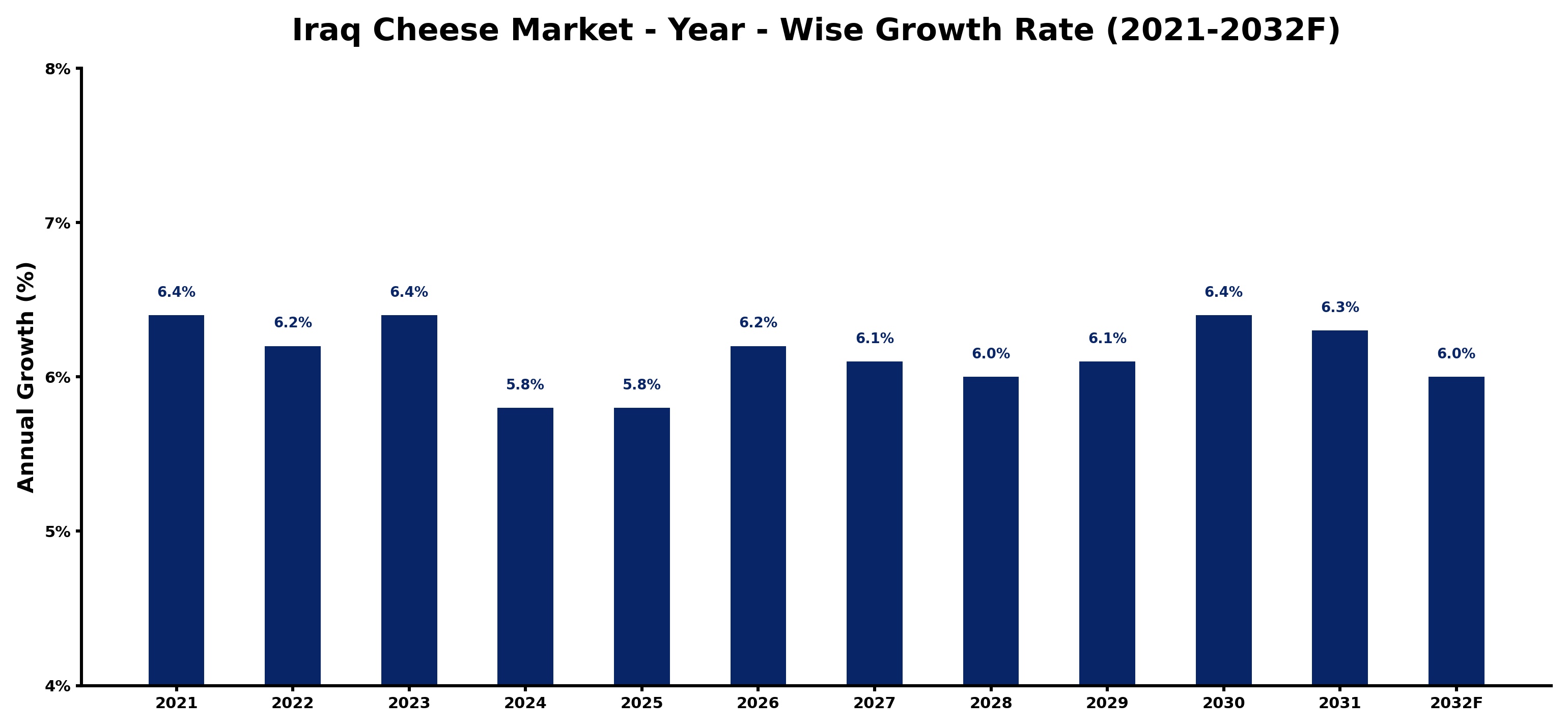
The table below presents the year‑wise growth rates along with the key drivers influencing the market
| Year | Growth Rate | Major Drivers |
| 2021 | 6.4% | Rising consumer demand for cheese |
| 2022 | 6.2% | Increased dairy farming investments |
| 2023 | 6.4% | Growing health consciousness among consumers |
| 2024 | 5.8% | Expansion of local cheese producers |
| 2025 | 5.8% | Innovative cheese product launches |
| 2026 | 6.2% | Enhanced distribution network efficiency |
| 2027 | 6.1% | Rising popularity of gourmet cheeses |
| 2028 | 6.0% | Increased cheese consumption in households |
| 2029 | 6.1% | Strengthened export opportunities for cheese |
| 2030 | 6.4% | Technological advancements in cheese production |
| 2031 | 6.3% | Culinary trends favoring cheese dishes |
| 2032 | 6.0% | Growing interest in artisanal cheeses |
Note - Market size estimations and growth projections presented in this report are based on 6Wresearch’s advanced forecasting approach, validated with industry datasets as of June 2026.
Iraq Cheese Market Synopsis
The Iraq cheese market has recently seen a noteworthy shift, with local producers gaining ground while imported brands increase in popularity. As consumer awareness of cheese varieties grows, the market is expected to enter a new phase of expansion, supported by both traditional and contemporary consumption patterns.
Looking forward, the market stands at a pivotal moment, as urbanization and the proliferation of modern retail channels transform consumer access to cheese. Innovations in both product and marketing strategies are essential for capturing the attention of a diverse consumer base increasingly eager for premium and exotic cheese options.
Iraq Cheese Market Key Takeaways
- The market is experiencing a shift toward premium and specialty cheeses as disposable incomes rise.
- Local dairy producers are increasingly innovating to offer diverse cheese options that cater to changing tastes.
- Health consciousness among consumers is driving demand for organic and natural cheese varieties.
- Retail expansion through supermarkets and online channels is facilitating broader access to cheese products.
- Strategic partnerships with local dairy farmers can enhance supply chain stability and product quality.
Evaluation of Restraints in Iraq Cheese Market
Despite its growth potential, the Iraq cheese market faces significant restraints. Cultural dietary habits often prioritize traditional dairy products, resulting in limited awareness and consumption of cheese among certain demographics. Furthermore, inadequate infrastructure for cold chain logistics can lead to quality issues and storage challenges, affecting both domestic and imported products. Competition from affordable imported cheeses poses additional challenges, as brand recognition may sway consumer preference. To overcome these obstacles, strategic marketing and infrastructure improvements will be critical.
Iraq Cheese Market Trends
Emerging trends in the Iraq cheese market reflect a growing consumer inclination toward premium products and specialty cheeses. As more individuals explore international cuisine, the use of cheese in diverse recipes is gaining popularity, marking a departure from traditional uses. Health-conscious consumers are increasingly drawn to natural and organic options, which are perceived as healthier alternatives. Furthermore, the rise of the foodservice sector is fostering demand for cheese as a key ingredient in various culinary applications, driving innovation and product diversification.
Iraq Cheese Market Opportunities
The potential for investment in the Iraq cheese market is robust, with opportunities arising from the increasing consumer demand for dairy products. Investors can explore avenues in dairy production and processing facilities to create high-quality cheese offerings that cater to both local preferences and international trends. Additionally, enhancing distribution channels and marketing strategies can facilitate access to a broader audience. Collaborating with local dairy farmers not only ensures a stable supply chain but also aligns with the growing interest in locally sourced products.
Government Initiatives in the Iraq Cheese Market
Government policies affecting the Iraq cheese market focus on trade regulations and food safety standards. The Iraqi government implements strict regulations on cheese imports to safeguard domestic producers while ensuring food quality for consumers. Import tariffs are strategically positioned to manage the influx of foreign cheeses, thereby promoting local industry growth. These measures aim to create a balanced market environment that supports both consumer needs and local agricultural development.
Future Insights of the Iraq Cheese Market
In the upcoming years, the Iraq cheese market is poised for sustained growth, buoyed by factors such as urbanization and rising awareness of the nutritional benefits of cheese. The evolution of dietary preferences towards Western-style consumption patterns is likely to shape demand significantly. Additionally, the continuing expansion of retail channels, including online platforms, will enhance the accessibility of cheese products across Iraq. However, stakeholders must navigate challenges such as price volatility and supply chain disruptions to capitalize on these promising growth avenues.
Iraq Cheese Market Latest Developments (May 2025 - June 2026)
The Iraq cheese market has seen significant activity, with an increase in local dairy producers investing in innovative processing techniques to improve cheese quality and diversify product lines. There has been a noteworthy rise in the establishment of gourmet cheese shops, catering to a growing demand for specialty cheeses. Additionally, collaborations between local producers and international partners are emerging to enhance market presence and distribution capabilities.
Iraq Cheese Market - Key Attractiveness of the Report
- 10 Years of Market Numbers
- Historical Data Starting from 2022 to 2025
- Base Year: 2025
- Forecast Data until 2032
- Key Performance Indicators Impacting the Market
- Major Upcoming Developments and Projects
Key Highlights of the Report:
- Iraq Cheese Market Outlook
- Market Size of Iraq Cheese Market, 2025
- Forecast of Iraq Cheese Market, 2032
- Historical Data and Forecast of Iraq Cheese Revenues & Volume for the Period 2022-2032F
- Iraq Cheese Market Trend Evolution
- Iraq Cheese Market Drivers and Challenges
- Iraq Cheese Price Trends
- Iraq Cheese Porter's Five Forces
- Iraq Cheese Industry Life Cycle
- Historical Data and Forecast of Iraq Cheese Market Revenues & Volume By Type for the Period 2022-2032F
- Historical Data and Forecast of Iraq Cheese Market Revenues & Volume By Natural for the Period 2022-2032F
- Historical Data and Forecast of Iraq Cheese Market Revenues & Volume By Processed for the Period 2022-2032F
- Historical Data and Forecast of Iraq Cheese Market Revenues & Volume By Product for the Period 2022-2032F
- Historical Data and Forecast of Iraq Cheese Market Revenues & Volume By Mozzarella for the Period 2022-2032F
- Historical Data and Forecast of Iraq Cheese Market Revenues & Volume By Cheddar for the Period 2022-2032F
- Historical Data and Forecast of Iraq Cheese Market Revenues & Volume By Feta for the Period 2022-2032F
- Historical Data and Forecast of Iraq Cheese Market Revenues & Volume By Parmesan for the Period 2022-2032F
- Historical Data and Forecast of Iraq Cheese Market Revenues & Volume By Roquefort for the Period 2022-2032F
- Historical Data and Forecast of Iraq Cheese Market Revenues & Volume By Others for the Period 2022-2032F
- Historical Data and Forecast of Iraq Cheese Market Revenues & Volume By Source for the Period 2022-2032F
- Historical Data and Forecast of Iraq Cheese Market Revenues & Volume By Cow Milk for the Period 2022-2032F
- Historical Data and Forecast of Iraq Cheese Market Revenues & Volume By Sheep Milk for the Period 2022-2032F
- Historical Data and Forecast of Iraq Cheese Market Revenues & Volume By Goat Milk for the Period 2022-2032F
- Historical Data and Forecast of Iraq Cheese Market Revenues & Volume By Buffalo for the Period 2022-2032F
- Historical Data and Forecast of Iraq Cheese Market Revenues & Volume By Distribution Channel for the Period 2022-2032F
- Historical Data and Forecast of Iraq Cheese Market Revenues & Volume By Hypermarkets for the Period 2022-2032F
- Historical Data and Forecast of Iraq Cheese Market Revenues & Volume By Supermarkets for the Period 2022-2032F
- Historical Data and Forecast of Iraq Cheese Market Revenues & Volume By Food Specialty Stores for the Period 2022-2032F
- Historical Data and Forecast of Iraq Cheese Market Revenues & Volume By Convenience Stores for the Period 2022-2032F
- Historical Data and Forecast of Iraq Cheese Market Revenues & Volume By Others for the Period 2022-2032F
- Iraq Cheese Import Export Trade Statistics
- Market Opportunity Assessment By Type
- Market Opportunity Assessment By Product
- Market Opportunity Assessment By Source
- Market Opportunity Assessment By Distribution Channel
- Iraq Cheese Top Companies Market Share
- Iraq Cheese Competitive Benchmarking By Technical and Operational Parameters
- Iraq Cheese Company Profiles
- Iraq Cheese Key Strategic Recommendations






































