Iraq Chlorine Market Size, Share & Growth Rate
The Iraq Chlorine Market was estimated at USD 164 Million in 2025 and is projected to reach USD 228 Million by 2032, growing at a CAGR of 4.8% from 2026 to 2032. This upward trajectory is driven primarily by the increasing need for effective water treatment solutions and disinfection processes, in light of rising public health awareness. The compound's role in various industrial applications further solidifies its demand across the nation's burgeoning chemical and manufacturing sectors.
Iraq Chlorine Market Year-wise Growth Rate and Key Drivers
This graph highlights how the Iraq Chlorine Market has steadily grown over the years, supported by major growth factors.
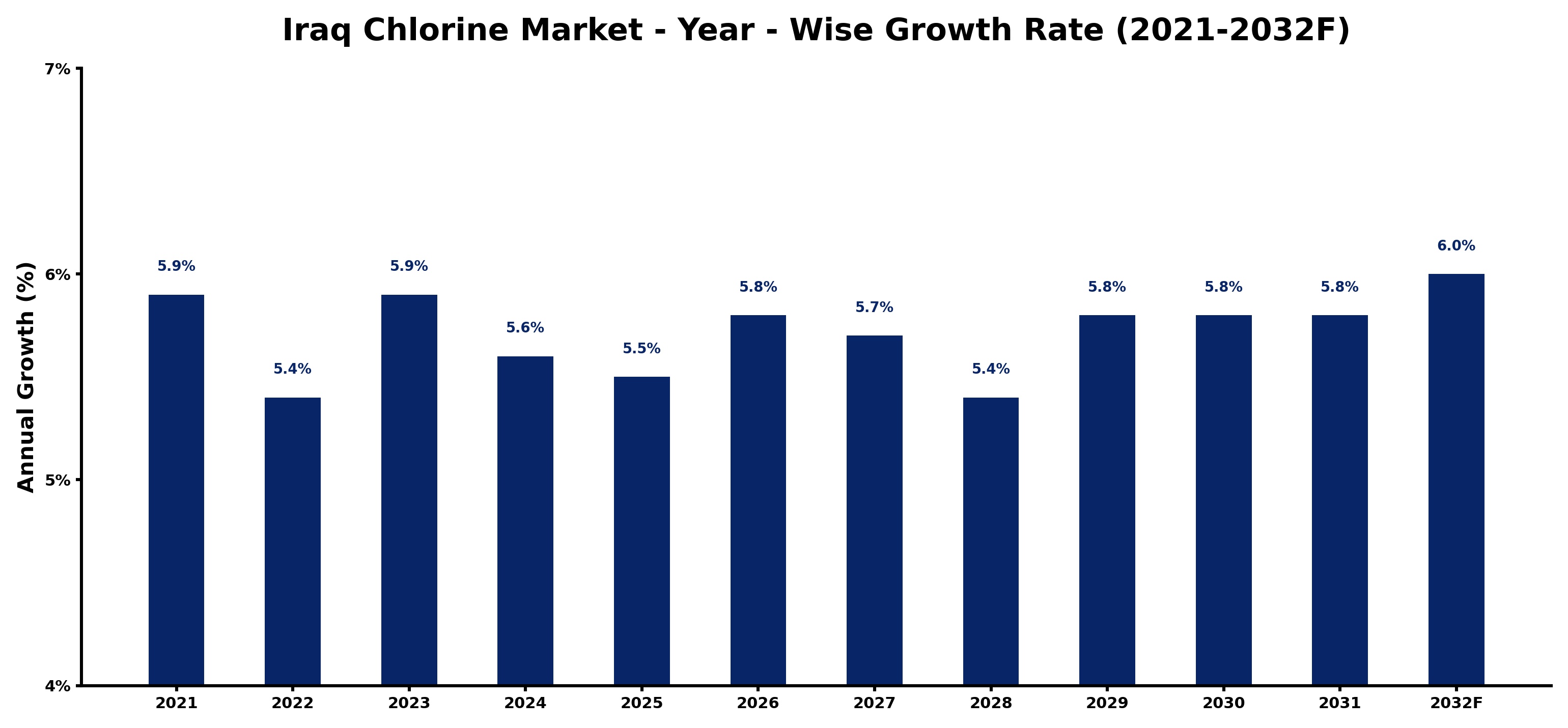
The table below presents the year‑wise growth rates along with the key drivers influencing the market
| Year | Growth Rate | Major Drivers |
| 2021 | 5.9% | Infrastructure development increased demand |
| 2022 | 5.4% | Water treatment regulations strengthened usage |
| 2023 | 5.9% | Industrial applications expanded significantly |
| 2024 | 5.6% | Health awareness promoted chlorine use |
| 2025 | 5.5% | Construction projects drove consumption growth |
| 2026 | 5.8% | Agricultural needs increased chlorine usage |
| 2027 | 5.7% | Urbanization enhanced water treatment needs |
| 2028 | 5.4% | Chemical manufacturing expanded production capacity |
| 2029 | 5.8% | Export opportunities stimulated market growth |
| 2030 | 5.8% | Technological advancements improved efficiency |
| 2031 | 5.8% | Public health initiatives increased demand |
| 2032 | 6.0% | Sustainability trends boosted chlorine applications |
Note - Market size estimations and growth projections presented in this report are based on 6Wresearch's advanced forecasting approach, validated with industry datasets as of June 2026.
Iraq Chlorine Market Synopsis
In Iraq, the demand for chlorine is significantly shaped by its critical application in water treatment and sanitation. The country's growing urban population is leading to heightened requirements for reliable water purification systems, which heavily rely on chlorine as a disinfectant.
Furthermore, industries such as textiles, pharmaceuticals, and pulp and paper are increasingly utilizing chlorine in their manufacturing processes. This has created a robust environment for chlorine production and distribution, presenting opportunities for suppliers to innovate and expand their offerings.
Iraq Chlorine Market Key Takeaways
- The market is projected to grow significantly, with a focus on water treatment and sanitation applications.
- Urbanization and population growth are key drivers of chlorine demand in Iraq.
- Government policies aim to support safe production and usage of chlorine.
- Challenges related to environmental concerns require innovative safety measures from manufacturers.
- Emerging industries are increasingly integrating chlorine in various production processes.
Evaluation of Restraints in Iraq Chlorine Market
Despite the positive outlook for the Iraq Chlorine Market, several restraints hinder its growth. Regulatory concerns regarding the environmental impact of chlorine usage may lead to stricter regulations, which can pose challenges for manufacturers aiming to maintain compliance while meeting market demands. Additionally, the fluctuations in global supply and demand dynamics could affect local production rates and pricing structures. Competition from alternative disinfection methods and imported products further complicates the landscape, compelling domestic suppliers to innovate and enhance their competitive edge.
Iraq Chlorine Market Trends
A notable trend in the Iraq Chlorine Market is the increasing emphasis on sustainable practices within the chemical sector. As public awareness grows regarding the environmental implications of chemical use, manufacturers are exploring safer alternatives and eco-friendly chlorine production techniques. Additionally, advancements in water treatment technologies are enhancing the efficiency and effectiveness of chlorine as a disinfectant, thus broadening its application scope. The integration of automated monitoring systems in water treatment facilities is also on the rise, ensuring optimal chlorine levels while minimizing safety risks.
Iraq Chlorine Market Opportunities
The Iraq Chlorine Market presents several growth opportunities primarily in the realm of technological advancements. Investment in innovative chlorine handling and storage solutions can boost safety and efficiency in usage. Furthermore, as industries evolve, there is substantial potential for chlorine producers to develop tailored solutions that meet the specific needs of sectors like pharmaceuticals and textiles, which demand high-quality chlorine products. Government incentives aimed at modernizing infrastructure for chemical handling also pave the way for enhanced market engagement and expansion.
Government Initiatives in the Iraq Chlorine Market
The Iraqi government recognizes the critical role of chlorine across various sectors, including water treatment and industrial applications. Policies are being enacted to bolster safety standards and environmental compliance in chlorine production. These initiatives include promoting innovative technologies in chlorine production, enhancing the infrastructure for safe handling, and supporting public education campaigns focused on the responsible use of chlorine products. This proactive approach aims to address public health concerns while fostering sustainable market growth.
Future Insights of the Iraq Chlorine Market
Looking ahead, the Iraq Chlorine Market is poised for steady growth, driven by urbanization and increasing industrial activity. The demand for safe and efficient water treatment solutions will continue to expand as public health standards become more stringent. Additionally, advancements in chlorine production methods and the adoption of alternative disinfection technologies will influence market dynamics, encouraging manufacturers to adapt to evolving consumer needs. As sustainability becomes paramount, the market may witness a shift towards greener practices, presenting new opportunities for innovation and investment.
Iraq Chlorine Market Latest Developments (May 2025 - June 2026)
Recent developments in the Iraq Chlorine Market reflect a growing commitment to safety and environmental responsibility. Several initiatives have emerged focusing on modernizing water treatment facilities to better manage chlorine usage and enhance public safety. The industry is also observing collaborations between local producers and international experts to improve chlorine handling practices. Moreover, there is a notable increase in the exploration of alternative disinfection methods alongside traditional chlorine applications, marking a significant shift in industry strategy.
Iraq Chlorine Market - Key Attractiveness of the Report
- 10 Years of Market Numbers
- Historical Data Starting from 2022 to 2025
- Base Year: 2025
- Forecast Data until 2032
- Key Performance Indicators Impacting the Market
- Major Upcoming Developments and Projects
Key Highlights of the Report:
- Iraq Chlorine Market Outlook
- Market Size of Iraq Chlorine Market, 2025
- Forecast of Iraq Chlorine Market, 2032
- Historical Data and Forecast of Iraq Chlorine Revenues & Volume for the Period 2022-2032F
- Iraq Chlorine Market Trend Evolution
- Iraq Chlorine Market Drivers and Challenges
- Iraq Chlorine Price Trends
- Iraq Chlorine Porter's Five Forces
- Iraq Chlorine Industry Life Cycle
- Historical Data and Forecast of Iraq Chlorine Market Revenues & Volume By Application for the Period 2022-2032F
- Historical Data and Forecast of Iraq Chlorine Market Revenues & Volume By EDC/PVC for the Period 2022-2032F
- Historical Data and Forecast of Iraq Chlorine Market Revenues & Volume By Isocyanates and Oxygenates for the Period 2022-2032F
- Historical Data and Forecast of Iraq Chlorine Market Revenues & Volume By Chloromethanes for the Period 2022-2032F
- Historical Data and Forecast of Iraq Chlorine Market Revenues & Volume By Solvents and Epichlorohydrin for the Period 2022-2032F
- Historical Data and Forecast of Iraq Chlorine Market Revenues & Volume By Inorganic Chemicals for the Period 2022-2032F
- Historical Data and Forecast of Iraq Chlorine Market Revenues & Volume By Other Applications for the Period 2022-2032F
- Historical Data and Forecast of Iraq Chlorine Market Revenues & Volume By End-user Industry for the Period 2022-2032F
- Historical Data and Forecast of Iraq Chlorine Market Revenues & Volume By Water Treatment for the Period 2022-2032F
- Historical Data and Forecast of Iraq Chlorine Market Revenues & Volume By Pharmaceutical for the Period 2022-2032F
- Historical Data and Forecast of Iraq Chlorine Market Revenues & Volume By Chemicals for the Period 2022-2032F
- Historical Data and Forecast of Iraq Chlorine Market Revenues & Volume By Paper and Pulp for the Period 2022-2032F
- Historical Data and Forecast of Iraq Chlorine Market Revenues & Volume By Plastic for the Period 2022-2032F
- Historical Data and Forecast of Iraq Chlorine Market Revenues & Volume By Pesticides for the Period 2022-2032F
- Historical Data and Forecast of Iraq Chlorine Market Revenues & Volume By Other End-user Industries for the Period 2022-2032F
- Iraq Chlorine Import Export Trade Statistics
- Market Opportunity Assessment By Application
- Market Opportunity Assessment By End-user Industry
- Iraq Chlorine Top Companies Market Share
- Iraq Chlorine Competitive Benchmarking By Technical and Operational Parameters
- Iraq Chlorine Company Profiles
- Iraq Chlorine Key Strategic Recommendations






































