Iraq Coaxial Cables Market Summary
The iraq coaxial cables market was estimated at USD 467 Million in 2025 and is projected to reach USD 638 Million by 2032, growing at a CAGR of 5.2% from 2026 to 2032.
Iraq Coaxial Cables Market Year-wise Growth Rate and Key Drivers
This graph highlights how the Iraq Coaxial Cables Market has steadily grown over the past five years, supported by major growth factors.
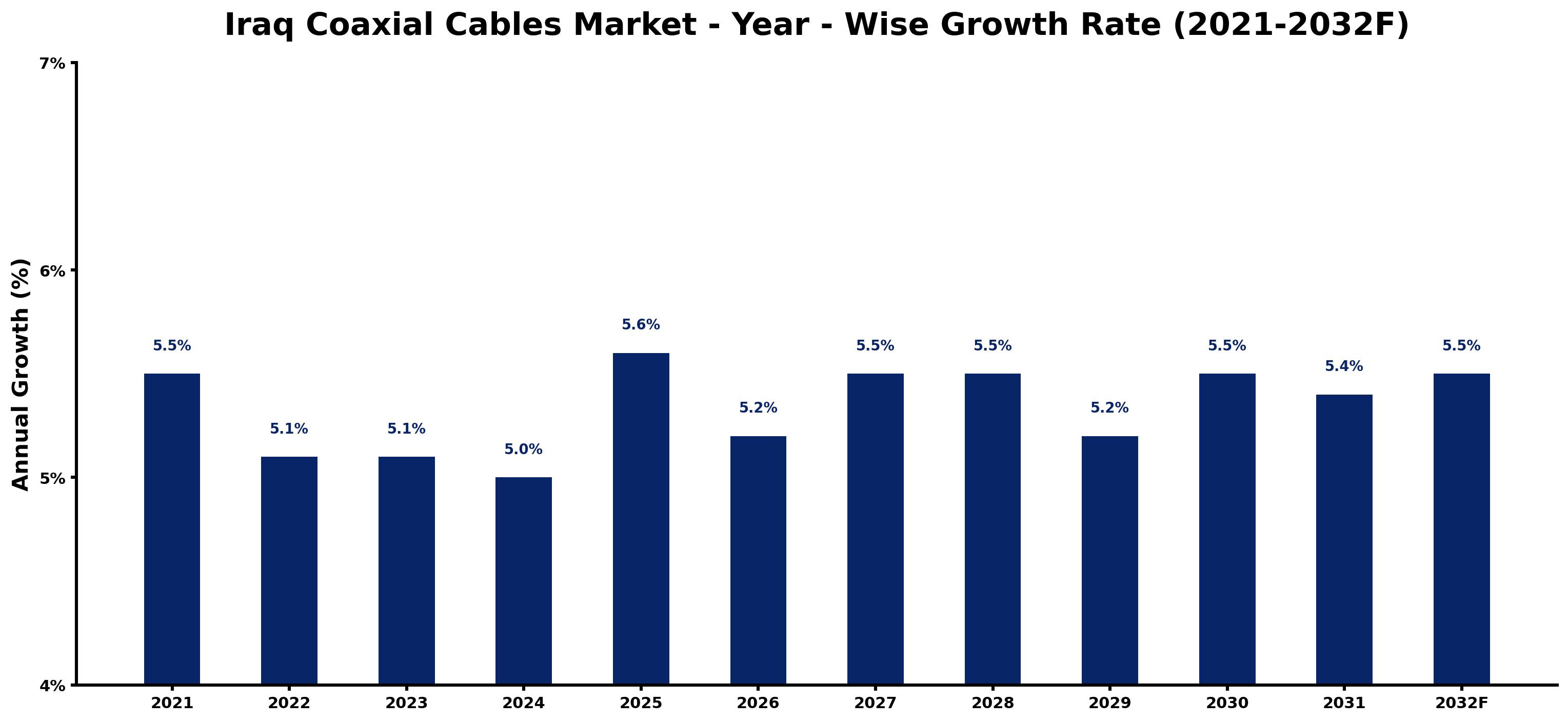
The table below presents the year wise growth rates along with the key drivers influencing the market
| Year | Growth Rate | Major Drivers |
| 2021 | 5.5% | Reconstruction efforts fuel infrastructure investments, boosting demand for coaxial cables. |
| 2022 | 5.1% | Emerging residential projects prompt increased installation of reliable communication systems. |
| 2023 | 5.1% | Economic stabilization encourages foreign investments in technology and telecommunications sectors. |
| 2024 | 5.0% | Telecommunication upgrades enhance bandwidth capacity, driving the need for advanced cabling solutions. |
| 2025 | 5.6% | Urban development initiatives create new opportunities for coaxial cable suppliers and installers. |
| 2026 | 5.2% | Increasing internet penetration encourages competitive pricing among local and international players. |
| 2027 | 5.5% | Rural electrification projects enhance connectivity, expanding the coaxial cable market landscape. |
| 2028 | 5.5% | Technological integration in smart cities demands higher-quality cabling infrastructure. |
| 2029 | 5.2% | Major events like trade expos stimulate temporary surges in cable installation projects. |
| 2030 | 5.5% | Environmental considerations lead to innovation in sustainable coaxial cable production methods. |
| 2031 | 5.4% | Partnerships between private firms and government agencies foster market expansion strategies. |
| 2032 | 5.5% | Digital transformation initiatives solidify coaxial cable's role in modern communication networks. |
Note - Market size estimations and growth projections presented in this report are based on 6Wresearch's advanced forecasting approach, validated with industry datasets as of June 2026.
Iraq Coaxial Cables Market Synopsis
The Iraq Coaxial Cables Market is projected to reach 5.2% and witness significant growth during the forecast period (2026-2032). This growth is primarily driven by the escalating demand for high-quality coaxial cables across various sectors, including telecommunications, data transmission, and broadcasting services. As investments in infrastructure development continue to rise, there is an increasing focus on enhancing connectivity and digital infrastructure, which further amplifies the need for reliable coaxial cables.
Iraq Coaxial Cables Market Growth Drivers
Several factors contribute to the robust growth of the Iraq Coaxial Cables Market. Firstly, the rapid urbanization in the country has led to increased requirements for efficient communication systems, which in turn drives the demand for high-performance coaxial cables. Secondly, rising disposable incomes among consumers enable greater access to advanced telecommunications services, thereby stimulating the market. Furthermore, governmental initiatives aimed at improving national connectivity and expanding internet access play a critical role in fostering market growth.
- The need for reliable data transmission systems is propelling the demand for coaxial cables in various applications.
- Urbanization is leading to the development of smart cities, which require modern communication infrastructure supported by coaxial cables.
- High-speed internet connectivity demands are urging consumers and businesses to seek better quality cables for seamless performance.
- Government policies promoting digital infrastructure development enhance opportunities for coaxial cable applications.
- Technological advancements are pushing manufacturers to innovate, resulting in newer, more efficient coaxial cable variants.
Iraq Coaxial Cables Market Trends and Opportunities
The Iraq Coaxial Cables Market is witnessing notable trends that indicate a shift towards higher quality and innovative products. There is an increasing adoption of hybrid networks that incorporate fiber-optic and coaxial cable technologies. Such networks offer enhanced bandwidth capabilities, meeting the growing demands of both residential and commercial sectors. Additionally, the market is seeing a trend towards strategic partnerships among businesses to bolster distribution networks, thus allowing for greater reach and service delivery.
- There is a marked transition towards high-quality coaxial cables that ensure improved performance and longevity.
- Investment in infrastructure continues to rise, focusing on enhanced telecommunications and smart city initiatives.
- Growing emphasis on digital transformation across industries is leading to increased demand for reliable coaxial cable solutions.
- The need for robust support in telecommunications is driving collaborative efforts among industry players.
- Research and development investments are being directed towards innovative cable technologies that cater to evolving market needs.
Iraq Coaxial Cables Market Challenges and Restraints
Despite the positive outlook, the Iraq Coaxial Cables Market faces several challenges that hinder its growth. One of the primary issues is the lack of standardization and quality control measures, resulting in variations in cable quality. This inconsistency complicates purchasing decisions for consumers who seek reliable products. The presence of counterfeit cables further exacerbates quality-related concerns. Additionally, the political and economic instability in Iraq can disrupt supply chains and distribution networks, posing risks for manufacturers.
- Inconsistent product quality due to a lack of standardization affects consumer trust and decision-making.
- Counterfeit products present significant challenges in maintaining market integrity and customer satisfaction.
- Political instability can lead to volatility in the supply chain, impacting cable availability and distribution.
- The fragmented nature of the market complicates navigation for new entrants and investors.
- Quality assurance challenges create barriers to market entry for reputable manufacturers.
Iraq Coaxial Cables Market Investment Opportunities
Investment opportunities within the Iraq Coaxial Cables Market appear promising, particularly relating to the growing demand for high-speed internet and telecommunications capabilities. The ongoing expansion of 4G and the anticipated roll-out of 5G networks create a fertile environment for investors looking to capitalize on this growth. Furthermore, as industries undergo digital transformations, the requirement for high-quality coaxial cables will become even more crucial.
- Investing in coaxial cable production and distribution firms can yield high returns due to increasing demand.
- The rise of smart cities presents opportunities for companies focused on infrastructure development and related technologies.
- Government incentives aimed at boosting local production can create advantageous conditions for investors.
- The digital transformation across sectors provides a broad market for high-quality coaxial cable applications.
- Recognizing key emerging trends can assist investors in making informed decisions related to market entry.
Iraq Coaxial Cables Market Government Investment and Initiatives
The Iraqi government has implemented several initiatives aimed at regulating the Coaxial Cables Market to foster its development. These initiatives include establishing standards for cable quality and safety to protect consumers from subpar products. Additionally, the government has instituted import regulations and tariffs to manage foreign competition and support local manufacturers. Incentivizing domestic production, the government encourages investment through various programs aimed at enhancing technological capabilities and market competitiveness.
Iraq Coaxial Cables Market Latest Developments (May 2025 - June 2026)
Recent developments in the Iraq Coaxial Cables Market highlight an increasing trend towards modernization and quality enhancement. Industry stakeholders are increasingly focusing on innovation-driven approaches to meet evolving consumer needs. Additionally, upgrades to existing telecommunications infrastructure are underway, aimed at improving the overall quality of internet and broadcasting services. These advancements signify a proactive approach by market participants to address both current demands and future projections for market growth.
Iraq Coaxial Cables Market - Key Attractiveness of the Report
- 10 Years of Market Numbers
- Historical Data Starting from 2022 to 2025
- Base Year: 2025
- Forecast Data until 2032
- Key Performance Indicators Impacting the Market
- Major Upcoming Developments and Projects
Key Highlights of the Report:
- Iraq Coaxial Cables Market Outlook
- Market Size of Iraq Coaxial Cables Market, 2025
- Forecast of Iraq Coaxial Cables Market, 2032F
- Historical Data and Forecast of Iraq Coaxial Cables Revenues & Volume for the Period 2022-2032F
- Iraq Coaxial Cables Market Trend Evolution
- Iraq Coaxial Cables Market Drivers and Challenges
- Iraq Coaxial Cables Price Trends
- Iraq Coaxial Cables Porter's Five Forces
- Iraq Coaxial Cables Industry Life Cycle
- Historical Data and Forecast of Iraq Coaxial Cables Market Revenues & Volume By Types for the Period 2022-2032F
- Historical Data and Forecast of Iraq Coaxial Cables Market Revenues & Volume By Hard-line Cable for the Period 2022-2032F
- Historical Data and Forecast of Iraq Coaxial Cables Market Revenues & Volume By Triaxial Cable for the Period 2022-2032F
- Historical Data and Forecast of Iraq Coaxial Cables Market Revenues & Volume By Twin Axial Cable for the Period 2022-2032F
- Historical Data and Forecast of Iraq Coaxial Cables Market Revenues & Volume By Applications for the Period 2022-2032F
- Historical Data and Forecast of Iraq Coaxial Cables Market Revenues & Volume By Internet Data Transfer for the Period 2022-2032F
- Historical Data and Forecast of Iraq Coaxial Cables Market Revenues & Volume By Video Distribution for the Period 2022-2032F
- Historical Data and Forecast of Iraq Coaxial Cables Market Revenues & Volume By Radio Distribution Frequency Transfer for the Period 2022-2032F
- Historical Data and Forecast of Iraq Coaxial Cables Market Revenues & Volume By Others for the Period 2022-2032F
- Historical Data and Forecast of Iraq Coaxial Cables Market Revenues & Volume By End-users for the Period 2022-2032F
- Historical Data and Forecast of Iraq Coaxial Cables Market Revenues & Volume By Cable Television Industry for the Period 2022-2032F
- Historical Data and Forecast of Iraq Coaxial Cables Market Revenues & Volume By Military and Aerospace for the Period 2022-2032F
- Historical Data and Forecast of Iraq Coaxial Cables Market Revenues & Volume By Internet Service Providers for the Period 2022-2032F
- Historical Data and Forecast of Iraq Coaxial Cables Market Revenues & Volume By Telephone Network Operators for the Period 2022-2032F
- Historical Data and Forecast of Iraq Coaxial Cables Market Revenues & Volume By Communication Equipment Manufactures for the Period 2022-2032F
- Iraq Coaxial Cables Import Export Trade Statistics
- Market Opportunity Assessment By Types
- Market Opportunity Assessment By Applications
- Market Opportunity Assessment By End-users
- Iraq Coaxial Cables Top Companies Market Share
- Iraq Coaxial Cables Competitive Benchmarking By Technical and Operational Parameters
- Iraq Coaxial Cables Company Profiles
- Iraq Coaxial Cables Key Strategic Recommendations






































