Iraq Connector Market Size, Share & Growth Rate
The Iraq Connector Market was estimated at USD 433 Million in 2025 and is projected to reach USD 596 Million by 2032, growing at a CAGR of 4.7% from 2026 to 2032. This growth trajectory reflects an increasing demand for electrical and electronic connectors across multiple sectors, including automotive, telecommunications, and consumer electronics. The ongoing expansion of infrastructure projects and the rising adoption of advanced electronic technologies are pivotal factors contributing to this positive outlook.
Iraq Connector Market Year-wise Growth Rate and Key Drivers
This graph highlights how the Iraq Connector Market has steadily grown over the years, supported by major growth factors.
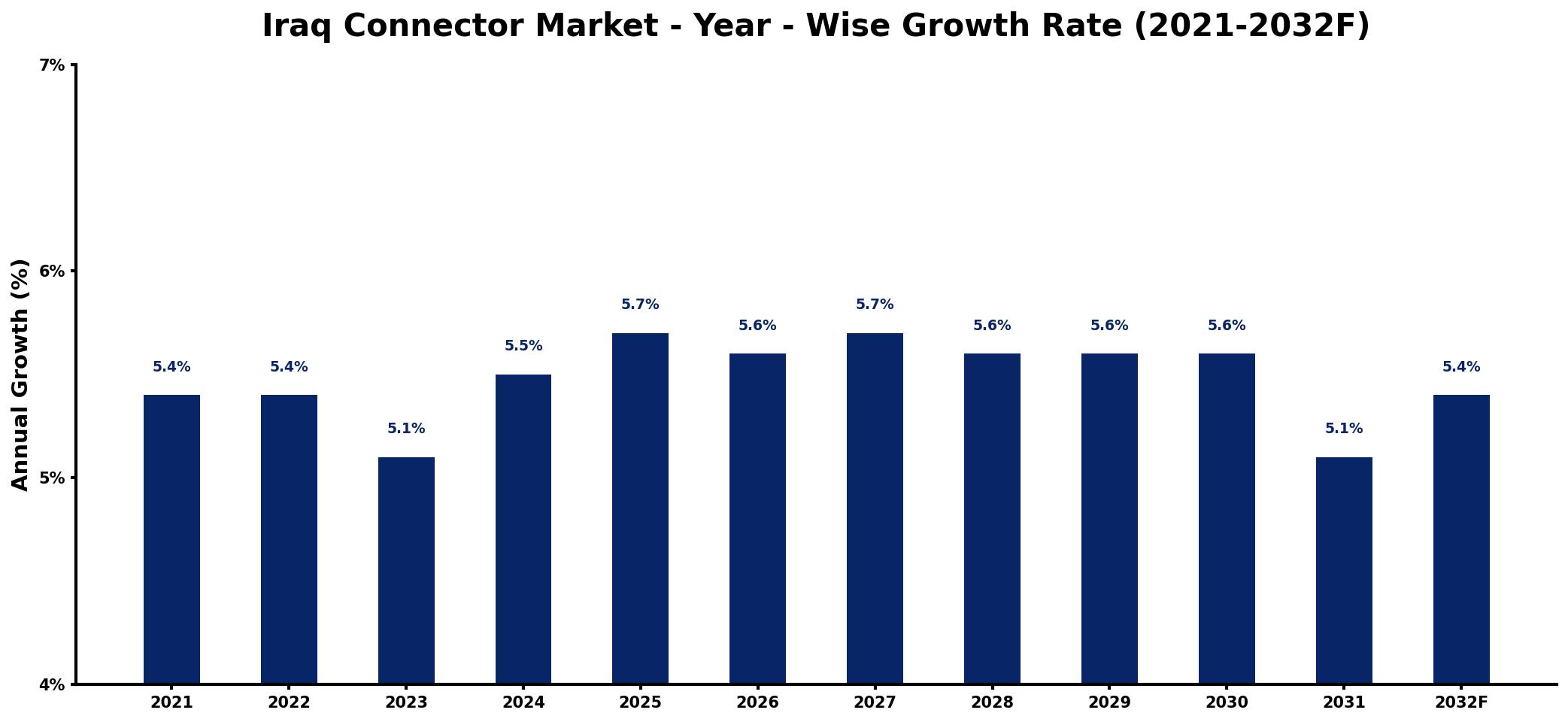
The table below presents the year‑wise growth rates along with the key drivers influencing the market
| Year | Growth Rate | Major Drivers |
| 2021 | 5.4% | Rising infrastructure development projects |
| 2022 | 5.4% | Increased foreign direct investments |
| 2023 | 5.1% | Growing telecommunications network expansion |
| 2024 | 5.5% | Boosted renewable energy initiatives |
| 2025 | 5.7% | Enhanced logistics and transportation systems |
| 2026 | 5.6% | Strengthened regional trade agreements |
| 2027 | 5.7% | Surge in construction activities |
| 2028 | 5.6% | Growing urbanization trends observed |
| 2029 | 5.6% | Heightened demand for technology upgrades |
| 2030 | 5.6% | Expansion of industrial manufacturing bases |
| 2031 | 5.1% | Emerging market diversification strategies |
| 2032 | 5.4% | Increased focus on sustainability practices |
Note: Market size estimations and growth projections presented in this report are based on 6Wresearch's proprietary forecasting methodology, utilizing the latest available industry data, government publications, and primary research inputs.
Iraq Connector Market Synopsis
The most significant force currently shaping the Iraq Connector Market is the rapid proliferation of connected devices. As industries embrace the Internet of Things (IoT), the need for reliable and high-performance connectors is becoming more pronounced, driving technological innovation and market expansion. This dynamic is fostering a robust demand for connectors that ensure seamless connectivity and efficient communication between various devices.
In addition to the rise of IoT, the growth of the automotive sector is another critical factor propelling the market. As vehicles increasingly integrate advanced electronics for safety and performance, the requirement for sophisticated connectors that meet these challenges is steadily increasing. The confluence of these trends is paving the way for significant advancements within the Iraq connector landscape.
Iraq Connector Market Key Takeaways
- The Iraq Connector Market is expected to experience steady growth, driven by rising demand in key sectors.
- Technological advancements and the miniaturization trend are enhancing connector performance and versatility.
- Government policies are focused on promoting industrial productivity and ensuring product quality standards.
- Investment in infrastructure and manufacturing capabilities is crucial for sustaining market growth.
- Quality assurance and compatibility with various devices remain vital challenges for end-users.
Evaluation of Restraints in Iraq Connector Market
Despite its promising growth potential, the Iraq Connector Market faces several key restraints that could inhibit its advancement. Foremost among these is the issue of technological compatibility; ensuring that connectors work seamlessly across various devices and standards is critical. Additionally, maintaining high-quality assurance in challenging operational environments poses a significant hurdle. Variability in quality can lead to costly downtime and safety concerns, ultimately affecting user confidence and market stability. Furthermore, intense competition from both domestic and international players places pressure on pricing strategies, potentially hindering innovation efforts and product development.
Iraq Connector Market Trends
A notable trend in the Iraq Connector Market is the move towards miniaturization, where connectors are designed to occupy less space while delivering higher performance. This is particularly relevant in the automotive sector, where space constraints are becoming increasingly common due to the integration of advanced technologies. Additionally, there is a strong push towards high-speed data transmission capabilities in connectors, necessitated by the growing demands of telecommunication and data-centric applications. The evolution towards modular designs also enhances adaptability, allowing manufacturers to optimize their products for diverse applications.
Iraq Connector Market Opportunities
The Iraq Connector Market presents ample growth opportunities, particularly as industries continue to invest in infrastructure development and modernization efforts. Expanding sectors like renewable energy and electric vehicles offer significant potential for connectors tailored to new technologies. Furthermore, with the increasing government focus on enhancing local manufacturing capabilities, there are opportunities for investment in advanced connector manufacturing facilities. As demand for high-performance connectors escalates, manufacturers who innovate and adopt cutting-edge technologies will likely capture significant market share.
Government Initiatives in the Iraq Connector Market
The Iraqi government is actively promoting initiatives aimed at bolstering industrial productivity and ensuring the quality of connector products. Regulatory frameworks are being established to set connector specifications and certification requirements that align with international standards, thereby protecting consumer interests. Moreover, the government provides incentives for investments in manufacturing facilities and supports research and development initiatives to foster innovation within the connector industry. These measures aim to facilitate collaboration among industry stakeholders and promote technology transfer, ultimately enhancing the market's growth prospects.
Future Insights of the Iraq Connector Market
Looking ahead to the period from 2026 to 2032, the Iraq Connector Market is poised for significant evolution. As the demand for connected devices continues to escalate, the need for reliable connectors will intensify, encouraging ongoing technological advancements. The expansion of sectors such as telecommunications and automotive electronics will further drive growth, with manufacturers increasingly focusing on developing high-performance, versatile connectors. Overall, the market is expected to adapt to the challenges presented by technological compatibility and quality assurance, positioning itself for a robust future.
Iraq Connector Market Latest Developments (2025 - 2026)
In the recent months, the Iraq connector industry has witnessed various developments aimed at enhancing product reliability and performance. There has been a noticeable increase in collaborations among local manufacturers to share best practices and innovations, focusing on quality assurance and compliance with international standards. Additionally, several key infrastructure projects are underway, signaling increased investment in connector applications. This heightened activity reflects a concerted effort to meet the burgeoning demand driven by the integration of advanced technologies across sectors.
Iraq Connector Market - Key Attractiveness of the Report
- 10 Years of Market Numbers
- Historical Data Starting from 2022 to 2025
- Base Year: 2025
- Forecast Data until 2032
- Key Performance Indicators Impacting the Market
- Major Upcoming Developments and Projects
Key Highlights of the Report:
- Iraq Connector Market Outlook
- Market Size of Iraq Connector Market, 2025
- Forecast of Iraq Connector Market, 2032
- Historical Data and Forecast of Iraq Connector Revenues & Volume for the Period 2022-2032F
- Iraq Connector Market Trend Evolution
- Iraq Connector Market Drivers and Challenges
- Iraq Connector Price Trends
- Iraq Connector Porter's Five Forces
- Iraq Connector Industry Life Cycle
- Historical Data and Forecast of Iraq Connector Market Revenues & Volume By Product for the Period 2022-2032F
- Historical Data and Forecast of Iraq Connector Market Revenues & Volume By PCB Connectors for the Period 2022-2032F
- Historical Data and Forecast of Iraq Connector Market Revenues & Volume By IO Connectors for the Period 2022-2032F
- Historical Data and Forecast of Iraq Connector Market Revenues & Volume By Circular Connectors for the Period 2022-2032F
- Historical Data and Forecast of Iraq Connector Market Revenues & Volume By Fiber Optic Connectors for the Period 2022-2032F
- Historical Data and Forecast of Iraq Connector Market Revenues & Volume By RF Coaxial Connectors for the Period 2022-2032F
- Historical Data and Forecast of Iraq Connector Market Revenues & Volume By Others for the Period 2022-2032F
- Historical Data and Forecast of Iraq Connector Market Revenues & Volume By End Use for the Period 2022-2032F
- Historical Data and Forecast of Iraq Connector Market Revenues & Volume By Telecom for the Period 2022-2032F
- Historical Data and Forecast of Iraq Connector Market Revenues & Volume By Transportation for the Period 2022-2032F
- Historical Data and Forecast of Iraq Connector Market Revenues & Volume By Automotive for the Period 2022-2032F
- Historical Data and Forecast of Iraq Connector Market Revenues & Volume By Industrial for the Period 2022-2032F
- Historical Data and Forecast of Iraq Connector Market Revenues & Volume By Computer & Peripherals for the Period 2022-2032F
- Historical Data and Forecast of Iraq Connector Market Revenues & Volume By Others for the Period 2022-2032F
- Iraq Connector Import Export Trade Statistics
- Market Opportunity Assessment By Product
- Market Opportunity Assessment By End Use
- Iraq Connector Top Companies Market Share
- Iraq Connector Competitive Benchmarking By Technical and Operational Parameters
- Iraq Connector Company Profiles
- Iraq Connector Key Strategic Recommendations






































