Japan Connector Market Size & Growth Rate
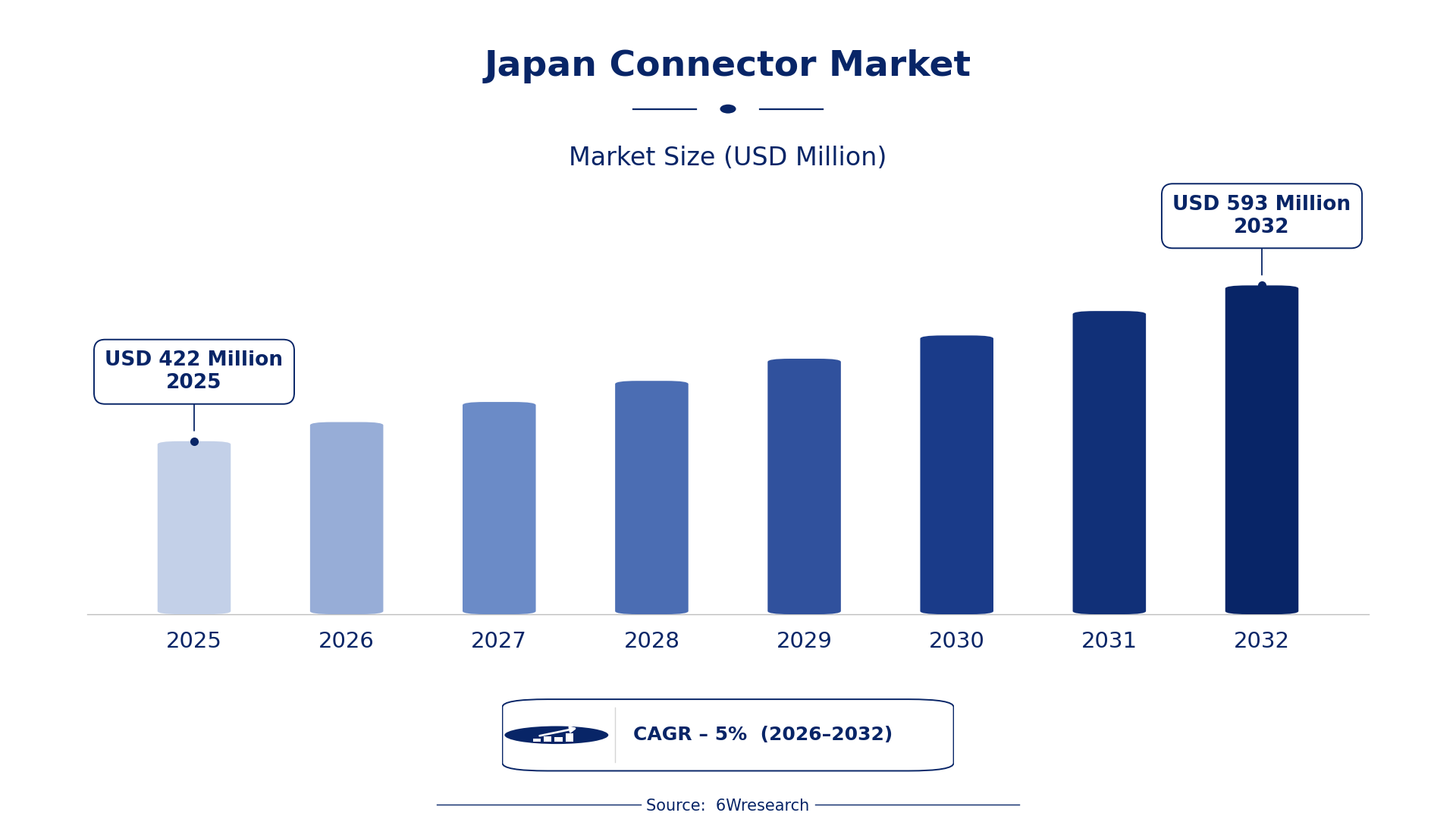
According to 6Wresearch internal database and industry insights, the Japan Connector Market was valued at USD 422 Million in 2025 and is projected to reach USD 593 Million by 2032, growing at a CAGR of approximately 5% during 2026–2032.
Japan Connector Market Highlights
| Report Metric | Details |
| Report Name | Japan Connector Market (2026-2032) |
| Market Size 2025 | USD 422 Million |
| Market Size 2032 | USD 593 Million |
| Absolute Growth 2025–2032 | USD 171 Million |
| CAGR 2026–2032 | 5% |
| Peak Annual Growth | 5.8% in 2032 |
| Forecast Period | 2026–2032 |
| Historical Data | 2022–2025 |
| Base Year | 2025 |
| Leading Product, 2025 | PCB Connectors (39% share) |
| Leading End Use, 2025 | Telecom (33% share) |
| Fastest-Growing Product | IO Connectors (7.5% CAGR) |
| Fastest-Growing End Use | Transportation (6.8% CAGR) |
| Growing Sector | Telecom |
| Key End Users | automotive manufacturers, telecommunications providers, industrial machinery producers, electronics manufacturers |
Japan Connector Market Year-wise Growth Rate and Key Drivers (2022–2032)
This graph illustrates the annual growth rates of the market from 2022 to 2032, highlighting a steady upward trajectory and projected market expansion over the forecast period.
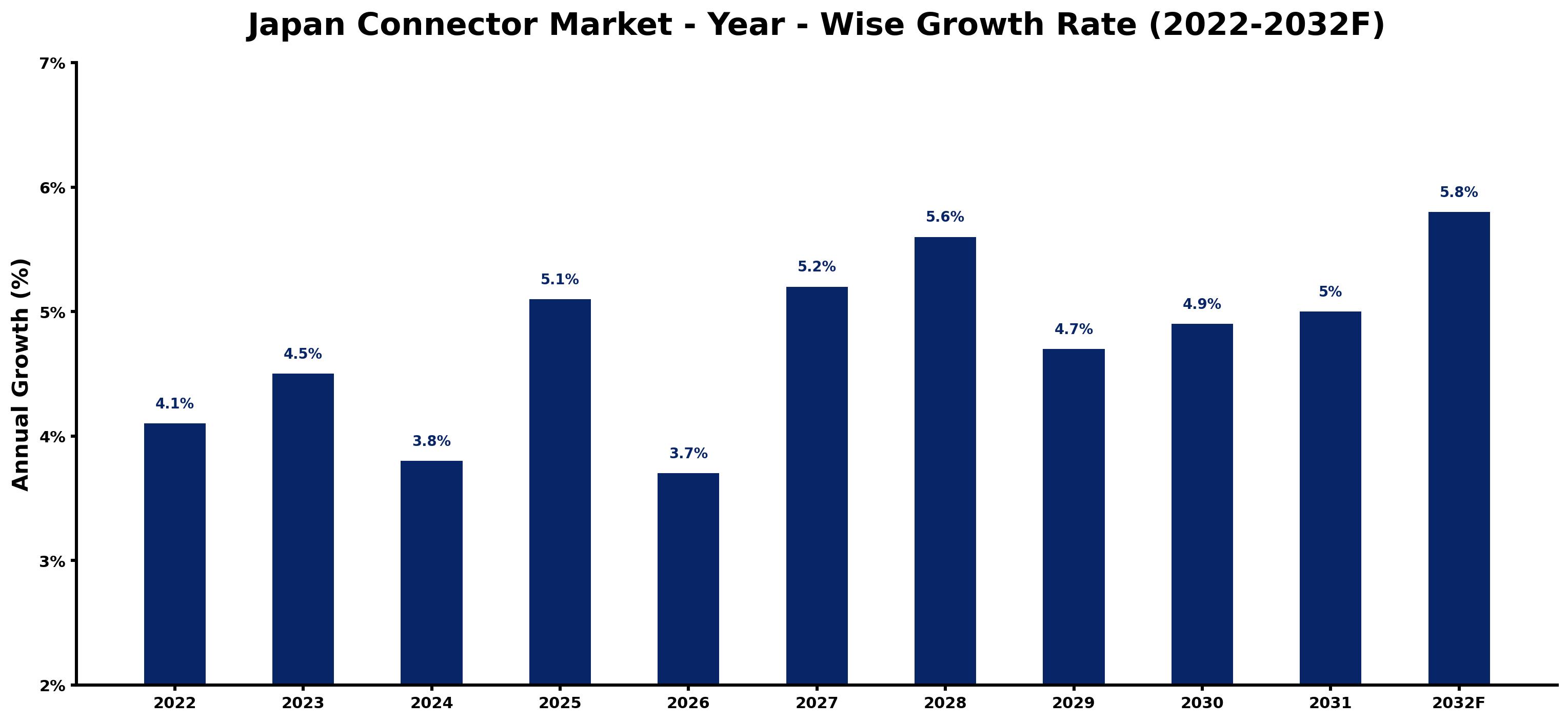
For each year, the table pairs the estimated growth rate with the leading influence on demand, showing how the drivers changed across the period.
| Year | Estimated Annual Growth (%) | Market Rationale |
| 2022 | 4.1 | Demand for connectors was steady, reflecting ongoing electronics production. |
| 2023 | 4.5 | Connector demand increased due to heightened automotive production and electronics usage. |
| 2024 | 3.8 | Growth slowed as the market adjusted to previous high levels of demand. |
| 2025 | 5.1 | Demand surged, driven by the automotive sector's strong performance and infrastructure investments. |
| 2026 | 3.7 | A slight slowdown occurred as the market stabilised after peak growth. |
| 2027 | 5.2 | Growth picked up again, supported by rising demand in telecommunications and automotive sectors. |
| 2028 | 5.6 | The market continued to grow, driven by increased investments in infrastructure and technology. |
| 2029 | 4.7 | Demand growth slowed as market conditions normalised after several years of expansion. |
| 2030 | 4.9 | Growth rebounded slightly, driven by renewed investments in technology and infrastructure. |
| 2031 | 5.0 | Connector demand increased as industries adapted to evolving technology needs. |
| 2032 | 5.8 | The market peaked with strong growth driven by advancements in 5G and automotive technologies. |
Note: Market size estimations and growth projections presented in this report are based on 6Wresearch's proprietary forecasting methodology, utilizing the latest available industry data, government publications, and primary research inputs.
Japan Connector Market Synopsis
Connectors serve as essential electronic components that join electrical circuits, manufactured through processes like injection molding and metal stamping. The Japan Connector Market is expanding, primarily due to strong demand from the automotive sector, which accounts for 35% of connector usage, and investments in telecommunications infrastructure, particularly for 5G rollouts. With a market valued at approximately 1.2 billion USD in 2023, growth is further fuelled by advancements in manufacturing technologies and increasing electronics consumption driven by Japan's large population.
Market Dynamics Impact Analysis (2026–2032)
| Factor | Type | Impact | Primary Segment Affected |
| Rising automotive production drives demand for connectors in vehicle electronics. | Driver | High | Automotive |
| Telecommunications infrastructure investments are increasing demand for fiber optic connectors. | Driver | High | Telecom |
| Growing demand for high-speed data transmission creates opportunities for fiber optic connectors. | Opportunity | High | Fiber Optic Connectors |
| The shift towards electric vehicles presents a significant opportunity for connector manufacturers. | Opportunity | High | Automotive |
| Competition from low-cost imports may limit pricing power for domestic manufacturers. | Restraint | Medium | PCB Connectors |
| Quality standards and certifications can restrict market entry for new players. | Restraint | Medium | IO Connectors |
| Supply chain disruptions can delay production schedules for manufacturers. | Challenge | High | Industrial |
| Technological advancements require continuous investment, straining smaller firms' resources. | Challenge | Medium | RF Coaxial Connectors |
Evaluation of Drivers in Japan Connector Market (2026–2032)
The main growth drivers and the segments they affect most are set out below.
| Drivers | Primary Segment Affected | Why It Matters (Evidence) |
| Increased vehicle production leads to higher connector demand in automotive applications. | Automotive | The automotive sector produced over 8 million vehicles in 2022, driving connector usage for vehicle connectivity systems. |
| Telecommunications investments are expanding, particularly for 5G infrastructure. | Telecom | Investments in fiber optic connectors are essential for Japan's 5G rollout, supporting communication capabilities. |
| Growth in electronic devices boosts demand for PCB connectors in consumer electronics. | PCB Connectors | Japan's electronics market, driven by a population of 125 million, sustains ongoing demand for connectors. |
| Industrial automation is increasing the need for connectors in machinery. | Industrial | The industrial sector employs over 30 million people in Japan, contributing to rising connector demand for automation. |
| The rise of smart devices drives demand for IO connectors in computing. | IO Connectors | Consumer reliance on technology increases the need for input/output devices in computers. |
Buyers are adding capacity as the automotive sector continues to thrive, with over 8 million vehicles produced in 2022, leading to increased demand for connectors. Telecommunications investments are surging, particularly for 5G infrastructure, driving the need for fiber optic connectors. Japan's large population of approximately 125 million fuels electronics demand, supporting the market for PCB connectors. The industrial sector, employing over 30 million people, is also contributing to rising demand for connectors in automation and machinery. The proliferation of smart devices is increasing the need for IO connectors in computing applications.
Evaluation of Restraints in Japan Connector Market
These are the pressures that could keep growth below its potential.
| Market Restraint | Primary Segment Affected | Why It Matters (Evidence) |
| Competition from low-cost imports may limit pricing power for domestic manufacturers. | PCB Connectors | As low-cost imports enter the market, domestic manufacturers face pressure to maintain competitive pricing. |
| Quality standards and certifications can restrict market entry for new players. | IO Connectors | Compliance with JIS standards can be a barrier for new entrants in the connector market. |
| Supply chain disruptions can delay production schedules for manufacturers. | Industrial | Global supply chain issues have affected the timely availability of raw materials for connector production. |
| Technological advancements require continuous investment, straining smaller firms' resources. | RF Coaxial Connectors | Smaller manufacturers may struggle to keep pace with rapid technological changes in connector design. |
| Market saturation in certain segments may limit growth potential. | Fiber Optic Connectors | As the market matures, growth opportunities may diminish in established connector segments. |
Japan Connector Market Challenges
Buyers encounter inflated costs due to a limited number of domestic suppliers for connectors, potentially raising prices by approximately 15% and straining budgets. Skills shortages in advanced manufacturing techniques impede production efficiency, delaying product launches by up to six months for producers. Increased competition from international markets pressures local manufacturers to reduce prices, risking profit margins by around 10%. Compliance with JIS standards complicates operations, resulting in operational costs that can exceed 5% of total expenses for manufacturers.
Trends in the Japan Connector Market
Below are the shifts with the largest effect on the Japan Connector Market.
- Shift from Traditional to Advanced Connector Technologies: Tokyo is experiencing a shift towards advanced connector technologies, driven by the demand for high-speed data transmission. Investments in fibre optic connectors have surged, reflecting the need for improved telecommunications infrastructure, with expenditures expected to reach billions by 2025.
- Transition from Copper to Fiber Optic Connectors: The push for 5G is driving a transition from copper to fibre optic connectors, crucial for high-speed data networks. Significant investments in infrastructure are projected to reshape the connector market, with funding reaching billions by 2025.
- Emergence of Smart Connectors in Automotive: The automotive sector is increasingly adopting smart connectors, which enhance vehicle connectivity. With over 8 million vehicles produced in 2022, the demand for advanced connector solutions is rising sharply, reflecting a shift in consumer expectations.
- Prioritisation of Sustainability in Connector Manufacturing: Aichi is focusing on sustainability in connector manufacturing, aligning with the Green Growth Strategy. Manufacturers are investing in eco-friendly materials and processes to meet new environmental standards, with initiatives expected to substantially reduce carbon footprints.
Investment Opportunities in the Japan Connector Market
Where to invest in the Japan Connector Market: the main openings are set out below.
- Supply of Fiber Optic Connectors for 5G Infrastructure: The demand for fibre optic connectors is surging due to Japan's 5G rollout, with investments expected to reach substantial levels. Suppliers can enter this market by partnering with telecommunications firms to provide essential components.
- Investment in Electric Vehicle Connector Solutions: The automotive industry's shift towards electric vehicles presents a promising opportunity for connector manufacturers. By collaborating with automotive suppliers, firms can develop specialised connectors for electric vehicle applications, tapping into a growing market.
- Expansion of Industrial Automation Solutions: The industrial sector's growth is driving demand for connectors in automation. Suppliers should focus on providing innovative connector solutions to manufacturers in regions like Tokyo and Aichi, where industrial activity is high, capitalising on expanding opportunities.
- Development of High-Quality PCB Connectors: With the electronics market expanding, there is a need for high-quality PCB connectors. Manufacturers can target this opportunity by obtaining JIS certification and partnering with electronics producers to ensure compliance and quality assurance.
Government Initiatives in the Japan Connector Market
The Industrial Safety and Health Act of 1972 mandates employer responsibilities regarding hazardous substances and machinery, impacting connector manufacturers' operational protocols. Compliance with this act ensures safer working conditions in production facilities, which is vital for maintaining workforce health and productivity.
The Battery Industry Strategy, overseen by the Ministry of Economy, Trade and Industry, aims to achieve 150 GWh of domestic battery manufacturing capacity by 2030. This strategy supports connector manufacturers by promoting technological advancements and funding initiatives that improve production efficiency.
Future Insight of the Japan Connector Market
The investment pipeline for advanced manufacturing technologies will create new opportunities, driving demand for high-quality connectors. By 2032, the rollout of 5G infrastructure will require upgrades in production capabilities, significantly increasing connector usage. A government programme to enhance semiconductor supply chains will stimulate growth in the connector sector, benefiting suppliers. With the automotive industry producing over 8 million vehicles in 2022, demand for connectors will remain strong across various applications.
Market Segmentation Analysis
Japan Connector Market report covers a detailed analysis of the following market segments:
By Product – PCB Connectors Lead, IO Connectors Expected to Grow Fastest
According to Summon Dutta, Assistant Manager at 6Wresearch, PCB Connectors took 39% of product revenue in 2025, more than any other category. PCB Connectors hold the largest share as they are vital for circuit boards in a variety of electronic devices, particularly in telecommunications. The substantial production of over 8 million vehicles in 2022 underlines the increasing demand for these connectors in Japan. The quickest growth will come from IO Connectors, forecast to expand at a CAGR of 7.5% between 2026 and 2032. IO Connectors are experiencing rapid growth due to their role as the interface for input/output devices in computers, driven by the surge in demand for advanced computing solutions. This segment's growth will continue as the need for enhanced connectivity in devices expands. Suppliers should focus on developing IO Connectors to align with the rising market demand.
By End Use – Telecom Leads, Transportation Expected to Grow Fastest
Telecom held 33% of the Japan Connector Market by end use in 2025. The Telecom sector is the largest end-use segment because it is crucial for communication infrastructure, which supports both personal and business connectivity in Japan. The ongoing investments in 5G technology further solidify Telecom's leading position in connector usage. Transportation is projected to grow fastest, at a CAGR of 6.8% during 2026–2032. Transportation is the fastest-growing segment, propelled by the increasing integration of electronics in vehicle systems, reflecting the shift towards smart transportation solutions. As vehicles incorporate more advanced electronic features, connector demand in this sector will significantly rise. Suppliers need to adapt their strategies to meet the increasing connector demands in the transportation sector.
Key Attractiveness of the Report
- 10 Years of Market Numbers
- Historical Data Starting from 2022 to 2025
- Base Year 2025
- Forecast Data until 2032
- Key Performance Indicators Impacting the Market
- Major Upcoming Developments and Projects
Key Highlights of the Report:
- Japan Connector Market Outlook
- Market Size of Japan Connector Market, 2025
- Forecast of Japan Connector Market, 2032
- Historical Data and Forecast of Japan Connector Revenues & Volume for the Period 2022-2032
- Japan Connector Market Trend Evolution
- Japan Connector Market Drivers and Challenges
- Japan Connector Price Trends
- Japan Connector Porter's Five Forces
- Japan Connector Industry Life Cycle
- Historical Data and Forecast of Japan Connector Market Revenues & Volume By Product for the Period 2022-2032
- Historical Data and Forecast of Japan Connector Market Revenues & Volume By PCB Connectors for the Period 2022-2032
- Historical Data and Forecast of Japan Connector Market Revenues & Volume By IO Connectors for the Period 2022-2032
- Historical Data and Forecast of Japan Connector Market Revenues & Volume By Circular Connectors for the Period 2022-2032
- Historical Data and Forecast of Japan Connector Market Revenues & Volume By Fiber Optic Connectors for the Period 2022-2032
- Historical Data and Forecast of Japan Connector Market Revenues & Volume By RF Coaxial Connectors for the Period 2022-2032
- Historical Data and Forecast of Japan Connector Market Revenues & Volume By Others for the Period 2022-2032
- Historical Data and Forecast of Japan Connector Market Revenues & Volume By End Use for the Period 2022-2032
- Historical Data and Forecast of Japan Connector Market Revenues & Volume By Telecom for the Period 2022-2032
- Historical Data and Forecast of Japan Connector Market Revenues & Volume By Transportation for the Period 2022-2032
- Historical Data and Forecast of Japan Connector Market Revenues & Volume By Automotive for the Period 2022-2032
- Historical Data and Forecast of Japan Connector Market Revenues & Volume By Industrial for the Period 2022-2032
- Historical Data and Forecast of Japan Connector Market Revenues & Volume By Computer & Peripherals for the Period 2022-2032
- Historical Data and Forecast of Japan Connector Market Revenues & Volume By Others for the Period 2022-2032
- Japan Connector Import Export Trade Statistics
- Market Opportunity Assessment By Product
- Market Opportunity Assessment By End Use
- Japan Connector Top Companies Market Share
- Japan Connector Competitive Benchmarking By Technical and Operational Parameters
- Japan Connector Company Profiles
- Japan Connector Key Strategic Recommendations
Market Covered
The study includes the following segmentation.
By Product
- PCB Connectors
- IO Connectors
- Circular Connectors
- Fiber Optic Connectors
- RF Coaxial Connectors
- Others
By End Use
- Telecom
- Transportation
- Automotive
- Industrial
- Computer & Peripherals
- Others































