Norway Connector Market Top 5 Importing Countries and Market Competition (HHI) Analysis
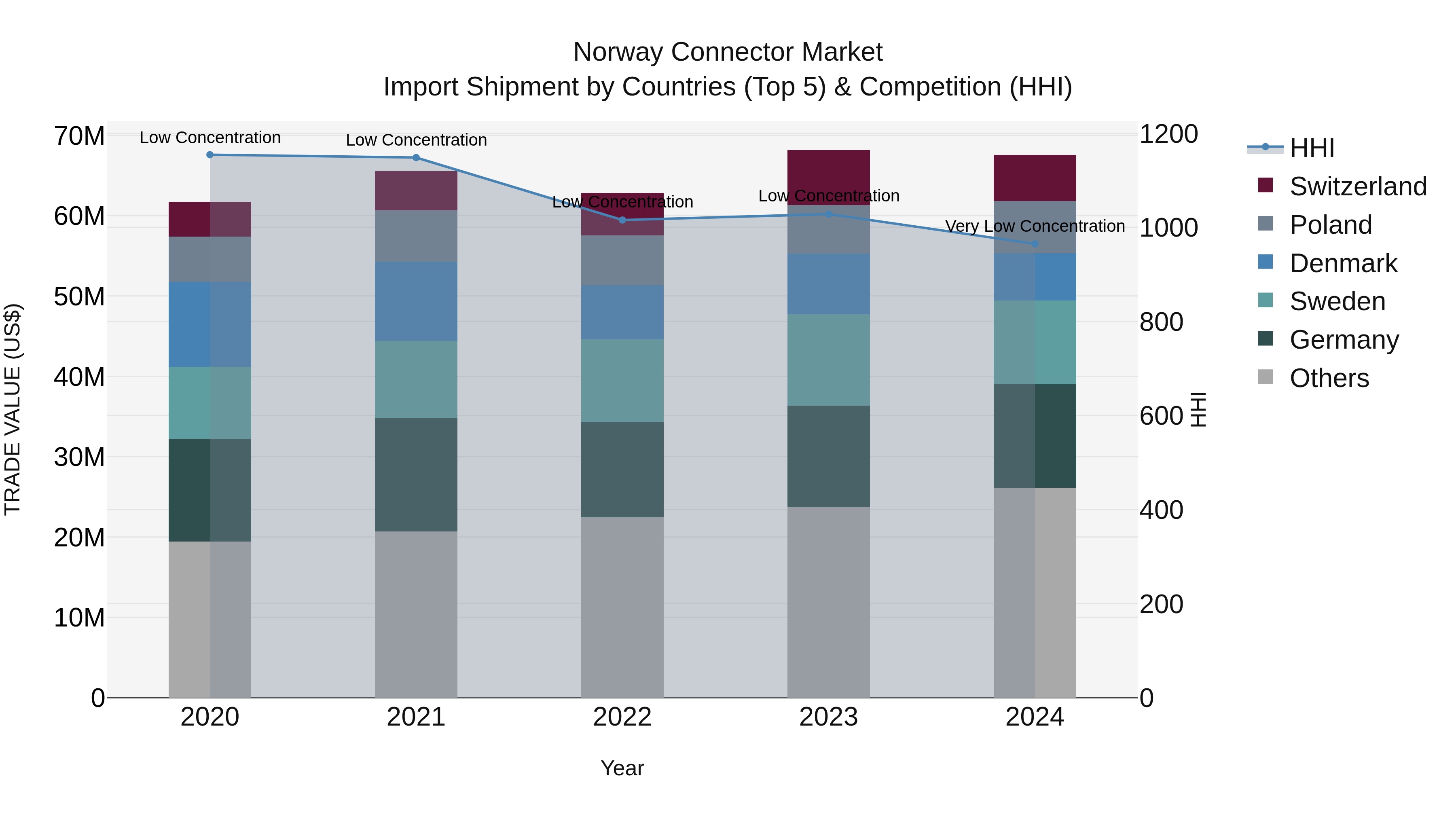
Norway`s connector import market saw a diverse range of suppliers in 2024, with Germany, Sweden, Poland, Denmark, and Switzerland emerging as the top exporting countries. The market displayed very low concentration levels, indicating a competitive landscape with multiple players. Despite a modest CAGR of 2.29% from 2020 to 2024, there was a slight decline in growth rate from 2023 to 2024. This data suggests a stable market environment with opportunities for various exporters to engage with Norway`s connector import market in the coming years.
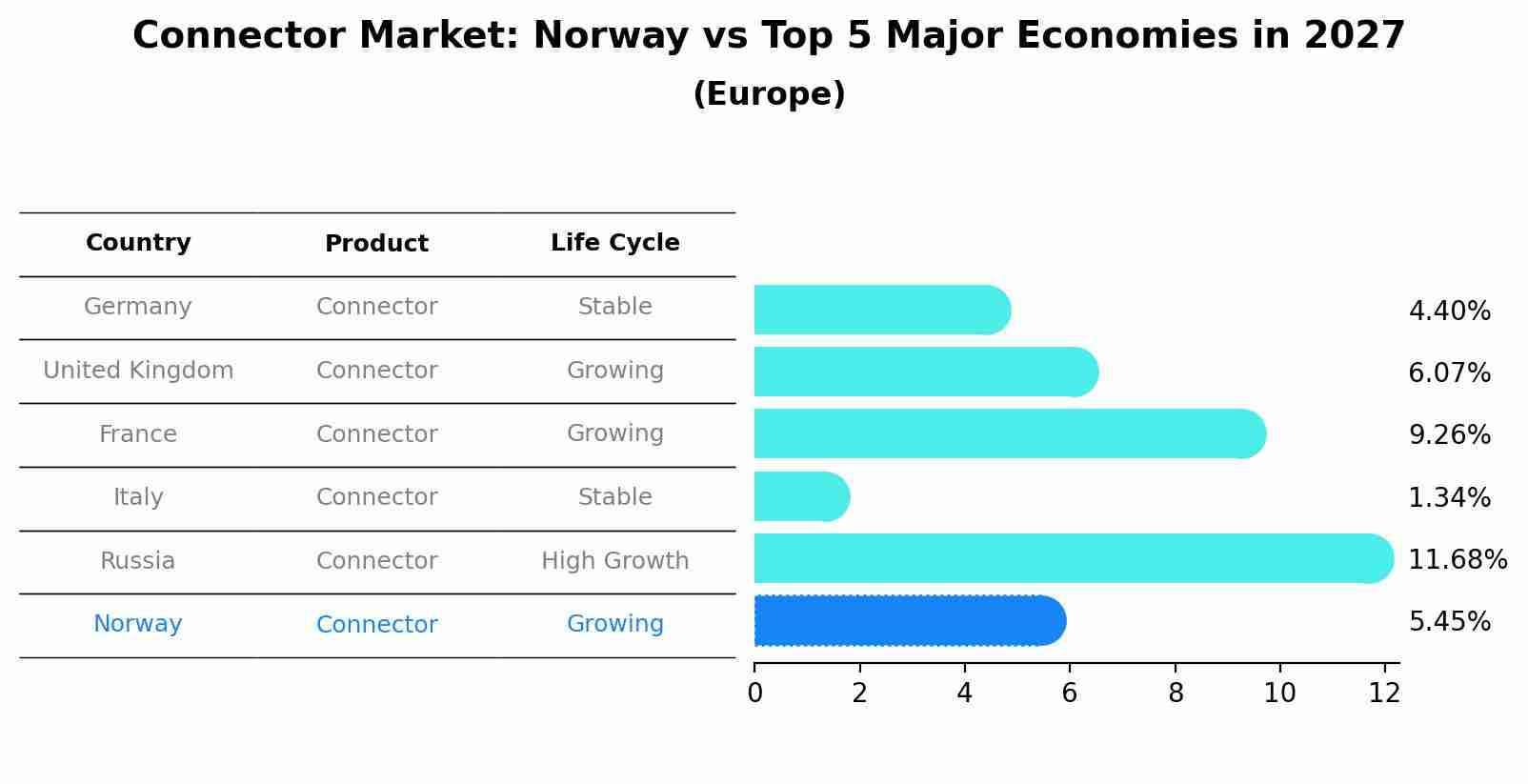
Connector Market: Norway vs Top 5 Major Economies in 2027 (Europe)
By 2027, Norway's Connector market is forecasted to achieve a growing growth rate of 5.45%, with Germany leading the Europe region, followed by United Kingdom, France, Italy and Russia.
Norway Connector Market Overview
The connector market in Norway is expanding as various industries require reliable and high-performance connectors for electronic devices and systems. Connectors are essential components in telecommunications, automotive, and consumer electronics. The market benefits from advancements in connector technologies and the increasing demand for connectivity solutions in diverse applications.
Drivers of the market
The Norway Connector Market benefits from the growing demand for reliable and efficient connectivity solutions across various industries. The proliferation of electronic devices and the need for robust connectors in telecommunications, automotive, and industrial applications support market expansion.
Challenges of the market
The connector market in Norway is constrained by the high cost of advanced connectors and the need for continuous technological upgrades to keep pace with evolving electronic systems. Additionally, competition from low-cost manufacturers and the commoditization of connector products put pressure on market players.
Government Policy of the market
Government policies in Norway for the Connector market emphasize quality and safety standards. Regulations ensure that connectors used in various applications, including electronics and automotive industries, meet rigorous performance and safety requirements. The government supports research and development in connector technologies and provides incentives for innovations that improve performance and reliability.
Key Highlights of the Report:
- Norway Connector Market Outlook
- Market Size of Norway Connector Market, 2024
- Forecast of Norway Connector Market, 2031
- Historical Data and Forecast of Norway Connector Revenues & Volume for the Period 2021-2031
- Norway Connector Market Trend Evolution
- Norway Connector Market Drivers and Challenges
- Norway Connector Price Trends
- Norway Connector Porter`s Five Forces
- Norway Connector Industry Life Cycle
- Historical Data and Forecast of Norway Connector Market Revenues & Volume By Product for the Period 2021-2031
- Historical Data and Forecast of Norway Connector Market Revenues & Volume By PCB Connectors for the Period 2021-2031
- Historical Data and Forecast of Norway Connector Market Revenues & Volume By IO Connectors for the Period 2021-2031
- Historical Data and Forecast of Norway Connector Market Revenues & Volume By Circular Connectors for the Period 2021-2031
- Historical Data and Forecast of Norway Connector Market Revenues & Volume By Fiber Optic Connectors for the Period 2021-2031
- Historical Data and Forecast of Norway Connector Market Revenues & Volume By RF Coaxial Connectors for the Period 2021-2031
- Historical Data and Forecast of Norway Connector Market Revenues & Volume By Others for the Period 2021-2031
- Historical Data and Forecast of Norway Connector Market Revenues & Volume By End Use for the Period 2021-2031
- Historical Data and Forecast of Norway Connector Market Revenues & Volume By Telecom for the Period 2021-2031
- Historical Data and Forecast of Norway Connector Market Revenues & Volume By Transportation for the Period 2021-2031
- Historical Data and Forecast of Norway Connector Market Revenues & Volume By Automotive for the Period 2021-2031
- Historical Data and Forecast of Norway Connector Market Revenues & Volume By Industrial for the Period 2021-2031
- Historical Data and Forecast of Norway Connector Market Revenues & Volume By Computer & Peripherals for the Period 2021-2031
- Historical Data and Forecast of Norway Connector Market Revenues & Volume By Others for the Period 2021-2031
- Norway Connector Import Export Trade Statistics
- Market Opportunity Assessment By Product
- Market Opportunity Assessment By End Use
- Norway Connector Top Companies Market Share
- Norway Connector Competitive Benchmarking By Technical and Operational Parameters
- Norway Connector Company Profiles
- Norway Connector Key Strategic Recommendations






































