Iraq Consumer Battery Market Size, Share & Growth Rate
The Iraq Consumer Battery Market was estimated at USD 436 Million in 2025 and is projected to reach USD 806 Million by 2032, growing at a CAGR of 9.2% from 2026 to 2032. This growth trajectory is largely fueled by the increasing adoption of consumer electronics, particularly smartphones and laptops, as well as the demand for portable devices that require reliable power sources. Furthermore, with a rising awareness of energy storage solutions among consumers, the appetite for various types of batteries continues to expand.
Iraq Consumer Battery Market Year-wise Growth Rate and Key Drivers
This graph highlights how the Iraq Consumer Battery Market has steadily grown over the years, supported by major growth factors.
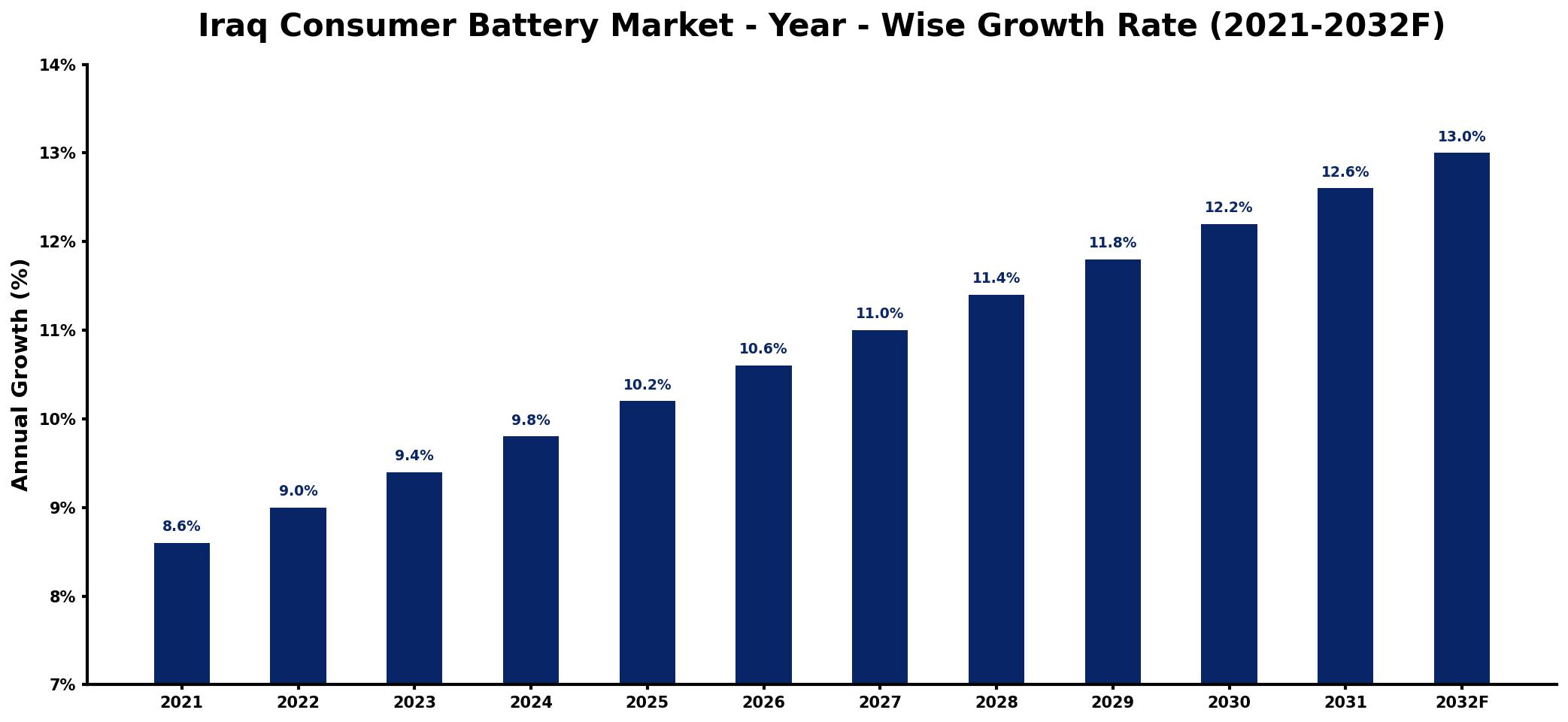
The table below presents the year‑wise growth rates along with the key drivers influencing the market
| Year | Growth Rate | Major Drivers |
| 2021 | 8.6% | Rising demand for portable electronics |
| 2022 | 9.0% | Increased investment in renewable energy |
| 2023 | 9.4% | Growth in telecommunications infrastructure |
| 2024 | 9.8% | Expansion of e-commerce platforms |
| 2025 | 10.2% | Surge in home automation systems |
| 2026 | 10.6% | Boost in outdoor recreational activities |
| 2027 | 11.0% | Development of smart city projects |
| 2028 | 11.4% | Increase in electric vehicle adoption |
| 2029 | 11.8% | growing emerging market penetration |
| 2030 | 12.2% | Rising popularity of portable gadgets |
| 2031 | 12.6% | expanding industrial usage applications |
| 2032 | 13.0% | Increased production of renewable devices |
Note: Market size estimations and growth projections presented in this report are based on 6Wresearch's proprietary forecasting methodology, utilizing the latest available industry data, government publications, and primary research inputs.
Iraq Consumer Battery Market Synopsis
The Iraq consumer battery market has recently gained momentum, fueled by a surge in electronic device adoption. However, the industry is still navigating through a landscape that presents significant growth potential. As the trend toward portable technology accelerates, businesses are increasingly focusing on consumer batteries that can meet the burgeoning demand for effective power solutions.
Despite its growth, the market faces challenges such as limited local production capabilities and dependence on imports. As companies seek to establish a stronger foothold, the balance between satisfying demand and overcoming operational hurdles will be critical. Moreover, government initiatives aimed at enhancing local manufacturing can further influence the market dynamics moving forward.
Iraq Consumer Battery Market Key Takeaways
- The market is experiencing strong growth driven by increased adoption of consumer electronics and portable devices.
- Major types of batteries include lithium-ion, alkaline, and nickel-metal hydride, each catering to specific consumer needs.
- Challenges such as reliance on imports and a shortage of skilled professionals continue to affect market efficiency.
- Government incentives aimed at boosting local production could alter competitive dynamics significantly.
- Sustainability and regulatory compliance are becoming increasingly important factors for manufacturers and consumers alike.
Evaluation of Restraints in Iraq Consumer Battery Market
The Iraq consumer battery market is hindered by several fundamental restraints that limit its potential. A significant concern is the limited availability of high-quality batteries, which forces a reliance on imports that are subject to international price fluctuations and supply chain challenges. This dependency places financial pressure on local businesses, often resulting in inflated costs for consumers. Additionally, a lack of skilled professionals knowledgeable in battery application and disposal compounds these issues, further complicating the market landscape. Finally, economic instability and political uncertainty create a volatile environment, deterring investment and innovation in the consumer electronics sector.
Iraq Consumer Battery Market Trends
Current trends indicate a growing consumer preference for rechargeable batteries, particularly lithium-ion variants, due to their efficiency and longer lifespans. Additionally, the rise of environmentally-conscious consumers is prompting a shift towards sustainable battery solutions and responsible disposal practices. Moreover, technological advancements in battery technology, such as faster charging capabilities and improved energy density, are playing a pivotal role in shaping market demand. These trends not only enhance user experience but also align with global sustainability efforts.
Iraq Consumer Battery Market Opportunities
Opportunities for growth in the Iraq consumer battery market are becoming increasingly apparent, particularly as the government supports local manufacturing initiatives. As foreign investments in battery production facilities grow, there will be a surge in job creation and innovation within the industry. The rising popularity of electric vehicles also presents a unique opportunity for battery manufacturers to expand their product offerings. Additionally, the demand for backup power solutions is likely to grow, especially in areas experiencing frequent power outages, creating a robust market for high-capacity batteries.
Government Initiatives in the Iraq Consumer Battery Market
To respond to the increasing demand for consumer batteries, the Iraqi government has been proactive in fostering local production capabilities. Initiatives include providing incentives for both foreign and domestic investments in battery manufacturing plants. Furthermore, the government is focused on establishing subsidies for research and development efforts in battery technology, aimed at encouraging innovation. Import tariffs have also been adjusted to protect local manufacturers, fostering a more competitive pricing environment for consumers. Such measures reflect the governments commitment to enhancing the sustainability and viability of the consumer battery market.
Future Insights of the Iraq Consumer Battery Market
Looking ahead to 2026-2032, the Iraq consumer battery market is poised for significant evolution, driven by technological advancements and government support. The anticipated growth in consumer electronics and portable devices will likely sustain demand for various battery types. As local manufacturing capabilities improve, consumers can expect better product availability and quality. Additionally, the market's responsiveness to global sustainability trends is expected to play a crucial role in shaping its future, with environmentally-friendly practices becoming a mainstay in production and distribution methods.
Iraq Consumer Battery Market Latest Developments (2025 - 2026)
In recent months, the Iraqi consumer battery market has seen a marked shift towards enhancing local production capabilities. New policies aimed at supporting domestic battery manufacturing have gained traction, resulting in increased foreign investments. There has also been a notable rise in initiatives focused on educating consumers about battery recycling and sustainable practices. Companies are increasingly launching innovative battery technologies that cater to the specific needs of the Iraqi consumer, indicating a proactive approach to market challenges.
Iraq Consumer Battery Market - Key Attractiveness of the Report
- 10 Years of Market Numbers
- Historical Data Starting from 2022 to 2025
- Base Year: 2025
- Forecast Data until 2032
- Key Performance Indicators Impacting the Market
- Major Upcoming Developments and Projects
Key Highlights of the Report:
- Iraq Consumer Battery Market Outlook
- Market Size of Iraq Consumer Battery Market, 2025
- Forecast of Iraq Consumer Battery Market, 2032
- Historical Data and Forecast of Iraq Consumer Battery Revenues & Volume for the Period 2022-2032F
- Iraq Consumer Battery Market Trend Evolution
- Iraq Consumer Battery Market Drivers and Challenges
- Iraq Consumer Battery Price Trends
- Iraq Consumer Battery Porter's Five Forces
- Iraq Consumer Battery Industry Life Cycle
- Historical Data and Forecast of Iraq Consumer Battery Market Revenues & Volume By Type for the Period 2022-2032F
- Historical Data and Forecast of Iraq Consumer Battery Market Revenues & Volume By Lithium-ion Batteries for the Period 2022-2032F
- Historical Data and Forecast of Iraq Consumer Battery Market Revenues & Volume By Zinc-Carbon Batteries for the Period 2022-2032F
- Historical Data and Forecast of Iraq Consumer Battery Market Revenues & Volume By Alkaline Batteries for the Period 2022-2032F
- Historical Data and Forecast of Iraq Consumer Battery Market Revenues & Volume By Nickel Metal Hydride for the Period 2022-2032F
- Historical Data and Forecast of Iraq Consumer Battery Market Revenues & Volume By Nickel Cadmium for the Period 2022-2032F
- Historical Data and Forecast of Iraq Consumer Battery Market Revenues & Volume By Others for the Period 2022-2032F
- Historical Data and Forecast of Iraq Consumer Battery Market Revenues & Volume By End-User for the Period 2022-2032F
- Historical Data and Forecast of Iraq Consumer Battery Market Revenues & Volume By Residential for the Period 2022-2032F
- Historical Data and Forecast of Iraq Consumer Battery Market Revenues & Volume By Commercial for the Period 2022-2032F
- Iraq Consumer Battery Import Export Trade Statistics
- Market Opportunity Assessment By Type
- Market Opportunity Assessment By End-User
- Iraq Consumer Battery Top Companies Market Share
- Iraq Consumer Battery Competitive Benchmarking By Technical and Operational Parameters
- Iraq Consumer Battery Company Profiles
- Iraq Consumer Battery Key Strategic Recommendations






































