Iraq Cosmetic Products Market Size, Share & Growth Rate
The Iraq Cosmetic Products Market was estimated at USD 214 Million in 2025 and is projected to reach USD 295 Million by 2032, growing at a CAGR of 4.7% from 2026 to 2032. This growth trajectory is propelled by a rising disposable income, particularly among the youth, who are increasingly embracing global beauty trends. Furthermore, a heightened awareness of personal grooming, fueled by social media influences, is expanding the market's footprint across various beauty segments.
Iraq Cosmetic Products Market Year-wise Growth Rate and Key Drivers
This graph highlights how the Iraq Cosmetic Products Market has steadily grown over the years, supported by major growth factors.
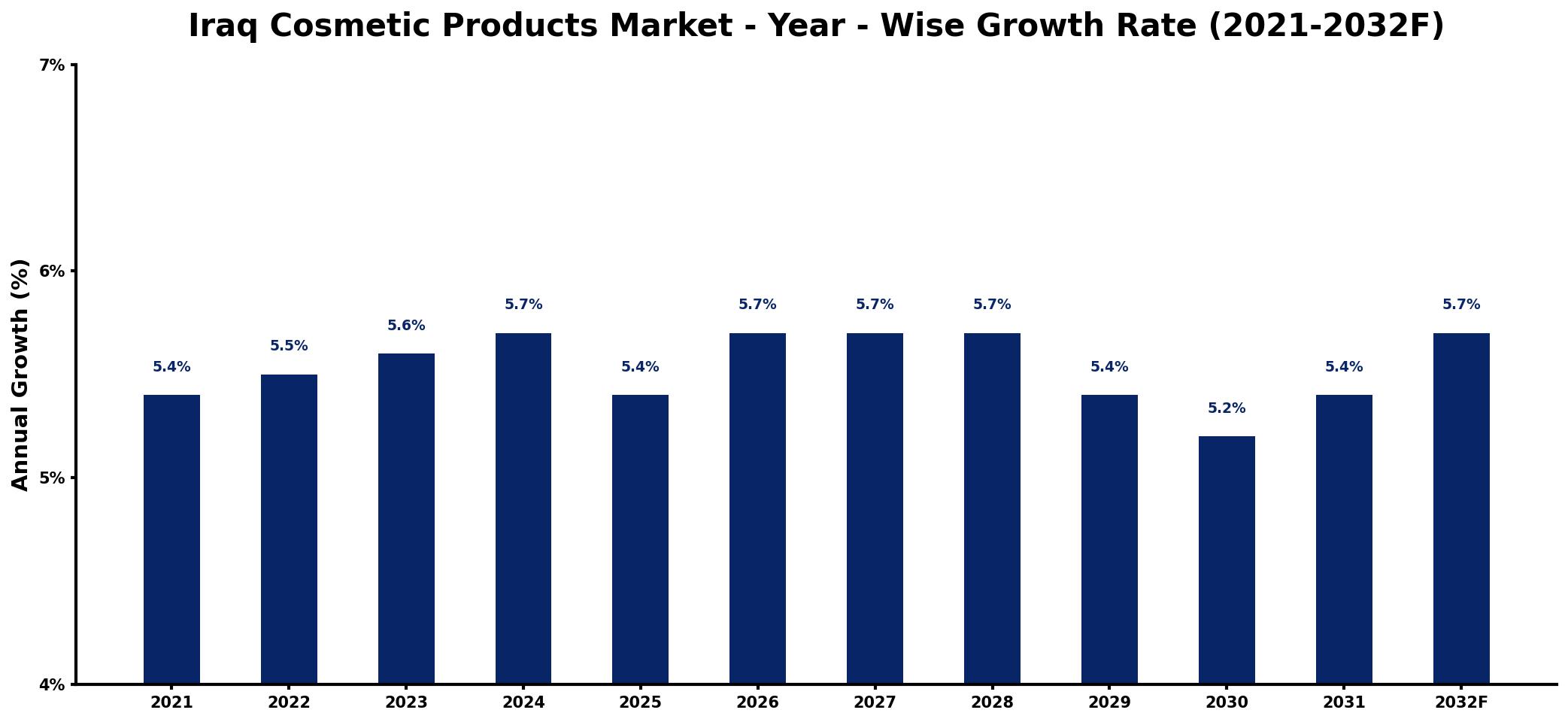
The table below presents the year‑wise growth rates along with the key drivers influencing the market
| Year | Growth Rate | Major Drivers |
| 2021 | 5.4% | Rising consumer spending power |
| 2022 | 5.5% | Increased online shopping platforms |
| 2023 | 5.6% | Growing youth population engagement |
| 2024 | 5.7% | Expansion of retail distribution channels |
| 2025 | 5.4% | Surge in social media influence |
| 2026 | 5.7% | Growth in local manufacturing capabilities |
| 2027 | 5.7% | Investment in sustainable sourcing |
| 2028 | 5.7% | Emergence of new brands |
| 2029 | 5.4% | Diversification of consumer preferences |
| 2030 | 5.2% | Strengthening of regional trade agreements |
| 2031 | 5.4% | Advancements in marketing strategies |
| 2032 | 5.7% | Enhanced focus on wellness trends |
Note: Market size estimations and growth projections presented in this report are based on 6Wresearch's proprietary forecasting methodology, utilizing the latest available industry data, government publications, and primary research inputs.
Iraq Cosmetic Products Market Synopsis
In recent years, the Iraq Cosmetic Products Market has experienced significant growth driven by changing consumer behaviors and preferences. However, as the market matures, it is now poised for a dynamic transformation, adapting to a mix of cultural nuances and global influences that continue to shape the landscape.
Looking forward, the industry is focusing on product innovation, catering to the specific demands of Iraqi consumers. The integration of local ingredients alongside international formulations is likely to be a game-changer, allowing companies to appeal to a broader audience while respecting cultural sensitivities.
Iraq Cosmetic Products Market Key Takeaways
- The market is experiencing a surge in demand, primarily due to increasing disposable incomes.
- Younger consumers are significantly influencing trends and driving sales across multiple beauty categories.
- The regulatory landscape emphasizes product safety and quality, shaping how companies operate.
- Social media plays a pivotal role in influencing consumer preferences and promoting beauty products.
- There is a growing trend toward the fusion of local and international beauty product formulations.
Evaluation of Restraints in Iraq Cosmetic Products Market
Despite the promising growth potential, the Iraq Cosmetic Products Market grapples with several restraints that can limit progress. Stringent regulations surrounding product labeling and importation require companies to invest considerable time and resources to ensure compliance. Moreover, varying consumer preferences, shaped by cultural and religious factors, can complicate market entry strategies. These challenges necessitate a nuanced approach to product development and marketing to align with local customs and values.
Iraq Cosmetic Products Market Trends
Current trends in the Iraq Cosmetic Products Market are notably influenced by the rise of organic and natural products as consumers increasingly seek safer and environmentally friendly options. The trend towards cruelty-free and ethically sourced ingredients is also gaining momentum, reflecting a broader global shift in consumer values. Additionally, brands are leveraging technology and e-commerce platforms to reach a wider audience, enhancing the shopping experience through personalized marketing strategies.
Iraq Cosmetic Products Market Opportunities
There are significant opportunities for growth within the Iraq Cosmetic Products Market, particularly in niche segments such as halal cosmetics. As consumers become more discerning, brands that can offer tailored solutions to meet specific cultural and religious needs will likely find themselves at an advantage. Furthermore, the potential to expand into e-commerce and digital marketing presents an avenue for brands to connect with the tech-savvy youth demographic, thus driving sales and brand loyalty.
Government Initiatives in the Iraq Cosmetic Products Market
The Iraqi government is actively focusing on enhancing consumer safety and product quality within the cosmetics sector. Regulatory frameworks are being developed to ensure compliance with international standards, particularly concerning product labeling and ingredient transparency. Furthermore, the government is committed to monitoring the manufacturing practices of cosmetic companies, thereby fostering a market environment that prioritizes consumer protection while encouraging industry growth through safe practices.
Future Insights of the Iraq Cosmetic Products Market
As we look toward 2026-2032, the Iraq Cosmetic Products Market is expected to navigate through a phase of robust development driven by a younger, more beauty-conscious population. Continuous exposure to international beauty standards through digital channels will further enhance consumer expectations. Innovations in product offerings, alongside a growing acceptance of diverse beauty ideals, are anticipated to create a vibrant market dynamic ripe for investment and expansion.
Iraq Cosmetic Products Market Latest Developments (2025 - 2026)
Recent industry developments indicate a heightened focus on regulatory compliance among cosmetic manufacturers. Companies are increasingly aligning their practices with government mandates to ensure product safety and quality. Moreover, the launch of new marketing campaigns tailored to young consumers illustrates a strategic shift toward embracing social media influences to enhance brand visibility and consumer engagement in this evolving marketplace.
Iraq Cosmetic Products Market - Key Attractiveness of the Report
- 10 Years of Market Numbers
- Historical Data Starting from 2022 to 2025
- Base Year: 2025
- Forecast Data until 2032
- Key Performance Indicators Impacting the Market
- Major Upcoming Developments and Projects
Key Highlights of the Report:
- Iraq Cosmetic Products Market Outlook
- Market Size of Iraq Cosmetic Products Market, 2025
- Forecast of Iraq Cosmetic Products Market, 2032
- Historical Data and Forecast of Iraq Cosmetic Products Revenues & Volume for the Period 2022-2032F
- Iraq Cosmetic Products Market Trend Evolution
- Iraq Cosmetic Products Market Drivers and Challenges
- Iraq Cosmetic Products Price Trends
- Iraq Cosmetic Products Porter's Five Forces
- Iraq Cosmetic Products Industry Life Cycle
- Historical Data and Forecast of Iraq Cosmetic Products Market Revenues & Volume By Type for the Period 2022-2032F
- Historical Data and Forecast of Iraq Cosmetic Products Market Revenues & Volume By Skin Care Products for the Period 2022-2032F
- Historical Data and Forecast of Iraq Cosmetic Products Market Revenues & Volume By Color Cosmetics for the Period 2022-2032F
- Historical Data and Forecast of Iraq Cosmetic Products Market Revenues & Volume By Hair Care Products for the Period 2022-2032F
- Historical Data and Forecast of Iraq Cosmetic Products Market Revenues & Volume By Fragrance And Deodorants for the Period 2022-2032F
- Historical Data and Forecast of Iraq Cosmetic Products Market Revenues & Volume By Sun Care Products for the Period 2022-2032F
- Historical Data and Forecast of Iraq Cosmetic Products Market Revenues & Volume By Soaps, Bath, & Shower Products for the Period 2022-2032F
- Historical Data and Forecast of Iraq Cosmetic Products Market Revenues & Volume By Oral Hygiene Products for the Period 2022-2032F
- Historical Data and Forecast of Iraq Skin Care Products Cosmetic Products Market Revenues & Volume By Personal Hygiene Products for the Period 2022-2032F
- Historical Data and Forecast of Iraq Cosmetic Products Market Revenues & Volume By Distribution Channel for the Period 2022-2032F
- Historical Data and Forecast of Iraq Cosmetic Products Market Revenues & Volume By Supermarkets for the Period 2022-2032F
- Historical Data and Forecast of Iraq Cosmetic Products Market Revenues & Volume By Pharmacy & Drug Stores for the Period 2022-2032F
- Historical Data and Forecast of Iraq Cosmetic Products Market Revenues & Volume By Department Stores for the Period 2022-2032F
- Historical Data and Forecast of Iraq Cosmetic Products Market Revenues & Volume By Direct Selling for the Period 2022-2032F
- Historical Data and Forecast of Iraq Cosmetic Products Market Revenues & Volume By Specialty Stores for the Period 2022-2032F
- Historical Data and Forecast of Iraq Cosmetic Products Market Revenues & Volume By Beauty Salons for the Period 2022-2032F
- Historical Data and Forecast of Iraq Cosmetic Products Market Revenues & Volume By Internet Retailing for the Period 2022-2032F
- Historical Data and Forecast of Iraq Cosmetic Products Market Revenues & Volume By Others for the Period 2022-2032F
- Iraq Cosmetic Products Import Export Trade Statistics
- Market Opportunity Assessment By Type
- Market Opportunity Assessment By Distribution Channel
- Iraq Cosmetic Products Top Companies Market Share
- Iraq Cosmetic Products Competitive Benchmarking By Technical and Operational Parameters
- Iraq Cosmetic Products Company Profiles
- Iraq Cosmetic Products Key Strategic Recommendations






































