Iraq Curtains and Window Blinds Market Size, Share & Growth Rate
The Iraq Curtains and Window Blinds Market was estimated at USD 1496 Million in 2025 and is projected to reach USD 2708 Million by 2032, growing at a CAGR of 8.8% from 2026 to 2032. This growth trajectory is primarily driven by increasing urbanization and rising disposable incomes, leading to an upsurge in home improvement projects. Additionally, the burgeoning awareness of contemporary interior design trends is prompting consumers to invest in stylish and high-quality window treatments.
Iraq Curtains and Window Blinds Market Year-wise Growth Rate and Key Drivers
This graph highlights how the Iraq Curtains and Window Blinds Market has steadily grown over the years, supported by major growth factors.
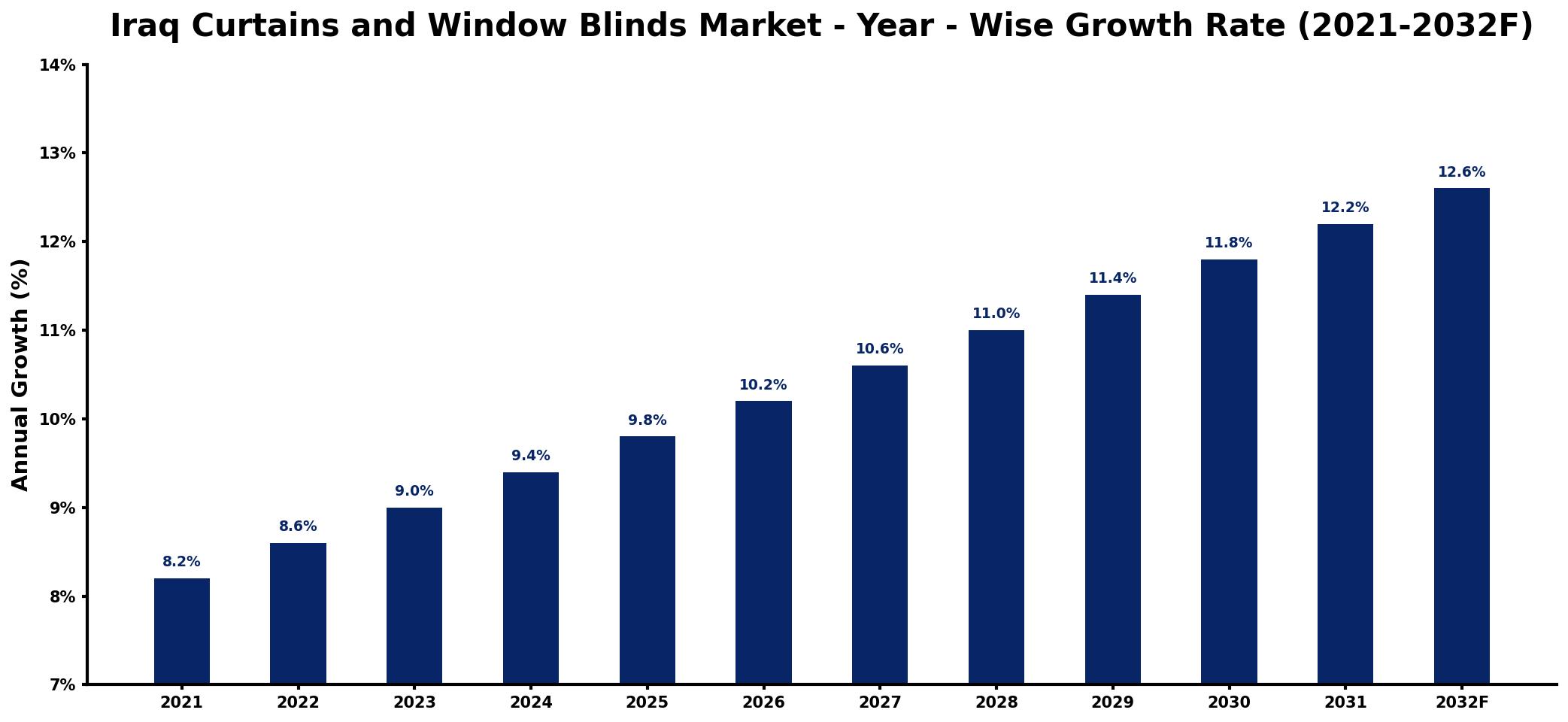
The table below presents the year‑wise growth rates along with the key drivers influencing the market
| Year | Growth Rate | Major Drivers |
| 2021 | 8.2% | Rising urbanization and housing projects |
| 2022 | 8.6% | Increased disposable income levels |
| 2023 | 9.0% | Growing focus on interior design |
| 2024 | 9.4% | Expansion of retail distribution networks |
| 2025 | 9.8% | Surge in home renovation activities |
| 2026 | 10.2% | Boost in construction sector investments |
| 2027 | 10.6% | Higher consumer awareness about aesthetics |
| 2028 | 11.0% | Innovation in sustainable materials usage |
| 2029 | 11.4% | Growth in hospitality industry demand |
| 2030 | 11.8% | Increase in expatriate population influx |
| 2031 | 12.2% | strengthening underlying market demand |
| 2032 | 12.6% | Enhanced government support for housing |
Note: Market size estimations and growth projections presented in this report are based on 6Wresearch's proprietary forecasting methodology, utilizing the latest available industry data, government publications, and primary research inputs.
Iraq Curtains and Window Blinds Market Synopsis
Recent momentum in the Iraq Curtains and Window Blinds Market reflects a burgeoning demand for aesthetically appealing window treatments across both residential and commercial sectors. With a diverse range of products available, including curtains, blinds, shades, and shutters, consumers are increasingly inclined toward customization and premium quality.
However, the market is poised for significant transformation as it adapts to modern preferences, embracing technological innovations and sustainable practices. This evolving landscape not only enhances consumer choices but also encourages investments in product development and local manufacturing, paving the way for a robust market future.
Iraq Curtains and Window Blinds Market Key Takeaways
- The market is projected to grow significantly, reaching USD 2708 Million by 2032.
- Urbanization and increased disposable incomes are pivotal factors driving growth.
- Smart and energy-efficient window treatments are gaining popularity among consumers.
- Customization and personalized designs are becoming essential in consumer purchasing decisions.
- Sustainability is increasingly influencing product choices and manufacturing processes.
Evaluation of Restraints in Iraq Curtains and Window Blinds Market
Despite its growth potential, the Iraq Curtains and Window Blinds Market encounters several restraints that can hinder expansion. A prevalent preference for traditional décor styles often overshadows modern alternatives, limiting consumer adoption of innovative designs. Furthermore, economic challenges, including limited disposable income for premium products, can deter purchasing behaviors. Additionally, competition from low-cost imported products hampers the local market's ability to establish a strong foothold. Political instability in the region also adds layers of uncertainty, affecting consumer confidence and overall market demand.
Iraq Curtains and Window Blinds Market Trends
A notable trend within the Iraq Curtains and Window Blinds Market is the shift toward modern designs that not only fulfill functional needs but also elevate aesthetic appeal. Consumers are increasingly inclined to seek out energy-efficient solutions, such as thermally insulated curtains and blinds that optimize indoor climates while curbing energy expenses. Furthermore, the rise of smart technology integration is shaping demand for remote-controlled window treatments, aligning with the growing need for convenience and enhanced security. Environmental consciousness is also a driving force, with eco-friendly materials becoming sought after as consumers become more discerning about their choices.
Iraq Curtains and Window Blinds Market Opportunities
The Iraq Curtains and Window Blinds Market presents substantial investment opportunities, fueled by an expanding middle class and a heightened interest in interior decoration. The ongoing reconstruction efforts in the country further amplify prospects for supplying window treatments to emerging residential and commercial developments. Investors can explore avenues in manufacturing, distribution channels, and retail outlets to tap into this growing market. Collaborating with local suppliers and retailers can enhance market penetration and facilitate effective navigation through the evolving landscape.
Government Initiatives in the Iraq Curtains and Window Blinds Market
Government initiatives play a crucial role in shaping the dynamics of the Iraq Curtains and Window Blinds Market. Regulatory policies established by the Ministry of Industry and Minerals focus on ensuring product quality and safety standards, bolstering consumer protection. Moreover, incentives such as subsidies and tax breaks for local manufacturers are designed to encourage domestic production and fair competition within the sector. These measures aim to enhance the overall market environment, supporting growth and competitiveness.
Future Insights of the Iraq Curtains and Window Blinds Market
Looking ahead to 2026-2032, the Iraq Curtains and Window Blinds Market is set to benefit from continued urbanization and the burgeoning interest in stylish, functional home environments. The demand for customized window treatments will persist, driven by consumer desires for personalization and high-quality designs. As economic conditions stabilize, enhanced consumer purchasing power will further stimulate market growth. The increasing integration of technology in home decor will likely redefine product offerings, providing consumers with innovative, stylish solutions for their living spaces.
Iraq Curtains and Window Blinds Market Latest Developments (2025 - 2026)
In recent months, the Iraq Curtains and Window Blinds Market has witnessed a surge in the introduction of smart window treatments that cater to the growing demand for home automation. Manufacturers are increasingly focusing on sustainable practices, launching eco-friendly product lines that appeal to environmentally conscious consumers. Additionally, expansion plans by local manufacturers are underway, reflecting an optimistic outlook towards catering to the rising demand for customized and quality window coverings. These developments are indicative of a market poised for innovation and growth.
Iraq Curtains and Window Blinds Market - Key Attractiveness of the Report
- 10 Years of Market Numbers
- Historical Data Starting from 2022 to 2025
- Base Year: 2025
- Forecast Data until 2032
- Key Performance Indicators Impacting the Market
- Major Upcoming Developments and Projects
Key Highlights of the Report:
- Iraq Curtains and Window Blinds Market Outlook
- Market Size of Iraq Curtains and Window Blinds Market, 2025
- Forecast of Iraq Curtains and Window Blinds Market, 2032
- Historical Data and Forecast of Iraq Curtains and Window Blinds Revenues & Volume for the Period 2022-2032F
- Iraq Curtains and Window Blinds Market Trend Evolution
- Iraq Curtains and Window Blinds Market Drivers and Challenges
- Iraq Curtains and Window Blinds Price Trends
- Iraq Curtains and Window Blinds Porter's Five Forces
- Iraq Curtains and Window Blinds Industry Life Cycle
- Historical Data and Forecast of Iraq Curtains and Window Blinds Market Revenues & Volume By Materials for the Period 2022-2032F
- Historical Data and Forecast of Iraq Curtains and Window Blinds Market Revenues & Volume By Curtains (Cotton, Linen, Polyester) for the Period 2022-2032F
- Historical Data and Forecast of Iraq Curtains and Window Blinds Market Revenues & Volume By Window Blinds (Cotton, Linen, Wood, PVC, Metal) for the Period 2022-2032F
- Historical Data and Forecast of Iraq Curtains and Window Blinds Market Revenues & Volume By Product for the Period 2022-2032F
- Historical Data and Forecast of Iraq Curtains and Window Blinds Market Revenues & Volume By Curtains (Box pleat curtains, Pinch pleat curtains & drapery, Goblet pleat curtains & drapery, Eyelet curtains & drapery) for the Period 2022-2032F
- Historical Data and Forecast of Iraq Curtains and Window Blinds Market Revenues & Volume By Window Blinds (Window Shades,, Window Screens, Connected) for the Period 2022-2032F
- Historical Data and Forecast of Iraq Curtains and Window Blinds Market Revenues & Volume By Distribution Channel for the Period 2022-2032F
- Historical Data and Forecast of Iraq Curtains and Window Blinds Market Revenues & Volume By B2B for the Period 2022-2032F
- Historical Data and Forecast of Iraq Curtains and Window Blinds Market Revenues & Volume By B2C for the Period 2022-2032F
- Historical Data and Forecast of Iraq Curtains and Window Blinds Market Revenues & Volume By E-commerce for the Period 2022-2032F
- Historical Data and Forecast of Iraq Curtains and Window Blinds Market Revenues & Volume By Price Range for the Period 2022-2032F
- Historical Data and Forecast of Iraq Curtains and Window Blinds Market Revenues & Volume By High for the Period 2022-2032F
- Historical Data and Forecast of Iraq Curtains and Window Blinds Market Revenues & Volume By Medium for the Period 2022-2032F
- Historical Data and Forecast of Iraq Curtains and Window Blinds Market Revenues & Volume By Low for the Period 2022-2032F
- Iraq Curtains and Window Blinds Import Export Trade Statistics
- Market Opportunity Assessment By Materials
- Market Opportunity Assessment By Product
- Market Opportunity Assessment By Distribution Channel
- Market Opportunity Assessment By Price Range
- Iraq Curtains and Window Blinds Top Companies Market Share
- Iraq Curtains and Window Blinds Competitive Benchmarking By Technical and Operational Parameters
- Iraq Curtains and Window Blinds Company Profiles
- Iraq Curtains and Window Blinds Key Strategic Recommendations






































