Iraq Digital Signage Market Size, Share & Growth Rate
The Iraq Digital Signage Market was estimated at USD 437 Million in 2025 and is projected to reach USD 617 Million by 2032, growing at a CAGR of 5.1% from 2026 to 2032. This growth trajectory is driven by increasing investments in digital infrastructure, fueled by a rising trend toward the digitization of marketing and communication strategies across various sectors, including retail and healthcare. The demand for innovative and dynamic communication solutions that enhance customer engagement is further accelerating market expansion.
Iraq Digital Signage Market Year-wise Growth Rate and Key Drivers
This graph highlights how the Iraq Digital Signage Market has steadily grown over the years, supported by major growth factors.
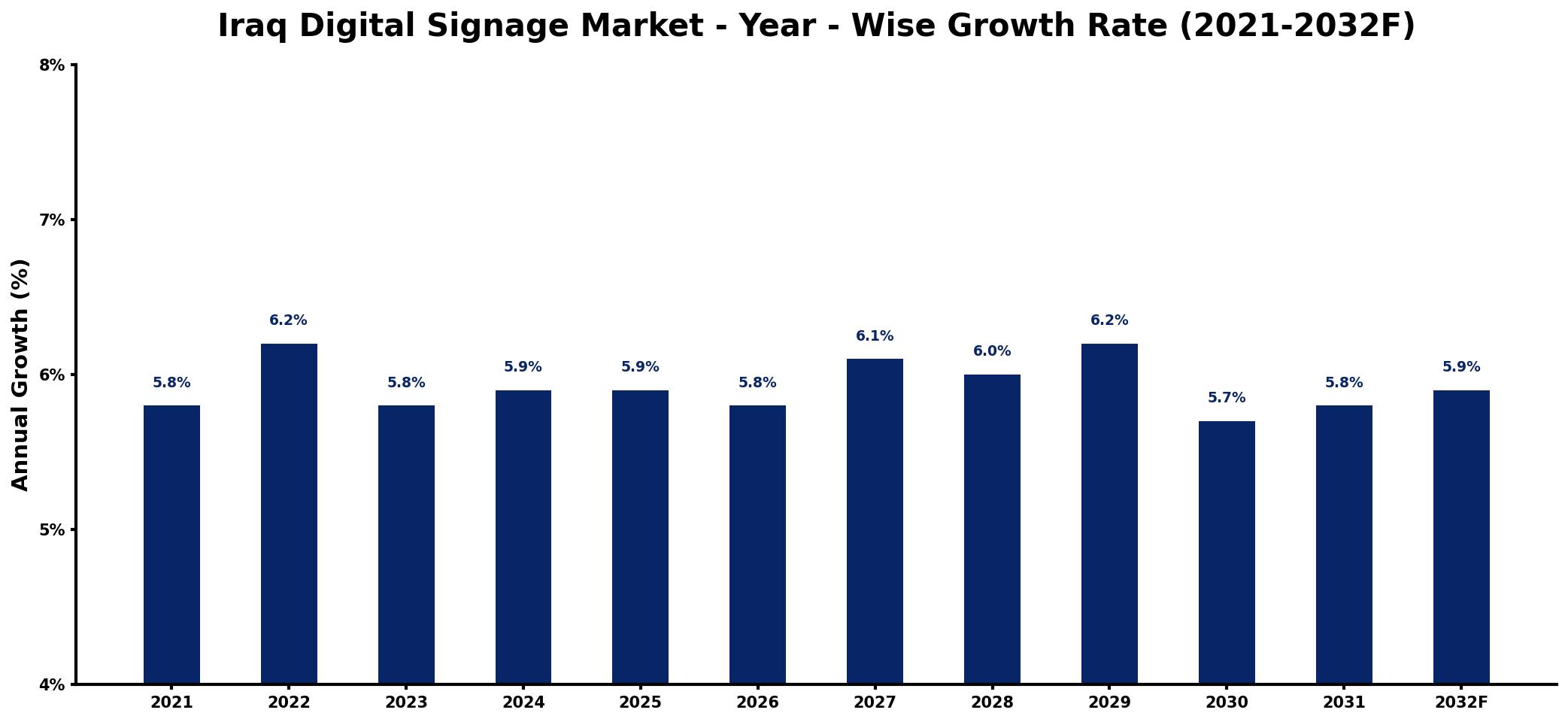
The table below presents the year‑wise growth rates along with the key drivers influencing the market
| Year | Growth Rate | Major Drivers |
| 2021 | 5.8% | Increased advertising investment strategies |
| 2022 | 6.2% | Growing retail sector expansion initiatives |
| 2023 | 5.8% | Rising demand for interactive solutions |
| 2024 | 5.9% | Enhanced urban infrastructure development projects |
| 2025 | 5.9% | Emergence of smart city initiatives |
| 2026 | 5.8% | Strengthened tourism and hospitality growth |
| 2027 | 6.1% | Advancements in technological integration |
| 2028 | 6.0% | Higher consumer engagement expectations |
| 2029 | 6.2% | Widespread adoption of experiential marketing |
| 2030 | 5.7% | Increased focus on brand visibility |
| 2031 | 5.8% | Expansion of event management services |
| 2032 | 5.9% | Growing need for real-time communication |
Note: Market size estimations and growth projections presented in this report are based on 6Wresearch's proprietary forecasting methodology, utilizing the latest available industry data, government publications, and primary research inputs.
Iraq Digital Signage Market Synopsis
As businesses in Iraq modernize their approach to advertising, digital signage solutions are becoming increasingly essential. This market is particularly benefitting from the surge in demand for interactive displays that offer real-time information and targeted messaging, catering to a tech-savvy consumer base eager for engagement.
Moreover, the integration of advanced technologies such as artificial intelligence is fostering a new era of personalized content delivery, enhancing the effectiveness of marketing campaigns. This adaptability makes digital signage a compelling choice for companies across various sectors, including hospitality and transportation.
Iraq Digital Signage Market Key Takeaways
- The market is experiencing steady growth driven by increasing digital adoption and infrastructure improvements.
- Dynamic and interactive displays are becoming vital for customer engagement and brand visibility.
- Cloud-based solutions and LED technology are on the rise, enhancing the effectiveness of digital signage.
- Political and economic factors present challenges, but opportunities for growth persist.
- Investment in partnerships with local businesses is crucial for navigating the market landscape.
Evaluation of Restraints in Iraq Digital Signage Market
While the Iraq Digital Signage Market is poised for significant growth, several restraints challenge its trajectory. Limited internet connectivity remains a critical issue, as many regions lack access to reliable high-speed networks necessary for effective digital signage solutions. Additionally, ongoing political instability can create uncertainty for businesses, discouraging investment in new technologies. Coupled with security concerns and the potential for regulatory hurdles, these factors necessitate a strategic approach for companies looking to succeed in this complex landscape.
Iraq Digital Signage Market Trends
Key trends currently shaping the Iraq Digital Signage Market include a shift towards more integrated cloud-based platforms, allowing businesses to manage content remotely and efficiently. The growing popularity of LED displays for outdoor advertising is also noteworthy, as they provide high visibility and adaptability to various environmental conditions. Furthermore, the incorporation of data analytics is enabling businesses to tailor their messaging more effectively, optimizing audience engagement and conversion rates.
Iraq Digital Signage Market Opportunities
Significant investment opportunities are emerging within the Iraq Digital Signage Market as the demand for advanced communication solutions rises. Companies can explore avenues in providing digital signage hardware and software, along with content creation and maintenance services. Collaborations with local enterprises and government agencies can help navigate barriers to entry, fostering growth and expansion potential in this evolving sector. As Iraqi businesses increasingly prioritize digitization, innovative and localized solutions will be key to capturing market share.
Government Initiatives in the Iraq Digital Signage Market
While the Iraqi government has not introduced specific policies aimed directly at the digital signage market, its broader initiatives to promote foreign investment and technological modernization can positively influence the sector. Regulatory frameworks governing advertising and telecommunications are evolving, which may facilitate a more conducive environment for digital signage businesses. Companies operating in Iraq must remain vigilant to changes in legislation that could affect their strategies and operations in this dynamic landscape.
Future Insights of the Iraq Digital Signage Market
The outlook for the Iraq Digital Signage Market remains optimistic through 2026-2032. With ongoing urbanization and increasing investment in infrastructure, the demand for innovative, engaging advertising solutions is set to escalate. As businesses across various sectors embrace digital technologies to communicate effectively with their audiences, advancements in display technology and smart city initiatives will likely serve as catalysts for market growth. Although challenges related to infrastructure and economic stability persist, the push for modernization is expected to drive considerable opportunities in this space.
Iraq Digital Signage Market Latest Developments (2025 - 2026)
Recent developments in the Iraq Digital Signage Market indicate a growing momentum towards the adoption of AI-driven solutions. Companies are exploring ways to enhance customer experiences through more personalized content delivery, driven by data analytics. Additionally, the expansion of digital signage installations in public transport and healthcare facilities showcases a shift towards integrating advanced communication methods in everyday services. Market players are also focusing on innovative partnerships that leverage local expertise, aiming to navigate the challenging business environment effectively.
Iraq Digital Signage Market - Key Attractiveness of the Report
- 10 Years of Market Numbers
- Historical Data Starting from 2022 to 2025
- Base Year: 2025
- Forecast Data until 2032
- Key Performance Indicators Impacting the Market
- Major Upcoming Developments and Projects
Key Highlights of the Report:
- Iraq Digital Signage Market Outlook
- Market Size of Iraq Digital Signage Market, 2025
- Forecast of Iraq Digital Signage Market, 2032
- Historical Data and Forecast of Iraq Digital Signage Revenues & Volume for the Period 2022-2032F
- Iraq Digital Signage Market Trend Evolution
- Iraq Digital Signage Market Drivers and Challenges
- Iraq Digital Signage Price Trends
- Iraq Digital Signage Porter's Five Forces
- Iraq Digital Signage Industry Life Cycle
- Historical Data and Forecast of Iraq Digital Signage Market Revenues & Volume By Product Type for the Period 2022-2032F
- Historical Data and Forecast of Iraq Digital Signage Market Revenues & Volume By Display Screen for the Period 2022-2032F
- Historical Data and Forecast of Iraq Digital Signage Market Revenues & Volume By Content Player for the Period 2022-2032F
- Historical Data and Forecast of Iraq Digital Signage Market Revenues & Volume By Software for the Period 2022-2032F
- Historical Data and Forecast of Iraq Digital Signage Market Revenues & Volume By Kiosk for the Period 2022-2032F
- Historical Data and Forecast of Iraq Digital Signage Market Revenues & Volume By Display Screen Type for the Period 2022-2032F
- Historical Data and Forecast of Iraq Digital Signage Market Revenues & Volume By Panel Based for the Period 2022-2032F
- Historical Data and Forecast of Iraq Digital Signage Market Revenues & Volume By True Color LED for the Period 2022-2032F
- Historical Data and Forecast of Iraq Digital Signage Market Revenues & Volume By Panel Based Display Screen Technology for the Period 2022-2032F
- Historical Data and Forecast of Iraq Digital Signage Market Revenues & Volume By LED for the Period 2022-2032F
- Historical Data and Forecast of Iraq Digital Signage Market Revenues & Volume By OLED for the Period 2022-2032F
- Historical Data and Forecast of Iraq Digital Signage Market Revenues & Volume By QLED for the Period 2022-2032F
- Historical Data and Forecast of Iraq Digital Signage Market Revenues & Volume By True Color Application for the Period 2022-2032F
- Historical Data and Forecast of Iraq Digital Signage Market Revenues & Volume By Indoor for the Period 2022-2032F
- Historical Data and Forecast of Iraq Digital Signage Market Revenues & Volume By Outdoor for the Period 2022-2032F
- Historical Data and Forecast of Iraq Digital Signage Market Revenues & Volume By Pixel Pitch for the Period 2022-2032F
- Historical Data and Forecast of Iraq Digital Signage Market Revenues & Volume By Indoor for the Period 2022-2032F
- Historical Data and Forecast of Iraq Digital Signage Market Revenues & Volume By Outdoor for the Period 2022-2032F
- Historical Data and Forecast of Iraq Digital Signage Market Revenues & Volume By Verticals for the Period 2022-2032F
- Historical Data and Forecast of Iraq Digital Signage Market Revenues & Volume By Commercial (office Spaces) for the Period 2022-2032F
- Historical Data and Forecast of Iraq Digital Signage Market Revenues & Volume By Transportation for the Period 2022-2032F
- Historical Data and Forecast of Iraq Digital Signage Market Revenues & Volume By Retail for the Period 2022-2032F
- Historical Data and Forecast of Iraq Digital Signage Market Revenues & Volume By Hospitality for the Period 2022-2032F
- Historical Data and Forecast of Iraq Digital Signage Market Revenues & Volume By Healthcare for the Period 2022-2032F
- Historical Data and Forecast of Iraq Digital Signage Market Revenues & Volume By Entertainment (Sports, Cultural and Reality Events, Amusement Parks) for the Period 2022-2032F
- Historical Data and Forecast of Iraq Digital Signage Market Revenues & Volume By Others (Education & BFSI) for the Period 2022-2032F
- Iraq Digital Signage Import Export Trade Statistics
- Market Opportunity Assessment By Product Type
- Market Opportunity Assessment By Display Screen Type
- Market Opportunity Assessment By Panel Based Display Screen Technology
- Market Opportunity Assessment By True Color Application
- Market Opportunity Assessment By Pixel Pitch
- Market Opportunity Assessment By Verticals
- Iraq Digital Signage Top Companies Market Share
- Iraq Digital Signage Competitive Benchmarking By Technical and Operational Parameters
- Iraq Digital Signage Company Profiles
- Iraq Digital Signage Key Strategic Recommendations






































