Iraq Edible Oil Market Size, Share & Growth Rate
The Iraq Edible Oil Market was estimated at USD 493 Million in 2025 and is projected to reach USD 674 Million by 2032, growing at a CAGR of 4.6% from 2026 to 2032. This upward trajectory is primarily fueled by an increasing population and a shift towards healthier cooking options, including olive and sunflower oils. Additionally, rising urbanization and changing consumer dietary habits are contributing significantly to the growth of this market.
Iraq Edible Oil Market Year-wise Growth Rate and Key Drivers
This graph highlights how the Iraq Edible Oil Market has steadily grown over the years, supported by major growth factors.
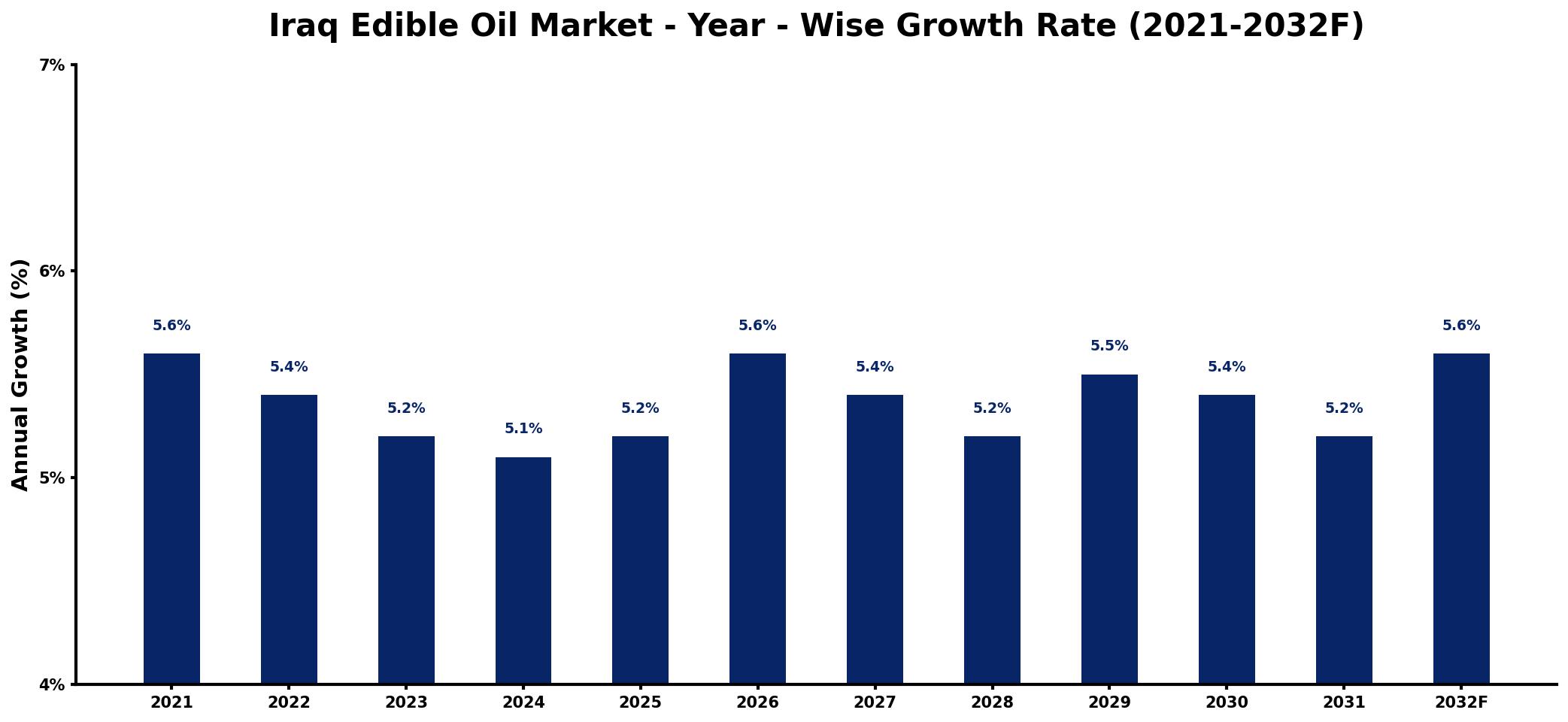
The table below presents the year‑wise growth rates along with the key drivers influencing the market
| Year | Growth Rate | Major Drivers |
| 2021 | 5.6% | Rising consumer health awareness |
| 2022 | 5.4% | Increased local production capacity |
| 2023 | 5.2% | Expanding retail distribution networks |
| 2024 | 5.1% | Growing demand for cooking alternatives |
| 2025 | 5.2% | Surge in foodservice sector growth |
| 2026 | 5.6% | Emerging trends in culinary innovation |
| 2027 | 5.4% | Investments in sustainable agriculture |
| 2028 | 5.2% | Strengthening export market opportunities |
| 2029 | 5.5% | Advancements in packaging technology |
| 2030 | 5.4% | Increased focus on organic products |
| 2031 | 5.2% | Growing popularity of plant-based diets |
| 2032 | 5.6% | Expansion of online grocery shopping |
Note: Market size estimations and growth projections presented in this report are based on 6Wresearch's proprietary forecasting methodology, utilizing the latest available industry data, government publications, and primary research inputs.
Iraq Edible Oil Market Synopsis
A notable characteristic of the Iraq Edible Oil Market is the rising preference for premium cooking oils among middle to high-income consumers, particularly olive oil. The growing health consciousness among consumers is prompting a significant shift from traditional palm oil to healthier alternatives.
Moreover, the market is witnessing a blend of traditional and modern dietary practices. Blended oils that offer varied flavor profiles and nutritional benefits are gaining traction, demonstrating consumers' evolving tastes and preferences. As domestic production is supported by government policies, the market landscape is becoming increasingly competitive.
Iraq Edible Oil Market Key Takeaways
- The demand for healthier cooking oils like olive and sunflower oil is rapidly increasing due to health-conscious consumers.
- Vegetable oils dominate the market, with palm oil remaining popular due to its affordability.
- Investment in sustainable practices and eco-friendly production is becoming a key differentiator for brands.
- Government policies are encouraging local production and reducing dependence on imports.
- Emerging trends include the growing popularity of organic and blended oils, catering to diverse consumer preferences.
Evaluation of Restraints in Iraq Edible Oil Market
Despite the promising growth trajectory, the Iraq Edible Oil Market faces significant challenges. Fluctuating raw material prices, particularly for palm and soybean oils, can severely impact production costs and pricing strategies. Additionally, the lack of robust infrastructure and logistics capabilities complicates the efficient transportation of edible oils throughout the country. Furthermore, the absence of modern technology and machinery in production processes can hinder quality enhancement and overall productivity. These elements create a challenging environment for market players aiming to thrive in this competitive landscape.
Iraq Edible Oil Market Trends
A definitive trend in the Iraq Edible Oil Market is the increasing consumer demand for healthier and higher-quality oils, such as olive and sunflower oils. This shift is accompanied by a growing focus on sustainability, with consumers actively seeking products that are ethically sourced and produced. The popularity of blended oils is also on the rise, as they offer unique benefits such as higher smoke points and diverse flavor profiles. Manufacturers are investing in product innovation and marketing strategies to align with these evolving preferences.
Iraq Edible Oil Market Opportunities
With a growing population and increased disposable incomes, the Iraq Edible Oil Market presents numerous investment opportunities. Establishing local production facilities could address the rising demand for healthier cooking oils and meet the preferences of the Iraqi consumer base. Additionally, investing in distribution networks can facilitate broader market reach. Companies that prioritize sustainable practices and innovative products tailored to local tastes are likely to stand out in this dynamic market environment.
Government Initiatives in the Iraq Edible Oil Market
The Iraqi government has implemented various policies aimed at promoting the local edible oil industry. This includes the imposition of import tariffs to safeguard domestic producers and encourage local manufacturing. Quality standards are strictly enforced to ensure that edible oil products are safe for consumers. Additionally, subsidies are sometimes provided to local manufacturers to foster self-sufficiency and reduce reliance on imported oils. These initiatives aim to stabilize the market and support growth within the domestic sector.
Future Insights of the Iraq Edible Oil Market
Looking ahead to the period of 2026 to 2032, the Iraq Edible Oil Market is set to experience significant expansion. Factors such as a burgeoning population, rising incomes, and a distinct shift toward healthier dietary choices will drive market growth. The government's support for local production and efforts to diminish dependence on imports will further reinforce this positive outlook. As technological advancements in oil extraction and processing methods gain traction, the market is poised for a transformative phase, creating exciting opportunities for both domestic and international stakeholders.
Iraq Edible Oil Market Latest Developments (2025 - 2026)
Recently, the Iraq Edible Oil Market has seen a noticeable uptick in local production capabilities, with several manufacturers focusing on enhancing their production processes. There is an observable trend towards product diversification as brands introduce new variants of healthier oils to cater to the changing preferences of consumers. Moreover, sustainability has become a focal point, with many producers exploring eco-friendly practices in sourcing and production. Increased marketing efforts are also being observed, aiming to educate consumers on the benefits of opting for healthier cooking oils.
Iraq Edible Oil Market - Key Attractiveness of the Report
- 10 Years of Market Numbers
- Historical Data Starting from 2022 to 2025
- Base Year: 2025
- Forecast Data until 2032
- Key Performance Indicators Impacting the Market
- Major Upcoming Developments and Projects
Key Highlights of the Report:
- Iraq Edible Oil Market Outlook
- Market Size of Iraq Edible Oil Market, 2025
- Forecast of Iraq Edible Oil Market, 2032
- Historical Data and Forecast of Iraq Edible Oil Revenues & Volume for the Period 2022-2032F
- Iraq Edible Oil Market Trend Evolution
- Iraq Edible Oil Market Drivers and Challenges
- Iraq Edible Oil Price Trends
- Iraq Edible Oil Porter's Five Forces
- Iraq Edible Oil Industry Life Cycle
- Historical Data and Forecast of Iraq Edible Oil Market Revenues & Volume By Type for the Period 2022-2032F
- Historical Data and Forecast of Iraq Edible Oil Market Revenues & Volume By Palm Oil for the Period 2022-2032F
- Historical Data and Forecast of Iraq Edible Oil Market Revenues & Volume By Soybean Oil for the Period 2022-2032F
- Historical Data and Forecast of Iraq Edible Oil Market Revenues & Volume By Mustard Oil for the Period 2022-2032F
- Historical Data and Forecast of Iraq Edible Oil Market Revenues & Volume By Sunflower Oil for the Period 2022-2032F
- Historical Data and Forecast of Iraq Edible Oil Market Revenues & Volume By Others for the Period 2022-2032F
- Historical Data and Forecast of Iraq Edible Oil Market Revenues & Volume By for the Period 2022-2032F
- Historical Data and Forecast of Iraq Edible Oil Market Revenues & Volume By Packaging Type for the Period 2022-2032F
- Historical Data and Forecast of Iraq Edible Oil Market Revenues & Volume By Pouches for the Period 2022-2032F
- Historical Data and Forecast of Iraq Edible Oil Market Revenues & Volume By Jars for the Period 2022-2032F
- Historical Data and Forecast of Iraq Edible Oil Market Revenues & Volume By Cans for the Period 2022-2032F
- Historical Data and Forecast of Iraq Edible Oil Market Revenues & Volume By Bottles for the Period 2022-2032F
- Historical Data and Forecast of Iraq Edible Oil Market Revenues & Volume By for the Period 2022-2032F
- Historical Data and Forecast of Iraq Edible Oil Market Revenues & Volume By Pack Size for the Period 2022-2032F
- Historical Data and Forecast of Iraq Edible Oil Market Revenues & Volume By Less than 1 Litres for the Period 2022-2032F
- Historical Data and Forecast of Iraq Edible Oil Market Revenues & Volume By 1 Litres for the Period 2022-2032F
- Historical Data and Forecast of Iraq Edible Oil Market Revenues & Volume By 1 Litres - 5 litres for the Period 2022-2032F
- Historical Data and Forecast of Iraq Edible Oil Market Revenues & Volume By 5 Litres - 10 Litres for the Period 2022-2032F
- Historical Data and Forecast of Iraq Edible Oil Market Revenues & Volume By 10 Litres and Above for the Period 2022-2032F
- Historical Data and Forecast of Iraq Edible Oil Market Revenues & Volume By for the Period 2022-2032F
- Historical Data and Forecast of Iraq Edible Oil Market Revenues & Volume By Packaging Material for the Period 2022-2032F
- Historical Data and Forecast of Iraq Edible Oil Market Revenues & Volume By Metal for the Period 2022-2032F
- Historical Data and Forecast of Iraq Edible Oil Market Revenues & Volume By Plastic for the Period 2022-2032F
- Historical Data and Forecast of Iraq Edible Oil Market Revenues & Volume By Paper for the Period 2022-2032F
- Historical Data and Forecast of Iraq Edible Oil Market Revenues & Volume By Others for the Period 2022-2032F
- Historical Data and Forecast of Iraq Edible Oil Market Revenues & Volume By Application for the Period 2022-2032F
- Historical Data and Forecast of Iraq Edible Oil Market Revenues & Volume By HoReCa for the Period 2022-2032F
- Historical Data and Forecast of Iraq Edible Oil Market Revenues & Volume By Home Users for the Period 2022-2032F
- Historical Data and Forecast of Iraq Edible Oil Market Revenues & Volume By Food Processing Industry for the Period 2022-2032F
- Historical Data and Forecast of Iraq Edible Oil Market Revenues & Volume By for the Period 2022-2032F
- Historical Data and Forecast of Iraq Edible Oil Market Revenues & Volume By Distribution Channel for the Period 2022-2032F
- Historical Data and Forecast of Iraq Edible Oil Market Revenues & Volume By Direct/Institutional Sales for the Period 2022-2032F
- Historical Data and Forecast of Iraq Edible Oil Market Revenues & Volume By Supermarkets and Hypermarkets for the Period 2022-2032F
- Historical Data and Forecast of Iraq Edible Oil Market Revenues & Volume By Convenience Stores for the Period 2022-2032F
- Historical Data and Forecast of Iraq Edible Oil Market Revenues & Volume By Online for the Period 2022-2032F
- Historical Data and Forecast of Iraq Edible Oil Market Revenues & Volume By Others for the Period 2022-2032F
- Iraq Edible Oil Import Export Trade Statistics
- Market Opportunity Assessment By Type
- Market Opportunity Assessment By Packaging Type
- Market Opportunity Assessment By Pack Size
- Market Opportunity Assessment By Packaging Material
- Market Opportunity Assessment By Application
- Market Opportunity Assessment By Distribution Channel
- Iraq Edible Oil Top Companies Market Share
- Iraq Edible Oil Competitive Benchmarking By Technical and Operational Parameters
- Iraq Edible Oil Company Profiles
- Iraq Edible Oil Key Strategic Recommendations






































