Iraq Electric Commercial Vehicle Market Size, Share & Growth Rate
The Iraq Electric Commercial Vehicle Market was estimated at USD 370 Million in 2025 and is projected to reach USD 512 Million by 2032, growing at a CAGR of 4.7% from 2026 to 2032. This growth trajectory is largely driven by heightened environmental awareness and robust government initiatives aimed at reducing carbon emissions and promoting electric vehicle adoption. As urban areas grapple with air pollution, the demand for electric buses and trucks is expected to surge, further propelling the market forward.
Iraq Electric Commercial Vehicle Market Year-wise Growth Rate and Key Drivers
This graph highlights how the Iraq Electric Commercial Vehicle Market has steadily grown over the years, supported by major growth factors.
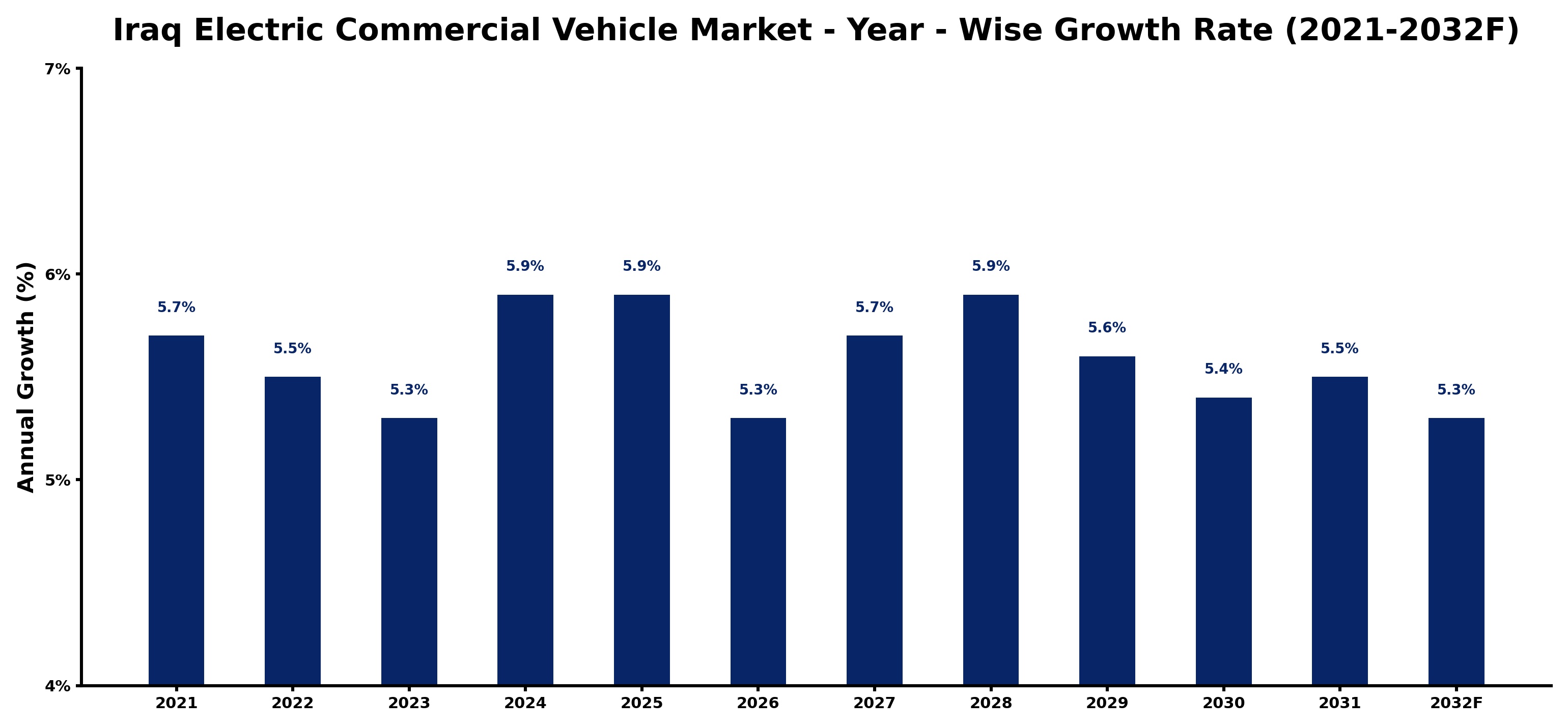
The table below presents the year‑wise growth rates along with the key drivers influencing the market
| Year | Growth Rate | Major Drivers |
| 2021 | 5.7% | Government incentives for electric vehicles |
| 2022 | 5.5% | Infrastructure development enhanced accessibility |
| 2023 | 5.3% | Consumer awareness of sustainability increased |
| 2024 | 5.9% | Partnerships with local manufacturers expanded |
| 2025 | 5.9% | Technological advancements improved efficiency |
| 2026 | 5.3% | Investment in renewable energy sources |
| 2027 | 5.7% | Public transportation electrification initiatives launched |
| 2028 | 5.9% | Corporate fleets transitioning to electric |
| 2029 | 5.6% | Regulatory support for clean energy |
| 2030 | 5.4% | Charging station networks expanded rapidly |
| 2031 | 5.5% | Increased demand for eco-friendly transport |
| 2032 | 5.3% | Collaboration with tech firms strengthened |
Note - Market size estimations and growth projections presented in this report are based on 6Wresearch’s advanced forecasting approach, validated with industry datasets as of June 2026.
Iraq Electric Commercial Vehicle Market Synopsis
A strong force shaping the Iraq Electric Commercial Vehicle Market today is the increasing government emphasis on sustainable transportation solutions. Policies promoting electric vehicles, including tax breaks and funding for infrastructure, are catalyzing growth in this sector.
Additionally, as businesses seek to enhance their operational efficiency and reduce long-term costs, there is a noticeable trend towards investing in electric vehicles. The combination of government support and corporate responsibility is setting the stage for significant advancements in the electric commercial vehicle sector.
Iraq Electric Commercial Vehicle Market Key Takeaways
- The market is projected to grow steadily due to favorable government policies and incentives.
- Increased demand for electric buses and trucks is a key driver of market expansion.
- Technological advancements in battery efficiency are enhancing the viability of electric commercial vehicles.
- Urban centers are becoming hotspots for electric vehicle adoption, addressing air quality concerns.
- Investment opportunities are emerging in manufacturing and infrastructure development.
Evaluation of Restraints in Iraq Electric Commercial Vehicle Market
The Iraq Electric Commercial Vehicle Market faces significant constraints that impede its growth potential. A notable challenge is the underdeveloped charging infrastructure, which creates barriers for prospective electric vehicle owners. High initial costs associated with electric vehicles further limit consumer adoption, particularly among small businesses and fleet operators. Additionally, the general lack of awareness about electric vehicle technologies can restrict market penetration. Addressing these restraints will require concerted efforts in infrastructure development and consumer education to foster a more conducive environment for electric vehicles.
Iraq Electric Commercial Vehicle Market Trends
Current trends in the Iraq Electric Commercial Vehicle Market reflect an increasing shift towards sustainable transport solutions. The demand for electric buses and delivery vehicles is on the rise, as urbanization and environmental concerns escalate. Technological improvements in battery life and charging capabilities are making electric vehicles more attractive to businesses. Furthermore, local companies are beginning to invest in electric vehicle fleets to cut costs and enhance their corporate social responsibility profiles.
Iraq Electric Commercial Vehicle Market Opportunities
The market presents multiple investment opportunities, particularly in the manufacturing of electric commercial vehicles and the development of essential charging infrastructure. As urban centers expand, the necessity for electric buses and delivery trucks is growing, paving the way for significant returns on investment. Collaborating with local entities and leveraging government incentives can create pathways for profitable ventures in this burgeoning market.
Government Initiatives in the Iraq Electric Commercial Vehicle Market
The Iraqi government has taken proactive measures to foster the growth of the electric commercial vehicle market. This includes implementing various incentives such as tax exemptions and subsidies for electric vehicle purchases. Moreover, public funding for research and development in the electric vehicle sector is being prioritized. Regulations encouraging the installation of charging stations are also in place, signaling a strong commitment to transition towards cleaner transportation solutions.
Future Insights of the Iraq Electric Commercial Vehicle Market
Looking ahead to 2026-2032, the Iraq Electric Commercial Vehicle Market is expected to flourish as government initiatives intensify and public awareness of the benefits of electric vehicles rises. The increasing adoption of electrification, coupled with advancements in battery technology, will likely play a pivotal role in market expansion. Challenges such as initial costs and charging infrastructure will need to be addressed, but the overall outlook remains positive as stakeholders across the board pivot towards sustainable solutions.
Iraq Electric Commercial Vehicle Market Latest Developments (May 2025 - June 2026)
In recent months, the Iraq Electric Commercial Vehicle Market has seen a notable increase in collaborations aimed at expanding charging infrastructure. Local companies are exploring partnerships with international firms to enhance technology transfer and improve vehicle efficiency. Furthermore, government-led initiatives are gaining momentum, with programs designed to educate businesses about the benefits of electric vehicle adoption. These developments signify a growing commitment to achieving a sustainable transportation framework in Iraq.
Iraq Electric Commercial Vehicle Market - Key Attractiveness of the Report
- 10 Years of Market Numbers
- Historical Data Starting from 2022 to 2025
- Base Year: 2025
- Forecast Data until 2032
- Key Performance Indicators Impacting the Market
- Major Upcoming Developments and Projects
Key Highlights of the Report:
- Iraq Electric Commercial Vehicle Market Outlook
- Market Size of Iraq Electric Commercial Vehicle Market, 2025
- Forecast of Iraq Electric Commercial Vehicle Market, 2032
- Historical Data and Forecast of Iraq Electric Commercial Vehicle Revenues & Volume for the Period 2022-2032F
- Iraq Electric Commercial Vehicle Market Trend Evolution
- Iraq Electric Commercial Vehicle Market Drivers and Challenges
- Iraq Electric Commercial Vehicle Price Trends
- Iraq Electric Commercial Vehicle Porter's Five Forces
- Iraq Electric Commercial Vehicle Industry Life Cycle
- Historical Data and Forecast of Iraq Electric Commercial Vehicle Market Revenues & Volume By Propulsion Type for the Period 2022-2032F
- Historical Data and Forecast of Iraq Electric Commercial Vehicle Market Revenues & Volume By BEV for the Period 2022-2032F
- Historical Data and Forecast of Iraq Electric Commercial Vehicle Market Revenues & Volume By PHEV for the Period 2022-2032F
- Historical Data and Forecast of Iraq Electric Commercial Vehicle Market Revenues & Volume By FCEV for the Period 2022-2032F
- Historical Data and Forecast of Iraq Electric Commercial Vehicle Market Revenues & Volume By Vehicle Type for the Period 2022-2032F
- Historical Data and Forecast of Iraq Electric Commercial Vehicle Market Revenues & Volume By Electric Bus for the Period 2022-2032F
- Historical Data and Forecast of Iraq Electric Commercial Vehicle Market Revenues & Volume By Electric Truck for the Period 2022-2032F
- Historical Data and Forecast of Iraq Electric Commercial Vehicle Market Revenues & Volume By Electric Pick-up Truck for the Period 2022-2032F
- Historical Data and Forecast of Iraq Electric Commercial Vehicle Market Revenues & Volume By Electric Van for the Period 2022-2032F
- Historical Data and Forecast of Iraq Electric Commercial Vehicle Market Revenues & Volume By Battery Type for the Period 2022-2032F
- Historical Data and Forecast of Iraq Electric Commercial Vehicle Market Revenues & Volume By Lithium-iron-phosphate (LFP) for the Period 2022-2032F
- Historical Data and Forecast of Iraq Electric Commercial Vehicle Market Revenues & Volume By Lithium-nickel-manganese-cobalt oxide (NMC) for the Period 2022-2032F
- Historical Data and Forecast of Iraq Electric Commercial Vehicle Market Revenues & Volume By Others for the Period 2022-2032F
- Historical Data and Forecast of Iraq Electric Commercial Vehicle Market Revenues & Volume By Battery Capacity for the Period 2022-2032F
- Historical Data and Forecast of Iraq Electric Commercial Vehicle Market Revenues & Volume By less than 50 kWh for the Period 2022-2032F
- Historical Data and Forecast of Iraq Electric Commercial Vehicle Market Revenues & Volume By 50??250 kWh for the Period 2022-2032F
- Historical Data and Forecast of Iraq Electric Commercial Vehicle Market Revenues & Volume By above 250 kWh for the Period 2022-2032F
- Historical Data and Forecast of Iraq Electric Commercial Vehicle Market Revenues & Volume By Power Output for the Period 2022-2032F
- Historical Data and Forecast of Iraq Electric Commercial Vehicle Market Revenues & Volume By less than 100 KW, for the Period 2022-2032F
- Historical Data and Forecast of Iraq Electric Commercial Vehicle Market Revenues & Volume By 100??250 KW for the Period 2022-2032F
- Historical Data and Forecast of Iraq Electric Commercial Vehicle Market Revenues & Volume By Above 250 KW for the Period 2022-2032F
- Historical Data and Forecast of Iraq Electric Commercial Vehicle Market Revenues & Volume By End-user for the Period 2022-2032F
- Historical Data and Forecast of Iraq Electric Commercial Vehicle Market Revenues & Volume By Last Mile Delivery for the Period 2022-2032F
- Historical Data and Forecast of Iraq Electric Commercial Vehicle Market Revenues & Volume By Distribution Service for the Period 2022-2032F
- Historical Data and Forecast of Iraq Electric Commercial Vehicle Market Revenues & Volume By Field Service for the Period 2022-2032F
- Historical Data and Forecast of Iraq Electric Commercial Vehicle Market Revenues & Volume By Refuse Service for the Period 2022-2032F
- Historical Data and Forecast of Iraq Electric Commercial Vehicle Market Revenues & Volume By Long Haul Transportation for the Period 2022-2032F
- Historical Data and Forecast of Iraq Electric Commercial Vehicle Market Revenues & Volume By Component for the Period 2022-2032F
- Historical Data and Forecast of Iraq Electric Commercial Vehicle Market Revenues & Volume By Electric Motor for the Period 2022-2032F
- Historical Data and Forecast of Iraq Electric Commercial Vehicle Market Revenues & Volume By EV Battery for the Period 2022-2032F
- Historical Data and Forecast of Iraq Electric Commercial Vehicle Market Revenues & Volume By Hydrogen Fuel Cell for the Period 2022-2032F
- Historical Data and Forecast of Iraq Electric Commercial Vehicle Market Revenues & Volume By Autonomous Vehicles for the Period 2022-2032F
- Historical Data and Forecast of Iraq Electric Commercial Vehicle Market Revenues & Volume By Electric Autonomous Truck for the Period 2022-2032F
- Historical Data and Forecast of Iraq Electric Commercial Vehicle Market Revenues & Volume By Electric Autonomous Bus for the Period 2022-2032F
- Iraq Electric Commercial Vehicle Import Export Trade Statistics
- Market Opportunity Assessment By Propulsion Type
- Market Opportunity Assessment By Vehicle Type
- Market Opportunity Assessment By Battery Type
- Market Opportunity Assessment By Battery Capacity
- Market Opportunity Assessment By Power Output
- Market Opportunity Assessment By End-user
- Market Opportunity Assessment By Component
- Market Opportunity Assessment By Autonomous Vehicles
- Iraq Electric Commercial Vehicle Top Companies Market Share
- Iraq Electric Commercial Vehicle Competitive Benchmarking By Technical and Operational Parameters
- Iraq Electric Commercial Vehicle Company Profiles
- Iraq Electric Commercial Vehicle Key Strategic Recommendations






































