Iraq Elevator and Escalator Market Summary
The iraq elevator and escalator market was estimated at USD 521 Million in 2025 and is projected to reach USD 922 Million by 2032, growing at a CAGR of 9.8% from 2026 to 2032.
Iraq Elevator and Escalator Market Year-wise Growth Rate and Key Drivers
This graph highlights how the Iraq Elevator and Escalator Market has steadily grown over the past five years, supported by major growth factors.
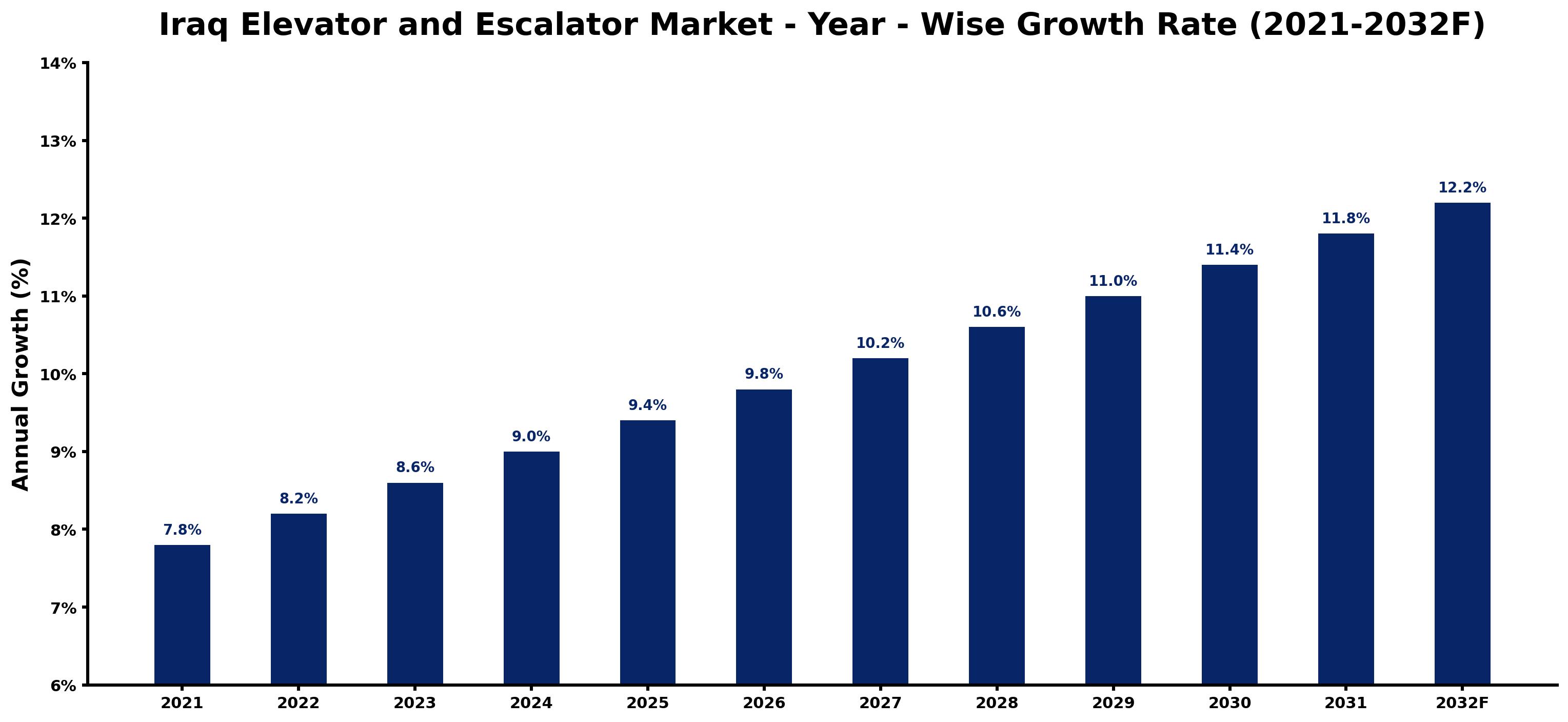
The table below presents the year wise growth rates along with the key drivers influencing the market
| Year | Growth Rate | Major Drivers |
| 2021 | 7.8% | The construction sector steadily gains momentum, pushing elevator demand in urban areas. |
| 2022 | 8.2% | Infrastructural investments lead to innovative designs tailored for Iraq's unique climate challenges. |
| 2023 | 8.6% | Emerging urban centers prompt a surge in commercial elevator and escalator installations. |
| 2024 | 9.0% | Post-conflict reconstruction projects prioritize vertical transportation for new residential buildings. |
| 2025 | 9.4% | A boom in tourism infrastructure encourages luxury elevators in hotels and shopping centers. |
| 2026 | 9.8% | Sustainable building initiatives drive interest in energy-efficient elevator technologies across Iraq. |
| 2027 | 10.2% | Collaboration between local firms and international players enhances competition in the market. |
| 2028 | 10.6% | Smart building technologies integrate with elevators, offering convenience to urban dwellers. |
| 2029 | 11.0% | Rising urban population density necessitates advanced public transport escalators in cities. |
| 2030 | 11.4% | Increased foreign investment in Iraq's infrastructure promotes modernization of older systems. |
| 2031 | 11.8% | Public-private partnerships emerge, accelerating infrastructure development and vertical transport upgrades. |
| 2032 | 12.2% | Expansion of real estate developments emphasizes the necessity for high-capacity elevator solutions. |
Note - Market size estimations and growth projections presented in this report are based on 6Wresearch's advanced forecasting approach, validated with industry datasets as of June 2026.
Iraq Elevator and Escalator Market Synopsis
The Iraq Elevator and Escalator Market is projected to reach 9.8% and witness significant growth during the forecast period (2026-2032). This growth is driven by a combination of urbanization, government infrastructure projects, and increased demand for vertical transportation solutions in commercial and residential buildings. The market's expansion is further supported by advancements in technology and a rising focus on sustainable building practices.
Iraq Elevator and Escalator Market Growth Drivers
The Iraq Elevator and Escalator Market is witnessing several key drivers that are shaping its trajectory. Firstly, the rapid urbanization in Iraqi cities is creating a pressing need for efficient vertical transport systems in both existing and new structures. Secondly, the government's commitment to improving infrastructure through various public projects is bolstering market demand. Additionally, an increase in foreign investments in commercial real estate is further stimulating growth as international investors seek to capitalize on Iraq's emerging market potential. The focus on energy-efficient and eco-friendly elevator technologies is also contributing to the market's expansion, as consumers increasingly prioritize sustainability. Lastly, advancements in technology, such as smart elevators, are enhancing user experience and operational efficiency, driving adoption across various sectors.
Iraq Elevator and Escalator Market Challenges and Restraints
Despite the promising outlook, the Iraq Elevator and Escalator Market faces certain challenges. A significant issue is the fluctuating economic environment, which may impact investment decisions and the pace of infrastructure development. Additionally, political instability and security concerns could deter foreign investments, affecting market growth. There is also a skill gap in the workforce, particularly in technical areas such as installation and maintenance of modern elevator systems. Furthermore, regulatory hurdles can pose challenges for companies looking to enter or expand within the market. Finally, competition from established markets and potential supply chain disruptions may inhibit the growth of local manufacturers.
Iraq Elevator and Escalator Market Opportunities
The Iraq Elevator and Escalator Market presents numerous opportunities for growth and innovation. One of the most significant opportunities lies in the burgeoning residential sector, where there is a growing demand for elevators in multi-story dwellings. The commercial sector is also expanding, with new office and retail spaces being developed that require modern vertical transportation solutions. Moreover, the government's ongoing infrastructure initiatives, including urban development and the construction of public transport systems, provide a favorable environment for market growth. Additionally, there is an opportunity for companies to leverage advanced technologies, such as IoT and AI, to develop smarter, more efficient systems. Finally, increasing awareness of the importance of accessibility in public and private buildings can drive demand for elevators and escalators tailored for those with mobility challenges.
Iraq Elevator and Escalator Market Regional Analysis
Geographically, the Iraq Elevator and Escalator Market is concentrated in urban centers, with Baghdad leading the demand due to its significant population and commercial activities. Other cities, such as Erbil and Basra, are also witnessing growth driven by infrastructure development and urbanization. The market dynamics vary across different regions, influenced by local economic conditions, urban planning policies, and demographic trends. As urban populations continue to rise, the demand for elevators and escalators in these regions is expected to grow steadily. Furthermore, investment in infrastructure projects in less developed areas is likely to enhance accessibility and drive market growth across the country.
Iraq Elevator and Escalator Market Investment Opportunities
Investment opportunities in the Iraq Elevator and Escalator Market are plentiful, particularly in technology adoption and infrastructure development. Stakeholders are encouraged to explore partnerships with local firms to strengthen market presence while benefiting from regional expertise. Additionally, there is potential for financing projects that focus on sustainable technologies, as the demand for energy-efficient systems is on the rise. Investing in training programs for local technicians can help bridge the skills gap in the industry, enhancing service and maintenance capabilities. Furthermore, exploring opportunities in the renovation and modernization of existing buildings can yield returns as older systems are upgraded to meet contemporary standards.
Iraq Elevator and Escalator Market Government Investment and Initiatives
The Iraqi government has undertaken several initiatives aimed at enhancing the infrastructure landscape, which includes significant investments in the elevator and escalator sector. These initiatives are part of broader development plans focused on rebuilding and modernizing urban areas. Policies promoting foreign investments are also being implemented to attract international expertise and capital into the market. Public spending on infrastructure projects, including commercial buildings, residential complexes, and transportation hubs, has increased, creating a favorable environment for the elevator and escalator market. Additionally, economic development plans emphasizing job creation and technology adoption are expected to support market growth in the coming years.
Iraq Elevator and Escalator Market Latest Developments (May 2025 - June 2026)
In the period from May 2025 to June 2026, the Iraq Elevator and Escalator Market is marked by various developments. The focus has shifted towards integrating advanced technologies into elevator systems, offering features such as smart controls and energy-efficient solutions. Infrastructure projects supported by the government have gained momentum, reflecting an increasing commitment to enhancing urban mobility. Additionally, there has been a noticeable rise in public-private partnerships aimed at improving service delivery and fostering innovation in vertical transportation. Companies are also exploring collaborations with technology providers to develop customized solutions tailored to the specific needs of the Iraqi market.
Iraq Elevator and Escalator Market - Key Attractiveness of the Report
- 10 Years of Market Numbers
- Historical Data Starting from 2022 to 2025
- Base Year: 2025
- Forecast Data until 2032
- Key Performance Indicators Impacting the Market
- Major Upcoming Developments and Projects
Q1: What factors are driving growth in the Iraq Elevator and Escalator Market?
Q2: What challenges does the market face?
Q3: What opportunities exist for investment in this market?
Q4: How is the government supporting the Iraq Elevator and Escalator Market?
Key Highlights of the Report:
- Iraq Elevator and Escalator Market Outlook
- Market Size of Iraq Elevator and Escalator Market, 2025
- Forecast of Iraq Elevator and Escalator Market, 2032F
- Historical Data and Forecast of Iraq Elevator and Escalator Revenues & Volume for the Period 2022-2032F
- Iraq Elevator and Escalator Market Trend Evolution
- Iraq Elevator and Escalator Market Drivers and Challenges
- Iraq Elevator and Escalator Price Trends
- Iraq Elevator and Escalator Porter's Five Forces
- Iraq Elevator and Escalator Industry Life Cycle
- Historical Data and Forecast of Iraq Elevator and Escalator Market Revenues & Volume By Types for the Period 2022-2032F
- Historical Data and Forecast of Iraq Elevator and Escalator Market Revenues & Volume By Elevator for the Period 2022-2032F
- Historical Data and Forecast of Iraq Elevator and Escalator Market Revenues & Volume By Escalator for the Period 2022-2032F
- Historical Data and Forecast of Iraq Elevator and Escalator Market Revenues & Volume By Moving Walkways for the Period 2022-2032F
- Historical Data and Forecast of Iraq Elevator and Escalator Market Revenues & Volume By Services for the Period 2022-2032F
- Historical Data and Forecast of Iraq Elevator and Escalator Market Revenues & Volume By Maintenance & Repair for the Period 2022-2032F
- Historical Data and Forecast of Iraq Elevator and Escalator Market Revenues & Volume By New Installation for the Period 2022-2032F
- Historical Data and Forecast of Iraq Elevator and Escalator Market Revenues & Volume By Modernization for the Period 2022-2032F
- Historical Data and Forecast of Iraq Elevator and Escalator Market Revenues & Volume By End-User for the Period 2022-2032F
- Historical Data and Forecast of Iraq Elevator and Escalator Market Revenues & Volume By Residential for the Period 2022-2032F
- Historical Data and Forecast of Iraq Elevator and Escalator Market Revenues & Volume By Commercial for the Period 2022-2032F
- Historical Data and Forecast of Iraq Elevator and Escalator Market Revenues & Volume By Public for the Period 2022-2032F
- Iraq Elevator and Escalator Import Export Trade Statistics
- Market Opportunity Assessment By Types
- Market Opportunity Assessment By Services
- Market Opportunity Assessment By End-User
- Iraq Elevator and Escalator Top Companies Market Share
- Iraq Elevator and Escalator Competitive Benchmarking By Technical and Operational Parameters
- Iraq Elevator and Escalator Company Profiles
- Iraq Elevator and Escalator Key Strategic Recommendations






































