Iraq Ethyl Alcohol Market Size, Share & Growth Rate
The Iraq Ethyl Alcohol Market was estimated at USD 261 Million in 2025 and is projected to reach USD 365 Million by 2032, growing at a CAGR of 4.9% from 2026 to 2032. This growth trajectory is primarily driven by the rising demand from the healthcare and personal care industries, along with an increasing focus on hygiene and sanitation post-COVID-19. Furthermore, the food and beverage sector's continual utilization of ethyl alcohol as a preservative and flavor enhancer also supports the overall expansion of the market.
Iraq Ethyl Alcohol Market Year-wise Growth Rate and Key Drivers
This graph highlights how the Iraq Ethyl Alcohol Market has steadily grown over the years, supported by major growth factors.
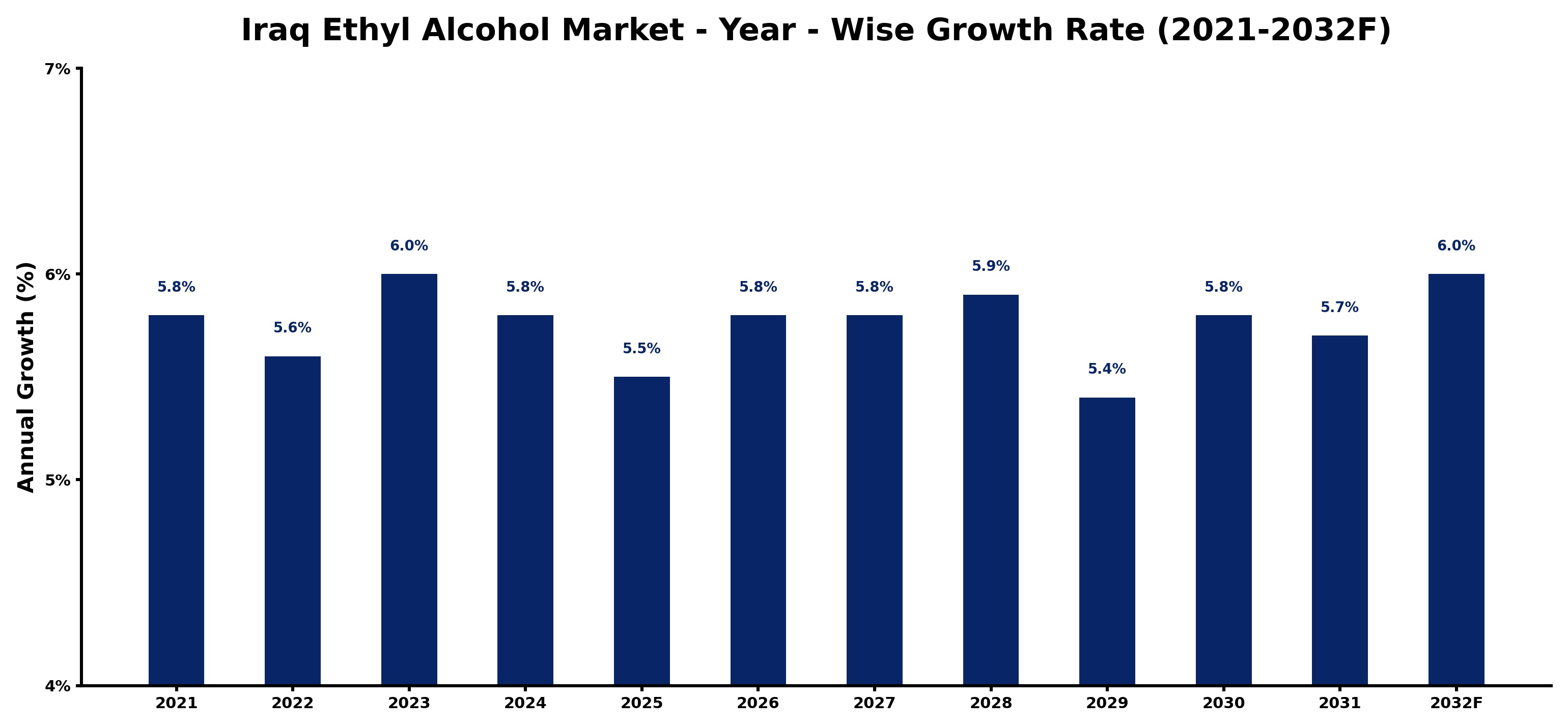
The table below presents the year‑wise growth rates along with the key drivers influencing the market
| Year | Growth Rate | Major Drivers |
| 2021 | 5.8% | Increased demand for sanitizers |
| 2022 | 5.6% | Rising beverage alcohol consumption |
| 2023 | 6.0% | Pharmaceutical industry growth accelerated |
| 2024 | 5.8% | Cosmetic product usage expanded |
| 2025 | 5.5% | Biofuel production gained momentum |
| 2026 | 5.8% | Industrial applications increased significantly |
| 2027 | 5.8% | E-commerce platforms enhanced sales |
| 2028 | 5.9% | Health and wellness trends emerged |
| 2029 | 5.4% | Export opportunities expanded globally |
| 2030 | 5.8% | Investment in local production increased |
| 2031 | 5.7% | Consumer awareness of quality improved |
| 2032 | 6.0% | Sustainability initiatives drove innovation |
Note - Market size estimations and growth projections presented in this report are based on 6Wresearch's advanced forecasting approach, validated with industry datasets as of June 2026.
Iraq Ethyl Alcohol Market Synopsis
The most significant force shaping the Iraq Ethyl Alcohol Market today is the heightened awareness surrounding hygiene standards, exacerbated by the COVID-19 pandemic. As more consumers and industries prioritize cleanliness and sanitization, the demand for ethyl alcohol-based products has surged, driving growth across multiple sectors.
In addition to healthcare, the cosmetics industry is witnessing a parallel rise in demand for ethyl alcohol. With an increasing population and disposable income, the need for personal care products containing ethyl alcohol is expected to further catalyze market growth.
Iraq Ethyl Alcohol Market Key Takeaways
- The Iraq Ethyl Alcohol Market is growing steadily due to increased demand from the pharmaceuticals, cosmetics, and food & beverage sectors.
- Hygiene awareness and the shift towards ethyl alcohol in sanitizers have significantly boosted consumption patterns.
- Regulatory frameworks are tightening, impacting the production and distribution landscape.
- The market presents numerous investment opportunities, particularly in production facilities and R&D.
- Political instability and supply chain challenges may pose hurdles to market entry and expansion.
Evaluation of Restraints in Iraq Ethyl Alcohol Market
Despite its growth prospects, the Iraq Ethyl Alcohol Market grapples with several restraints that could impede progress. Political instability remains a pivotal concern, creating a fluctuating business environment that deters investment. Coupled with security issues, this instability complicates logistics and the transportation of ethyl alcohol products. Furthermore, regulatory constraints—including complex licensing, compliance demands, and fluctuating import-export laws—can present considerable barriers for businesses aiming to thrive in this market. These factors combine to create an unpredictable landscape, necessitating careful navigation for stakeholders.
Iraq Ethyl Alcohol Market Trends
Several key trends are currently shaping the Iraq Ethyl Alcohol Market. The ongoing emphasis on health and safety has led to an increased adoption of ethyl alcohol in sanitization products. Additionally, innovations in product formulations within the cosmetics industry are expanding the applications of ethyl alcohol, thereby enhancing its demand. There's also a notable trend towards local sourcing of raw materials, driven by the desire to mitigate supply chain disruptions. Sustainability practices are emerging, as companies seek eco-friendly alternatives and more responsible production methods.
Iraq Ethyl Alcohol Market Opportunities
Investment opportunities in the Iraq Ethyl Alcohol Market are plentiful and diverse. The rising demand across various industries suggests potential for establishing ethanol production facilities tailored to local requirements. Moreover, collaboration with local manufacturers can provide advantageous market access and distribution networks. With ongoing consumer trends leaning towards innovative uses of ethyl alcohol, research and development initiatives focused on new applications can yield lucrative returns. Investors keen on engaging in this market should conduct comprehensive analyses to ascertain strategic entry points while being mindful of regulatory landscapes.
Government Initiatives in the Iraq Ethyl Alcohol Market
Government policies related to the Iraq Ethyl Alcohol Market largely focus on regulating production and ensuring public safety. Strict licensing requirements are enforced to maintain high safety and quality standards, aiming to curb illicit activities associated with ethyl alcohol. Additionally, there are measures in place governing advertising to minimize adverse health impacts. These regulations also encompass import and export practices, ensuring that the market operates within controlled parameters that promote responsible consumption and production.
Future Insights of the Iraq Ethyl Alcohol Market
Looking ahead to 2026-2032, the Iraq Ethyl Alcohol Market is poised for notable expansion, driven by continuous demand across diverse industries. The ongoing population growth and increasing disposable incomes are likely to elevate consumption patterns further. However, it is crucial to monitor challenges stemming from regulatory constraints and raw material price fluctuations. With strategic planning and adaptability, stakeholders can harness emerging opportunities and navigate potential market hurdles effectively.
Iraq Ethyl Alcohol Market Latest Developments (May 2025 - June 2026)
In the period between May 2025 and June 2026, the Iraq Ethyl Alcohol Market has witnessed a notable shift towards enhanced local production capabilities. There are ongoing discussions regarding public-private partnerships aimed at bolstering the production and distribution networks of ethyl alcohol. Regulatory bodies are also considering revisions to existing frameworks to simplify compliance for businesses, thereby encouraging greater participation in the market. Moreover, the increased availability of ethyl alcohol in various consumer products reflects the growing market response to hygiene demands.
Iraq Ethyl Alcohol Market - Key Attractiveness of the Report
- 10 Years of Market Numbers
- Historical Data Starting from 2022 to 2025
- Base Year: 2025
- Forecast Data until 2032
- Key Performance Indicators Impacting the Market
- Major Upcoming Developments and Projects
Key Highlights of the Report:
- Iraq Ethyl Alcohol Market Outlook
- Market Size of Iraq Ethyl Alcohol Market, 2025
- Forecast of Iraq Ethyl Alcohol Market, 2032
- Historical Data and Forecast of Iraq Ethyl Alcohol Revenues & Volume for the Period 2022-2032F
- Iraq Ethyl Alcohol Market Trend Evolution
- Iraq Ethyl Alcohol Market Drivers and Challenges
- Iraq Ethyl Alcohol Price Trends
- Iraq Ethyl Alcohol Porter's Five Forces
- Iraq Ethyl Alcohol Industry Life Cycle
- Historical Data and Forecast of Iraq Ethyl Alcohol Market Revenues & Volume By Grade for the Period 2022-2032F
- Historical Data and Forecast of Iraq Ethyl Alcohol Market Revenues & Volume By Food Grade for the Period 2022-2032F
- Historical Data and Forecast of Iraq Ethyl Alcohol Market Revenues & Volume By Industrial Grade for the Period 2022-2032F
- Historical Data and Forecast of Iraq Ethyl Alcohol Market Revenues & Volume By Pharmaceutical Grade for the Period 2022-2032F
- Historical Data and Forecast of Iraq Ethyl Alcohol Market Revenues & Volume By Lab Grade for the Period 2022-2032F
- Historical Data and Forecast of Iraq Ethyl Alcohol Market Revenues & Volume By End-user Industry for the Period 2022-2032F
- Historical Data and Forecast of Iraq Ethyl Alcohol Market Revenues & Volume By Automotive and Transportation for the Period 2022-2032F
- Historical Data and Forecast of Iraq Ethyl Alcohol Market Revenues & Volume By Food and Beverage for the Period 2022-2032F
- Historical Data and Forecast of Iraq Ethyl Alcohol Market Revenues & Volume By Pharmaceutical for the Period 2022-2032F
- Historical Data and Forecast of Iraq Ethyl Alcohol Market Revenues & Volume By Cosmetics and Personal Care (Includes hand-Sanitizer) for the Period 2022-2032F
- Historical Data and Forecast of Iraq Ethyl Alcohol Market Revenues & Volume By Other End-user Industries for the Period 2022-2032F
- Iraq Ethyl Alcohol Import Export Trade Statistics
- Market Opportunity Assessment By Grade
- Market Opportunity Assessment By End-user Industry
- Iraq Ethyl Alcohol Top Companies Market Share
- Iraq Ethyl Alcohol Competitive Benchmarking By Technical and Operational Parameters
- Iraq Ethyl Alcohol Company Profiles
- Iraq Ethyl Alcohol Key Strategic Recommendations






































