Iraq Ethylene Vinyl Acetate Market Size, Share & Growth Rate
The Iraq Ethylene Vinyl Acetate Market was estimated at USD 159 Million in 2025 and is projected to reach USD 212 Million by 2032, growing at a CAGR of 4.2% from 2026 to 2032. This growth trajectory is primarily driven by the rising demand across packaging, automotive, and solar energy sectors. As construction activities ramp up and infrastructure projects gain momentum, EVA's versatile applications in adhesives and coatings further amplify this expanding market landscape.
Iraq Ethylene Vinyl Acetate Market Year-wise Growth Rate and Key Drivers
This graph highlights how the Iraq Ethylene Vinyl Acetate Market has steadily grown over the years, supported by major growth factors.
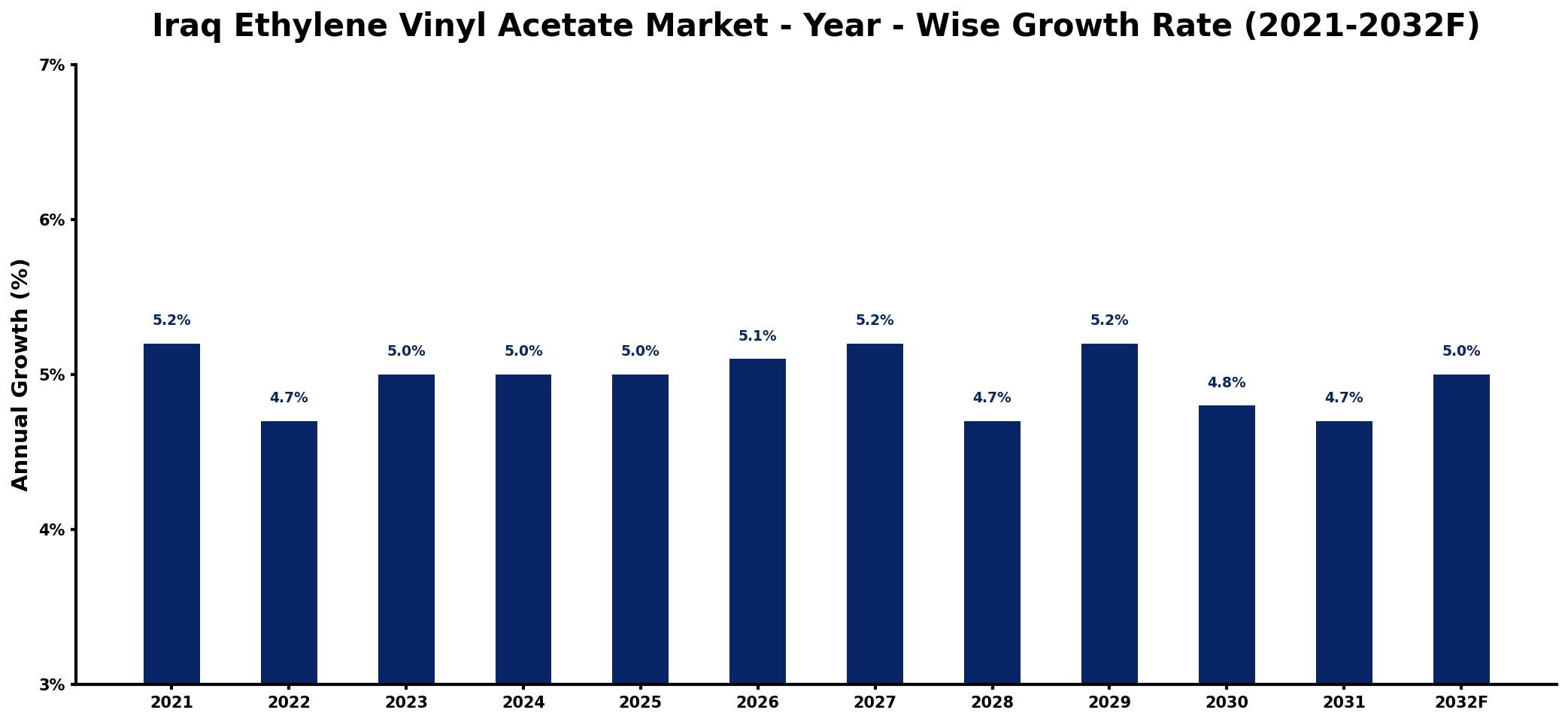
The table below presents the year‑wise growth rates along with the key drivers influencing the market
| Year | Growth Rate | Major Drivers |
| 2021 | 5.2% | Rising construction sector investments |
| 2022 | 4.7% | Increased packaging industry requirements |
| 2023 | 5.0% | Growing automotive manufacturing demand |
| 2024 | 5.0% | Expansion of consumer goods production |
| 2025 | 5.0% | Surge in electronics manufacturing needs |
| 2026 | 5.1% | Boost in healthcare product demand |
| 2027 | 5.2% | Enhancement of agricultural applications |
| 2028 | 4.7% | Growth in renewable energy projects |
| 2029 | 5.2% | Development of infrastructure initiatives |
| 2030 | 4.8% | Increase in textile industry needs |
| 2031 | 4.7% | Rising demand for footwear materials |
| 2032 | 5.0% | increased domestic production output |
Note: Market size estimations and growth projections presented in this report are based on 6Wresearch's proprietary forecasting methodology, utilizing the latest available industry data, government publications, and primary research inputs.
Iraq Ethylene Vinyl Acetate Market Synopsis
The growing adoption of Ethylene Vinyl Acetate in the packaging industry in Iraq is notable, primarily due to its flexibility and durability. As manufacturers seek innovative materials that align with consumer preferences for sustainable products, EVA is becoming increasingly attractive in various applications.
Moreover, the escalation of solar energy projects in Iraq is fuelling demand for EVA, known for its excellent light transmittance and weather resistance. This burgeoning interest is expected to provide a significant boost to the market as industries aim for energy-efficient and eco-friendly solutions.
Iraq Ethylene Vinyl Acetate Market Key Takeaways
- The Iraq EVA market is showing consistent growth due to increased industrial activities, particularly in packaging and construction.
- Sustainable practices and eco-friendly materials are driving the adoption of EVA across diverse sectors.
- Infrastructure development in Iraq creates a favorable environment for EVA applications in adhesives and coatings.
- Government initiatives to boost foreign investments are expected to enhance market dynamics.
- Challenges such as geopolitical tensions and raw material price fluctuations need careful navigation.
Evaluation of Restraints in Iraq Ethylene Vinyl Acetate Market
Despite the promising outlook, several restraints are holding back the Iraq Ethylene Vinyl Acetate market. Political instability and security concerns can significantly disrupt supply chains, causing delays in production and distribution. Additionally, the fluctuating prices of raw materials can create unpredictable cost structures for manufacturers, leading to potential profit margin pressures. The underdeveloped infrastructure and regulatory framework also pose challenges, making compliance with quality standards a complex issue for businesses operating in the EVA sector.
Iraq Ethylene Vinyl Acetate Market Trends
Key trends shaping the Iraq Ethylene Vinyl Acetate market include the increasing shift towards sustainable and recyclable materials, aligning with global environmental concerns. The emphasis on lightweight and flexible materials is driving product innovation, particularly in packaging solutions. Furthermore, advancements in technology are enhancing the performance characteristics of EVA, making it more suitable for demanding applications in various industries.
Iraq Ethylene Vinyl Acetate Market Opportunities
Investment opportunities abound in the Iraq EVA market, primarily due to the growth in sectors such as solar energy, automotive, and packaging. Establishing local production facilities could meet the increasing demand for high-quality EVA products, reducing import dependency. Additionally, the government's push for industrial development and modernization opens doors for foreign investments, presenting an advantageous environment for new entrants looking to capitalize on the market's growth potential.
Government Initiatives in the Iraq Ethylene Vinyl Acetate Market
The Iraqi government has taken significant steps to foster the growth of the Ethylene Vinyl Acetate market. Key initiatives include offering incentives to manufacturers and promoting foreign direct investments in the sector. Additionally, the government is focused on enhancing infrastructure and streamlining regulatory processes to facilitate smoother operations for EVA producers. By encouraging research and development in innovative EVA applications, these efforts aim to bolster domestic production while reducing reliance on imports.
Future Insights of the Iraq Ethylene Vinyl Acetate Market
Looking ahead to 2026-2032, the Iraq Ethylene Vinyl Acetate market is positioned for steady growth, propelled by escalating demand from various sectors, including packaging and renewable energy. The anticipated rise in construction activities will further augment the need for EVA in adhesives and coatings. While challenges like raw material price volatility and environmental concerns may pose risks, strategic investments and product innovation are likely to create a pathway for sustainable market expansion.
Iraq Ethylene Vinyl Acetate Market Latest Developments (2025 - 2026)
Recent developments in the Iraq Ethylene Vinyl Acetate market indicate a burgeoning interest in sustainable production practices. Companies are exploring eco-friendly manufacturing processes to align with global environmental standards. Additionally, increased collaboration between local manufacturers and international firms is emerging, aimed at leveraging technological advancements to enhance product offerings. This trend is expected to further drive innovation and competitiveness in the market.
Iraq Ethylene Vinyl Acetate Market - Key Attractiveness of the Report
- 10 Years of Market Numbers
- Historical Data Starting from 2022 to 2025
- Base Year: 2025
- Forecast Data until 2032
- Key Performance Indicators Impacting the Market
- Major Upcoming Developments and Projects
Key Highlights of the Report:
- Iraq Ethylene Vinyl Acetate Market Outlook
- Market Size of Iraq Ethylene Vinyl Acetate Market, 2025
- Forecast of Iraq Ethylene Vinyl Acetate Market, 2032
- Historical Data and Forecast of Iraq Ethylene Vinyl Acetate Revenues & Volume for the Period 2022-2032F
- Iraq Ethylene Vinyl Acetate Market Trend Evolution
- Iraq Ethylene Vinyl Acetate Market Drivers and Challenges
- Iraq Ethylene Vinyl Acetate Price Trends
- Iraq Ethylene Vinyl Acetate Porter's Five Forces
- Iraq Ethylene Vinyl Acetate Industry Life Cycle
- Historical Data and Forecast of Iraq Ethylene Vinyl Acetate Market Revenues & Volume By Grade for the Period 2022-2032F
- Historical Data and Forecast of Iraq Ethylene Vinyl Acetate Market Revenues & Volume By Low Density for the Period 2022-2032F
- Historical Data and Forecast of Iraq Ethylene Vinyl Acetate Market Revenues & Volume By Medium Density for the Period 2022-2032F
- Historical Data and Forecast of Iraq Ethylene Vinyl Acetate Market Revenues & Volume By High Density for the Period 2022-2032F
- Historical Data and Forecast of Iraq Ethylene Vinyl Acetate Market Revenues & Volume By Application for the Period 2022-2032F
- Historical Data and Forecast of Iraq Ethylene Vinyl Acetate Market Revenues & Volume By Films for the Period 2022-2032F
- Historical Data and Forecast of Iraq Ethylene Vinyl Acetate Market Revenues & Volume By Adhesives for the Period 2022-2032F
- Historical Data and Forecast of Iraq Ethylene Vinyl Acetate Market Revenues & Volume By Foams for the Period 2022-2032F
- Historical Data and Forecast of Iraq Ethylene Vinyl Acetate Market Revenues & Volume By Solar Cell Encapsulation for the Period 2022-2032F
- Historical Data and Forecast of Iraq Ethylene Vinyl Acetate Market Revenues & Volume By Other Applications for the Period 2022-2032F
- Iraq Ethylene Vinyl Acetate Import Export Trade Statistics
- Market Opportunity Assessment By Grade
- Market Opportunity Assessment By Application
- Iraq Ethylene Vinyl Acetate Top Companies Market Share
- Iraq Ethylene Vinyl Acetate Competitive Benchmarking By Technical and Operational Parameters
- Iraq Ethylene Vinyl Acetate Company Profiles
- Iraq Ethylene Vinyl Acetate Key Strategic Recommendations






































