Iraq Fans And Blowers Market Size, Share & Growth Rate
The Iraq Fans And Blowers Market was estimated at USD 156 Million in 2025 and is projected to reach USD 208 Million by 2032, growing at a CAGR of 4.2% from 2026 to 2032. This positive growth trajectory is fueled by the increasing industrialization across key sectors such as oil and gas, power generation, and construction. Additionally, government initiatives aimed at enhancing infrastructure and promoting energy efficiency are further accelerating demand for fans and blowers in Iraq.
Iraq Fans And Blowers Market Year-wise Growth Rate and Key Drivers
This graph highlights how the Iraq Fans And Blowers Market has steadily grown over the years, supported by major growth factors.
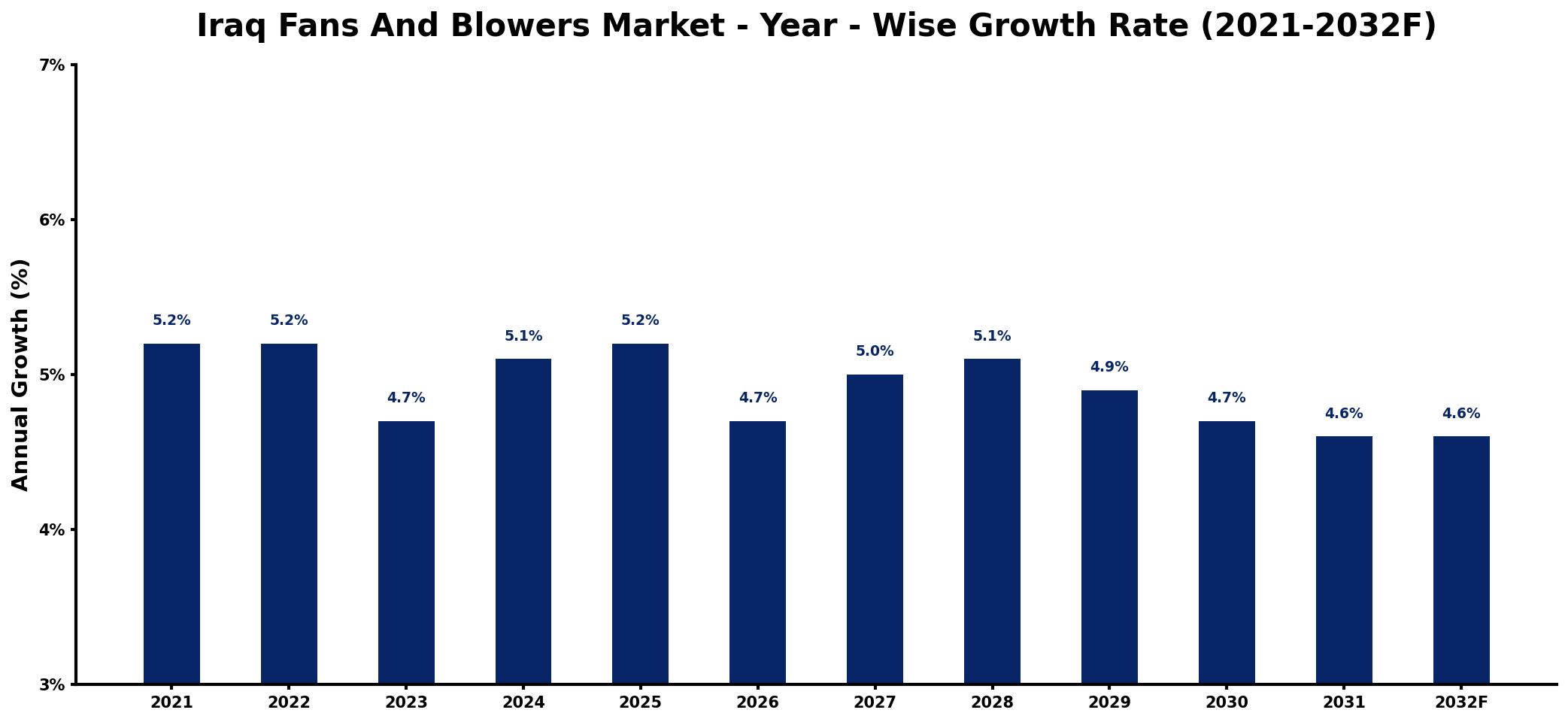
The table below presents the year‑wise growth rates along with the key drivers influencing the market
| Year | Growth Rate | Major Drivers |
| 2021 | 5.2% | Rising construction sector investments |
| 2022 | 5.2% | Increased industrial production activities |
| 2023 | 4.7% | Growing demand for ventilation systems |
| 2024 | 5.1% | Expansion of HVAC market applications |
| 2025 | 5.2% | Surge in renewable energy projects |
| 2026 | 4.7% | Development of infrastructure projects |
| 2027 | 5.0% | Heightened focus on energy efficiency |
| 2028 | 5.1% | Boost in agricultural mechanization efforts |
| 2029 | 4.9% | Increase in residential building permits |
| 2030 | 4.7% | increased pharmaceutical industry usage |
| 2031 | 4.6% | improved raw material availability |
| 2032 | 4.6% | expanding healthcare application demand |
Note: Market size estimations and growth projections presented in this report are based on 6Wresearch's proprietary forecasting methodology, utilizing the latest available industry data, government publications, and primary research inputs.
Iraq Fans And Blowers Market Synopsis
The demand for high-performance fans and blowers is surging, driven by the rapid expansion of industries like oil and gas and manufacturing in Iraq. As infrastructure development progresses, sectors such as construction are increasingly requiring reliable ventilation solutions to ensure operational efficiency.
Moreover, the market is leaning towards more energy-efficient and eco-friendly products, reflecting a global shift towards sustainability. Manufacturers are responding by innovating technologies that not only meet but exceed industry standards for energy consumption and environmental impact.
Iraq Fans And Blowers Market Key Takeaways
- The market is anticipated to grow due to rising demand from various industrial sectors.
- Energy efficiency and sustainability are becoming critical factors in product development.
- Government initiatives are aiding infrastructure enhancements, creating a conducive environment for market growth.
- Investment opportunities exist in high-quality, specialized fans and blowers tailored for local needs.
- Technological advancements are shaping product offerings, particularly in smart fan systems.
Evaluation of Restraints in Iraq Fans And Blowers Market
The Iraq fans and blowers market is hindered by several critical challenges. Political instability and economic fluctuations introduce significant uncertainty, impacting overall business confidence in the region. Additionally, infrastructural inadequacies pose barriers to efficient distribution and supply chain management. The prevalence of counterfeit products complicates market dynamics, often leading to consumer distrust and further challenges for local manufacturers striving to compete against low-quality imports. Furthermore, regional security concerns continue to jeopardize business operations, making strategic planning essential for any stakeholders looking to establish a foothold in this market.
Iraq Fans And Blowers Market Trends
Currently, there is a notable trend toward the adoption of energy-efficient and environmentally friendly products within the Iraq fans and blowers market. Manufacturers are prioritizing innovation, focusing on creating products that consume less energy while maintaining optimal performance levels. The demand for specialized applications in critical sectors like oil and gas is driving companies to invest in research and development, particularly in smart and connected devices offering remote monitoring capabilities. As businesses become more environmentally conscious, the shift toward sustainable solutions continues to shape the market's future.
Iraq Fans And Blowers Market Opportunities
Investment opportunities in the Iraq fans and blowers market are significant, particularly given the country's expanding industrial sector. Local businesses are increasingly looking for high-quality, energy-efficient solutions tailored to their specific requirements. Companies can benefit from exploring aftermarket services, including maintenance and repair, to support existing systems and maximize customer engagement. Forming strategic partnerships with local entities can enhance distribution channels and provide a more robust entry point into this promising market. The ongoing push for infrastructure development presents an ideal landscape for innovative product offerings.
Government Initiatives in the Iraq Fans And Blowers Market
The Iraqi government is actively implementing policies aimed at enhancing the safety, efficiency, and sustainability of industrial operations, which directly impacts the fans and blowers market. Regulations are in place to ensure that manufacturers adhere to rigorous quality standards while promoting the use of energy-efficient technologies. These governmental efforts are not only designed to foster competition within the market but also to support the well-being of consumers and protect the environment.
Future Insights of the Iraq Fans And Blowers Market
Looking ahead, the future of the Iraq fans and blowers market is bright, buoyed by ongoing industrialization and infrastructure development initiatives. The continuous push for ventilation and air movement solutions across critical sectors will sustain demand, while advancements in technology will enable further growth. As energy-efficient products gain traction, manufacturers are likely to invest more heavily in innovative designs. However, stakeholders must remain mindful of the challenges posed by political instability and economic uncertainties, adapting their strategies accordingly to capitalize on emerging opportunities.
Iraq Fans And Blowers Market Latest Developments (2025 - 2026)
The Iraq fans and blowers market is witnessing a wave of innovations aimed at enhancing energy efficiency and product performance. Manufacturers are increasingly focusing on the integration of smart technologies into their product lines, which facilitate better monitoring and control of air movement systems. Additionally, partnerships between local businesses and international suppliers are becoming more common, aimed at improving the quality of products available in the market. These collaborations are essential for fostering competitive advantages and addressing the demand for specialized solutions across various sectors.
Iraq Fans And Blowers Market - Key Attractiveness of the Report
- 10 Years of Market Numbers
- Historical Data Starting from 2022 to 2025
- Base Year: 2025
- Forecast Data until 2032
- Key Performance Indicators Impacting the Market
- Major Upcoming Developments and Projects
Key Highlights of the Report:
- Iraq Fans And Blowers Market Outlook
- Market Size of Iraq Fans And Blowers Market, 2025
- Forecast of Iraq Fans And Blowers Market, 2032
- Historical Data and Forecast of Iraq Fans And Blowers Revenues & Volume for the Period 2022-2032F
- Iraq Fans And Blowers Market Trend Evolution
- Iraq Fans And Blowers Market Drivers and Challenges
- Iraq Fans And Blowers Price Trends
- Iraq Fans And Blowers Porter's Five Forces
- Iraq Fans And Blowers Industry Life Cycle
- Historical Data and Forecast of Iraq Fans And Blowers Market Revenues & Volume By Type for the Period 2022-2032F
- Historical Data and Forecast of Iraq Fans And Blowers Market Revenues & Volume By Centrifugal Fans and Blowers for the Period 2022-2032F
- Historical Data and Forecast of Iraq Fans And Blowers Market Revenues & Volume By Axial Fans and Blowers for the Period 2022-2032F
- Historical Data and Forecast of Iraq Fans And Blowers Market Revenues & Volume By Others for the Period 2022-2032F
- Historical Data and Forecast of Iraq Fans And Blowers Market Revenues & Volume By Application for the Period 2022-2032F
- Historical Data and Forecast of Iraq Fans And Blowers Market Revenues & Volume By Industrial for the Period 2022-2032F
- Historical Data and Forecast of Iraq Fans And Blowers Market Revenues & Volume By Commercial for the Period 2022-2032F
- Historical Data and Forecast of Iraq Fans And Blowers Market Revenues & Volume By Others for the Period 2022-2032F
- Historical Data and Forecast of Iraq Fans And Blowers Market Revenues & Volume By Distribution Channel for the Period 2022-2032F
- Historical Data and Forecast of Iraq Fans And Blowers Market Revenues & Volume By Online for the Period 2022-2032F
- Historical Data and Forecast of Iraq Fans And Blowers Market Revenues & Volume By Offline for the Period 2022-2032F
- Iraq Fans And Blowers Import Export Trade Statistics
- Market Opportunity Assessment By Type
- Market Opportunity Assessment By Application
- Market Opportunity Assessment By Distribution Channel
- Iraq Fans And Blowers Top Companies Market Share
- Iraq Fans And Blowers Competitive Benchmarking By Technical and Operational Parameters
- Iraq Fans And Blowers Company Profiles
- Iraq Fans And Blowers Key Strategic Recommendations






































