Iraq Farm Equipment Market Size, Share & Growth Rate
The Iraq Farm Equipment Market was estimated at USD 247 Million in 2025 and is projected to reach USD 324 Million by 2032, growing at a CAGR of 4.0% from 2026 to 2032. This growth is primarily driven by the increasing adoption of modern agricultural practices, coupled with government initiatives aimed at enhancing food security and productivity. The evolving landscape of Iraqi agriculture, with a focus on mechanization, underscores a significant shift toward advanced farming solutions.
Iraq Farm Equipment Market Year-wise Growth Rate and Key Drivers
This graph highlights how the Iraq Farm Equipment Market has steadily grown over the years, supported by major growth factors.
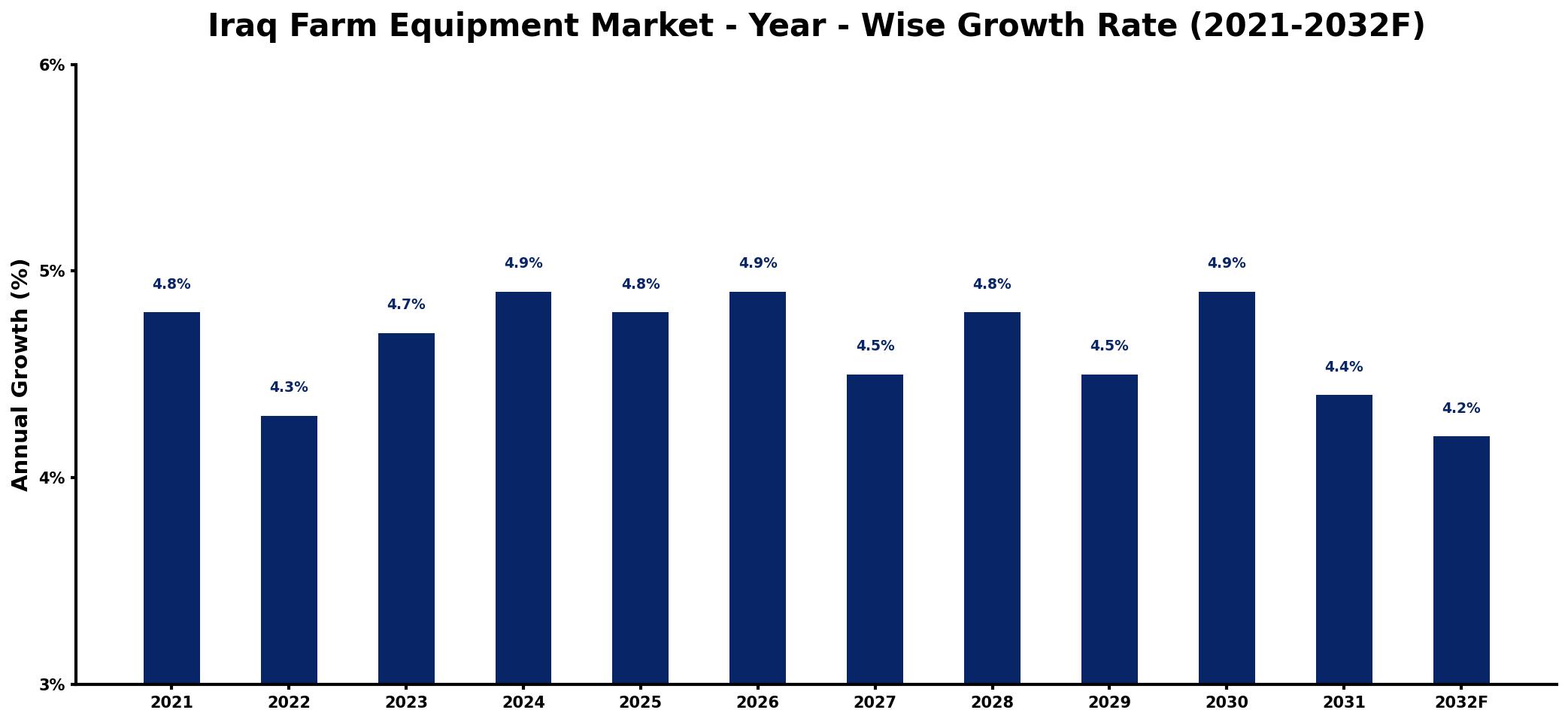
The table below presents the year‑wise growth rates along with the key drivers influencing the market
| Year | Growth Rate | Major Drivers |
| 2021 | 4.8% | Rising agricultural investment trends |
| 2022 | 4.3% | Expansion of irrigation infrastructure |
| 2023 | 4.7% | Increasing crop yield technologies |
| 2024 | 4.9% | Growing demand for mechanization |
| 2025 | 4.8% | Boost in rural development projects |
| 2026 | 4.9% | Enhanced access to financing options |
| 2027 | 4.5% | Strengthening agricultural cooperatives network |
| 2028 | 4.8% | Supportive government policy initiatives |
| 2029 | 4.5% | growing regional consumption patterns |
| 2030 | 4.9% | Growing interest in precision agriculture |
| 2031 | 4.4% | improved raw material availability |
| 2032 | 4.2% | Adoption of modern agricultural techniques |
Note: Market size estimations and growth projections presented in this report are based on 6Wresearch's proprietary forecasting methodology, utilizing the latest available industry data, government publications, and primary research inputs.
Iraq Farm Equipment Market Synopsis
The Iraq Farm Equipment Market is poised for steady growth, reflecting a robust shift toward modernization and mechanization in agricultural practices. Farmers are increasingly adopting advanced equipment, including tractors, harvesters, and irrigation systems, to improve efficiency and crop yields.
This momentum is further fueled by government support, fostering an environment where innovation and sustainable practices can thrive. Despite facing infrastructural challenges, the market presents a unique opportunity for agricultural advancement that aligns with global trends toward efficiency and sustainability.
Iraq Farm Equipment Market Key Takeaways
- Significant demand for advanced farm machinery, including tractors and irrigation systems.
- Increasing focus on precision agriculture to optimize resource use and reduce environmental impact.
- Government initiatives promoting modernization and supporting farmers with subsidies.
- Challenges such as infrastructure deficiencies and access to financing continue to affect growth.
- Emerging trends in eco-friendly and energy-efficient farming equipment gaining traction.
Evaluation of Restraints in Iraq Farm Equipment Market
Despite the promising outlook, several restraints hinder the full potential of the Iraq Farm Equipment Market. Limited access to financing and modern machinery remains a critical barrier for many farmers. The countrys ongoing political and economic instability contributes to challenges in logistics and distribution, particularly for importing advanced equipment. Additionally, inadequate infrastructure, including poor road conditions and unreliable electricity supply, complicates the effective utilization of farm machinery. Furthermore, a skills gap in the workforce can hinder the adoption of advanced technologies, slowing down the modernization of agriculture in the region.
Iraq Farm Equipment Market Trends
The landscape of the Iraq Farm Equipment Market is transforming, marked by a significant push toward mechanization. Farmers are increasingly incorporating technology to streamline operations and improve outputs. Emerging trends such as precision farming technologies are gaining traction, allowing for more efficient resource management and better environmental stewardship. Additionally, there is a noticeable movement towards sustainable practices, prompting the adoption of eco-friendly equipment that aligns with global sustainability goals. The rise of smart farming solutions further illustrates the sectors commitment to innovation, setting the stage for a new era in Iraqi agriculture.
Iraq Farm Equipment Market Opportunities
The Iraq Farm Equipment Market presents substantial investment opportunities, driven by the urgent need to enhance agricultural productivity. There is a growing demand for modern tractors, efficient irrigation systems, and advanced harvesting equipment, reflecting a broader trend towards modernization in agriculture. Investors can find value in not only traditional farm machinery but also in innovative solutions that incorporate technology and sustainability. The governments supportive policies, including subsidies and incentives for agricultural investments, further enhance the attractiveness of the market, providing a fertile ground for growth.
Government Initiatives in the Iraq Farm Equipment Market
The Iraqi government has implemented various initiatives aimed at boosting the agricultural sector, focusing on modernization and increased self-sufficiency in food production. Policies include offering subsidies and financial assistance to farmers for acquiring modern equipment and technologies. Regulations have been established to ensure the quality and safety of imported agricultural machinery, while efforts to stimulate domestic production are underway through partnerships with international manufacturers. These initiatives are integral to the broader strategy of enhancing food security and agricultural productivity across the nation.
Future Insights of the Iraq Farm Equipment Market
Looking ahead to 2026-2032, the Iraq Farm Equipment Market is expected to expand further as government support continues to drive agricultural modernization. With a young and growing population, the need for increased food production will remain a priority, further stimulating demand for advanced machinery. The integration of technological innovations, such as precision agriculture and smart farming techniques, will play a pivotal role in shaping the markets future. As these trends take root, they are likely to attract significant investments and usher in an era of increased efficiency and sustainability in Iraqi agriculture.
Iraq Farm Equipment Market Latest Developments (2025 - 2026)
In the recent months, the Iraq Farm Equipment Market has witnessed a surge in initiatives focused on enhancing agricultural productivity through modernization. Various stakeholders have been collaborating to address infrastructural challenges, with discussions centered on improving logistics and distribution channels for farm equipment. Additionally, there has been a noticeable increase in the introduction of smart farming technologies, aiming to optimize resource utilization and enhance crop yields, showcasing the markets commitment to innovation and sustainability.
Iraq Farm Equipment Market - Key Attractiveness of the Report
- 10 Years of Market Numbers
- Historical Data Starting from 2022 to 2025
- Base Year: 2025
- Forecast Data until 2032
- Key Performance Indicators Impacting the Market
- Major Upcoming Developments and Projects
Key Highlights of the Report:
- Iraq Farm Equipment Market Outlook
- Market Size of Iraq Farm Equipment Market, 2025
- Forecast of Iraq Farm Equipment Market, 2032
- Historical Data and Forecast of Iraq Farm Equipment Revenues & Volume for the Period 2022-2032F
- Iraq Farm Equipment Market Trend Evolution
- Iraq Farm Equipment Market Drivers and Challenges
- Iraq Farm Equipment Price Trends
- Iraq Farm Equipment Porter's Five Forces
- Iraq Farm Equipment Industry Life Cycle
- Historical Data and Forecast of Iraq Farm Equipment Market Revenues & Volume By Power Output for the Period 2022-2032F
- Historical Data and Forecast of Iraq Farm Equipment Market Revenues & Volume By <30 HP for the Period 2022-2032F
- Historical Data and Forecast of Iraq Farm Equipment Market Revenues & Volume By 31??70 HP for the Period 2022-2032F
- Historical Data and Forecast of Iraq Farm Equipment Market Revenues & Volume By 71??130 HP for the Period 2022-2032F
- Historical Data and Forecast of Iraq Farm Equipment Market Revenues & Volume By 131??250 HP for the Period 2022-2032F
- Historical Data and Forecast of Iraq Farm Equipment Market Revenues & Volume By >250 HP for the Period 2022-2032F
- Historical Data and Forecast of Iraq Farm Equipment Market Revenues & Volume By Drive Type for the Period 2022-2032F
- Historical Data and Forecast of Iraq Farm Equipment Market Revenues & Volume By Two-wheel for the Period 2022-2032F
- Historical Data and Forecast of Iraq Farm Equipment Market Revenues & Volume By Four-wheel for the Period 2022-2032F
- Historical Data and Forecast of Iraq Farm Equipment Market Revenues & Volume By Function for the Period 2022-2032F
- Historical Data and Forecast of Iraq Farm Equipment Market Revenues & Volume By Plowing & Cultivating for the Period 2022-2032F
- Historical Data and Forecast of Iraq Farm Equipment Market Revenues & Volume By Sowing & Planting for the Period 2022-2032F
- Historical Data and Forecast of Iraq Farm Equipment Market Revenues & Volume By Plant Protection & Fertilizing for the Period 2022-2032F
- Historical Data and Forecast of Iraq Farm Equipment Market Revenues & Volume By Harvesting & Threshing for the Period 2022-2032F
- Historical Data and Forecast of Iraq Farm Equipment Market Revenues & Volume By Others for the Period 2022-2032F
- Historical Data and Forecast of Iraq Farm Equipment Market Revenues & Volume By Equipment Type for the Period 2022-2032F
- Historical Data and Forecast of Iraq Farm Equipment Market Revenues & Volume By Tractors for the Period 2022-2032F
- Historical Data and Forecast of Iraq Farm Equipment Market Revenues & Volume By Combines for the Period 2022-2032F
- Historical Data and Forecast of Iraq Farm Equipment Market Revenues & Volume By Sprayers for the Period 2022-2032F
- Historical Data and Forecast of Iraq Farm Equipment Market Revenues & Volume By Balers for the Period 2022-2032F
- Historical Data and Forecast of Iraq Farm Equipment Market Revenues & Volume By Others for the Period 2022-2032F
- Iraq Farm Equipment Import Export Trade Statistics
- Market Opportunity Assessment By Power Output
- Market Opportunity Assessment By Drive Type
- Market Opportunity Assessment By Function
- Market Opportunity Assessment By Equipment Type
- Iraq Farm Equipment Top Companies Market Share
- Iraq Farm Equipment Competitive Benchmarking By Technical and Operational Parameters
- Iraq Farm Equipment Company Profiles
- Iraq Farm Equipment Key Strategic Recommendations






































