Iraq Fatty Alcohol Market Size, Share & Growth Rate
The Iraq Fatty Alcohol Market was estimated at USD 1303 Million in 2025 and is projected to reach USD 1885 Million by 2032, growing at a CAGR of 5.4% from 2026 to 2032. This growth trajectory is fueled by the increasing demand for fatty alcohols across various sectors, particularly personal care and household cleaning products. As consumers seek out high-quality ingredients for skincare and detergent formulations, the market stands to benefit from this sustained preference for natural and organic components.
Iraq Fatty Alcohol Market Year-wise Growth Rate and Key Drivers
This graph highlights how the Iraq Fatty Alcohol Market has steadily grown over the years, supported by major growth factors.
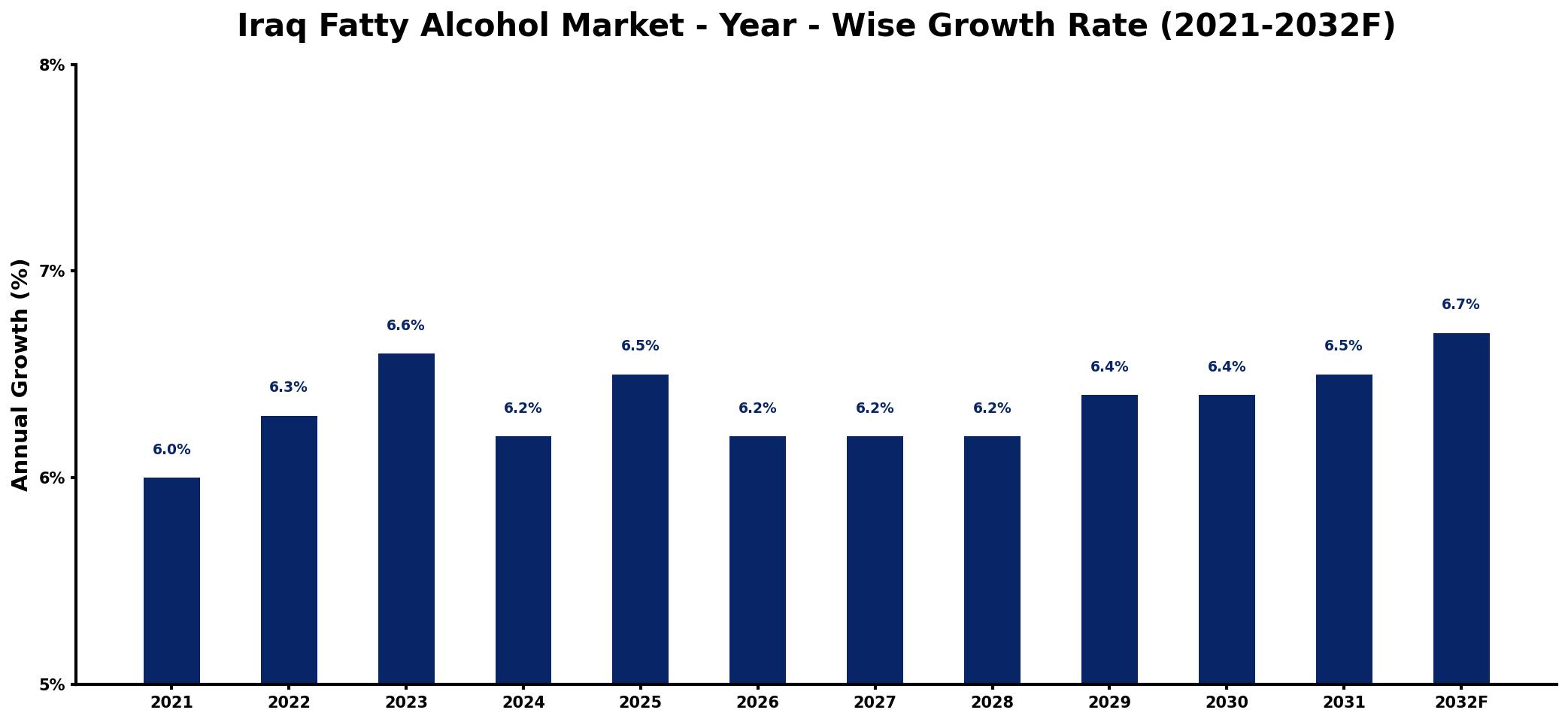
The table below presents the year‑wise growth rates along with the key drivers influencing the market
| Year | Growth Rate | Major Drivers |
| 2021 | 6.0% | Rising demand in personal care |
| 2022 | 6.3% | Increased investment in manufacturing |
| 2023 | 6.6% | Growth in household cleaning sector |
| 2024 | 6.2% | Surge in industrial applications usage |
| 2025 | 6.5% | Expansion of cosmetic product lines |
| 2026 | 6.2% | Development of sustainable sourcing practices |
| 2027 | 6.2% | Increase in regional export opportunities |
| 2028 | 6.2% | Emergence of new formulation technologies |
| 2029 | 6.4% | strengthening underlying market demand |
| 2030 | 6.4% | Rise in consumer health awareness |
| 2031 | 6.5% | increased capital investment inflows |
| 2032 | 6.7% | Increased focus on eco-friendly solutions |
Note: Market size estimations and growth projections presented in this report are based on 6Wresearch's proprietary forecasting methodology, utilizing the latest available industry data, government publications, and primary research inputs.
Iraq Fatty Alcohol Market Synopsis
Iraq's fatty alcohol market is marked by a burgeoning demand for products such as soaps, shampoos, and detergents, emphasizing their emollient and cleansing properties. Notably, local manufacturers are responding to shifting consumer preferences by innovating formulations that prioritize sustainability and natural ingredients.
Moreover, as awareness of the benefits of fatty alcohols grows, industries such as pharmaceuticals are exploring these compounds for their potential in therapeutic applications. This sector's expansion, combined with government initiatives to bolster local production, indicates a robust landscape for market growth.
Iraq Fatty Alcohol Market Key Takeaways
- The market is experiencing strong demand from personal care and household cleaning sectors.
- Innovation in product formulations is a key focus among local manufacturers.
- Consumer awareness regarding natural and sustainable ingredients is driving growth.
- Investment in research and development is enhancing product quality and application.
- Strategic partnerships are crucial for navigating the regulatory landscape in Iraq.
Evaluation of Restraints in Iraq Fatty Alcohol Market
Despite the favorable outlook, the Iraq fatty alcohol market faces several restraints that could impact its growth trajectory. Political instability in the region has led to a limited availability of raw materials, which poses a risk to supply chains and results in price volatility. Moreover, local producers often contend with competition from imported products, which are sometimes perceived as superior due to advanced technology and established quality standards. Regulatory hurdles regarding environmental sustainability can also impede production, requiring local firms to navigate complex compliance landscapes while striving for efficiency and cost-effectiveness.
Iraq Fatty Alcohol Market Trends
The Iraq fatty alcohol market is currently witnessing several trends that are shaping its landscape. There is a growing emphasis on the development of biodegradable and eco-friendly products, reflecting broader consumer trends favoring sustainability. The adoption of innovative extraction and manufacturing technologies is also on the rise, enhancing the efficiency and quality of fatty alcohol production. Furthermore, increased collaboration between businesses and research institutions is expected to lead to breakthroughs in product applications, particularly in the pharmaceutical sector, thereby expanding market reach.
Iraq Fatty Alcohol Market Opportunities
Investment opportunities in the Iraqi fatty alcohol market are substantial, driven by the country's natural resource endowment, notably palm oil and petrochemical feedstocks. As urbanization and disposable incomes rise, so too does the demand for personal care products, creating fertile ground for new manufacturing ventures. Additionally, the establishment of partnerships with local suppliers can provide a strategic advantage in navigating the complexities of the regulatory environment, enabling companies to secure a competitive position in this evolving market landscape.
Government Initiatives in the Iraq Fatty Alcohol Market
The Iraqi government is actively promoting domestic production of fatty alcohols as part of its broader economic strategy. Initiatives such as import tariffs on foreign products aim to bolster local manufacturers while maintaining quality standards within the industry. Furthermore, incentives for research and development are designed to foster innovation and enhance the competitiveness of Iraqi firms on a global scale. Regulatory reforms focused on simplifying business operations are also in progress, creating a more conducive environment for investment and growth within the fatty alcohol sector.
Future Insights of the Iraq Fatty Alcohol Market
Looking ahead to the period between 2026 and 2032, the Iraq fatty alcohol market is poised for sustained growth. The anticipated rise in disposable incomes and shifting consumer preferences towards premium products are expected to drive demand. Additionally, advancements in production technology coupled with favorable government policies are likely to further support market expansion. However, manufacturers must remain vigilant in managing the challenges posed by raw material price fluctuations and regulatory constraints to fully capitalize on the opportunities ahead.
Iraq Fatty Alcohol Market Latest Developments (2025 - 2026)
Recent developments in the Iraq fatty alcohol market indicate a shift towards integrating sustainability into production processes. Companies are increasingly investing in advanced technologies that minimize environmental impact while enhancing product quality. Furthermore, there have been efforts to strengthen supply chains by collaborating with local farmers and distributors, thereby increasing the resilience of the market against geopolitical disruptions. Additionally, workshops and training programs aimed at improving the technical skills of the workforce are gaining traction, reinforcing the industry's capacity for innovation.
Iraq Fatty Alcohol Market - Key Attractiveness of the Report
- 10 Years of Market Numbers
- Historical Data Starting from 2022 to 2025
- Base Year: 2025
- Forecast Data until 2032
- Key Performance Indicators Impacting the Market
- Major Upcoming Developments and Projects
Key Highlights of the Report:
- Iraq Fatty Alcohol Market Outlook
- Market Size of Iraq Fatty Alcohol Market, 2025
- Forecast of Iraq Fatty Alcohol Market, 2032
- Historical Data and Forecast of Iraq Fatty Alcohol Revenues & Volume for the Period 2022-2032F
- Iraq Fatty Alcohol Market Trend Evolution
- Iraq Fatty Alcohol Market Drivers and Challenges
- Iraq Fatty Alcohol Price Trends
- Iraq Fatty Alcohol Porter's Five Forces
- Iraq Fatty Alcohol Industry Life Cycle
- Historical Data and Forecast of Iraq Fatty Alcohol Market Revenues & Volume By Product for the Period 2022-2032F
- Historical Data and Forecast of Iraq Fatty Alcohol Market Revenues & Volume By C6-C10 for the Period 2022-2032F
- Historical Data and Forecast of Iraq Fatty Alcohol Market Revenues & Volume By C11-C14 for the Period 2022-2032F
- Historical Data and Forecast of Iraq Fatty Alcohol Market Revenues & Volume By C15-C22 for the Period 2022-2032F
- Historical Data and Forecast of Iraq Fatty Alcohol Market Revenues & Volume By Application for the Period 2022-2032F
- Historical Data and Forecast of Iraq Fatty Alcohol Market Revenues & Volume By Soaps & Detergents for the Period 2022-2032F
- Historical Data and Forecast of Iraq Fatty Alcohol Market Revenues & Volume By Personal Care for the Period 2022-2032F
- Historical Data and Forecast of Iraq Fatty Alcohol Market Revenues & Volume By Lubricants for the Period 2022-2032F
- Historical Data and Forecast of Iraq Fatty Alcohol Market Revenues & Volume By Amines for the Period 2022-2032F
- Historical Data and Forecast of Iraq Fatty Alcohol Market Revenues & Volume By Others for the Period 2022-2032F
- Iraq Fatty Alcohol Import Export Trade Statistics
- Market Opportunity Assessment By Product
- Market Opportunity Assessment By Application
- Iraq Fatty Alcohol Top Companies Market Share
- Iraq Fatty Alcohol Competitive Benchmarking By Technical and Operational Parameters
- Iraq Fatty Alcohol Company Profiles
- Iraq Fatty Alcohol Key Strategic Recommendations






































