Iraq Flower and Ornamental Plants Market Summary
The iraq flower and ornamental plants market was estimated at USD 1028 Million in 2025 and is projected to reach USD 1470 Million by 2032, growing at a CAGR of 5.9% from 2026 to 2032.
Iraq Flower and Ornamental Plants Market Year-wise Growth Rate and Key Drivers
This graph highlights how the Iraq Flower and Ornamental Plants Market has steadily grown over the past five years, supported by major growth factors.
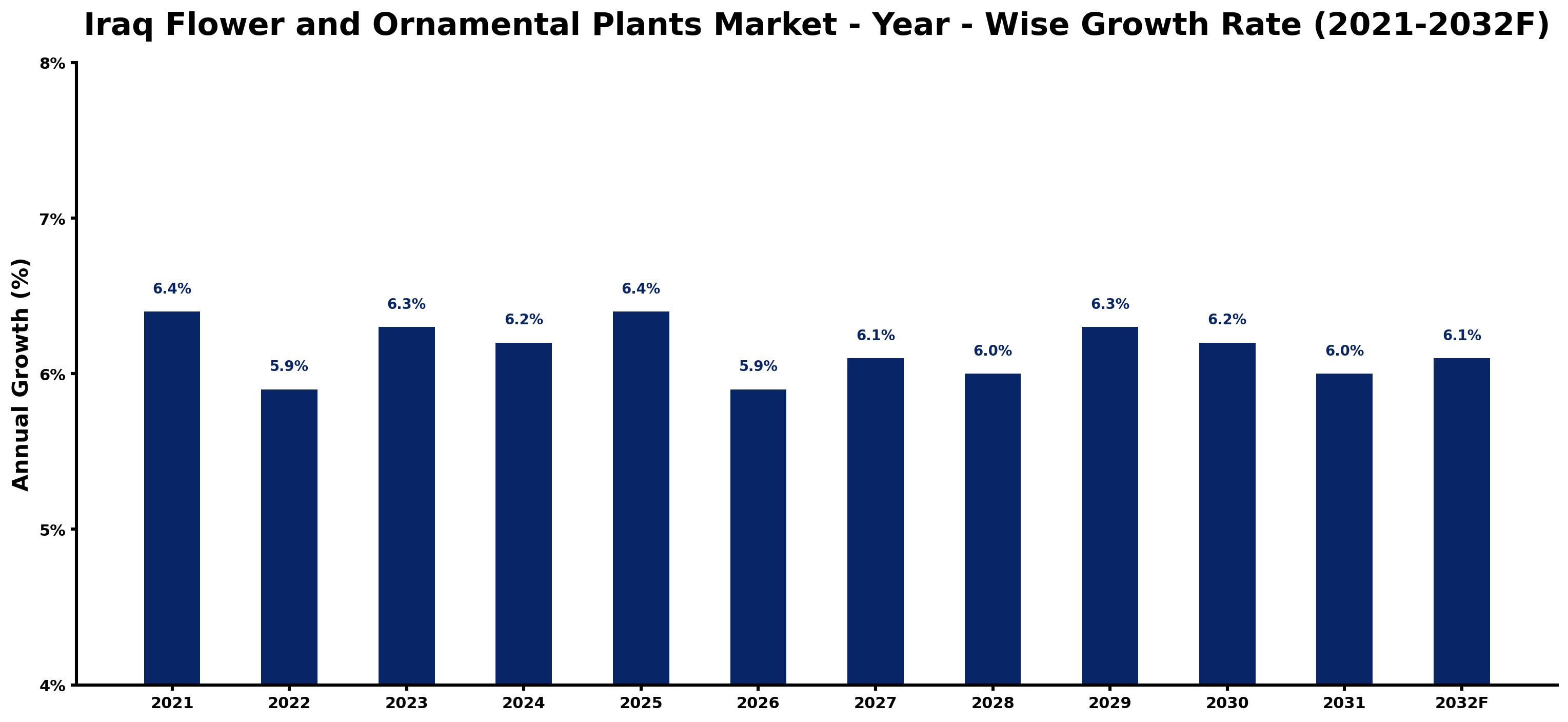
The table below presents the year wise growth rates along with the key drivers influencing the market
| Year | Growth Rate | Major Drivers |
| 2021 | 6.4% | Increased awareness of landscape beautification encourages local flower cultivation initiatives. |
| 2022 | 5.9% | Urban expansion in Baghdad creates demand for ornamental plants in residential projects. |
| 2023 | 6.3% | Local artisans influence consumer preferences toward unique, handcrafted floral arrangements. |
| 2024 | 6.2% | Social media platforms boost flower sales through online marketplaces and promotions. |
| 2025 | 6.4% | Climate resilience strategies promote drought-resistant ornamental plants for landscaping. |
| 2026 | 5.9% | Local universities introduce horticulture programs, fostering innovation in plant cultivation. |
| 2027 | 6.1% | International trade agreements enhance imports of exotic flower varieties into Iraq. |
| 2028 | 6.0% | Growing eco-tourism initiatives include floral attractions, increasing tourist revenue in horticulture. |
| 2029 | 6.3% | Corporate office landscaping trends create a niche market for interior ornamental plants. |
| 2030 | 6.2% | Regional floral festivals stimulate creativity and awareness around domestic plant species. |
| 2031 | 6.0% | Innovative irrigation technologies allow for efficient water use in ornamental gardening. |
| 2032 | 6.1% | Increased accessibility to gardening supplies bolsters participation in flower cultivation hobbies. |
Note - Market size estimations and growth projections presented in this report are based on 6Wresearch's advanced forecasting approach, validated with industry datasets as of June 2026.
Iraq Flower and Ornamental Plants Market Synopsis
The Iraq Flower and Ornamental Plants Market is projected to reach 5.9% and witness significant growth during the forecast period (2026-2032). Iraq has a rich tradition of cultivating flowers and ornamental plants, supported by its well-developed agricultural infrastructure. The government's commitment to bolstering this sector through various incentives indicates a favorable environment for both domestic producers and international stakeholders. With a rising demand for floral arrangements, landscaping, and interior decoration, the potential for the Iraq flower and ornamental plants market is poised for substantial expansion.
Iraq Flower and Ornamental Plants Market Growth Drivers
The primary factors propelling the growth of the Iraq flower and ornamental plants market include:
- Increased consumer spending on decorative products such as garlands, cut flowers, and foliage items, driven by a growing preference for aesthetic appeal in residential and commercial spaces.
- The advancement of marketing channels, particularly through digital platforms, providing greater accessibility for consumers and businesses alike, thereby enhancing market reach.
- A shift in consumer preferences towards environmentally-friendly options, fueling demand for natural decorations, including artificial flowers and sustainable farming practices.
- The positive impact of Iraq's accession to the World Trade Organization (WTO), allowing for more competitive pricing structures and improved access to international markets.
- Growing urbanization and a rising interest in landscaping and gardening, contributing to an increased need for ornamental plants and flowers.
Iraq Flower and Ornamental Plants Market Trends and Opportunities
As the Iraq flower and ornamental plants market evolves, several notable trends are emerging:
- The increasing integration of e-commerce platforms in the floral industry is reshaping consumer buying habits, making it easier for buyers to access a variety of floral products online.
- A rising trend towards DIY (do-it-yourself) home decor projects, leading consumers to seek out specific flowers and plants for personal use.
- The growing awareness of environmental sustainability is pushing both consumers and businesses to adopt practices that favor eco-friendly products, thus enhancing the market for artificial flowers made from sustainable materials.
- A focus on the development of urban green spaces, which is fostering a demand for suitable ornamental plants and flowers in cities across Iraq.
- The potential for collaboration between local growers and international suppliers, opening avenues for knowledge transfer and improved quality standards in domestic production.
Iraq Flower and Ornamental Plants Market Challenges and Restraints
Despite the favorable landscape, the Iraq flower and ornamental plants market faces significant challenges:
- Limited domestic production capacity, which forces local florists to rely heavily on imports, increasing costs and vulnerability to fluctuations in international trade.
- Market fragmentation, with a significant number of small-scale operators lacking the resources and technology to scale up effectively.
- Economic instability and security concerns that may hinder investment and growth in the agricultural sector.
- Inadequate distribution and logistical infrastructure, which can impede timely delivery of products and reduce market competitiveness.
- Climate conditions that may not always favor the cultivation of certain ornamental plants, creating challenges in product availability and diversity.
Iraq Flower and Ornamental Plants Market Government Investment and Initiatives
The government of Iraq is actively promoting the development of the flower and ornamental plants market through various initiatives:
- Implementation of supportive policies aimed at enhancing agricultural productivity, including funding for research and development in floriculture.
- Creation of incentives for local growers to invest in modern agricultural techniques and sustainable practices.
- Introduction of training programs to equip farmers and florists with essential skills and knowledge in floriculture and landscaping.
- Facilitation of partnerships between governmental bodies and private sectors to foster investment in the ornamental plants market.
- Engagement in international trade agreements to streamline export procedures, thereby encouraging local businesses to venture into global markets.
Iraq Flower and Ornamental Plants Market Latest Developments (May 2025 - June 2026)
Recent developments in the Iraq flower and ornamental plants market indicate a notable shift in industry dynamics:
- A surge in the establishment of online platforms for the sale of flowers and ornamental plants, enabling florists to reach a broader customer base.
- Initiatives focusing on environmental sustainability, leading to increased production of eco-friendly floral products, aligning with global trends.
- A rise in community-supported agriculture (CSA) programs, connecting consumers directly with local growers, thus promoting fresh produce and floral arrangements.
- Collaborative efforts between the government and educational institutions to enhance research in ornamental horticulture, suggesting a commitment to long-term sector growth.
- Increased attendance at floriculture exhibitions and trade fairs, showcasing the potential and diversity of Iraq's floral offerings.
Iraq Flower and Ornamental Plants Market - Key Attractiveness of the Report
- 10 Years of Market Numbers
- Historical Data Starting from 2022 to 2025
- Base Year: 2025
- Forecast Data until 2032
- Key Performance Indicators Impacting the Market
- Major Upcoming Developments and Projects
Key Highlights of the Report:
- Iraq Flower and Ornamental Plants Market Outlook
- Market Size of Iraq Flower and Ornamental Plants Market, 2025
- Forecast of Iraq Flower and Ornamental Plants Market, 2032F
- Historical Data and Forecast of Iraq Flower and Ornamental Plants Revenues & Volume for the Period 2022-2032F
- Iraq Flower and Ornamental Plants Market Trend Evolution
- Iraq Flower and Ornamental Plants Market Drivers and Challenges
- Iraq Flower and Ornamental Plants Price Trends
- Iraq Flower and Ornamental Plants Porter's Five Forces
- Iraq Flower and Ornamental Plants Industry Life Cycle
- Historical Data and Forecast of Iraq Flower and Ornamental Plants Market Revenues & Volume By Product Type for the Period 2022-2032F
- Historical Data and Forecast of Iraq Flower and Ornamental Plants Market Revenues & Volume By Potted Plants for the Period 2022-2032F
- Historical Data and Forecast of Iraq Flower and Ornamental Plants Market Revenues & Volume By Cut Flowers for the Period 2022-2032F
- Historical Data and Forecast of Iraq Flower and Ornamental Plants Market Revenues & Volume By Application for the Period 2022-2032F
- Historical Data and Forecast of Iraq Flower and Ornamental Plants Market Revenues & Volume By Home for the Period 2022-2032F
- Historical Data and Forecast of Iraq Flower and Ornamental Plants Market Revenues & Volume By Commercial for the Period 2022-2032F
- Iraq Flower and Ornamental Plants Import Export Trade Statistics
- Market Opportunity Assessment By Product Type
- Market Opportunity Assessment By Application
- Iraq Flower and Ornamental Plants Top Companies Market Share
- Iraq Flower and Ornamental Plants Competitive Benchmarking By Technical and Operational Parameters
- Iraq Flower and Ornamental Plants Company Profiles
- Iraq Flower and Ornamental Plants Key Strategic Recommendations






































