Iraq Food & Grocery Retail Market Size, Share & Growth Rate
The Iraq Food & Grocery Retail Market was estimated at USD 1445 Million in 2025 and is projected to reach USD 2702 Million by 2032, growing at a CAGR of 9.4% from 2026 to 2032. This growth trajectory is primarily driven by the increasing urbanization and a burgeoning middle class seeking modern and convenient shopping experiences. As consumers shift towards packaged and branded goods, the demand for diverse food products is expected to rise significantly, further fueling market expansion.
Iraq Food & Grocery Retail Market Year-wise Growth Rate and Key Drivers
This graph highlights how the Iraq Food & Grocery Retail Market has steadily grown over the years, supported by major growth factors.
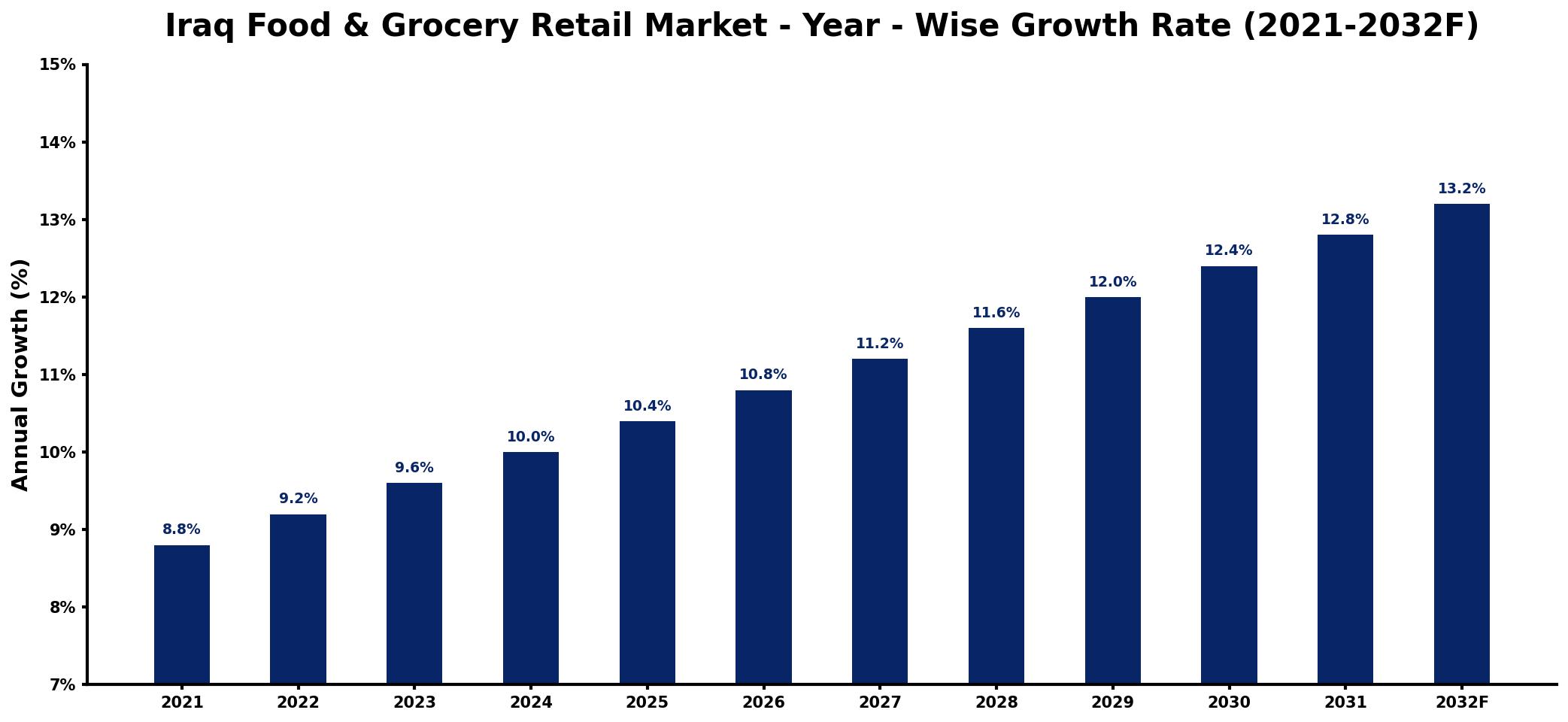
The table below presents the year‑wise growth rates along with the key drivers influencing the market
| Year | Growth Rate | Major Drivers |
| 2021 | 8.8% | Rising consumer spending patterns |
| 2022 | 9.2% | Increased urbanization and migration |
| 2023 | 9.6% | Expansion of distribution networks |
| 2024 | 10.0% | Growth in online shopping platforms |
| 2025 | 10.4% | Enhanced supply chain efficiencies |
| 2026 | 10.8% | Investment in local manufacturing |
| 2027 | 11.2% | Diversification of product offerings |
| 2028 | 11.6% | Strengthening of brand loyalty programs |
| 2029 | 12.0% | Emergence of health-conscious consumers |
| 2030 | 12.4% | Technological advancements in logistics |
| 2031 | 12.8% | Increased collaboration with suppliers |
| 2032 | 13.2% | Focus on sustainability initiatives |
Note: Market size estimations and growth projections presented in this report are based on 6Wresearch's proprietary forecasting methodology, utilizing the latest available industry data, government publications, and primary research inputs.
Iraq Food & Grocery Retail Market Synopsis
The landscape of the Iraq Food & Grocery Retail Market is heavily influenced by traditional markets, or souks, which remain integral to urban communities. These souks offer an extensive range of local produce, spices, and culturally significant foods, catering to a diverse consumer base that values freshness and local flavors.
Simultaneously, modern retail formats are gaining traction, with chains like Carrefour beginning to establish a foothold in major cities. This shift indicates a dual consumer preference for both traditional and contemporary shopping environments, driven by changing lifestyles and an increase in disposable incomes.
- The market is evolving rapidly, moving towards modern retail formats while still valuing traditional shopping practices.
- Urbanization and rising disposable incomes are key drivers of consumer demand for convenience and quality in food products.
- Health and wellness trends are reshaping the product offerings, with an increased focus on organic and natural foods.
- Investment opportunities are present in expanding supermarkets, convenience stores, and online platforms.
- Government policies are gradually enhancing food safety and quality standards, positively impacting market operations.
Despite its promising growth potential, the Iraq Food & Grocery Retail Market faces significant restraints. Political instability remains a major concern, affecting consumer confidence and investment inflows. Additionally, security issues disrupt distribution networks, resulting in inconsistent product availability. Infrastructure deficits also hamper the efficient movement of goods, while reliance on imports makes the market vulnerable to fluctuations in global prices. These challenges underscore the need for strategic investments in supply chain resilience to unlock the market's full potential.
The market is currently witnessing a robust demand for convenience, with ready-to-eat and quick-preparation food products gaining popularity. This trend is further complemented by the rising use of online grocery shopping platforms, reflecting a shift towards technological solutions in retail. Additionally, there is a marked increase in consumer interest in health and wellness products, as more shoppers prioritize nutritious and natural food options. The growing appeal of international brands also signals an evolving culinary landscape, with consumers eager to explore diverse flavors and offerings.
The Iraq Food & Grocery Retail Market presents numerous investment opportunities, primarily due to its expanding population and urbanization trends. Retailers can tap into the demand for modern supermarkets and hypermarkets that offer a variety of products under one roof. Moreover, the growth in e-commerce and online grocery shopping platforms provides a lucrative avenue for investment. Establishing efficient supply chains and local partnerships can also position investors to better serve consumer preferences while enhancing product quality and availability.
The Iraqi government is actively engaged in reforming the food and grocery retail sector through various policy measures aimed at enhancing food security and quality standards. These include stricter regulations on food safety and initiatives to promote local agricultural production, thereby reducing dependence on imports. Efforts are also being made to streamline import and export procedures and improve the efficiency of supply chains to better meet consumer needs. Overall, these initiatives are designed to create a more sustainable and competitive retail environment.
Looking ahead, the Iraq Food & Grocery Retail Market is set to experience considerable growth through 2026-2032. With factors such as an increasing urban population, rising disposable incomes, and a burgeoning middle class, demand for high-quality food products will escalate. The trend towards modern retail formats is expected to reshape consumer shopping experiences, making them more efficient and enjoyable. However, navigating potential obstacles related to infrastructure and political stability will be critical for sustaining this positive momentum.
Recent developments in the Iraq Food & Grocery Retail Market indicate a growing shift towards digital retail platforms, as more consumers embrace online shopping. This transformation is accompanied by increasing investments in supply chain logistics aimed at enhancing distribution efficiency. Additionally, various retail outlets are expanding their offerings to include more health-focused products in response to consumer demand for wellness-oriented options. Such trends signal an ongoing adaptation to consumer preferences in the evolving Iraqi market.
- 10 Years of Market Numbers
- Historical Data Starting from 2022 to 2025
- Base Year: 2025
- Forecast Data until 2032
- Key Performance Indicators Impacting the Market
- Major Upcoming Developments and Projects
Key Highlights of the Report:
- Iraq Food & Grocery Retail Market Outlook
- Market Size of Iraq Food & Grocery Retail Market, 2025
- Forecast of Iraq Food & Grocery Retail Market, 2032
- Historical Data and Forecast of Iraq Food & Grocery Retail Revenues & Volume for the Period 2022-2032F
- Iraq Food & Grocery Retail Market Trend Evolution
- Iraq Food & Grocery Retail Market Drivers and Challenges
- Iraq Food & Grocery Retail Price Trends
- Iraq Food & Grocery Retail Porter's Five Forces
- Iraq Food & Grocery Retail Industry Life Cycle
- Historical Data and Forecast of Iraq Food & Grocery Retail Market Revenues & Volume By Product for the Period 2022-2032F
- Historical Data and Forecast of Iraq Food & Grocery Retail Market Revenues & Volume By Fresh Food for the Period 2022-2032F
- Historical Data and Forecast of Iraq Food & Grocery Retail Market Revenues & Volume By Frozen Food for the Period 2022-2032F
- Historical Data and Forecast of Iraq Food & Grocery Retail Market Revenues & Volume By Food Cupboard for the Period 2022-2032F
- Historical Data and Forecast of Iraq Food & Grocery Retail Market Revenues & Volume By Beverages for the Period 2022-2032F
- Historical Data and Forecast of Iraq Food & Grocery Retail Market Revenues & Volume By Cleaning & Household for the Period 2022-2032F
- Historical Data and Forecast of Iraq Food & Grocery Retail Market Revenues & Volume By Others for the Period 2022-2032F
- Historical Data and Forecast of Iraq Food & Grocery Retail Market Revenues & Volume By Distribution Channel for the Period 2022-2032F
- Historical Data and Forecast of Iraq Food & Grocery Retail Market Revenues & Volume By Supermarkets & Hypermarkets for the Period 2022-2032F
- Historical Data and Forecast of Iraq Food & Grocery Retail Market Revenues & Volume By Convenience Stores for the Period 2022-2032F
- Historical Data and Forecast of Iraq Food & Grocery Retail Market Revenues & Volume By Departmental Stores & Clubs for the Period 2022-2032F
- Historical Data and Forecast of Iraq Food & Grocery Retail Market Revenues & Volume By Online for the Period 2022-2032F
- Iraq Food & Grocery Retail Import Export Trade Statistics
- Market Opportunity Assessment By Product
- Market Opportunity Assessment By Distribution Channel
- Iraq Food & Grocery Retail Top Companies Market Share
- Iraq Food & Grocery Retail Competitive Benchmarking By Technical and Operational Parameters
- Iraq Food & Grocery Retail Company Profiles
- Iraq Food & Grocery Retail Key Strategic Recommendations






































