Iraq Fuel Oil Market Size, Share & Growth Rate
The Iraq Fuel Oil Market was estimated at USD 267 Million in 2025 and is projected to reach USD 350 Million by 2032, growing at a CAGR of 3.9% from 2026 to 2032. This growth trajectory is driven by an increasing demand from various sectors including power generation, heating, and industrial applications. As Iraq continues to develop its infrastructure and enhance economic activities, fuel oil plays a pivotal role in supporting these advances.
Iraq Fuel Oil Market Year-wise Growth Rate and Key Drivers
This graph highlights how the Iraq Fuel Oil Market has steadily grown over the years, supported by major growth factors.
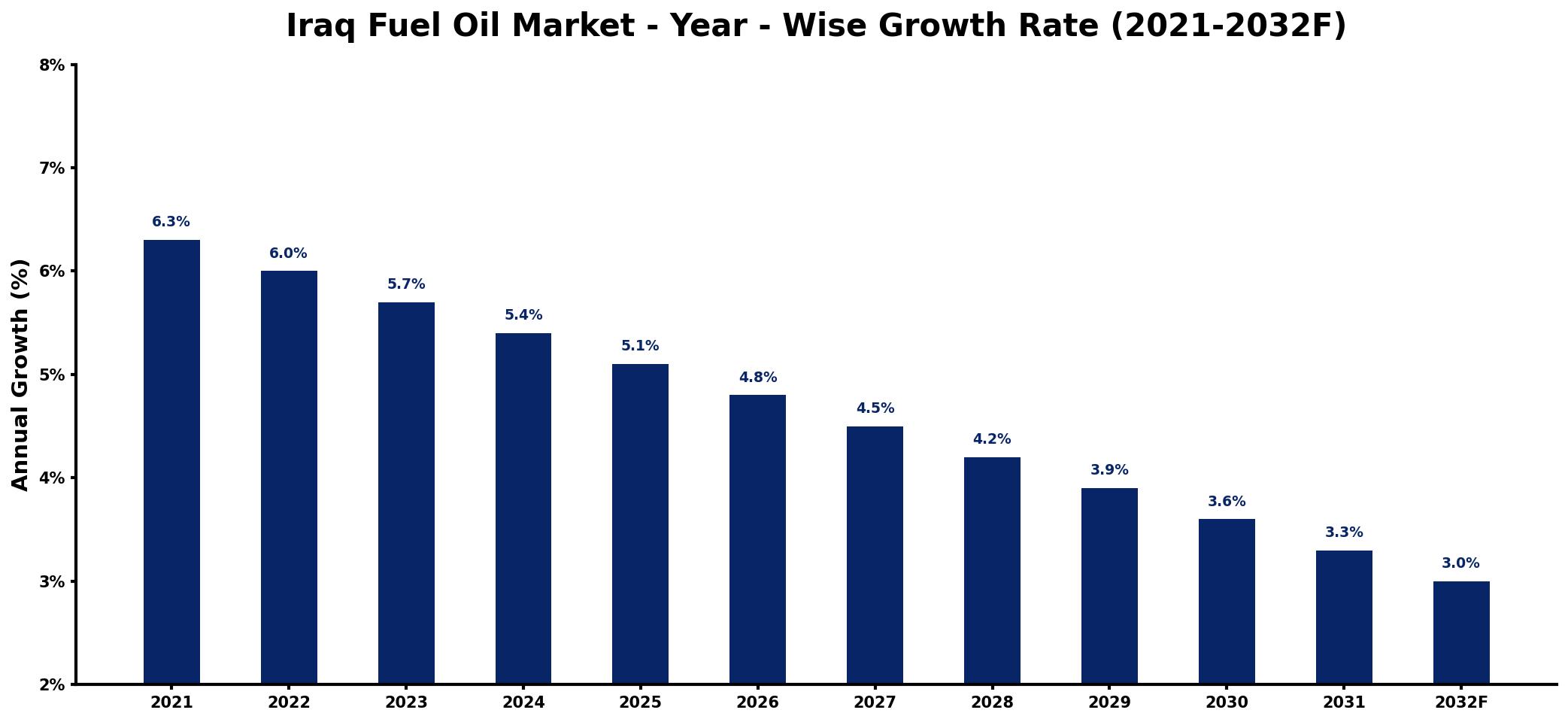
The table below presents the year‑wise growth rates along with the key drivers influencing the market
| Year | Growth Rate | Major Drivers |
| 2021 | 6.3% | Increased industrial energy consumption |
| 2022 | 6.0% | Growing power generation investments |
| 2023 | 5.7% | Expansion of transportation infrastructure |
| 2024 | 5.4% | Rising residential heating needs |
| 2025 | 5.1% | Boost in manufacturing activities |
| 2026 | 4.8% | Higher demand for electricity generation |
| 2027 | 4.5% | Development of new energy projects |
| 2028 | 4.2% | Enhanced logistics and distribution networks |
| 2029 | 3.9% | Increased urbanization and population growth |
| 2030 | 3.6% | Growing demand for alternative sources |
| 2031 | 3.3% | Strengthening regional energy collaborations |
| 2032 | 3.0% | Advancements in energy efficiency technologies |
Note: Market size estimations and growth projections presented in this report are based on 6Wresearch's proprietary forecasting methodology, utilizing the latest available industry data, government publications, and primary research inputs.
Iraq Fuel Oil Market Synopsis
In Iraq, fuel oil is not just a fuel; it is a cornerstone of energy security, crucial for both residential and industrial sectors. With high energy density and economic viability, fuel oil is essential for maintaining power supply and heating requirements, especially in a country facing fluctuating energy demands.
The variety of fuel oil grades available caters to different applications, ensuring that utilities, factories, and commercial establishments can access the energy they need. This adaptability enhances the overall energy mix in Iraq, making fuel oil a strategic asset for the nation's growth.
Iraq Fuel Oil Market Key Takeaways
- The market is projected to grow significantly, bolstered by rising energy demands across various sectors.
- Government initiatives aimed at ensuring fuel supply and stabilizing prices are critical for market sustainability.
- Investment in refining and distribution infrastructure is essential for improving fuel availability.
- Environmental regulations pose challenges but also drive innovation in cleaner fuel alternatives.
- Regional conflicts and economic fluctuations remain key factors influencing market dynamics.
Evaluation of Restraints in Iraq Fuel Oil Market
The Iraq Fuel Oil Market faces several restraints that could impede its growth. Chief among these are the challenges related to energy demand management, which affects supply consistency across regions. Pricing volatility remains a concern, influenced by global oil markets and local geopolitical factors. Furthermore, environmental regulations necessitate adaptations in production and consumption practices. Refineries must also navigate issues related to crude oil quality, which impacts the overall efficiency of fuel production. Balancing domestic supply with the actual energy needs is a delicate endeavor that requires ongoing attention and strategic planning.
Iraq Fuel Oil Market Trends
Current trends in the Iraq Fuel Oil Market include a shift toward more efficient and environmentally compliant fuel usage. Industries are increasingly looking at upgrading their technology to optimize refinery operations, aligning with global best practices. Additionally, theres a growing awareness and implementation of energy conservation measures, driven in part by government initiatives and public awareness campaigns. The focus on enhancing infrastructure for better fuel distribution is also becoming paramount, ensuring reliable access to this critical energy source.
Iraq Fuel Oil Market Opportunities
Significant opportunities exist in enhancing fuel refining capacities and investing in advanced technologies that allow for cleaner fuel production. The governments policies aimed at stabilizing prices create a favorable environment for investment. Moreover, as Iraq pushes towards greater energy independence, there will likely be increased demand for domestic fuel oil production capabilities, providing a lucrative avenue for stakeholders in the market.
Government Initiatives in the Iraq Fuel Oil Market
The Iraqi government has implemented various policies aimed at regulating the fuel oil market to ensure energy security and affordability. These initiatives include subsidies and price controls on fuel oil products, which serve to stabilize consumer prices and mitigate the effects of global oil price fluctuations. Moreover, the government is focusing on investment in fuel refining and distribution infrastructure, enhancing the reliability of fuel supply across the nation. Public awareness campaigns promoting energy efficiency and conservation further underline the commitment to sustainable energy practices.
Future Insights of the Iraq Fuel Oil Market
Looking ahead to 2026-2032, the Iraq Fuel Oil Market is poised for steady growth, driven by the ongoing need for robust energy solutions in the industrial and residential sectors. As infrastructure projects progress and the economy develops, fuel oil will continue to play an indispensable role in meeting energy demands. Enhanced refinery operations and adherence to environmental standards will be crucial for future advancements, ensuring that the market adapts and thrives in the evolving energy landscape.
Iraq Fuel Oil Market Latest Developments (2025 - 2026)
Recently, the Iraq Fuel Oil Market has seen increased governmental focus on enhancing the refining capacity to address domestic energy needs more effectively. New initiatives aimed at modernizing existing facilities have been proposed, alongside discussions for public-private partnerships to improve distribution networks. Moreover, advancements in environmental regulation compliance are gaining traction, with various stakeholders investing in cleaner technologies to align with global energy trends.
Iraq Fuel Oil Market - Key Attractiveness of the Report
- 10 Years of Market Numbers
- Historical Data Starting from 2022 to 2025
- Base Year: 2025
- Forecast Data until 2032
- Key Performance Indicators Impacting the Market
- Major Upcoming Developments and Projects
Key Highlights of the Report:
- Iraq Fuel Oil Market Outlook
- Market Size of Iraq Fuel Oil Market, 2025
- Forecast of Iraq Fuel Oil Market, 2032
- Historical Data and Forecast of Iraq Fuel Oil Revenues & Volume for the Period 2022-2032F
- Iraq Fuel Oil Market Trend Evolution
- Iraq Fuel Oil Market Drivers and Challenges
- Iraq Fuel Oil Price Trends
- Iraq Fuel Oil Porter's Five Forces
- Iraq Fuel Oil Industry Life Cycle
- Historical Data and Forecast of Iraq Fuel Oil Market Revenues & Volume By Application for the Period 2022-2032F
- Historical Data and Forecast of Iraq Fuel Oil Market Revenues & Volume By Marine for the Period 2022-2032F
- Historical Data and Forecast of Iraq Fuel Oil Market Revenues & Volume By Industrial for the Period 2022-2032F
- Historical Data and Forecast of Iraq Fuel Oil Market Revenues & Volume By Others for the Period 2022-2032F
- Iraq Fuel Oil Import Export Trade Statistics
- Market Opportunity Assessment By Application
- Iraq Fuel Oil Top Companies Market Share
- Iraq Fuel Oil Competitive Benchmarking By Technical and Operational Parameters
- Iraq Fuel Oil Company Profiles
- Iraq Fuel Oil Key Strategic Recommendations






































