Iraq Greenhouse Horticulture Market Size, Share & Growth Rate
The Iraq Greenhouse Horticulture Market was estimated at USD 81 Million in 2025 and is projected to reach USD 88 Million by 2032, growing at a CAGR of 1.2% from 2026 to 2032. This growth trajectory is significantly fueled by the rising demand for high-quality fruits and vegetables, which is increasingly becoming a priority among consumers. Additionally, government initiatives aimed at enhancing agricultural practices and the integration of advanced technologies in greenhouse farming are pivotal in driving this market forward.
Iraq Greenhouse Horticulture Market Year-wise Growth Rate and Key Drivers
This graph highlights how the Iraq Greenhouse Horticulture Market has steadily grown over the years, supported by major growth factors.
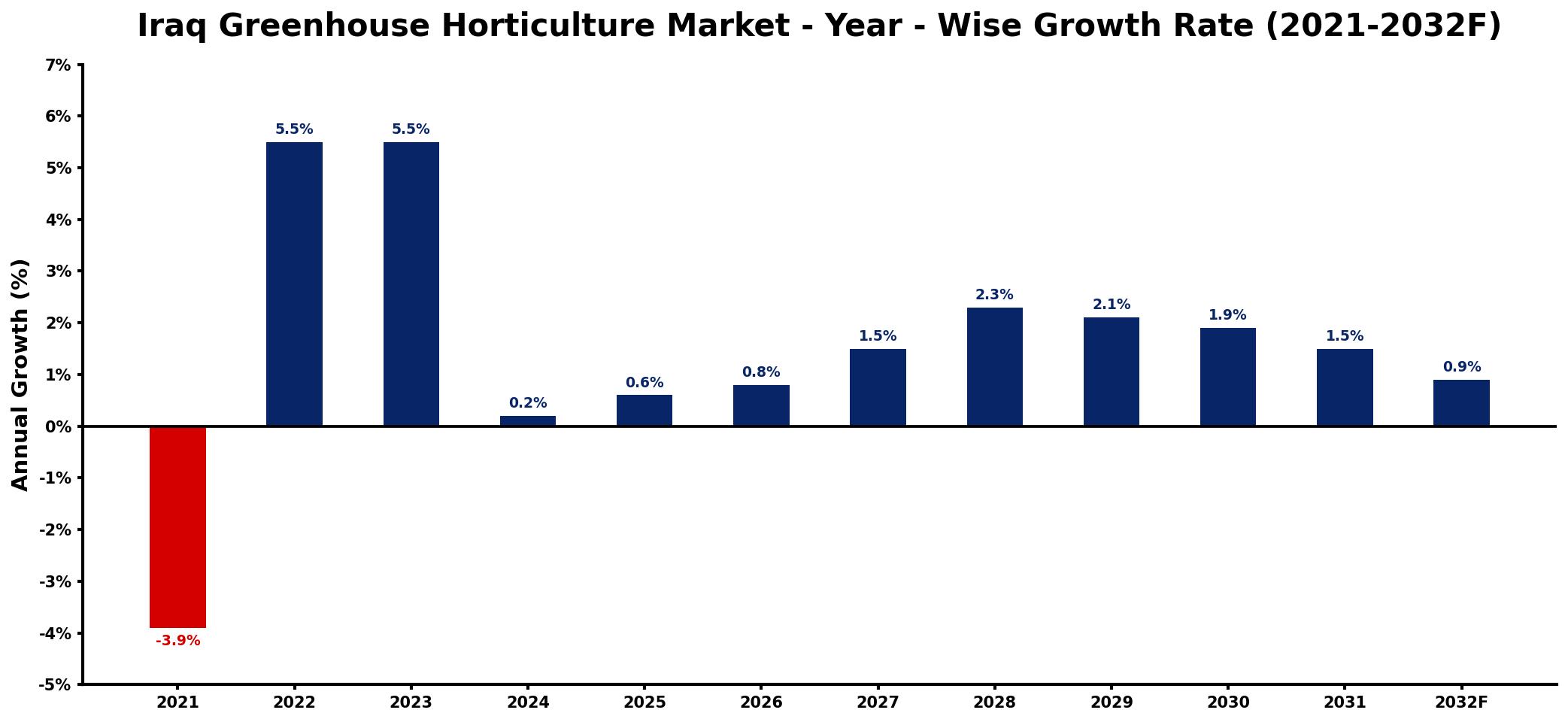
The table below presents the year‑wise growth rates along with the key drivers influencing the market
| Year | Growth Rate | Major Drivers |
| 2021 | -3.9% | decreased consumer spending patterns |
| 2022 | 5.5% | increased investment in agriculture |
| 2023 | 5.5% | growing domestic food demand |
| 2024 | 0.2% | rising interest in sustainable practices |
| 2025 | 0.6% | expansion of export markets |
| 2026 | 0.8% | technological advancements in farming |
| 2027 | 1.5% | increased government support initiatives |
| 2028 | 2.3% | enhanced distribution network capabilities |
| 2029 | 2.1% | growing urban population needs |
| 2030 | 1.9% | increased emphasis on local sourcing |
| 2031 | 1.5% | rising health consciousness among consumers |
| 2032 | 0.9% | development of agro-tourism initiatives |
Note: Market size estimations and growth projections presented in this report are based on 6Wresearch's proprietary forecasting methodology, utilizing the latest available industry data, government publications, and primary research inputs.
Iraq Greenhouse Horticulture Market Synopsis
The Iraq Greenhouse Horticulture Market is witnessing a paradigm shift in agricultural practices, as farmers and investors embrace the benefits of greenhouse cultivation. This method not only allows for year-round production but also enhances the quality of crops, which are vital in meeting the local demand for fresh produce.
In Iraq, popular crops include tomatoes, cucumbers, peppers, and various herbs, particularly focusing on organic and sustainable methods. While challenges remain, such as infrastructure limitations and political instability, the overall outlook for greenhouse horticulture remains promising, with growth opportunities emerging through international collaborations and modernization of agricultural practices.
Iraq Greenhouse Horticulture Market Key Takeaways
- Growing consumer demand for high-quality, locally sourced produce is a primary driver of market growth.
- Government policies promoting agricultural development are fostering innovation and investment in greenhouse horticulture.
- Technological advancements, particularly in climate control and irrigation, are enhancing operational efficiency.
- Limited access to financing and infrastructure presents challenges, yet opportunities for expansion exist.
- Organic and sustainable farming practices are increasingly adopted by growers, appealing to health-conscious consumers.
Evaluation of Restraints in Iraq Greenhouse Horticulture Market
The Iraq Greenhouse Horticulture Market grapples with several significant restraints that impede its growth. A primary concern is the limited access to financing, which restricts many farmers from investing in necessary technologies and resources. Moreover, inadequate infrastructure, particularly in transportation and storage, contributes to high post-harvest losses and diminishes product quality. The ongoing political instability further exacerbates these issues by creating an unpredictable environment for investors and disrupting supply chains. Additionally, water scarcity and quality issues pose serious risks to agricultural sustainability, necessitating a focus on efficient water management solutions to ensure long-term viability.
Iraq Greenhouse Horticulture Market Trends
Current trends in the Iraq Greenhouse Horticulture Market highlight a strong shift toward sustainable agricultural practices. Farmers are increasingly adopting greenhouse technologies to enhance productivity while minimizing environmental impacts. The use of automated climate control systems and hydroponic growing methods is gaining traction, allowing for precise management of growing conditions. This trend is coupled with a broader societal movement towards healthy eating, prompting a greater emphasis on organic produce. Government support for modernizing the agriculture sector and promoting self-sufficiency in food production further reinforces these trends, making greenhouse horticulture a focal point for future agricultural development in Iraq.
Iraq Greenhouse Horticulture Market Opportunities
The Iraq Greenhouse Horticulture Market presents a wealth of investment opportunities that are ripe for exploration. With an increasing population and a growing need for high-quality food, there is a strong demand for greenhouse construction and related technologies. Investors can tap into the market by offering innovative solutions that enhance farming efficiency, such as advanced irrigation systems and crop protection products. Furthermore, as awareness of sustainable farming practices rises, there is potential for expanded export opportunities, particularly for organic produce. Building robust domestic supply chains and forming strategic partnerships with international suppliers can also yield significant growth prospects.
Government Initiatives in the Iraq Greenhouse Horticulture Market
The Iraqi government has enacted various policies aimed at bolstering the Greenhouse Horticulture Market. These initiatives include financial support and incentives for farmers engaged in greenhouse horticulture, fostering an environment conducive to growth. There is also a strong emphasis on promoting sustainable practices that align with environmental protection goals. By facilitating access to modern technologies and resources, the government seeks to enhance productivity and support the overall development of the agriculture sector, while simultaneously encouraging exports to improve economic stability.
Future Insights of the Iraq Greenhouse Horticulture Market
Looking ahead to the years 2026-2032, the Iraq Greenhouse Horticulture Market is set for notable expansion. The confluence of increasing consumer demand for fresh, locally sourced produce and a governmental push for agricultural modernization creates a fertile landscape for growth. Technological advancements in greenhouse operations, particularly in climate management and irrigation, are expected to drive productivity gains. However, addressing significant challenges such as water scarcity and political instability will be paramount in ensuring sustainable market development. Overall, the market holds promise, presenting opportunities for investors and stakeholders to play a pivotal role in shaping its future.
Iraq Greenhouse Horticulture Market Latest Developments (2025 - 2026)
Recent developments in the Iraq Greenhouse Horticulture Market indicate a growing commitment to modern agricultural practices. Numerous initiatives have emerged focusing on the introduction of advanced farming technologies aimed at increasing yields and minimizing resource usage. Public-private partnerships are becoming more common, facilitating knowledge transfer and investment in infrastructure. Furthermore, efforts to improve water management practices are gaining attention, as stakeholders recognize the critical role that sustainable water solutions play in the longevity of greenhouse farming. These trends signal a positive shift in the industry, aligning with broader goals of food security and economic resilience.
Iraq Greenhouse Horticulture Market - Key Attractiveness of the Report
- 10 Years of Market Numbers
- Historical Data Starting from 2022 to 2025
- Base Year: 2025
- Forecast Data until 2032
- Key Performance Indicators Impacting the Market
- Major Upcoming Developments and Projects
Key Highlights of the Report:
- Iraq Greenhouse Horticulture Market Outlook
- Market Size of Iraq Greenhouse Horticulture Market, 2025
- Forecast of Iraq Greenhouse Horticulture Market, 2032
- Historical Data and Forecast of Iraq Greenhouse Horticulture Revenues & Volume for the Period 2022-2032F
- Iraq Greenhouse Horticulture Market Trend Evolution
- Iraq Greenhouse Horticulture Market Drivers and Challenges
- Iraq Greenhouse Horticulture Price Trends
- Iraq Greenhouse Horticulture Porter's Five Forces
- Iraq Greenhouse Horticulture Industry Life Cycle
- Historical Data and Forecast of Iraq Greenhouse Horticulture Market Revenues & Volume By Material Type for the Period 2022-2032F
- Historical Data and Forecast of Iraq Greenhouse Horticulture Market Revenues & Volume By Glass for the Period 2022-2032F
- Historical Data and Forecast of Iraq Greenhouse Horticulture Market Revenues & Volume By Plastic for the Period 2022-2032F
- Historical Data and Forecast of Iraq Greenhouse Horticulture Market Revenues & Volume By Crop Type for the Period 2022-2032F
- Historical Data and Forecast of Iraq Greenhouse Horticulture Market Revenues & Volume By Fruits and Vegetables for the Period 2022-2032F
- Historical Data and Forecast of Iraq Greenhouse Horticulture Market Revenues & Volume By Flowers and Ornamentals for the Period 2022-2032F
- Historical Data and Forecast of Iraq Greenhouse Horticulture Market Revenues & Volume By Nursery Crops for the Period 2022-2032F
- Historical Data and Forecast of Iraq Greenhouse Horticulture Market Revenues & Volume By Others for the Period 2022-2032F
- Historical Data and Forecast of Iraq Greenhouse Horticulture Market Revenues & Volume By Technology for the Period 2022-2032F
- Historical Data and Forecast of Iraq Greenhouse Horticulture Market Revenues & Volume By Heating System for the Period 2022-2032F
- Historical Data and Forecast of Iraq Greenhouse Horticulture Market Revenues & Volume By Cooling System for the Period 2022-2032F
- Iraq Greenhouse Horticulture Import Export Trade Statistics
- Market Opportunity Assessment By Material Type
- Market Opportunity Assessment By Crop Type
- Market Opportunity Assessment By Technology
- Iraq Greenhouse Horticulture Top Companies Market Share
- Iraq Greenhouse Horticulture Competitive Benchmarking By Technical and Operational Parameters
- Iraq Greenhouse Horticulture Company Profiles
- Iraq Greenhouse Horticulture Key Strategic Recommendations






































